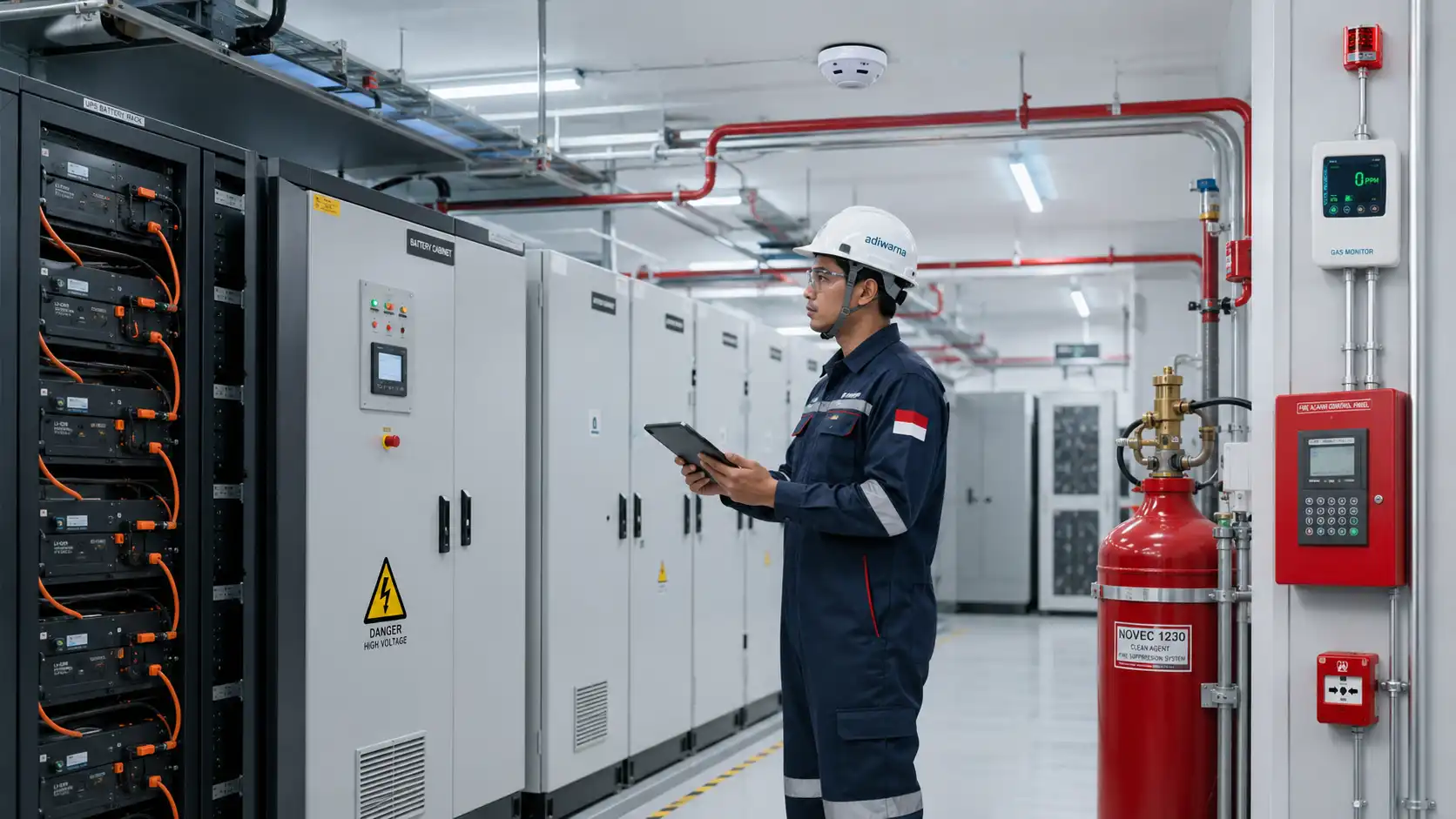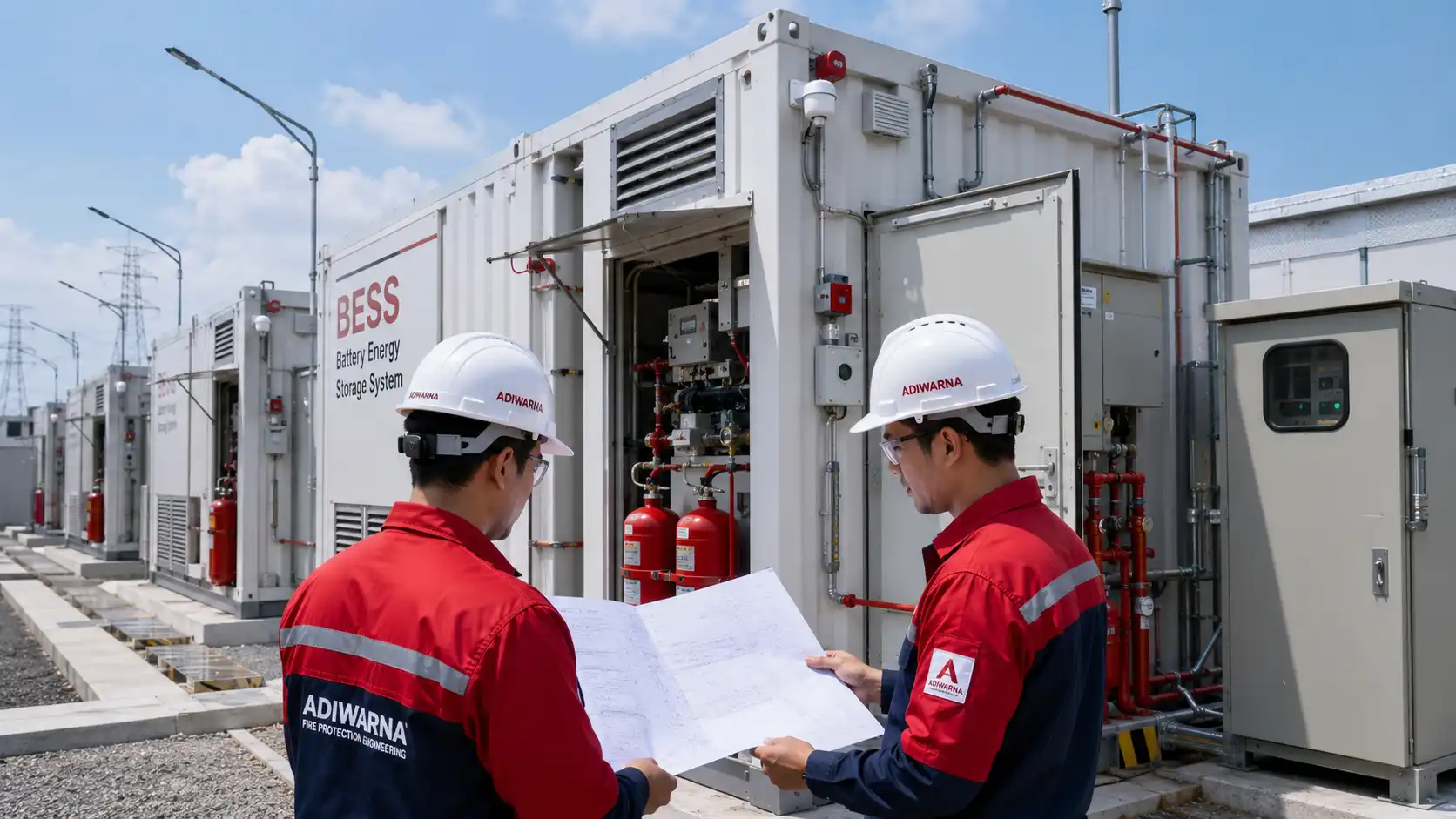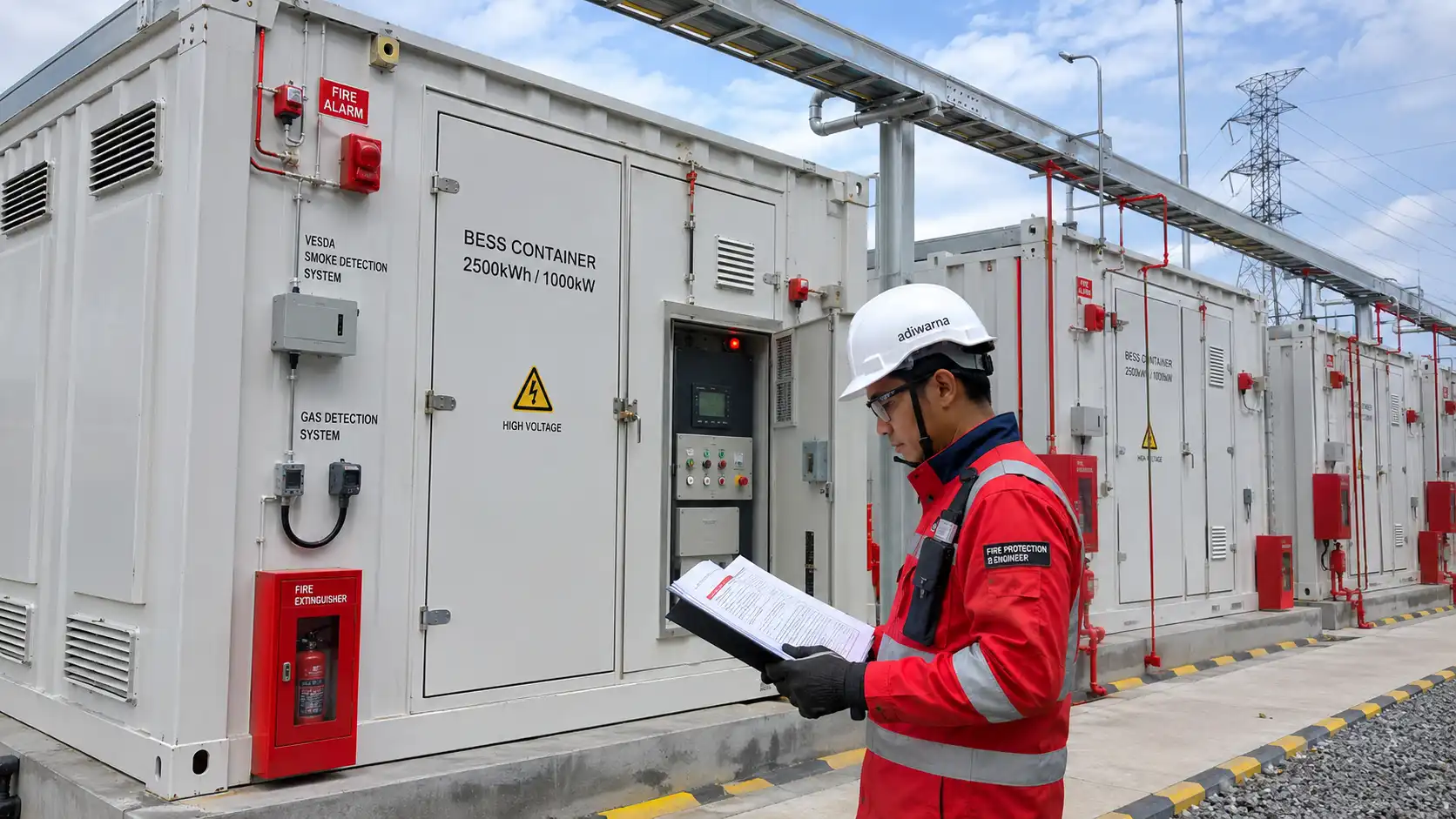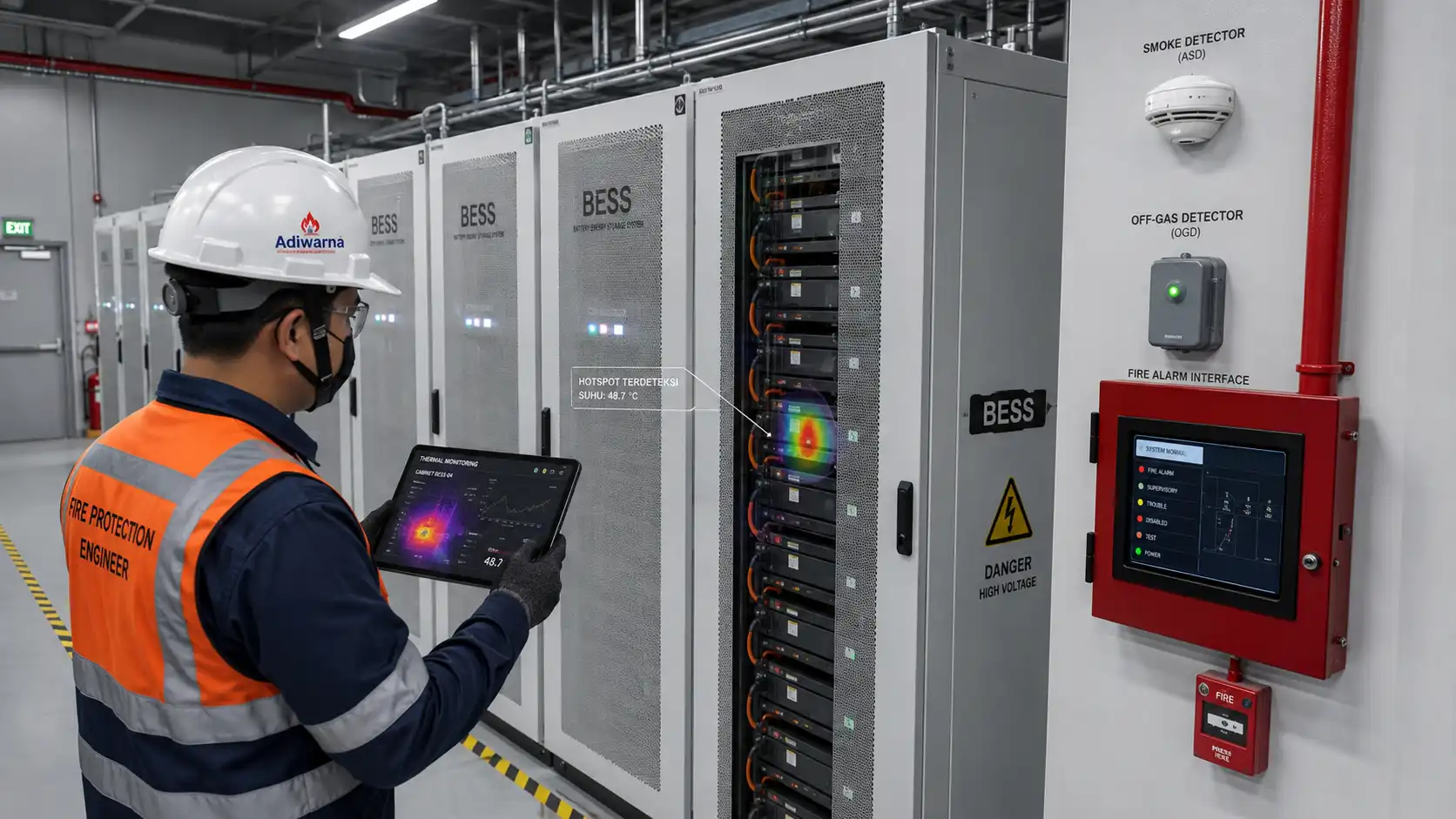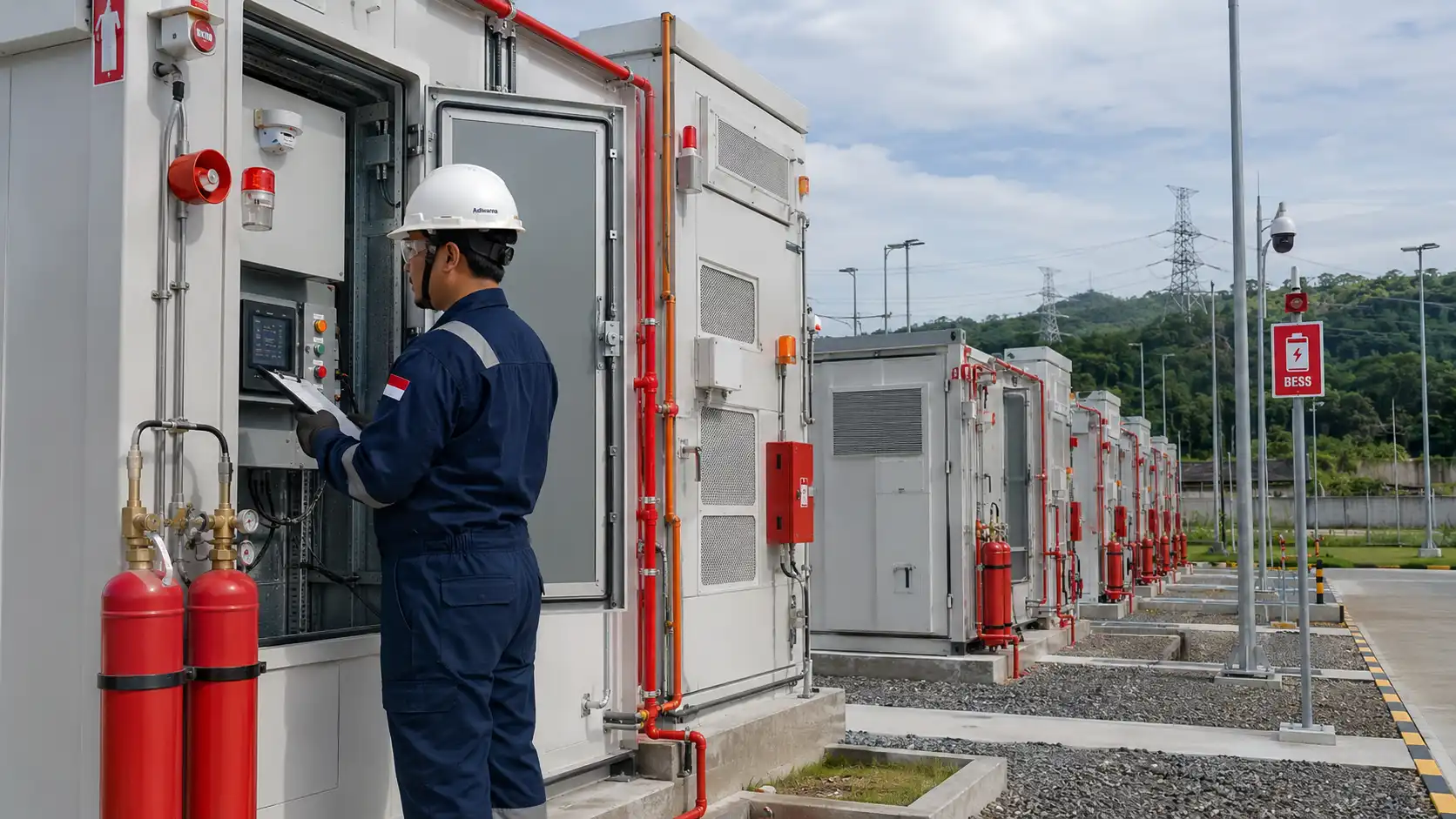

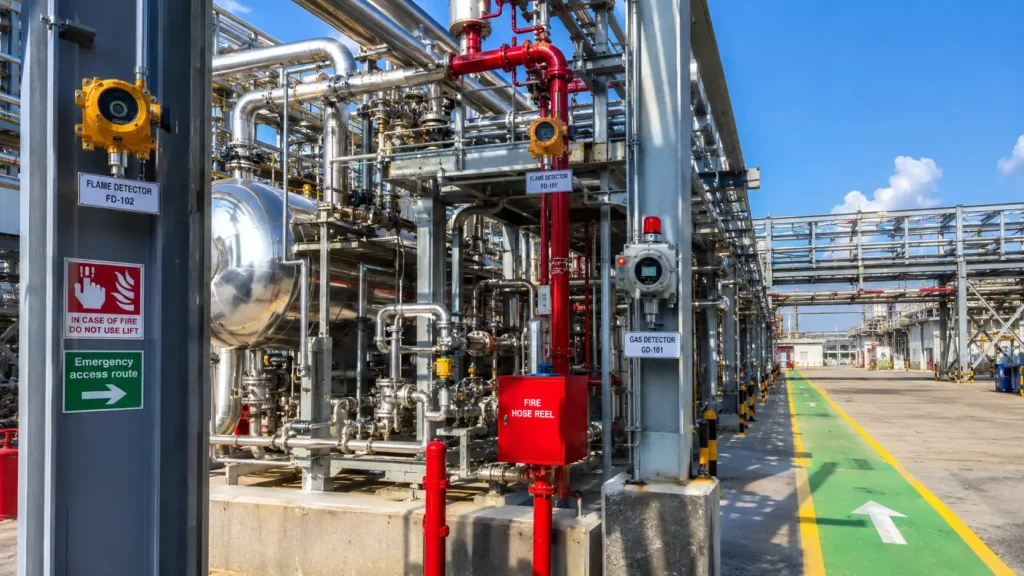
Flame detector is a fire detection device designed to quickly identify flame radiation, so the safety system can provide an alarm before a fire develops into a larger incident. Therefore, this device is highly needed in industrial areas with rapid fire risks, such as oil & gas facilities, petrochemical plants, tank farms, loading stations, turbine rooms, generator rooms, and flammable material storage facilities.
In addition, some industrial fires do not always begin with clearly visible smoke. Therefore, a smoke-based detection system alone is often not enough for open areas, windy environments, or process areas that contain highly flammable materials.
With proper installation, flame detection devices can help operators identify hazardous locations faster. Furthermore, the alarm signal can be transmitted to a fire alarm panel, fire and gas controller, emergency shutdown system, deluge system, or foam system.
For integrated industrial fire protection needs, PT Adiwarna Anugerah Abadi provides solutions through its Fire Protection Contractor service, which includes consultation, design, procurement, installation, testing, commissioning, service, and maintenance.
Why Is a Flame Detector Needed in Industry?
Flame detector is needed because fire in industrial areas can appear and spread within a very short time. Therefore, early detection becomes an important part of protecting workers, assets, and production processes.
In addition, areas such as oil & gas and petrochemical plants have potential hydrocarbon leaks, combustible gases, and pressurized processes. Thus, the detection system must be able to identify fire quickly before an incident escalates into a major fire.
However, every industrial area has different risk characteristics. Therefore, detector technology selection must consider fuel type, environmental conditions, detection distance, field of view, and potential interference from light, heat, or welding activities.
In oil and gas facilities, this device is often part of a fire and gas system. Therefore, Adiwarna’s Oil and Gas Fire Protection System page can be used as a reference to understand how detection, alarm, suppression, and emergency control are connected in one system.
How a Flame Detector Works
Flame detector works by reading radiation energy generated by flames. Generally, fire produces ultraviolet or infrared radiation that can be identified by specialized sensors.
Then, the sensor processes the signal pattern and distinguishes it from ordinary light or heat sources. In this way, modern devices can reduce the risk of false alarms when the technology and settings are selected correctly.
After the flame signal is confirmed, the device sends output to a panel or controller. Next, the system can activate visual alarms, audible alarms, control room notifications, or automatic suppression systems based on the cause and effect matrix.
Because this process happens quickly, flame detection devices are very useful in areas that require fast response. Therefore, system planning must be carried out from the engineering stage, not only during field installation.
Types of Flame Detection Technology
In practice, fire detection technology has several options. Therefore, engineers must understand the differences between each technology before selecting the most suitable device.
Common technologies include:
- UV detector.
- IR detector.
- UV/IR detector.
- Dual IR detector.
- Triple IR or IR3 detector.
- Multi-spectrum detector.
- Video flame detection.
- Explosion-proof detector.
In addition, each technology has its own strengths and limitations. For example, a UV detector has a fast response, but it can be affected by certain radiation sources such as welding or lightning.
Meanwhile, IR and IR3 detectors are often used for hydrocarbon fires. However, placement must still consider heat sources, obstruction, and viewing angle.
As an additional reference, UV, IR, and multispectrum technologies are also explained in industrial flame detection solutions such as the Crowcon Flame Detection page.
UV/IR Flame Detector for Industrial Areas
Flame detector UV/IR combines ultraviolet and infrared sensors in one device. With this combination, the system can validate the presence of fire through two different spectrums.
In addition, UV/IR technology can help reduce false alarms compared with single-sensor technology under certain conditions. However, the device must still be configured according to the characteristics of the area.
In process areas, UV/IR is often selected when a facility requires fast response and signal verification. Therefore, this technology is widely used in areas with potential open-flame hazards.
Even so, engineers still need to perform field evaluation. This is because vapor, dust, flare activity, welding, and light reflection can affect detection performance if they are not considered properly.
IR3 Flame Detector for Hydrocarbon Fire
Flame detector IR3 uses three infrared sensors at different wavelengths. Therefore, this technology is often selected for areas with hydrocarbon fire risks.
In addition, IR3 usually has better capability to distinguish fire from several non-fire heat sources. Thus, this technology is suitable for oil & gas facilities, tank farms, jetties, loading areas, and petrochemical plants.
However, IR3 still requires a clear line of sight. If fire is blocked by equipment, vessels, pipe racks, walls, or steel structures, the detector may lose its ability to read the hazard optimally.
Therefore, the field of view must be calculated from the beginning. Furthermore, the installation position should be included in drawings so it is not changed carelessly during installation.
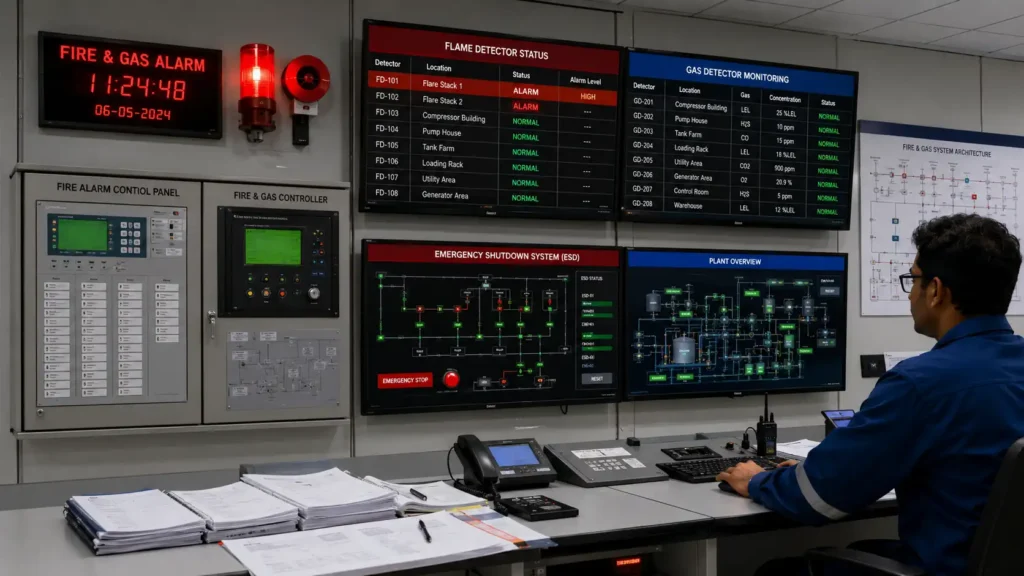
Flame Detector in a Fire and Gas Detection System
Flame detector usually works together with gas detectors, manual call points, alarm beacons, sirens, fire alarm panels, and fire and gas controllers. Therefore, this device does not stand alone but becomes part of a broader safety system.
First, the detector reads the presence of fire in the risk area. Then, the signal is sent to the controller to be processed based on predefined alarm logic.
After that, the controller can activate local alarms, control room alarms, deluge valves, foam systems, or emergency shutdown. In this way, the system can provide an automatic response faster than manual action.
In addition, this integration helps operators understand hazard priority. Therefore, alarm status, detector location, and event type must be displayed clearly on the panel or control room HMI.
Flame Detector for Oil & Gas and Tank Farms
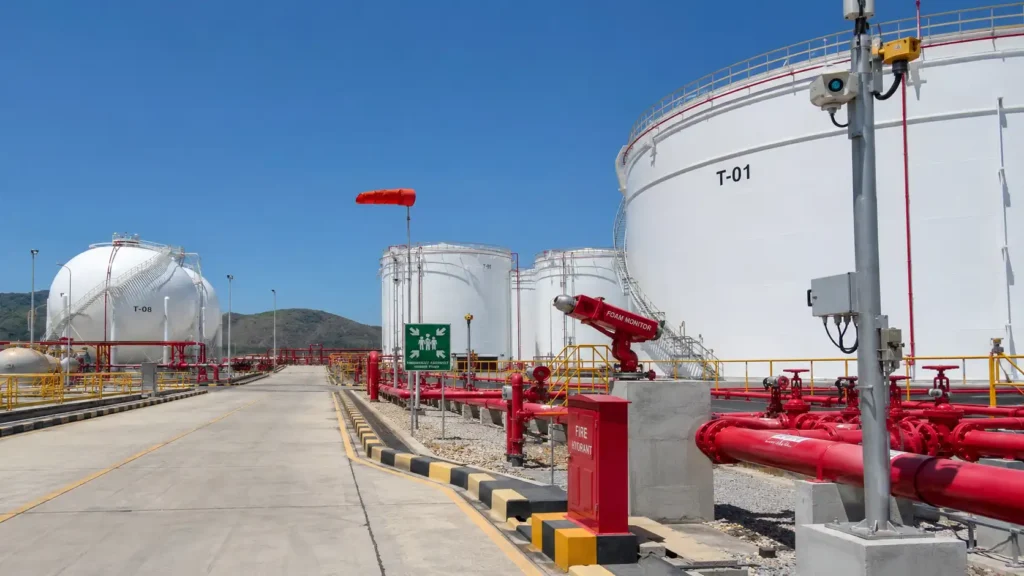
Flame detector is highly relevant for oil & gas and tank farms because both areas contain liquid fuels, combustible gases, and potential rapid-fire scenarios. Therefore, the detection system must be designed to provide alarms as early as possible.
In tank farms, fire detection devices can be installed to monitor areas around storage tanks, foam monitors, pump stations, loading bays, and manifolds. In addition, the system can be combined with a foam system so the suppression response is more prepared.
For areas with liquid fuel risks, Foam System Adiwarna can become part of an integrated protection solution.
With proper design, alarms from detectors can activate actions according to the scenario. For example, alarms can trigger sirens, flashing beacons, ESD, deluge valves, or foam application based on the risk assessment.
Integration with Fire Alarm System
A flame detection device must be connected to the fire alarm system so alarms can be delivered to the right area. Usually, integration is performed through relays, input modules, addressable modules, or fire and gas controllers.
After the signal is received, the panel displays the alarm location. Then, the system can activate sounders, strobes, annunciators, or alarm notification devices.
In addition, the alarm system can send signals to the BMS, security room, or control room. Thus, hazard information is not only known locally but also at the monitoring center.
As a general reference, NFPA 72 is often used in the design of fire alarm and signaling systems. Therefore, this standard can be used as a reference when designing alarm integration.
Integration with Fire Suppression System
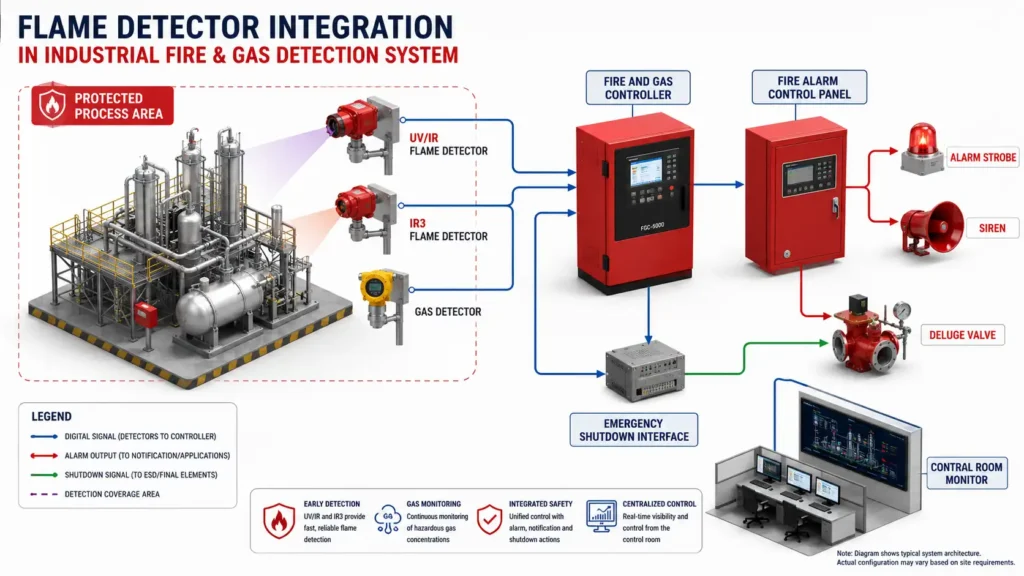
In some high-risk areas, alarms from flame detection devices can be used to activate fire suppression systems. However, automatic activation must follow safe and validated logic.
For example, process areas can use a deluge system to cool equipment and control fire. Meanwhile, tank farm areas can use a foam system to cover the surface of liquid fuel.
In addition, some facilities may use clean agent, CO₂, or water mist systems for specific applications. Therefore, the type of suppression system must be adjusted to the risk characteristics and protected assets.
For critical asset protection, Adiwarna provides Fire Suppression System services that can be adapted to industrial facilities, data centers, machine rooms, and high-hazard areas.
Important Factors in Detector Placement
Detector placement strongly determines system reliability. Therefore, installation points should not be selected only based on cable installation convenience.
Key factors that need to be considered include:
- Fuel type.
- Potential fire sources.
- Field of view.
- Detection range.
- Line of sight.
- Obstruction.
- Mounting height.
- Mounting angle.
- Area classification.
- Indoor or outdoor conditions.
- Exposure to dust, vapor, rain, or heat.
- Welding and hot work activities.
- Maintenance access.
- Potential false alarms.
In addition, the detector must be directed toward the main risk area. If the installation angle is wrong, the device may read a less relevant area while missing the actual hazard area.
Testing and Commissioning
Testing and commissioning are required to ensure all functions work according to design. Therefore, this process should not only check indicator lights.
Important activities usually include:
- Visual inspection.
- Loop test.
- Functional test.
- Alarm simulation.
- Field of view verification.
- Controller communication test.
- Relay output test.
- Fire alarm integration test.
- Deluge or suppression interface test.
- Cause and effect test.
- Control room monitoring test.
- Documentation review.
In addition, test results must be recorded clearly. With this documentation, owners, contractors, consultants, and HSE teams have a clear basis for system acceptance.
If differences are found between the design and field conditions, correction must be carried out before the system is declared ready for operation. Therefore, commissioning becomes an important stage in ensuring reliability.
Maintenance and Periodic Inspection
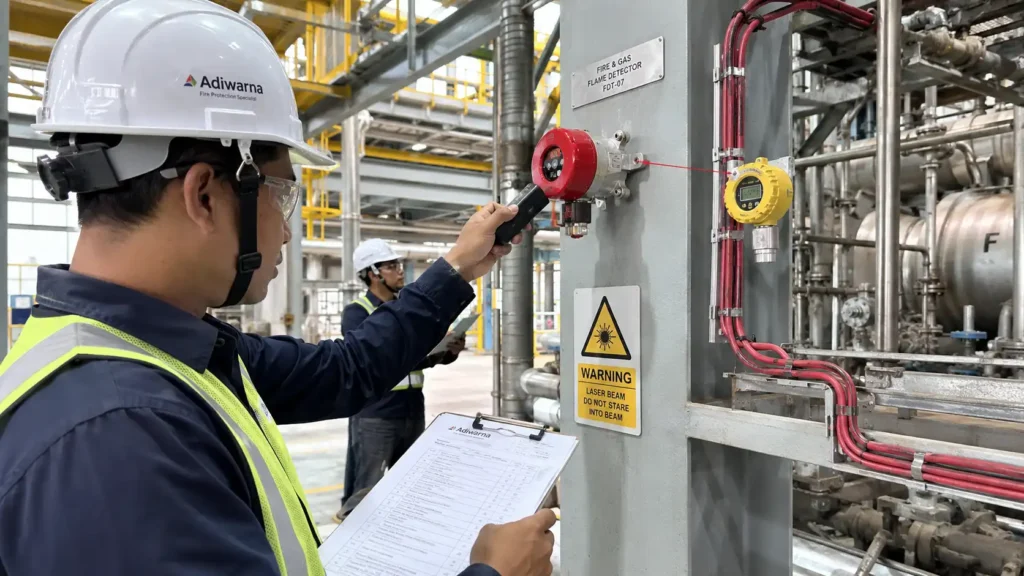
Maintenance is required so the device remains clean, accurate, and ready to provide alarms. Therefore, inspection schedules must be prepared consistently.
Common inspections include housing condition, lens condition, bracket condition, cable condition, gland condition, power status, fault status, alarm history, and event log. In addition, technicians need to ensure that no new obstruction blocks the field of view.
In outdoor areas, the device can be exposed to rain, dust, heat, chemical vapor, and corrosion. Therefore, protective covers, enclosures, and mounting hardware must be inspected regularly.
With good maintenance, the system can operate more consistently. Conversely, detectors that are rarely tested can create a false sense of safety because their performance is never verified.
Common Mistakes in Flame Detection Projects
Many problems occur not because the device is poor. Instead, failures often appear because design, installation, integration, or maintenance is not performed correctly.
Common mistakes to avoid include:
- Selecting the wrong detector technology.
- Not calculating field of view.
- Installing detectors behind pipes or equipment.
- Ignoring area classification.
- Not analyzing false alarm sources.
- Having unclear alarm logic.
- Having an incomplete cause and effect matrix.
- Not testing panel integration.
- Installing detectors too far from the risk area.
- Providing no maintenance access.
- Not cleaning the lens periodically.
- Having incomplete commissioning documentation.
By avoiding these mistakes, the detection system can operate more reliably. In addition, facilities can improve readiness for emergency conditions.
Benefits of a Flame Detection System for Companies
A fire detection system provides major benefits for companies. First, the system helps provide faster alarms when fire appears.
In addition, the system helps reduce the potential for fire escalation. As a result, asset damage, production downtime, and worker safety risks can be reduced.
Furthermore, an integrated system also supports HSE audits and insurance reviews. Therefore, design, testing, and maintenance documentation must be managed properly.
Finally, a properly designed detection system can improve facility readiness during emergencies. Therefore, investment in this system provides both safety value and operational value.
Why Choose PT Adiwarna Anugerah Abadi?
PT Adiwarna Anugerah Abadi can help companies design fire detection systems as part of integrated industrial fire protection. In addition, Adiwarna understands the needs of high-risk facilities such as oil & gas, petrochemical plants, factories, warehouses, data centers, and power plants.
With the right engineering approach, each device can be selected based on risk, location, environmental condition, alarm logic, and integration requirements. Therefore, the system is not only installed but also tested, maintained, and ready for operation.
For projects that require comprehensive integration, EPC Fire Protection Adiwarna can support engineering, procurement, construction, testing, commissioning, service, and maintenance.
If your company needs design, installation, testing, commissioning, service, or maintenance for a fire and gas detection system, consult your project requirements through the Adiwarna Contact Page.
Conclusion
Flame detector is an important device for quickly detecting open flames in high-risk industrial areas. Therefore, this device is highly relevant for oil & gas facilities, petrochemical plants, tank farms, loading areas, generator rooms, and flammable material storage facilities.
However, system reliability is not determined by the device alone. Instead, performance depends heavily on technology selection, field of view, installation location, panel integration, testing, commissioning, and maintenance.
With proper planning, a fire detection system can help protect workers, assets, production processes, and company reputation. Therefore, PT Adiwarna Anugerah Abadi is ready to help deliver professional, integrated, and risk-based fire protection solutions.