


Lithium battery thermal runaway is a failure condition in which heat inside a battery cell rises rapidly and triggers internal reactions that generate even more heat. If the process cannot be controlled, the battery may release gases, smoke, flames, and potentially create explosion hazards or propagation to neighboring cells.
This risk becomes increasingly significant in facilities that use large quantities of lithium-ion batteries, including Battery Energy Storage Systems (BESS), UPS systems, data centers, telecommunications facilities, solar energy storage installations, electric vehicle infrastructure, and battery storage areas.
Therefore, effective protection requires more than installing fire extinguishing equipment. Battery monitoring, early detection, fire alarm systems, off-gas detection, shutdown functions, ventilation, suppression, and emergency response should operate as an integrated safety strategy.
Quick Answer
Lithium battery thermal runaway is a self-sustaining chain reaction caused by an internal temperature increase that generates heat faster than the battery can dissipate it. The condition can cause venting, flammable gas release, fire, explosion, and cell-to-cell propagation. Prevention requires battery monitoring, early detection, temperature control, fire protection systems, and appropriate emergency response procedures.
What Is Lithium Battery Thermal Runaway?
Lithium battery thermal runaway occurs when an internal battery failure generates heat that accelerates further chemical reactions inside the cell. As temperature rises, these reactions can become faster and more severe. At a certain point, the process becomes self-sustaining and may continue even after the original external heat source is removed.
OSHA explains that heat generated by a failing lithium-ion cell can damage adjacent cells and trigger additional heat release in a chain reaction known as thermal runaway.
Read OSHA’s guidance on lithium-ion battery safety.
In industrial applications, thermal runaway risks should be evaluated during the design stage. This is especially important because lithium-ion batteries have relatively high energy density and are commonly arranged in cell, module, rack, cabinet, and container configurations.
Why Does Lithium Battery Thermal Runaway Occur?
Not every battery failure immediately develops into a fire. However, several conditions can damage separators, electrodes, electrolytes, or battery control systems and eventually initiate thermal runaway.
Common causes include:
- internal short circuits;
- manufacturing defects;
- overcharging;
- inappropriate charging equipment;
- overheating;
- mechanical impact;
- puncture or crushing;
- installation damage;
- cooling-system failure;
- operation outside permitted temperature limits;
- battery degradation;
- Battery Management System failure;
- external fire exposure.
OSHA also identifies physical damage, extreme temperatures, and improper charging as factors that can increase lithium-ion battery failure risks.
Internal Short Circuit
An internal short circuit can develop when a separator inside the cell is damaged and allows the positive and negative sections to interact improperly.
As a result, localized electrical current can increase and generate heat rapidly.
Overcharging
Charging beyond manufacturer-defined parameters can create unstable electrochemical and thermal conditions.
For this reason, the Battery Management System and charging system must maintain voltage, current, and temperature within the permitted operating envelope.
Mechanical Damage
A battery that has been dropped, punctured, crushed, or structurally damaged may develop internal defects that are not immediately visible from the outside.
This type of damage requires careful evaluation during transportation, installation, maintenance, and operation.
Stages of Lithium Battery Thermal Runaway
Lithium battery thermal runaway may develop through several stages. The sequence is not necessarily identical for every battery chemistry or design, but it can generally include:
- an abnormal condition begins;
- cell temperature starts increasing;
- internal materials begin reacting;
- internal pressure increases;
- the cell begins venting;
- gases and vapors are released;
- thermal runaway develops;
- released gases may ignite;
- heat affects neighboring cells;
- propagation develops into adjacent modules or racks.
Because this sequence can progress rapidly, the fire protection system should not wait for visible flames before generating an alarm.
UL 9540A is used to evaluate thermal runaway behavior and fire propagation in Battery Energy Storage Systems. Testing can be performed at cell, module, unit, and installation levels.
Learn more about the UL 9540A test method from UL Solutions.
Main Causes of Lithium Battery Thermal Runaway
Several initiating conditions deserve particular attention during battery fire risk assessments.
1. Excessive Temperature
High temperatures can accelerate material degradation and worsen the condition of a cell that already has an internal defect.
Therefore, HVAC, cooling systems, airflow, and temperature monitoring should form part of the overall battery safety strategy.
2. Electrical System Failure
Faults involving inverters, chargers, cables, connectors, busbars, or battery racks may create abnormal heat or electrical conditions.
Electrical connections should therefore be inspected as part of routine preventive maintenance.
3. BMS Failure
The Battery Management System monitors important battery parameters including voltage, current, temperature, state of charge, and other operating conditions.
If monitoring or communication fails, the system may lose an important layer of early protection.
4. Individual Cell Failure
A defect within one cell may escalate into a much larger event if heat transfers to neighboring cells.
Module and rack design should therefore consider the possibility of cell-to-cell and module-to-module propagation.
Early Warning Signs of Lithium Battery Thermal Runaway
Early detection is critical because abnormal battery conditions can develop before visible flames appear.
Possible warning signs include:
- abnormal temperature rise;
- battery swelling or bulging;
- cracking;
- hissing sounds;
- leakage;
- voltage changes;
- abnormal current;
- unusual gases or odors;
- smoke;
- pressure changes;
- BMS alarms;
- activation of off-gas detection.
OSHA identifies indicators such as bulging, cracking, hissing, leaking, rising temperature, and smoking as potential signs of battery damage or failure.
Operators should not rely solely on visual inspection. In large installations, automated monitoring is important because many batteries are housed inside modules, cabinets, or enclosures that are not directly visible.
Lithium Battery Thermal Runaway Risks in BESS
In BESS installations, lithium battery thermal runaway becomes more complex because the number of cells and the amount of stored energy are significantly greater than in small consumer devices.
A single BESS container can contain numerous modules located in close proximity. Consequently, failure in one cell may develop into cell-to-cell propagation, module-to-module propagation, or potentially affect adjacent BESS units.
Major hazards include:
- fire;
- thermal propagation;
- gas release;
- toxic exposure;
- deflagration;
- explosion;
- equipment damage;
- operational shutdown;
- reignition;
- risks to emergency responders.
The Fire Safety Research Institute has reported that gases released during lithium-ion battery thermal runaway can create explosion hazards when they accumulate and later encounter an ignition source.
Read the FSRI research on explosion hazards from thermal runaway gases.
For this reason, BESS design should consider not only fire but also gas monitoring, ventilation, explosion mitigation, separation distances, and emergency response procedures.
For facilities containing mission-critical equipment, see Adiwarna’s guide to data center fire protection.
How Does Early Thermal Runaway Detection Work?
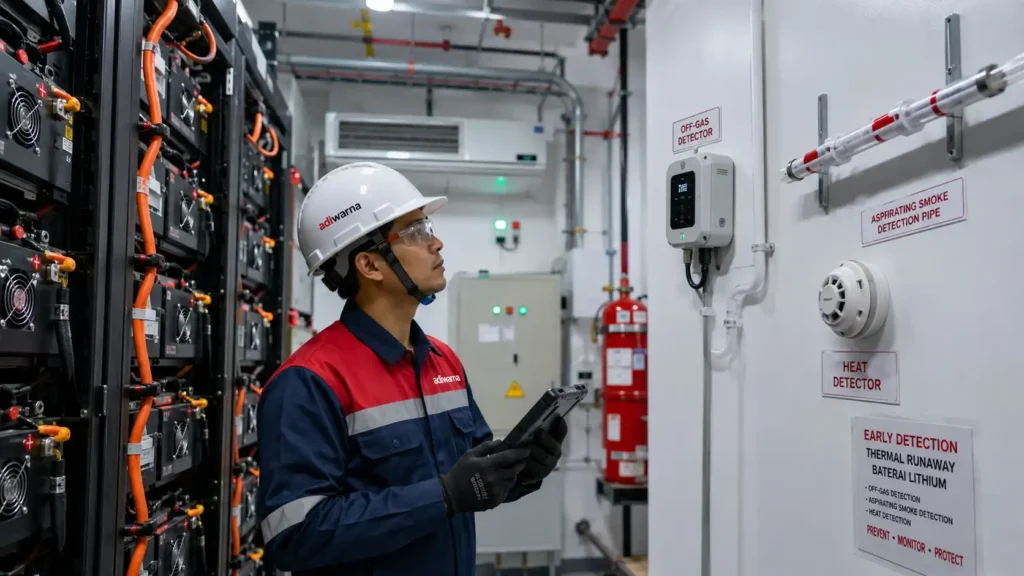
An early detection strategy should use multiple indicators because battery failure may first appear through electrical, thermal, gas, or smoke-related changes.
Several technologies can be integrated.
Battery Management System
A BMS may provide the first layer of monitoring by tracking:
- cell voltage;
- module voltage;
- current;
- state of charge;
- temperature;
- communication faults;
- battery imbalance.
BMS alarms may trigger warnings, charging limitations, isolation, or shutdown actions according to the system design.
Off-Gas Detection
Some lithium-ion cells can release gases before visible smoke or flames appear.
Off-gas detectors may therefore provide an earlier warning that allows operators to initiate actions according to the approved cause-and-effect matrix.
Aspirating Smoke Detection
Aspirating smoke detection systems continuously sample air through a network of pipes.
This technology can be used in facilities where very early smoke detection is required.
Heat Detection
Heat detectors identify abnormal temperature conditions based on fixed-temperature or rate-of-rise principles, depending on the selected technology.
Fire Alarm System
Fire safety devices should be properly integrated with the fire alarm control panel.
PT Adiwarna Anugerah Abadi explains that fire alarm systems can be integrated with fire suppression equipment, HVAC shutdown, and other building control functions to initiate further responses.
Learn more about Adiwarna’s Fire Alarm System.
How to Prevent Lithium Battery Thermal Runaway
Preventing lithium battery thermal runaway should begin before a battery system is placed into operation.
The following strategies can provide a foundation for risk reduction.
Use Batteries Within Manufacturer Specifications
Batteries should operate within manufacturer-defined limits, including temperature, charging rate, voltage limits, and environmental conditions.
Control Battery Temperature
HVAC or cooling systems should maintain ambient and battery temperatures within recommended operating ranges.
Potential hotspots should also be identified and minimized.
Use a Battery Management System
A BMS is important for detecting abnormal cell or module conditions.
However, alarm thresholds, interlocks, and shutdown logic must also be properly designed and tested.
Implement Continuous Monitoring
Large battery installations should continuously monitor critical conditions.
Temperature, voltage, current, gas, smoke, and alarm history can all provide information about changes in battery health and operating conditions.
Prevent Mechanical Damage
Batteries that have been dropped, punctured, swollen, or structurally damaged should be evaluated immediately.
A suspected damaged battery should not be treated in the same manner as a normal unit.
Perform Inspection and Maintenance
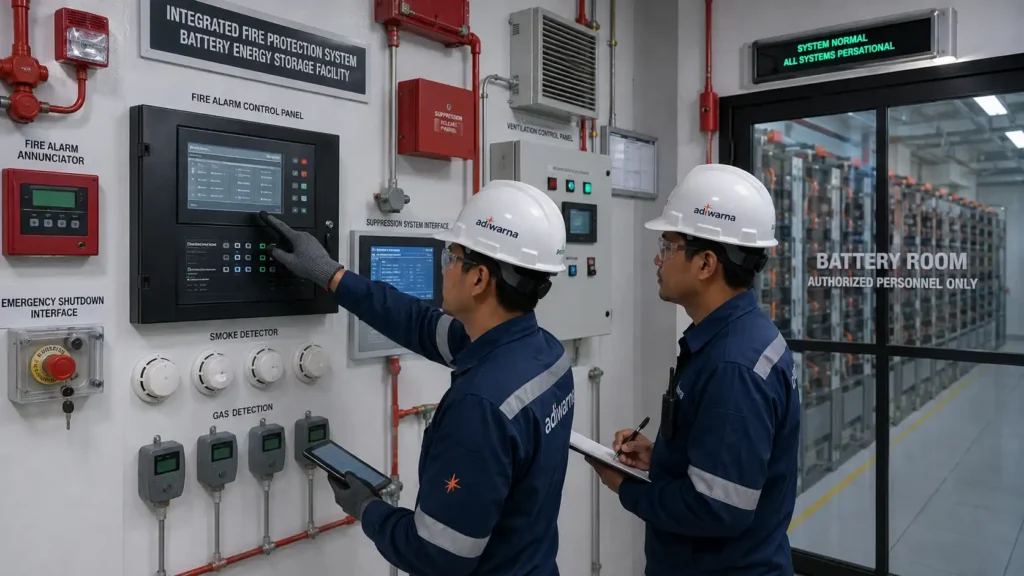
Routine inspections can help identify:
- corrosion;
- loose connections;
- overheating;
- battery swelling;
- cooling-system faults;
- abnormal alarms;
- sensor failures;
- cable damage.
OSHA also recommends following manufacturer instructions and maintaining appropriate storage and monitoring practices for large lithium-ion battery facilities.
The Role of Fire Protection in Lithium Battery Thermal Runaway
Fire protection equipment may not always stop chemical reactions that are already occurring inside a battery cell. Therefore, the objective of protection must be defined more broadly than simply extinguishing visible flames.
A fire protection strategy can be designed to:
- detect abnormal conditions;
- provide early warning;
- initiate shutdown;
- control external flames;
- limit propagation;
- provide cooling;
- protect adjacent units;
- manage fire products;
- support emergency responders.
In critical areas, suppression-system selection should be based on hazard analysis and relevant fire-testing data.
Read more about fire suppression system equipment for critical assets.
How to Select Fire Suppression for Lithium Batteries
There is no single suppression agent that automatically provides the best solution for every lithium-ion battery installation.
Selection depends on factors such as:
- battery chemistry;
- cell format;
- storage capacity;
- stored energy;
- enclosure design;
- indoor or outdoor installation;
- rack configuration;
- ventilation;
- fire-testing results;
- propagation risk;
- water availability;
- electrical hazards;
- environmental requirements.
Water-Based Systems
Water has a high heat-absorption capacity and can therefore play an important role in cooling and controlling thermal propagation.
However, water distribution, access to the heat source, drainage, battery configuration, and equipment characteristics still require engineering assessment.
Clean Agent or Inert Gas Systems
Clean agent and inert gas systems can control flames without leaving residue under certain conditions.
However, eliminating visible flames does not necessarily mean the internal thermal runaway reaction has stopped.
Their application should therefore consider risk assessment, gas monitoring, ventilation strategy, cooling requirements, and relevant fire-testing data.
Adiwarna provides various fire suppression system solutions for critical facilities according to specific facility protection requirements.
Standards for Lithium Battery Thermal Runaway Protection
Several standards and test methods provide important references when designing energy storage installations.
NFPA 855
NFPA 855 addresses the installation of stationary energy storage systems and includes requirements concerning commissioning, operation, maintenance, electrochemical ESS, lithium-ion battery storage, and firefighting considerations.
View NFPA 855 — Standard for the Installation of Stationary Energy Storage Systems.
UL 9540A
UL 9540A is a test method used to evaluate thermal runaway fire propagation in Battery Energy Storage Systems.
Testing provides information about how batteries behave during thermal runaway and can support evaluation of installation configurations and fire protection strategies.
Learn about UL 9540A from UL Solutions.
Why Is Fire Testing Important?
Large-scale fire testing can help evaluate:
- flame spread;
- heat release;
- gas emissions;
- suppression performance;
- separation distances;
- propagation potential;
- impact on surrounding units.
UL Solutions explains that large-scale testing can be used to evaluate BESS behavior when gases released from batteries are ignited during a fire event.
Learn more about large-scale fire testing and UL 9540A.
Engineering decisions should therefore not rely solely on assumptions or designs copied from previous projects.
Common Mistakes When Managing Lithium Battery Risks
Relying Only on Smoke Detectors
Smoke detection is important, but battery failure may first produce electrical, thermal, or gas-related indications before smoke is detected.
A multi-layered detection strategy is more appropriate for high-risk battery installations.
Assuming All Battery Chemistries Behave the Same
Lithium iron phosphate, NMC, NCA, and other lithium-ion chemistries have different thermal and electrochemical characteristics.
Fire protection strategies should therefore be based on the actual battery chemistry and system configuration used at the facility.
Selecting Fire Suppression Only Based on Cost
Suppression equipment cost should not be the only consideration.
Thermal runaway, cooling requirements, propagation risk, gas hazards, potential downtime, and personnel safety also need to be evaluated.
Ignoring Gas Detection
Thermal runaway gases can create a serious hazard even before visible flames appear.
Gas accumulation within enclosed spaces should therefore be included in the hazard analysis.
Operating Without a Cause-and-Effect Matrix
The BMS, detectors, fire alarm, HVAC, emergency shutdown, exhaust, and suppression system should operate according to a clearly defined sequence.
Without proper integration, individual safety devices may function independently without producing an effective overall response.
FAQ About Lithium Battery Thermal Runaway
Does Lithium Battery Thermal Runaway Always Cause Fire?
No. Lithium battery thermal runaway may produce heat, gas, venting, smoke, or flames depending on battery chemistry, cell design, and failure conditions.
However, the situation can remain dangerous because released gases may accumulate and ignite later.
Can Lithium Battery Thermal Runaway Be Stopped?
Stopping an internal reaction that is already progressing inside a battery cell can be extremely difficult.
For this reason, battery safety strategies emphasize prevention, early detection, isolation, cooling, propagation control, and emergency response.
What Are the Early Signs of Lithium Battery Thermal Runaway?
Possible warning signs include increasing temperature, swelling, hissing, leakage, gas release, abnormal electrical parameters, smoke, and BMS alarms.
Large facilities should use automatic monitoring and detection systems to accelerate response.
Can LiFePO4 Batteries Experience Lithium Battery Thermal Runaway?
Yes. Lithium iron phosphate has different thermal stability characteristics from several other lithium-ion chemistries, but this does not mean it is completely immune to thermal runaway.
Risk should still be assessed according to battery design, system configuration, and operating conditions.
Can Clean Agent Systems Stop Lithium Battery Thermal Runaway?
Clean agents can control visible flames under certain circumstances but may not stop reactions already occurring inside battery cells.
Therefore, clean agent systems should not be treated as the sole protection strategy for lithium-ion battery installations.
Can Lithium Battery Thermal Runaway Cause an Explosion?
Yes. Flammable gases released during battery failure may accumulate within an enclosure. If the concentration enters a flammable range and an ignition source is present, deflagration or explosion can occur.
Read FSRI research on lithium-ion thermal runaway explosion hazards.
How Is UL 9540A Related to Lithium Battery Thermal Runaway?
UL 9540A is used to evaluate thermal runaway fire propagation in energy storage systems.
Test data can help engineers, manufacturers, facility owners, and Authorities Having Jurisdiction understand how the system may behave during a battery failure.
Consult Adiwarna for Lithium Battery Fire Protection
The risks associated with lithium battery thermal runaway require a broader strategy than simply installing portable extinguishers or suppression cylinders.
Battery monitoring, fire detection, gas detection, fire alarms, shutdown, ventilation, suppression, and emergency response should be engineered as an integrated system.
PT Adiwarna Anugerah Abadi Tbk provides design and engineering, supply, installation, testing and commissioning, as well as service and maintenance for various fire protection requirements.
For BESS, UPS rooms, data centers, battery rooms, or industrial facilities, contact the Adiwarna team for a fire protection consultation.
Conclusion
Lithium battery thermal runaway is a significant risk in facilities using lithium-ion batteries because the failure of one cell can generate heat, gases, fire, and potentially propagate to neighboring cells and modules.
Prevention should begin with proper equipment selection, Battery Management Systems, cooling, inspection, monitoring, and early detection. Fire alarms, off-gas detection, ventilation, suppression, and emergency response should also be designed based on the specific hazard.
For BESS and other large-scale battery installations, references such as NFPA 855 and UL 9540A can support engineering analysis and fire-risk assessment. With a layered approach, lithium battery thermal runaway can be detected earlier and its potential impact on personnel, assets, and operations can be reduced.