
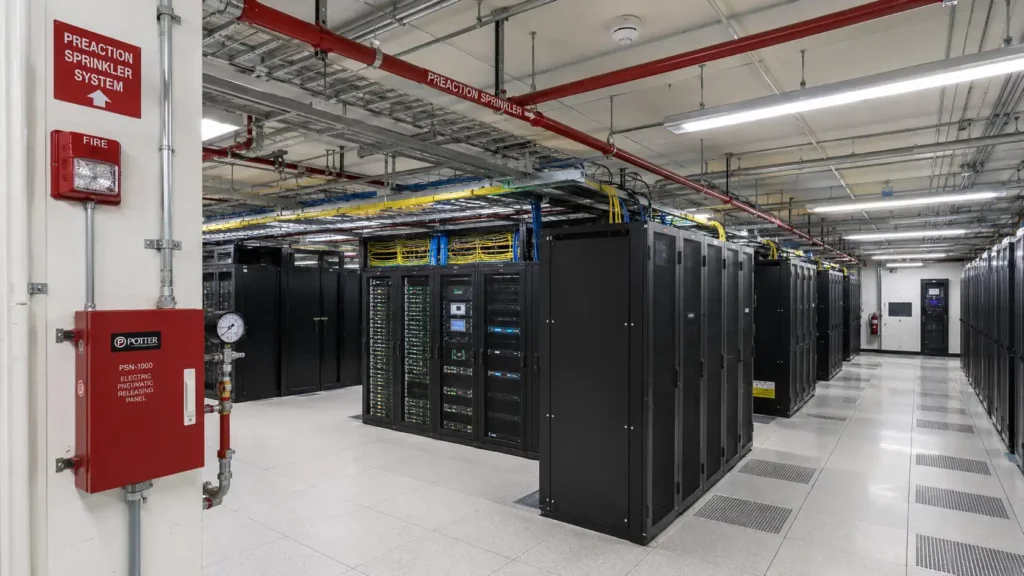
Preaction sprinkler system is a fire sprinkler system designed to keep water out of the pipe network until specific conditions are met, so water discharge can be controlled more safely than in a conventional wet sprinkler system. Therefore, this system is commonly used in areas with water-sensitive assets, such as data centers, server rooms, archive rooms, museums, laboratories, clean rooms, control rooms, and industrial facilities with high-value equipment.
In addition, a preaction system becomes a strong option when facility owners need water-based fire protection but also want to reduce the risk of accidental discharge. Therefore, the system design must properly combine fire detection, control panels, preaction valves, piping networks, sprinkler heads, alarms, and testing procedures.
In industrial applications, this system is usually connected to a fire alarm system so water release occurs based on a valid detection signal. As a result, water does not immediately enter the piping network only because of mechanical damage to a sprinkler head or a pressure disturbance.
For integrated fire protection needs, PT Adiwarna Anugerah Abadi provides Fire Suppression System solutions that can be adapted to critical facilities, data centers, technical rooms, and sensitive industrial areas.
Why Is a Preaction Sprinkler System Important?
Preaction sprinkler system is important because some areas are not only exposed to fire risk but also vulnerable to major losses if water is released uncontrollably. Therefore, this system provides an additional control layer before water enters the protected area.
In addition, some facilities store electronic equipment, important documents, research materials, or special machinery that can be damaged by water. Because of this, a preaction system can become a balanced solution between fire suppression needs and asset protection requirements.
In a wet sprinkler system, the pipes are always filled with water. In contrast, a preaction system usually keeps the pipes filled with pressurized air or nitrogen until the valve is activated by a detection signal. Thus, the risk of water leakage caused by damaged pipes or sprinkler heads can be reduced.
However, this system should not be selected only because it appears safer. This is because its design and maintenance are more complex than standard sprinkler systems. Therefore, planning must be carried out by a team that understands standards, room risks, and operational requirements.
How a Preaction Sprinkler System Works
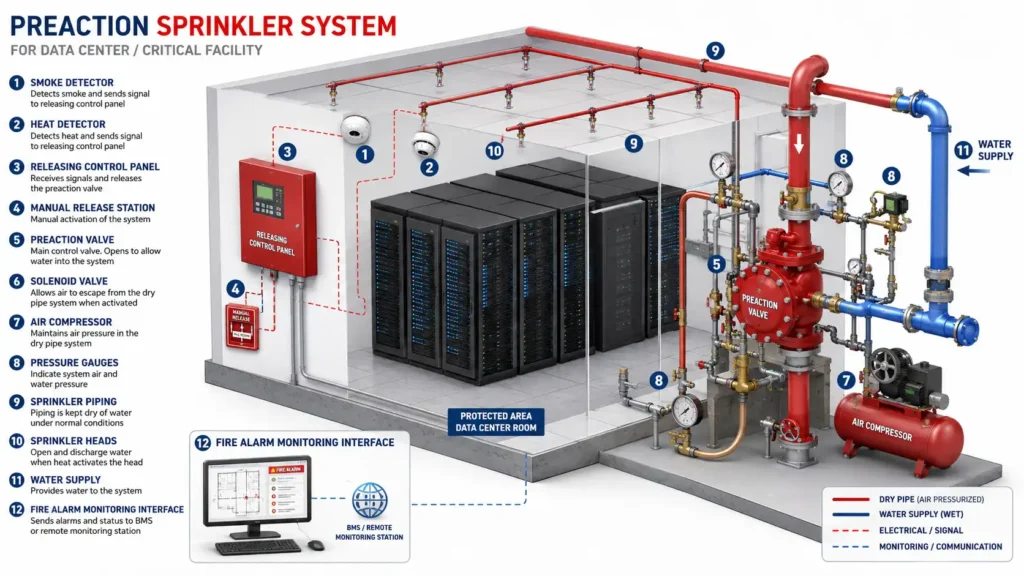
Preaction sprinkler system works by combining a fire detection system and a sprinkler system. First, detectors such as smoke detectors, heat detectors, or aspirating smoke detectors identify signs of fire.
Then, the signal from the detector is sent to a fire alarm control panel or releasing control panel. After that, the panel activates the preaction valve if the alarm condition meets the designed logic.
Next, water enters the sprinkler piping network. However, water will only discharge from a sprinkler head if that sprinkler opens due to heat from the fire.
With this operating method, the system can reduce the possibility of accidental water discharge. Therefore, preaction systems are often used in areas that require confirmed detection before the piping network is filled with water.
Main Components of a Preaction Sprinkler System
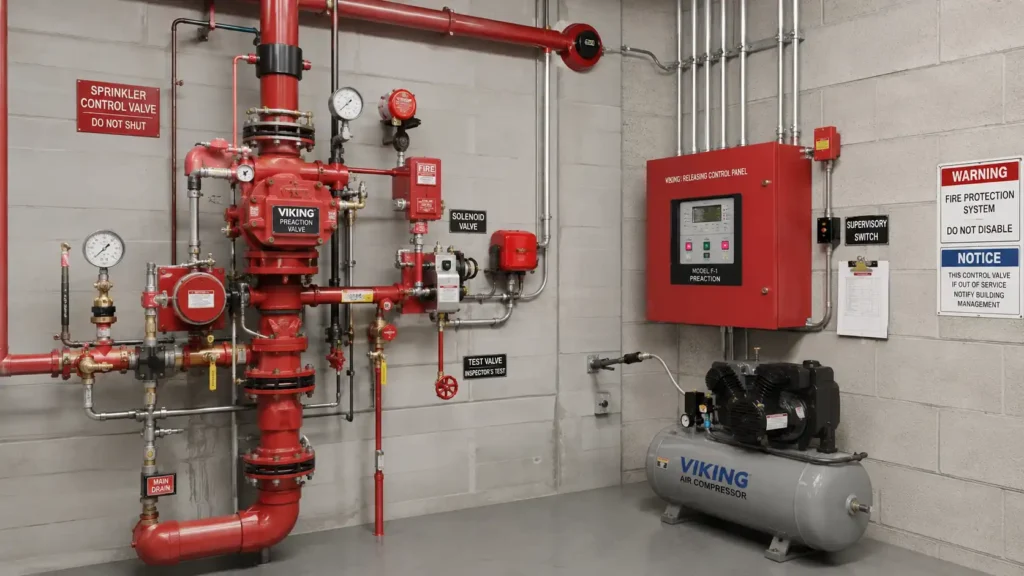
A preaction system consists of several interconnected components. Therefore, each component must be selected and tested properly so the system can operate according to the design.
Common main components include:
- Preaction valve.
- Releasing control panel.
- Smoke detector or heat detector.
- Manual release station.
- Supervisory switch.
- Air compressor or nitrogen supply.
- Pressure gauge.
- Water supply valve.
- Alarm bell or alarm device.
- Sprinkler piping.
- Sprinkler head.
- Flow switch.
- Tamper switch.
- Drain valve.
- Test valve.
- Fire alarm interface.
- Monitoring interface.
In addition, the system also requires wiring, conduit, power supply, battery backup, and cause-and-effect documentation. Thus, the integration between detection and water release can operate clearly and reliably.
Preaction Sprinkler System for Data Centers and Server Rooms
Preaction sprinkler system is highly relevant for data centers and server rooms because these areas contain electronic equipment that is sensitive to water. Therefore, the fire protection system must be able to respond to fire while reducing the risk of unnecessary water release.
In addition, data centers often require a combination of early warning detection, fire alarm systems, clean agent systems, and sprinkler protection. With a layered approach, facility owners can achieve fast detection while maintaining additional protection if the fire develops.
In server rooms, a preaction system can be combined with sensitive smoke detection. Then, the alarm can be verified through the panel before the valve opens and the piping starts to fill with water.
For server rooms and critical asset protection, Adiwarna also provides Fire Alarm System solutions that can be integrated with sprinkler systems, clean agent systems, and control room monitoring.
Preaction Sprinkler System in a Layered Fire Protection Strategy
Preaction sprinkler system usually does not stand alone in critical areas. Instead, this system often becomes part of a layered fire protection strategy that includes early detection, alarms, suppression, sprinklers, monitoring, and emergency response.
First, the detection system provides an early warning when smoke or heat is detected. Then, the panel processes the signal based on the designed logic.
After that, the preaction valve can open if the alarm condition is fulfilled. However, the sprinkler head must still break or open due to heat before water discharges at the fire point.
With this concept, the system provides more careful control. Therefore, preaction is often used when an area requires strong fire protection while water discharge must remain controlled.
Types of Preaction Sprinkler System
Preaction systems have several configurations. Therefore, the system type must be selected based on area risk, design standards, and operational needs.
Common types include:
- Single interlock preaction.
- Double interlock preaction.
- Non-interlock preaction.
- Electric release preaction.
- Pneumatic release preaction.
- Electric/pneumatic release preaction.
In addition, each configuration works differently. Therefore, engineers must understand valve activation conditions, pipe pressure status, and sprinkler head activation before choosing the most suitable system.
Single Interlock Preaction System
Single interlock preaction operates when the detection system sends an alarm signal. After the alarm is confirmed, the preaction valve opens and water enters the sprinkler piping network.
However, water still does not discharge until the sprinkler head opens because of heat. Thus, this system provides additional control compared with a wet pipe sprinkler system.
In addition, single interlock is suitable for areas that need protection against accidental water discharge from piping. However, the system still requires reliable fire detection so the valve can operate at the right time.
Therefore, detectors, panels, wiring, and releasing circuits must be tested periodically. If detection fails, the valve may not open when required.
Double Interlock Preaction System
Double interlock preaction requires two conditions before the valve opens. First, the detection system must send an alarm signal. Second, air pressure in the pipe must drop because the sprinkler head has opened.
Thus, water will not enter the pipe only because of a detector alarm. Conversely, water will also not enter only because the pipe loses pressure without a fire indication from the detector.
Because this logic is stricter, double interlock is often used in areas that are highly sensitive to water. However, the system response can be slower than single interlock because it requires two activation conditions.
Therefore, selecting double interlock must consider the balance between asset protection and fire suppression response. With proper analysis, the system can be adapted to the area’s risk.
Difference Between Preaction, Wet Pipe, Dry Pipe, and Deluge Systems
Sprinkler systems have several types, so facility owners need to understand the differences. With this understanding, system selection can be made more accurately.
A wet pipe sprinkler system has water inside the pipes at all times. Therefore, this system is simple and fast in response, but it has a higher water leakage risk in sensitive areas.
A dry pipe sprinkler system uses pressurized air inside the pipes, then water enters after the sprinkler head opens and pressure drops. This system is often used in freezing-risk areas or specific areas unsuitable for wet pipe systems.
Preaction combines fire detection and valve control before water enters the pipe. Therefore, this system is more suitable for water-sensitive rooms.
Meanwhile, a deluge system uses open sprinklers or nozzles, so water discharges from all points when the valve activates. Therefore, deluge is more suitable for high-hazard areas that require a large and rapid water discharge.
Areas Suitable for Preaction Systems
Not every area requires a preaction system. However, this system is highly suitable for facilities with critical assets or high water damage risk.
Areas that commonly use this system include:
- Data centers.
- Server rooms.
- Archive rooms.
- Museums.
- Libraries.
- Laboratories.
- Clean rooms.
- Control rooms.
- Certain electrical panel rooms.
- Telecommunication facilities.
- Document collection rooms.
- High-value production areas.
- Electronic equipment rooms.
- Research and technology facilities.
In addition, this system can also be used in facilities that require more detailed alarm supervision. Thus, operators can understand alarm stages before water is released.
Integration with Fire Alarm System
A preaction system strongly depends on integration with fire alarms. Therefore, alarm design must be prepared from the early engineering stage, not after sprinkler installation is completed.
The fire alarm panel or releasing panel receives signals from detectors. Then, the panel processes the logic and activates the solenoid on the preaction valve if alarm conditions are fulfilled.
In addition, the panel can also send signals to sounders, strobes, annunciators, BMS, or control rooms. Thus, operators can clearly identify alarm, trouble, supervisory, and waterflow statuses.
As a general reference, NFPA 72 is often used for fire alarm and signaling system design. Therefore, preaction integration with alarm systems should follow proper signaling principles.
Technical Standards to Consider
Sprinkler system design must refer to relevant technical standards. Therefore, specifications should not be based only on room size or the number of sprinkler heads.
In general, NFPA 13 is often used as a reference for sprinkler system installation. In addition, NFPA 25 is widely used as a reference for inspection, testing, and maintenance of water-based fire protection systems.
Besides NFPA standards, projects may also refer to local regulations, insurance requirements, company standards, and manufacturer manuals. Thus, the design must be prepared comprehensively from the engineering stage.
Important points that are usually reviewed include hydraulic calculation, water supply, pipe size, valve arrangement, detector layout, alarm logic, supervisory signal, drain, test connection, and maintenance access.
Important Factors in System Design

Preaction system design must consider both fire protection requirements and water damage risks. Therefore, engineers need to perform a comprehensive evaluation before selecting a configuration.
Important factors include:
- Hazard classification.
- Type of protected assets.
- Area sensitivity to water.
- Room height.
- Room layout.
- Detector type.
- Alarm logic.
- Water supply.
- Hydraulic calculation.
- Pipe routing.
- Valve room location.
- Supervisory monitoring.
- Maintenance access.
- Redundancy requirements.
- Integration with BMS or control room.
In addition, coordination between disciplines is very important. This is because sprinkler, fire alarm, HVAC, electrical, ceiling, access floor, and architectural layouts can affect one another.
Testing and Commissioning
Testing and commissioning are required so the system works according to the design. Therefore, this process must cover mechanical, electrical, control, and alarm aspects.
Important activities usually include:
- Visual inspection.
- Pipe pressure test.
- Air pressure supervisory test.
- Detector activation test.
- Releasing panel test.
- Manual release test.
- Solenoid activation test.
- Preaction valve trip test.
- Waterflow alarm test.
- Supervisory signal test.
- Drain test.
- Alarm notification test.
- Integration test.
- Cause and effect test.
- Documentation review.
In addition, test results must be recorded in an official report. With this documentation, owners, consultants, contractors, and HSE teams have a clear basis for system acceptance.
If differences are found between design and field conditions, corrections must be completed before the system is declared ready for operation. Therefore, commissioning becomes a very important stage.
Preaction Sprinkler System Maintenance
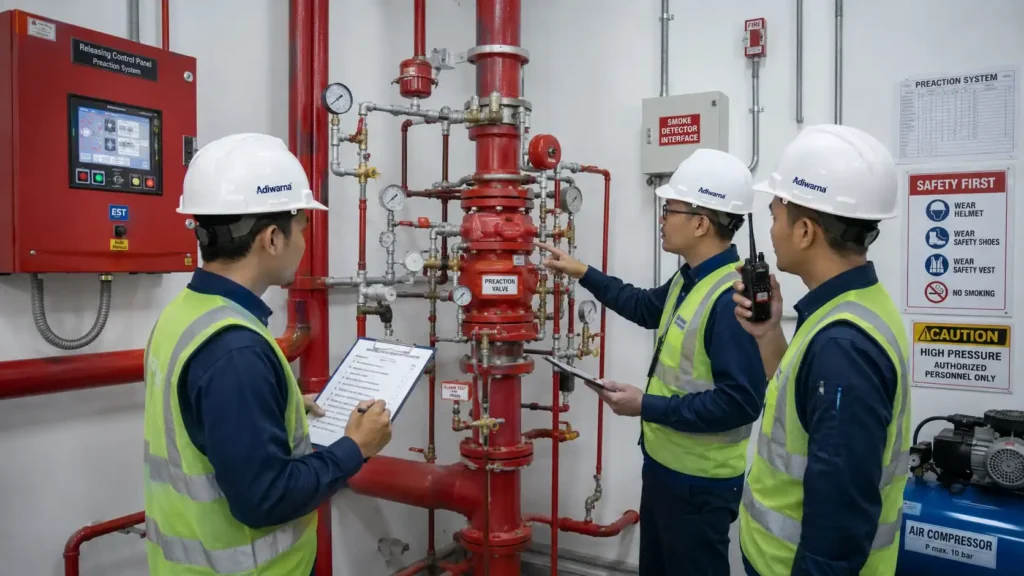
Maintenance for a preaction system must be performed regularly because it has mechanical and electrical components that depend on each other. Therefore, inspections should not only focus on valves or sprinkler heads.
Common checks include valve condition, air pressure, water pressure, supervisory switch, solenoid, detector, panel, battery, alarm, drain, and trouble status. In addition, technicians need to ensure there is no corrosion, leakage, obstruction, or room modification that affects coverage.
In critical areas, maintenance schedules must be more disciplined. Thus, potential failures can be identified before an emergency occurs.
If the system is rarely tested, facility owners may feel visually safe even though the water release function may not be ready. Therefore, preventive maintenance becomes an important part of reliability.
Common Mistakes in Preaction Projects
Many problems in preaction systems occur because design and integration are not properly planned. Therefore, small mistakes in alarm logic or valve arrangement can affect system performance.
Common mistakes to avoid include:
- Selecting a preaction type without risk analysis.
- Using an unsuitable detector layout.
- Having unclear alarm logic.
- Not fully testing the releasing panel.
- Not monitoring supervisory signals.
- Not maintaining the air compressor.
- Placing the valve room in a difficult-access location.
- Not coordinating pipe routing.
- Not updating hydraulic calculations.
- Providing insufficient maintenance access.
- Having incomplete cause-and-effect documentation.
- Performing only partial testing.
By avoiding these mistakes, the system can operate more reliably. In addition, the risk of false trips, delayed operation, and discharge failure can be reduced.
Benefits of Preaction Sprinkler for Companies
A preaction system provides major benefits for companies with sensitive assets. First, the system helps provide water-based fire protection with safer discharge control.
In addition, the system can reduce the risk of damage caused by accidental water discharge. Thus, companies can protect high-value assets without ignoring fire suppression requirements.
Furthermore, this system supports compliance, HSE audits, and insurance reviews. Therefore, design, testing, commissioning, and maintenance must be properly documented.
Finally, a preaction system can increase operational confidence in critical facilities. Therefore, investment in this system provides both safety value and business value.
Why Choose PT Adiwarna Anugerah Abadi?
PT Adiwarna Anugerah Abadi can help companies design preaction sprinkler systems as part of integrated fire protection. In addition, Adiwarna understands the needs of sensitive facilities such as data centers, server rooms, archive rooms, laboratories, clean rooms, control rooms, and industrial facilities.
With the right engineering approach, each component can be selected based on risk, standards, alarm logic, water supply, and operational needs. Therefore, the system is not only installed but also ready to be tested, maintained, and operated.
For projects that require complete integration, EPC Fire Protection Adiwarna can support engineering, procurement, construction, testing, commissioning, service, and maintenance.
If your company needs sprinkler system design, installation, testing, commissioning, service, or maintenance, consult your project requirements through the Adiwarna Contact Page.
Conclusion
Preaction sprinkler system is a suitable fire protection solution for critical areas and water-sensitive spaces. Therefore, this system is highly relevant for data centers, server rooms, archive rooms, museums, laboratories, clean rooms, and high-value industrial facilities.
However, system reliability is not determined only by the valve or sprinkler head. Instead, performance depends heavily on design, detection, alarm logic, hydraulic calculation, testing, commissioning, and maintenance.
With proper planning, a preaction system can help protect people, assets, important documents, electronic equipment, and operational continuity. Therefore, PT Adiwarna Anugerah Abadi is ready to help deliver professional, integrated, and risk-based fire protection solutions.