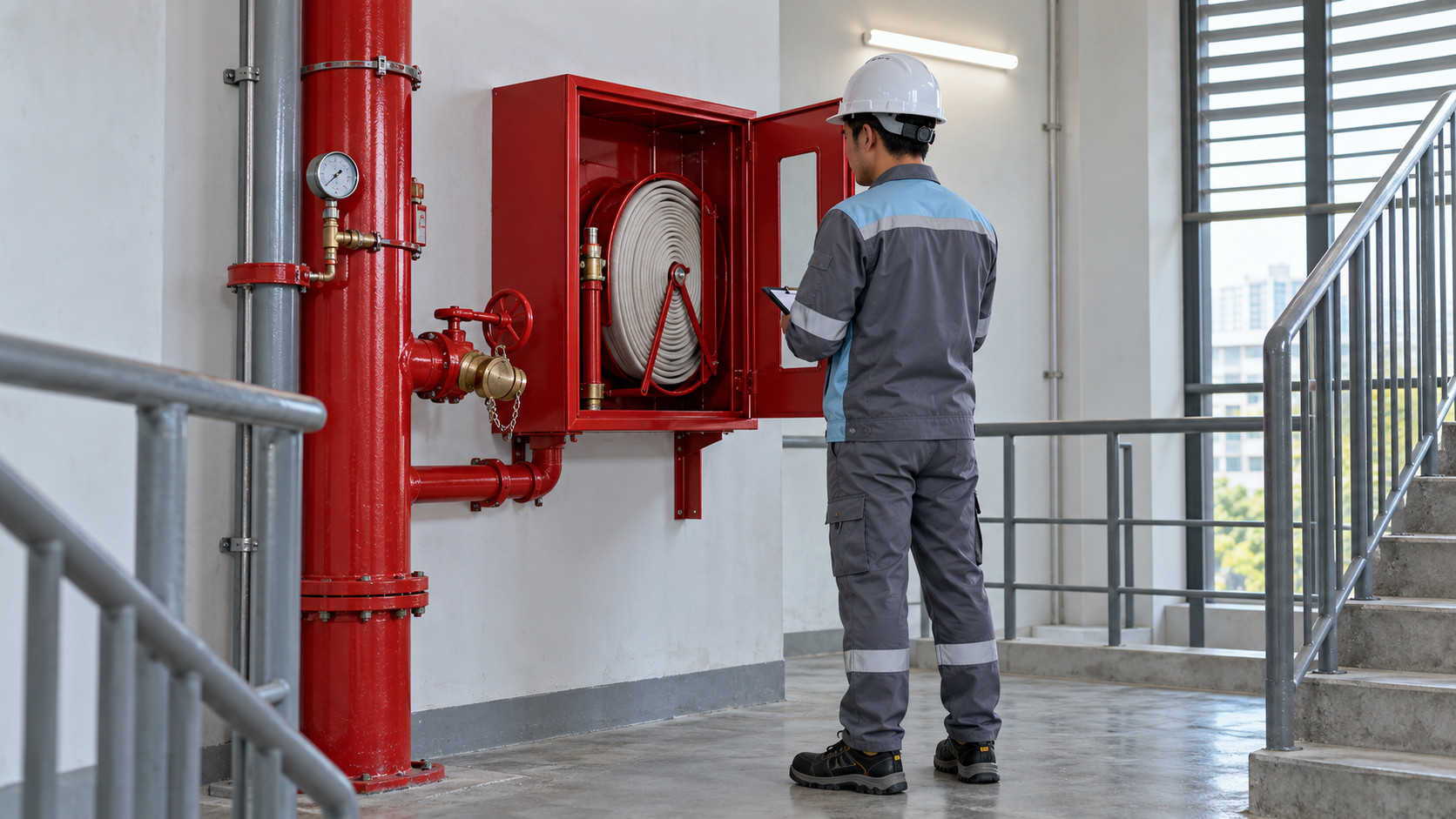

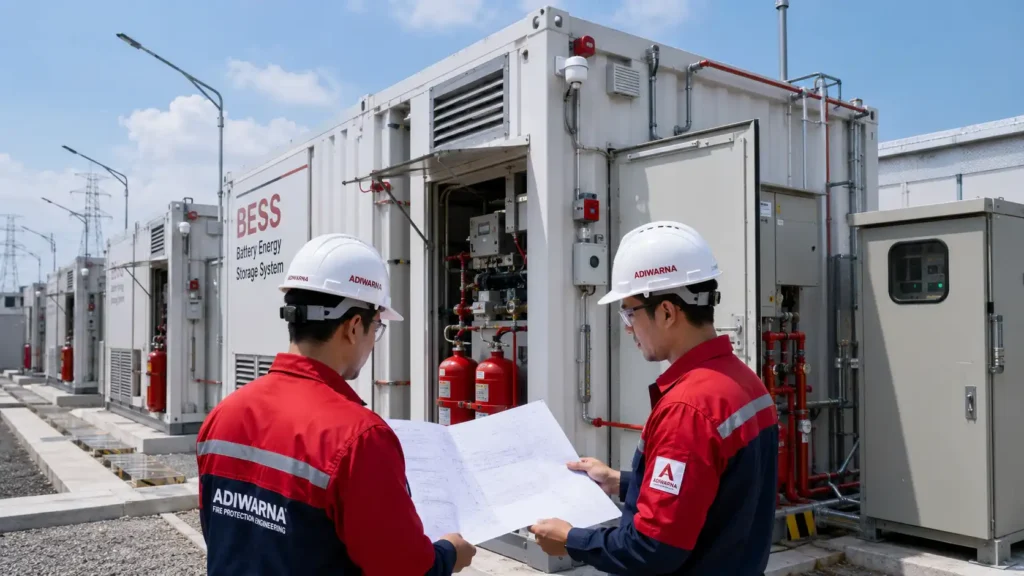
A BESS fire suppression contractor should be capable of addressing Battery Energy Storage System risks as an integrated safety challenge, rather than simply installing suppression cylinders and nozzles. BESS installations involve electrical energy, high-energy batteries, thermal runaway, gas release, cell-to-cell propagation, fire, and potential deflagration hazards.
Therefore, contractor selection should consider design and engineering capabilities, fire detection, gas monitoring, suppression, emergency shutdown, ventilation interfaces, control logic, testing, commissioning, and maintenance.
These risks are also reflected in current safety standards. NFPA 855:2026 is the current edition of the Standard for the Installation of Stationary Energy Storage Systems and establishes minimum requirements intended to mitigate hazards associated with ESS installations.
View NFPA 855 information from NFPA.
Meanwhile, UL Solutions uses UL 9540A as a test method for evaluating thermal runaway and fire propagation in Battery Energy Storage Systems.
Learn about UL 9540A from UL Solutions.
Quick Answer
A BESS fire suppression contractor is a company responsible for designing, installing, integrating, testing, commissioning, and maintaining fire protection systems for Battery Energy Storage Systems. A qualified contractor should understand thermal runaway, gas release, fire propagation, NFPA 855, UL 9540A, fire detection, suppression, emergency shutdown, ventilation, and cause-and-effect logic so that all protection layers work as one integrated system.
Why Do You Need a Specialized BESS Fire Suppression Contractor?
A BESS is different from a conventional electrical room. A single installation may contain hundreds or thousands of lithium-ion cells arranged into modules, racks, cabinets, and containers.
When one cell fails, heat may affect neighboring cells and initiate propagation. Battery failures can be associated with internal short circuits, mechanical damage, extreme temperature, improper charging, and other abnormal conditions.
Read OSHA information about lithium-ion battery safety.
Battery failure can also release combustible gases. Research from the Fire Safety Research Institute has demonstrated that gases released during lithium-ion thermal runaway can accumulate and create explosion hazards.
Read FSRI research on lithium-ion battery thermal runaway explosion hazards.
For this reason, a contractor should understand the relationship between:
- Battery Management Systems;
- smoke detection;
- heat detection;
- aspirating smoke detection;
- off-gas detection;
- fire alarms;
- emergency shutdown;
- ventilation;
- explosion mitigation;
- fire suppression;
- emergency response.
This broader capability is what differentiates a specialized BESS fire suppression contractor from a conventional fire suppression installer.
What Does a BESS Fire Suppression Contractor Do?
A BESS fire suppression contractor should ideally become involved during the engineering stage rather than only after the project owner has already selected an extinguishing agent.
A comprehensive scope may include the following stages.
1. Collect BESS Technical Data
The contractor should request information such as:
- battery chemistry;
- total energy capacity;
- cell and module configuration;
- number of racks;
- enclosure or container dimensions;
- HVAC system;
- Battery Management System;
- charging and discharging characteristics;
- facility layout;
- manufacturer documentation;
- product listings or certifications;
- UL 9540A test reports, when available.
Without this information, fire suppression decisions risk being based on assumptions.
2. Conduct a Hazard Assessment
The engineering team should evaluate potential scenarios involving:
- overheating;
- internal battery failure;
- thermal runaway;
- cell-to-cell propagation;
- module-to-module propagation;
- gas accumulation;
- smoke generation;
- fire;
- deflagration;
- exposure to neighboring equipment or containers.
The assessment helps define the objective of the fire protection system.
3. Develop a Fire Protection Philosophy
A fire protection philosophy explains how the facility will:
- detect abnormal conditions;
- provide early warning;
- initiate shutdown;
- control ventilation;
- activate suppression;
- limit propagation;
- notify operators;
- support emergency response.
This document can then serve as a foundation for the cause-and-effect matrix and detailed engineering.
A BESS Fire Suppression Contractor Must Understand Thermal Runaway
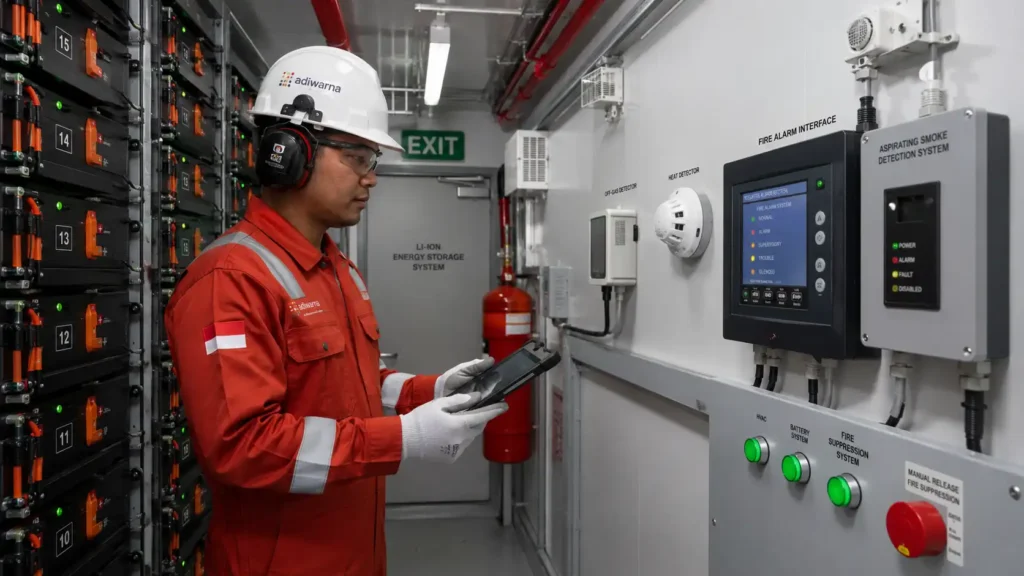
Understanding thermal runaway is one of the most important capabilities to assess when selecting a BESS fire suppression contractor.
Thermal runaway is different from an ordinary combustible-material fire. Internal reactions can continue generating heat inside a battery cell even after visible flames have been controlled.
UL 9540A is specifically designed to evaluate thermal runaway fire propagation in BESS installations. Testing can provide information on battery behavior, gas generation, propagation, heat release, and installation-level hazards.
Review the UL 9540A Test Method.
Therefore, contractors should be able to interpret fire-test reports rather than relying only on product names or extinguishing-agent categories.
BESS Fire Suppression Contractor and NFPA 855
A BESS fire suppression contractor working on a project where NFPA standards form part of the design basis should understand NFPA 855:2026.
NFPA describes the standard as providing minimum requirements for mitigating hazards associated with Energy Storage Systems.
View NFPA 855 — Standard for the Installation of Stationary Energy Storage Systems.
However, NFPA 855 should not be interpreted as requiring one universal suppression agent for every BESS project.
A contractor should consider:
- battery chemistry;
- equipment listing;
- enclosure configuration;
- installation arrangement;
- fire-testing results;
- explosion hazards;
- separation;
- fire detection;
- emergency response;
- AHJ requirements.
For additional standard and compliance information, Adiwarna can also publish or internally link to its supporting NFPA 855 BESS guide.
BESS Fire Suppression Contractor and UL 9540A
UL 9540A is not a fire suppression product. It is a test method used to evaluate thermal runaway fire propagation in energy storage systems.
UL Solutions explains that the method is referenced by fire and safety codes and standards used for ESS installations.
For contractors, a UL 9540A report can help provide information concerning:
- cell-to-cell propagation;
- module behavior;
- gas release;
- ignition potential;
- flame propagation;
- enclosure behavior;
- separation considerations;
- performance of active protection measures.
This means suppression-system selection should use actual fire-test information whenever applicable data is available.
What Systems Should a BESS Fire Suppression Contractor Integrate?
One common project mistake is treating the suppression system as separate from the rest of the BESS safety infrastructure.
A BESS fire suppression contractor should evaluate integration between multiple systems.
| System | Primary Function |
|---|---|
| Battery Management System | Monitors battery operating conditions |
| Off-gas detection | Detects early gas release |
| Smoke detection | Detects combustion products |
| Heat detection | Identifies abnormal temperature conditions |
| Fire alarm | Manages alarms and cause-and-effect actions |
| Emergency shutdown | Isolates selected equipment or energy processes |
| Ventilation | Controls air conditions according to engineering logic |
| Fire suppression | Controls identified fire scenarios |
| Monitoring system | Provides information to operators |
| Emergency response | Defines actions during an incident |
Integration should be demonstrated through functional testing rather than only appearing connected on wiring drawings.
For fire detection requirements, see Adiwarna’s Fire Alarm Systems.
How Should a BESS Fire Suppression Contractor Select an Extinguishing System?
There is no single extinguishing agent that automatically provides the best solution for every BESS installation.
The contractor should first define the protection objective, such as:
- suppressing flames;
- providing cooling;
- limiting thermal propagation;
- protecting surrounding equipment;
- limiting fire growth;
- supporting emergency-response operations.
Only after defining the objective should the suppression technology be selected.
Water-Based Systems
Water has a high capacity for absorbing heat and may play an important role in cooling and exposure protection.
Potential systems include:
- automatic sprinklers;
- water spray;
- deluge;
- water mist.
However, discharge requirements, access to the heat source, rack geometry, drainage, electrical arrangements, and fire-test information should still be evaluated.
Gaseous Fire Suppression
Clean agent and inert gas systems can suppress certain fire scenarios without leaving significant residue.
However, eliminating visible flame does not necessarily stop internal battery thermal runaway.
A well-documented BESS incident in Surprise, Arizona involved cascading thermal runaway in a 2.16 MWh lithium-ion system that eventually developed into a deflagration and seriously injured four firefighters.
Therefore, gaseous suppression should not be selected solely because it is clean or suitable for electronic equipment.
For more information about automatic suppression technology, see Adiwarna’s Fire Suppression System Equipment.
A BESS Fire Suppression Contractor Must Understand Gas and Explosion Hazards
Gas generation is one of the reasons BESS fire protection requires specialized engineering.
Research by FSRI has shown that lithium-ion batteries undergoing thermal runaway can generate combustible gases capable of creating an explosion hazard when accumulation and delayed ignition occur.
Read FSRI research on thermal runaway gas hazards.
Consequently, the engineering assessment may include:
- off-gas detectors;
- gas concentration monitoring;
- enclosure volume;
- ventilation;
- emergency exhaust;
- ignition sources;
- pressure relief;
- deflagration venting;
- shutdown;
- explosion mitigation.
A contractor should also understand that ventilation should not automatically operate under every fire or gas scenario without engineering analysis.
The cause-and-effect strategy should determine the appropriate response.
What Is Cause-and-Effect in BESS Fire Suppression?
A cause-and-effect matrix defines what each safety system should do when a specific condition is detected.
A simplified conceptual example is shown below.
| Cause | Potential Effect to Evaluate |
| BMS abnormal condition | Warning to operator |
| Off-gas detected | Alarm and preventive action |
| Smoke detected | Fire alarm activation |
| Confirmed fire | Selected shutdown actions |
| Gas reaches defined condition | Ventilation or explosion mitigation according to design |
| Suppression criteria confirmed | System release according to logic |
| System fault | Trouble notification |
This table is only illustrative.
The actual sequence should not be copied between projects because battery chemistry, BESS configuration, fire-test results, and hazard conditions may differ.
Functional testing should confirm that all programmed sequences operate as intended.
Testing and Commissioning by a BESS Fire Suppression Contractor
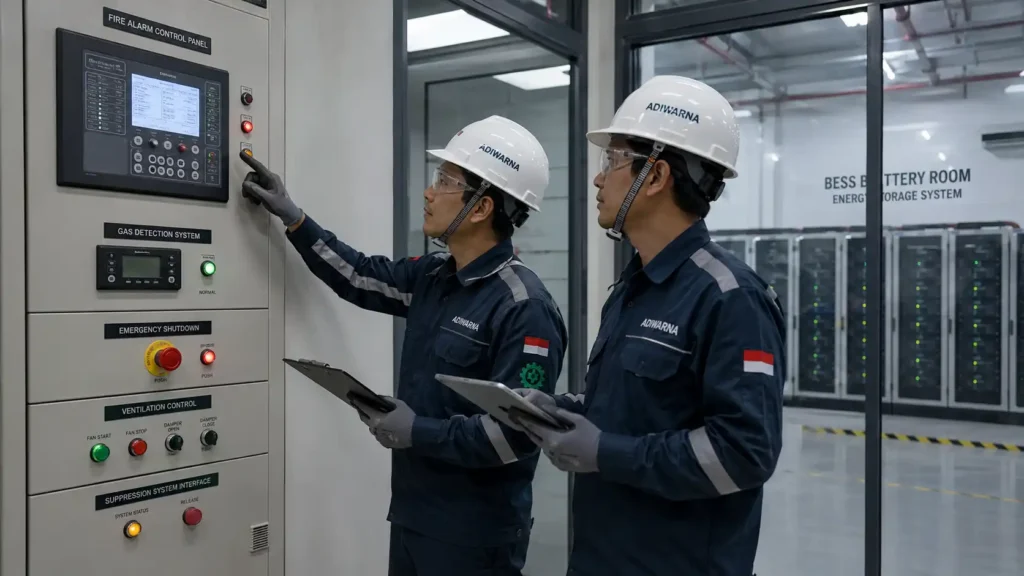
The work of a BESS fire suppression contractor is not complete when detectors, panels, piping, and suppression equipment have been installed.
Testing and commissioning are essential to confirm that the integrated system operates correctly.
Testing may include:
- detector activation;
- BMS signals;
- gas detector alarms;
- fire alarm notification;
- shutdown signals;
- HVAC interfaces;
- ventilation commands;
- suppression release sequences;
- supervisory signals;
- fault monitoring;
- remote notifications.
Each test should be documented in a commissioning report.
The owner should also receive documentation such as:
- as-built drawings;
- device lists;
- product datasheets;
- operating manuals;
- cause-and-effect matrix;
- testing records;
- maintenance schedules;
- emergency contacts.
10 Criteria for Choosing a BESS Fire Suppression Contractor
Use the following criteria when evaluating potential contractors.
1. Design and Engineering Capability
Do not select a contractor only because it can supply equipment.
The engineering team should be able to explain the technical reason for every detector, suppression method, and safety interlock.
2. Understanding of Battery Chemistry
The contractor should understand that battery chemistry and configuration influence fire and thermal runaway hazards.
3. Ability to Review UL 9540A Reports
Understanding fire-test data helps reduce the risk of engineering by assumption.
4. Knowledge of NFPA 855
When NFPA forms part of the project design basis, the contractor should be able to interpret NFPA 855 requirements within the actual project context.
5. Thermal Runaway Expertise
Ask how the contractor evaluates:
- early detection;
- propagation;
- cooling;
- gas release;
- potential reignition.
6. Fire Alarm Integration Capability
The fire alarm, detectors, BMS, shutdown system, ventilation, and suppression equipment should operate within one coordinated safety ecosystem.
7. Understanding of Explosion Hazards
The contractor should discuss off-gas and deflagration, not only smoke and flame.
8. Commissioning Capability
Confirm that functional and integrated testing will be performed instead of visual inspection alone.
9. Complete Documentation
As-built drawings, test reports, manuals, and maintenance schedules should form part of the handover package.
10. After-Sales Service
BESS fire protection systems require ongoing inspection, testing, maintenance, and technical support after commissioning.
Questions to Ask a BESS Fire Suppression Contractor
Before appointing a contractor, ask questions such as:
- Do you review UL 9540A reports before selecting fire suppression?
- How do you define the fire protection objective?
- Can thermal runaway continue after visible flame is extinguished?
- How is off-gas detection integrated?
- How does the BMS communicate with the fire alarm system?
- What happens when off-gas is detected?
- How is ventilation controlled?
- Is explosion risk assessed?
- How is the extinguishing agent selected?
- Do you perform integrated system testing?
- What documentation is provided after commissioning?
- How is preventive maintenance performed?
A contractor that cannot explain these topics clearly should be evaluated more carefully before appointment.
Common Mistakes When Choosing a BESS Fire Suppression Contractor
Choosing Only Based on the Lowest Price
The lowest initial price does not necessarily result in the lowest lifecycle cost.
An inadequate design may lead to redesign, false alarms, commissioning failures, or major installation changes.
Selecting the Extinguishing Agent First
Project owners should avoid starting with the question, “Which gas should we use?”
The first question should be:
What hazard are we trying to control?
Not Requesting Fire-Test Data
Equipment specifications alone may not indicate how a BESS behaves when thermal runaway occurs.
Ignoring Explosion Hazards
A fire suppression system that ignores gas accumulation may leave a significant BESS hazard uncontrolled.
Skipping Integrated Testing
Individual components can pass separate tests but still fail when required to operate together.
Does a BESS Fire Suppression Contractor Have to Follow NFPA 855?
The application of NFPA 855 depends on:
- project specifications;
- owner requirements;
- consultant requirements;
- insurer requirements;
- Authority Having Jurisdiction;
- applicable regulations.
NFPA 855 is not automatically an Indonesian regulation. However, it is widely used as an important technical reference for stationary ESS engineering and is currently available in the 2026 edition.
For projects in Indonesia, the engineering team should also evaluate:
- applicable national regulations;
- relevant SNI standards;
- local fire authority requirements;
- project specifications;
- equipment manufacturer requirements;
- insurer requirements;
- international standards specified by the project.
A compliance matrix can help compare these requirements systematically.
Why Consider Adiwarna as a BESS Fire Suppression Contractor?
PT Adiwarna Anugerah Abadi Tbk focuses on fire protection solutions for facilities including data centers, power plants, oil and gas operations, petrochemical facilities, and industrial environments.
For BESS projects, this type of multidisciplinary fire-protection capability is relevant because the required solution can involve fire detection, alarm, suppression, engineering, system integration, and commissioning.
Adiwarna also provides fire protection services covering engineering, implementation, testing, commissioning, and maintenance.
Learn more about Adiwarna’s capabilities through its Industrial Fire Protection Contractor page.
Project owners should still provide battery technical data, layouts, fire-test reports, and project specifications so the engineering team can evaluate an appropriate BESS protection strategy.
FAQ About BESS Fire Suppression Contractors
What Is a BESS Fire Suppression Contractor?
A BESS fire suppression contractor is a company responsible for designing, supplying, installing, integrating, testing, commissioning, and maintaining fire protection systems for Battery Energy Storage Systems.
Its expertise should cover thermal runaway, fire detection, gas monitoring, suppression, explosion hazards, and integration between BMS and fire alarm systems.
How Do I Choose a BESS Fire Suppression Contractor?
Evaluate the contractor’s engineering capability, high-risk fire protection experience, understanding of NFPA 855 and UL 9540A, ability to interpret battery data, control-system integration capability, testing and commissioning procedures, and after-sales maintenance support.
Price should not be the only selection criterion.
Should a BESS Fire Suppression Contractor Understand UL 9540A?
Yes, particularly when UL 9540A forms part of the project specification or a relevant test report is available from the BESS manufacturer.
UL 9540A evaluates thermal runaway fire propagation and provides useful information for ESS safety engineering.
Does Every BESS Use a Clean Agent?
No.
Extinguishing-system selection depends on battery chemistry, enclosure configuration, fire behavior, fire-test results, cooling requirements, propagation risk, and the intended protection objective.
Does a BESS Need Off-Gas Detection?
The requirement should be determined through hazard assessment and according to the equipment and protection strategy being used.
Off-gas detection can provide early warning of gas release during abnormal battery conditions in certain BESS configurations.
How Much Does a BESS Fire Suppression Contractor Cost?
Project cost depends on factors including:
- BESS capacity;
- number of containers;
- battery chemistry;
- detection systems;
- gas monitoring;
- suppression method;
- controller requirements;
- ventilation integration;
- shutdown interfaces;
- cabling and piping;
- testing;
- commissioning.
An accurate quotation should therefore be based on technical documentation and the project layout.
What Documents Should a BESS Fire Suppression Contractor Provide?
Typical documents may include:
- engineering drawings;
- calculations;
- product datasheets;
- device lists;
- cause-and-effect matrices;
- as-built drawings;
- testing records;
- commissioning reports;
- operating manuals;
- maintenance schedules.
The final documentation package should follow project requirements.
Consult Adiwarna for BESS Fire Suppression
Choosing a BESS fire suppression contractor requires a broader evaluation than simply comparing detector brands or extinguishing agents.
Battery chemistry, thermal runaway, propagation, off-gas release, fire detection, explosion hazards, shutdown functions, ventilation, suppression, and emergency response should be evaluated as parts of one integrated system.
PT Adiwarna Anugerah Abadi Tbk can support design and engineering, fire alarm systems, fire suppression, installation, testing and commissioning, and maintenance for facilities with specialized fire risks.
To discuss your Battery Energy Storage System project, contact the Adiwarna team and prepare the battery datasheet, BESS capacity, layout, UL 9540A report if available, and project specifications for a more focused initial assessment.
Conclusion
The right BESS fire suppression contractor does more than supply extinguishing equipment. The engineering partner should understand battery behavior, thermal runaway, fire propagation, gas release, explosion hazards, fire detection, shutdown logic, and integrated commissioning.
References such as NFPA 855:2026 and UL 9540A can provide important safety frameworks and test information for the engineering process.
By selecting a BESS fire suppression contractor based on technical capability, integration expertise, documentation, testing, and after-sales support, facility owners can develop a fire protection system that better addresses the actual risks associated with Battery Energy Storage Systems.