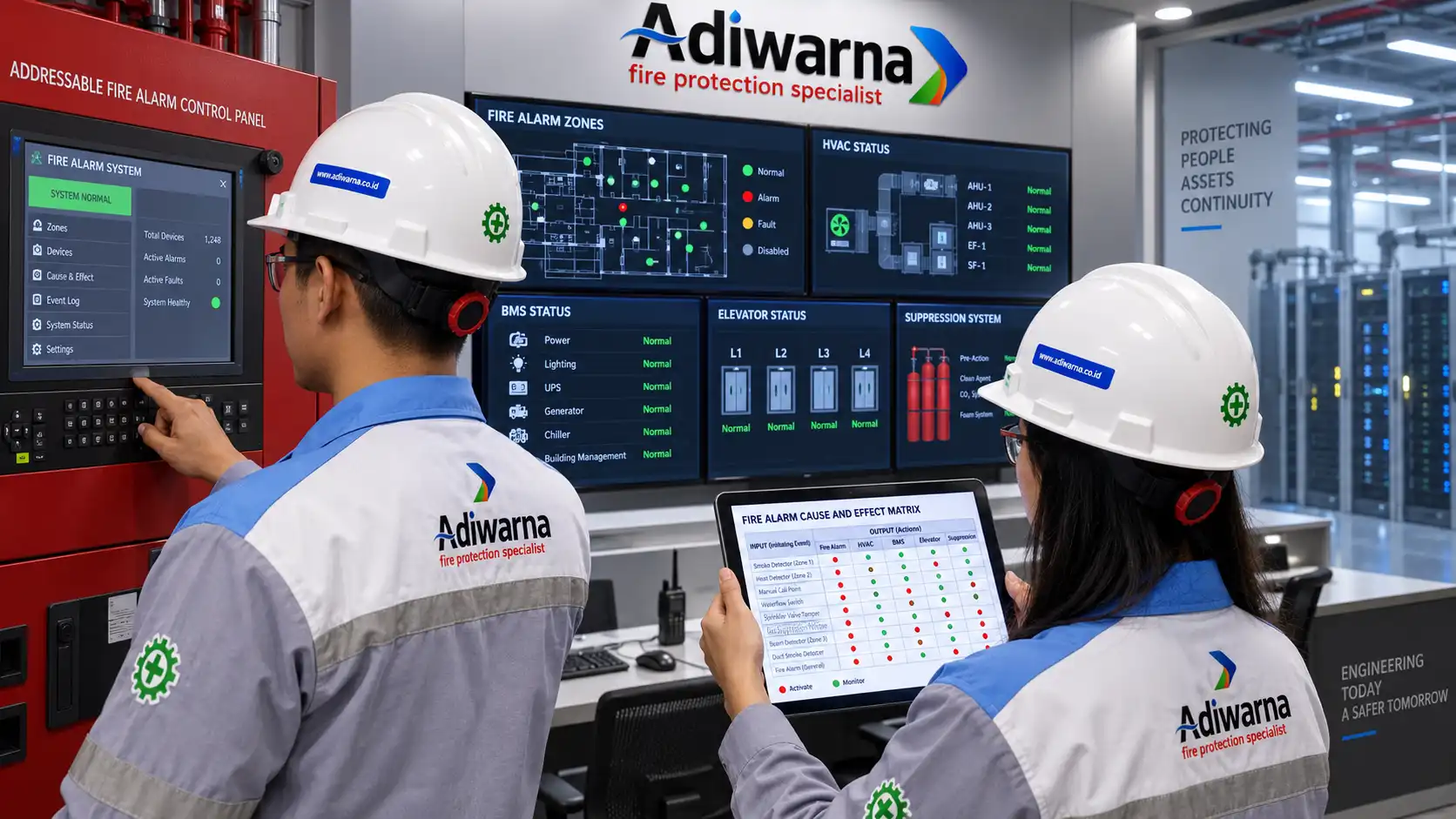

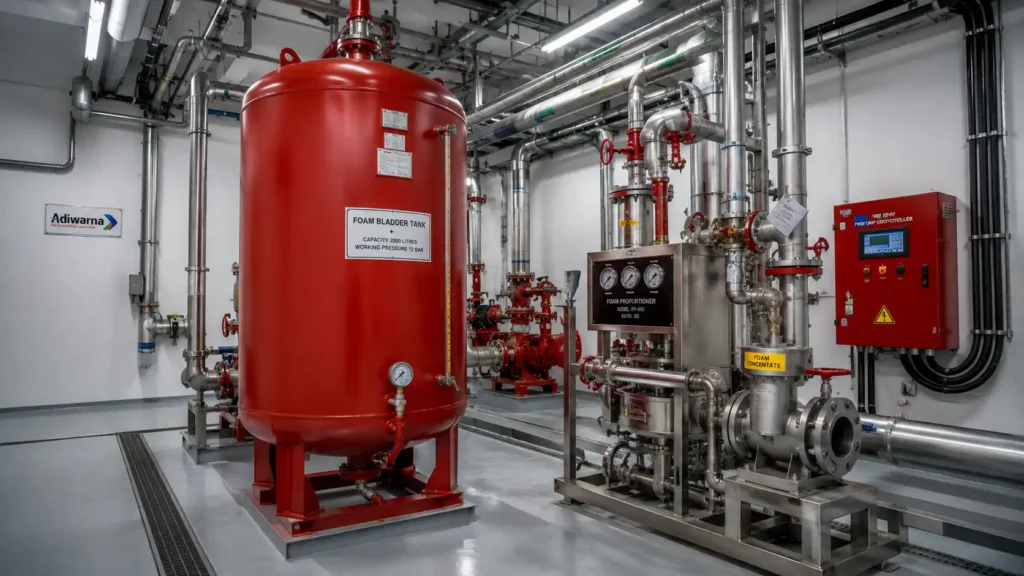
Bladder tank is an important component in a foam fire fighting system for protecting areas with flammable liquid fire risks. This system is widely used in oil and gas facilities, chemical plants, tank farms, jetties, fuel warehouses, and high-risk industrial facilities. Therefore, its selection and installation must follow a technical approach.
For Class B fires, water alone is often not enough. Flammable liquids such as gasoline, diesel, solvents, and hydrocarbons require foam to cover the fuel surface.
In addition, foam helps reduce the release of flammable vapor. As a result, the risk of re-ignition can be controlled more effectively.
PT Adiwarna Anugerah Abadi helps companies design, install, test, and maintain foam fire fighting systems. The Adiwarna team adjusts each bladder tank to risk capacity, foam concentrate demand, and facility technical standards.
Adiwarna bladder tank service
Why Bladder Tank Is Important in a Foam System
Bladder tank stores foam concentrate and supports proportional mixing between foam and water. This system works with a proportioner so the foam concentration follows the design requirement.
First, water from the fire water system enters and applies pressure to the bladder. Second, that pressure pushes foam concentrate toward the proportioner. After that, foam concentrate mixes with water and forms foam solution.
As a result, the system can produce a stable foam mixture. This mixture then flows to the foam chamber, foam monitor, foam-water sprinkler, or other discharge devices.
However, system performance depends heavily on design. Tank capacity, foam type, mixing ratio, water pressure, and piping route must be calculated correctly.
NFPA 11 Standard for Low-, Medium-, and High-Expansion Foam
How Bladder Tank Works in a Foam Fire Suppression System
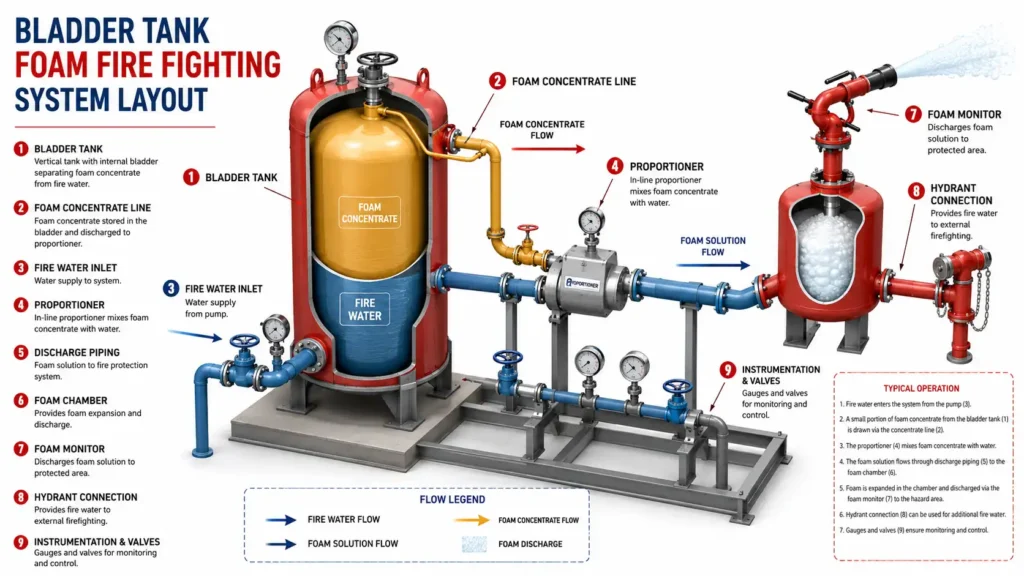
Bladder tank works through the balanced pressure proportioning principle. Inside the tank, an elastomeric bladder stores the foam concentrate.
When the system activates, pressurized water enters the area outside the bladder. This water pressure compresses the bladder and pushes foam concentrate out.
Then, the foam concentrate enters the proportioner. The proportioner controls the amount of foam concentrate according to the design ratio, such as 1%, 3%, or 6%.
After mixing with water, the foam solution flows to the discharge device. This device can be a foam chamber, foam maker, monitor, or special nozzle.
In addition, the system must maintain stable pressure. If pressure is not suitable, foam concentration can change and suppression performance can decrease.
Areas Suitable for Bladder Tank Systems
Not every facility needs a foam system. Therefore, engineers must review the material type, fire scenario, and suppression requirements.
Common areas using bladder tank systems include:
- Oil storage tanks.
- Fuel tank farms.
- Loading and unloading areas.
- Jetties or marine terminals.
- Chemical warehouses.
- Power plant fuel areas.
- Hangars.
- Petrochemical facilities.
- Pump stations.
- Diesel tank areas.
- Process areas with flammable liquids.
- Industrial facilities with Class B fire risks.
In addition, this system suits facilities that need automatic and consistent foam application. It also supports faster response when fire starts to develop.
Adiwarna foam system article
Main Components in a Bladder Tank System
A bladder tank system does not work alone. It requires supporting components so foam can perform according to the design.
Common components include:
- Foam concentrate.
- Vertical or horizontal bladder tank.
- Internal bladder.
- Foam proportioner.
- Water inlet valve.
- Foam concentrate outlet.
- Pressure gauge.
- Drain valve.
- Vent valve.
- Check valve.
- Isolation valve.
- Foam chamber.
- Foam monitor.
- Fire water piping.
- Test connection.
- Control valve.
- Fire pump.
- Water tank.
In addition, each component must be compatible with the foam type. Seal, valve, bladder, and piping materials must match the characteristics of the foam concentrate.
Bladder Tank for Oil & Gas and Tank Farms
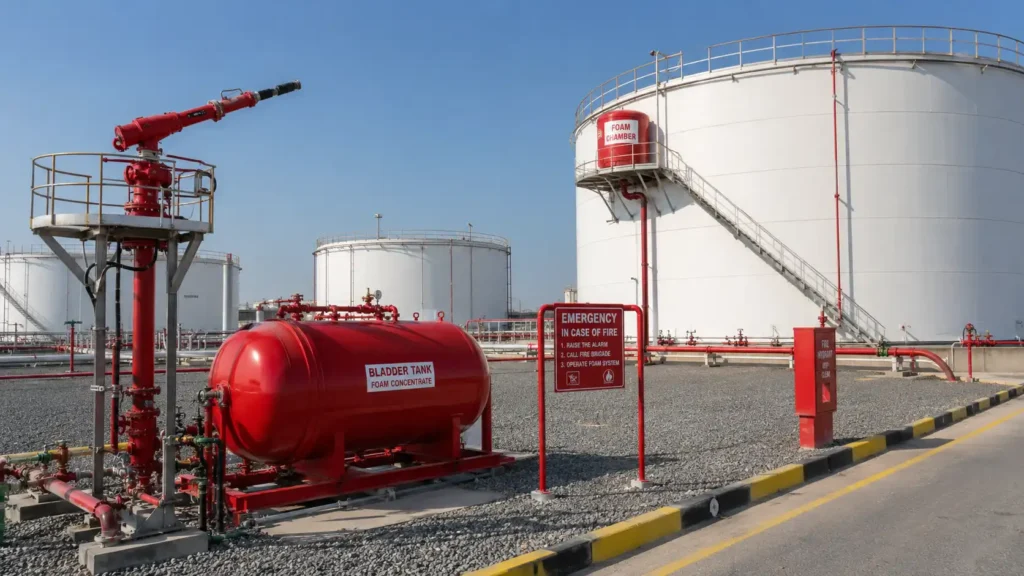
Bladder tank is highly important in oil and gas facilities and tank farms because these areas have flammable liquid fire risks. Storage tanks, bundwalls, loading areas, and pump areas require foam systems that are ready to operate quickly.
For storage tanks, foam chambers can deliver foam onto the liquid surface. Foam then forms a blanket that covers the fuel surface.
In addition, fire monitors can protect open areas. Monitors help direct foam solution to the fire point within a specific reach distance.
However, the design must consider the worst-case scenario. Engineers must calculate the protected area, application duration, flow rate, and foam concentrate demand.
Adiwarna oil and gas fire protection system
Bladder Tank for Chemical Plants and Fuel Warehouses
Bladder tank is also relevant for chemical plants and fuel warehouses. These areas often store solvents, alcohol, resin, thinner, or other flammable liquids.
However, the foam type must be selected correctly. Some polar solvent liquids require special foam that resists breakdown.
In addition, storage layout must be considered. Drum spacing, spill containment, ventilation, and firefighting access can affect the protection strategy.
Therefore, foam systems must not be designed generically. Each area must be analyzed based on material safety data sheets, storage volume, and spill potential.
Difference Between Bladder Tank, Foam Pump, and Foam Dosing System
Many facilities compare bladder tank with foam pumps or foam dosing systems. All three can inject foam concentrate into the fire water line.
A bladder tank does not require a dedicated foam pump. The system uses water pressure to compress the bladder and push foam concentrate.
Meanwhile, a foam pump uses a pump to transfer concentrate. This system can suit large-capacity needs or specific configurations.
In addition, a foam dosing system can use more complex control technology. This system is often used for applications that need precise adjustment and advanced monitoring.
However, bladder tank remains popular because the design is simple, reliable, and easy for facility teams to understand.
Technical Standards for Bladder Tank Systems
Bladder tank must be designed according to relevant technical standards. Standards help ensure the system is safe, effective, and testable.
Common references include:
- NFPA 11 for foam systems.
- NFPA 16 for foam-water sprinkler and foam-water spray systems.
- NFPA 20 for fire pumps.
- NFPA 24 for private fire service mains.
- NFPA 30 for flammable and combustible liquids.
- Relevant SNI fire protection requirements.
- Company HSE requirements.
- Insurance and safety audit requirements.
- Manufacturer design manuals.
However, standards must be applied according to site conditions. Engineers must evaluate hazards, material type, flow requirement, application duration, and firefighting access.
NFPA 30 Flammable and Combustible Liquids Code
Foam Concentrate Types to Consider
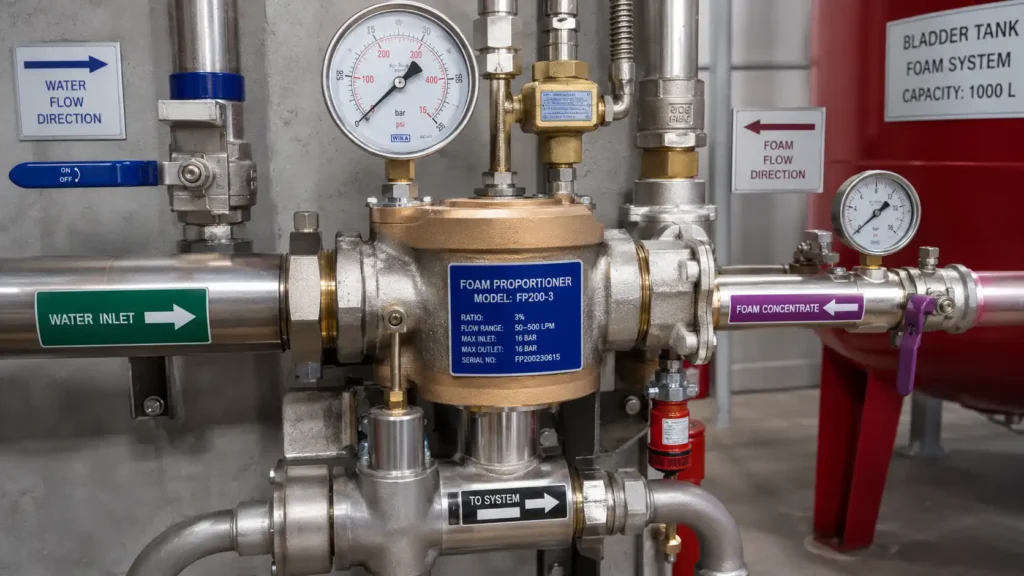
Foam concentrate selection determines system performance. The wrong foam can reduce suppression effectiveness.
Common foam types include:
- AFFF.
- AR-AFFF.
- Fluorine-free foam.
- Protein foam.
- Fluoroprotein foam.
- High-expansion foam.
In addition, global trends now encourage more environmentally responsible foam selection. Some facilities have started evaluating fluorine-free foam alternatives to reduce environmental risk.
However, foam replacement must not be done carelessly. Engineers must check foam compatibility with the bladder, proportioner, discharge device, and fire scenario.
EPA PFAS and firefighting foam information
Planning Stages for a Bladder Tank System
System planning must follow clear stages. These stages help ensure the system matches facility risks.
1. Risk Area Survey
First, the team surveys the protected area. They inspect storage tanks, loading areas, pump areas, piping, and firefighting access.
In addition, the team reviews the fire water system condition. Water pressure and flow greatly affect foam system performance.
2. Flammable Material Identification
Next, engineers review the stored material type. This data can come from MSDS, tank capacity, and operating conditions.
Therefore, foam selection becomes more accurate. Hydrocarbon liquids and polar solvents may require different foam types.
3. Foam Requirement Calculation
After that, engineers calculate the required foam solution. The calculation covers application rate, protected area, suppression duration, and foam concentration.
Then, engineers determine the bladder tank capacity. The capacity must be sufficient for the design scenario and reserve needs.
4. Piping and Proportioner Design
Next, the team designs the piping route and proportioner. The piping must deliver foam solution at the required pressure.
In addition, valves must be easy to access. Maintenance teams need to inspect, flush, test, and repair the system safely.
5. Installation and Commissioning
After the final design, the team installs the tank, valves, proportioner, piping, and discharge devices. Installation must be neat, safe, and aligned with specifications.
Next, the team performs commissioning. Testing may include pressure testing, functional testing, foam concentration testing, and flow verification.
Adiwarna EPC fire protection service
Common Mistakes in Bladder Tank Projects
Many problems occur because of poor design or maintenance. Small errors can greatly affect foam system performance.
Common mistakes to avoid include:
- Choosing the wrong foam type.
- Miscalculating tank capacity.
- Not checking the proportioning ratio.
- Not checking fire water pressure.
- Not providing a test connection.
- Not inspecting the bladder periodically.
- Placing valves in hard-to-access locations.
- Designing piping without flushing support.
- Not preparing as-built drawings.
- Not performing foam concentration testing.
In addition, material changes are often ignored. Yet, changes in fuel or chemical type can change foam requirements.
Bladder Tank Maintenance Requirements
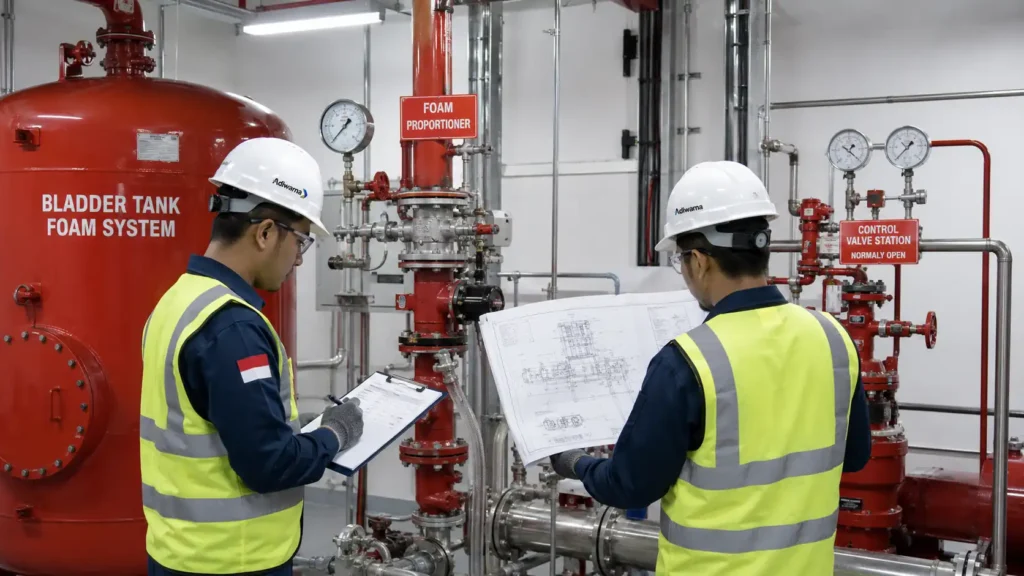
Bladder tank maintenance must be performed regularly. The goal is to keep the system ready during emergencies.
General inspections include:
- Tank physical condition.
- System pressure.
- Pressure gauge condition.
- Valve condition.
- Foam concentrate condition.
- Potential bladder leakage.
- Pipe and fitting condition.
- Access to discharge devices.
- Tank area cleanliness.
- Inspection document completeness.
In addition, teams need to check foam concentrate shelf life. Foam with reduced quality can weaken fire suppression performance.
Benefits of Using a Professional Bladder Tank System
Using a professionally designed bladder tank provides many benefits. These benefits are important for facilities with Class B fire risks.
Key benefits include:
- Foam concentrate is stored more safely.
- Proportioning becomes more stable.
- The system is simpler.
- Fire response becomes faster.
- Suitable for flammable liquid areas.
- Maintenance becomes easier.
- Testing becomes more measurable.
- Documentation becomes more complete.
- Safety audit readiness improves.
In addition, a good system helps companies maintain business continuity. Downtime risk and asset loss can be reduced more effectively.
Why Choose PT Adiwarna Anugerah Abadi?
PT Adiwarna Anugerah Abadi helps clients select and implement bladder tank systems based on facility needs. The Adiwarna team understands oil and gas facilities, tank farms, chemical plants, warehouses, power plants, and high-risk industrial sites.
In addition, Adiwarna can support projects from consultation to maintenance. This approach helps clients get a safer and more integrated foam system.
Adiwarna’s key advantages include:
- Experienced technical team.
- Facility risk analysis.
- Proper foam concentrate selection.
- Bladder tank capacity calculation.
- Proportioner and piping design.
- Fire water system integration.
- Measurable testing and commissioning.
- Complete project documentation.
- Inspection and maintenance support.
With this approach, facilities become more prepared for Class B fires. In addition, the system becomes easier for internal teams to manage.
Adiwarna fire protection products
Tips Before Choosing a Bladder Tank
Before selecting the system, prepare facility technical data. This data helps engineers create a more accurate design.
Prepare the following information:
- Protected area layout.
- Flammable material type.
- Tank capacity or storage volume.
- Material MSDS.
- Fire water pump data.
- Available water pressure and flow.
- Foam application area.
- Discharge device type.
- Target standard or audit.
- Facility operating schedule.
- Existing system condition.
- Long-term maintenance needs.
In addition, involve HSE, facility, operations, engineering, and maintenance teams from the beginning. They understand daily risks and technical limitations in the field.
Conclusion: Bladder Tank Determines Foam System Reliability
Bladder tank determines the reliability of a foam fire fighting system in facilities with flammable liquid fire risks. A good system must be designed, installed, tested, and maintained professionally.
However, every facility has different risks. Therefore, design must be based on hazards, material type, area capacity, technical standards, and operational needs.
In conclusion, PT Adiwarna Anugerah Abadi is ready to help your business choose the right bladder tank. Consult your foam system, fire water network, hydrant, fire pump, foam chamber, foam monitor, installation, testing, and maintenance needs with Adiwarna’s specialist team.
Contact Adiwarna for bladder tank consultation