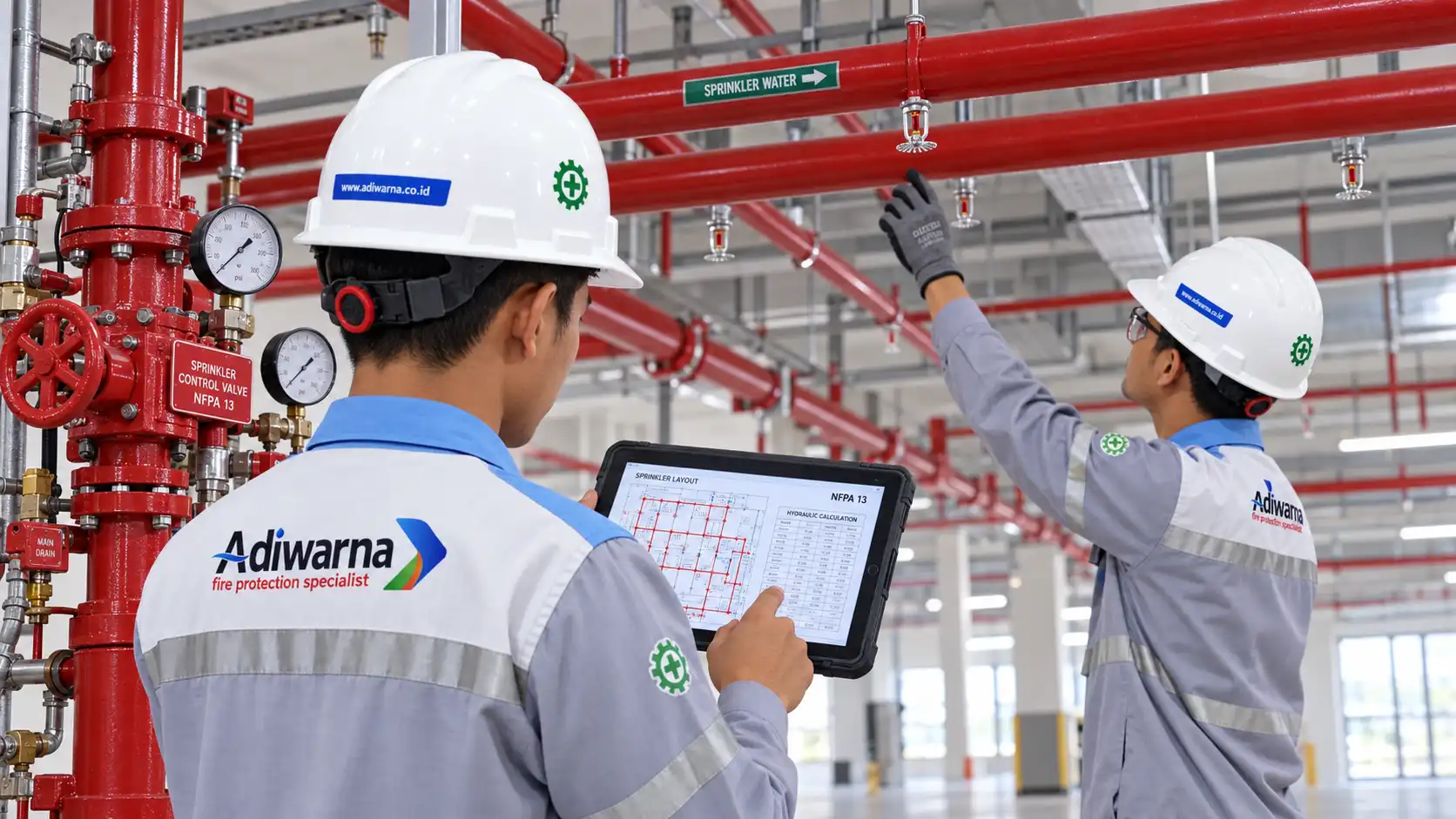

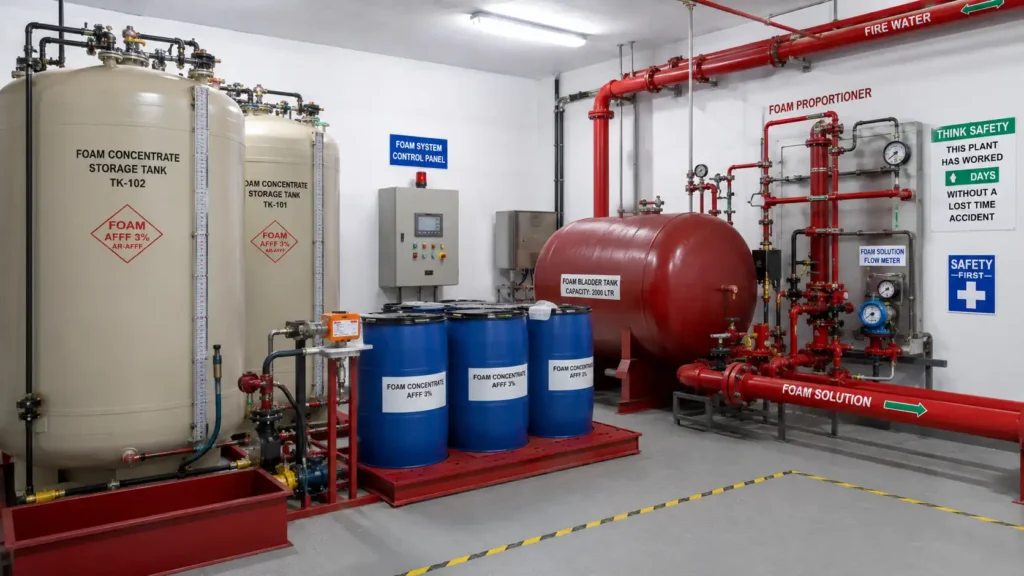
Foam concentrate is a concentrated liquid mixed with water at a specified ratio to produce a foam solution for firefighting applications. After the solution is discharged through a foam monitor, foam chamber, sprinkler, or nozzle, it mixes with air to create finished foam that can cover the fuel surface.
This extinguishing medium is widely used to protect tank farms, refineries, fuel terminals, loading racks, aircraft hangars, petrochemical plants, chemical facilities, marine terminals, and oil and gas facilities exposed to flammable-liquid fire hazards.
Unlike water alone, firefighting foam can form a blanket over the fuel surface. This layer helps suppress flammable vapors, separate the fuel from oxygen, reduce heat transfer, and limit the possibility of reignition.
However, every concentrate has different operating characteristics, mixing ratios, fuel compatibility, and application requirements. Therefore, it should not be selected only according to price or a general product description such as AFFF.
PT Adiwarna Anugerah Abadi provides various foam concentrate products for industrial, marine, mining, municipal, petrochemical, aviation, and transportation applications. The available portfolio includes Class A foam, Class B foam, high-expansion concentrate, protein foam, wetting agents, and non-fluorinated foam products.
What Is Foam Concentrate?
Foam concentrate is a formulated liquid designed to be mixed with water at a specified concentration, commonly 1%, 3%, or 6%.
The mixture of water and concentrate is known as foam solution. After that solution is aerated through a suitable discharge device, the resulting product is called finished foam.
The general foam-generation process includes:
- A fire pump supplies water from the fire water tank.
- Water flows through a foam proportioner or ratio controller.
- Foam concentrate is introduced into the water stream at the specified percentage.
- The water and concentrate form a foam solution.
- The solution travels through the distribution piping.
- A monitor, chamber, sprinkler, nozzle, or generator introduces air.
- Finished foam is applied to the fuel surface or protected area.
In an integrated foam fire fighting system, the concentrate must operate together with the bladder tank or foam pump, proportioning device, distribution piping, discharge equipment, fire alarm system, and control equipment.
How Does Foam Concentrate Extinguish Fire?

Finished foam does more than wet the burning material. It creates a continuous or semi-continuous layer over the surface of a flammable liquid.
This foam blanket can help:
- Separate the fuel surface from oxygen.
- Suppress the release of combustible vapors.
- Reduce heat transfer.
- Limit the spread of burning liquid.
- Control a flammable-liquid spill.
- Reduce the risk of flashback or reignition.
For this reason, foam systems are commonly used for Class B fires involving gasoline, diesel, aviation fuel, crude oil, solvents, alcohols, and selected process liquids.
Adiwarna’s overview of foam systems for flammable-liquid fires explains why foam provides protection that water alone may not deliver effectively for these hazards.
Difference Between Foam Concentrate, Foam Solution, and Finished Foam
The terms concentrate, solution, and finished foam are sometimes used interchangeably, although they represent different stages of the foam-production process.
| Term | Explanation |
|---|---|
| Foam concentrate | Concentrated liquid before it is mixed with water |
| Foam solution | Mixture of water and concentrate at the specified ratio |
| Finished foam | Aerated foam solution discharged from the application device |
| Foam blanket | Layer of finished foam covering the fuel surface |
| Proportioning ratio | Percentage of concentrate contained in the foam solution |
For example, a 3% concentrate is intended to be introduced into the water stream at the concentration established by the manufacturer.
The proportioning system must maintain that concentration throughout its approved operating flow range.
If the concentration is too low, the finished foam may not provide the required extinguishing or vapor-suppression performance. If the concentration is too high, the concentrate may be consumed unnecessarily and the available discharge duration may be reduced.
Types of Foam Concentrate
Foam selection should be based on the protected fuel, application method, environmental conditions, technical standards, and compatibility with the installed equipment.
1. AFFF Foam Concentrate
Aqueous Film Forming Foam, commonly known as AFFF, has traditionally been used for hydrocarbon fuel fires involving materials such as:
- Gasoline.
- Diesel fuel.
- Kerosene.
- Aviation fuel.
- Crude oil.
- Selected hydrocarbon solvents.
AFFF is designed to create a foam blanket and a thin aqueous film that helps suppress fuel vapors. It has therefore been widely used in tank farms, fuel terminals, loading areas, refineries, and oil and gas facilities.
More information about this application is available in Adiwarna’s article on AFFF foam for liquid-fuel fire protection.
2. AR-AFFF Foam Concentrate
Alcohol-Resistant AFFF is designed for polar solvents that can break down ordinary foam blankets.
Liquids that may require alcohol-resistant foam include:
- Ethanol.
- Methanol.
- Isopropyl alcohol.
- Acetone.
- Selected ketones.
- Polar solvents.
- Fuels blended with alcohol.
AR-AFFF creates a protective polymeric layer between the fuel and the foam blanket. This layer helps reduce foam destruction caused by water-miscible liquids.
Some AR-AFFF products have dual ratings such as 3×3 or 3×6. These numbers indicate the concentration required for different fuel groups according to the manufacturer’s approved application data.
3. Fluorine-Free Foam
Fluorine-free foam is formulated without intentionally added fluorochemicals. Depending on the manufacturer and certification system, it may be described as F3, SFFF, or non-fluorinated foam.
Adiwarna offers products such as CHEMGUARD NFF 3×3 UL201, a non-fluorinated concentrate intended for hydrocarbon and polar-solvent applications at a nominal 3% concentration.
The transition to a fluorine-free concentrate should consider:
- Fuel compatibility.
- Required application density.
- Expansion ratio.
- Drainage time.
- Burnback resistance.
- Proportioning range.
- Discharge-device compatibility.
- Concentrate viscosity.
- System cleaning and decontamination.
- System approval and listing.
A new concentrate should not be placed into an existing system without an engineering and compatibility review.
4. Protein Foam
Protein foam is formulated using protein-based materials that can produce a stable foam blanket with good heat resistance.
It has historically been used for hydrocarbon fires and selected industrial applications. However, its expansion characteristics, application rates, and equipment requirements differ from those of synthetic foam products.
5. Fluoroprotein Foam
Fluoroprotein foam combines a protein base with fluorochemical additives to improve spreading capability and resistance to fuel contamination.
Its use should be reviewed against applicable environmental requirements and regulations concerning fluorinated substances.
6. High-Expansion Foam Concentrate
High-expansion foam can produce a very large volume of finished foam from a relatively small quantity of foam solution.
Potential applications include:
- Aircraft hangars.
- Warehouses.
- Ship engine rooms.
- Cargo holds.
- Cable tunnels.
- Large enclosed industrial spaces.
The system requires high-expansion generators and sufficient airflow to fill the protected enclosure effectively.
7. Class A Foam
Class A foam is intended for ordinary combustible materials such as:
- Wood.
- Paper.
- Textiles.
- Vegetation.
- Selected porous materials.
It helps water penetrate the material and improves wetting performance. Its application is different from Class B foam used for flammable-liquid hazards.
8. Wetting Agents
A wetting agent reduces the surface tension of water, improving its ability to spread and penetrate selected materials.
Although it can enhance water application, a wetting agent does not necessarily create the same vapor-sealing foam blanket produced by a Class B foam concentrate.
Foam Concentrate Ratios: 1%, 3%, and 6%
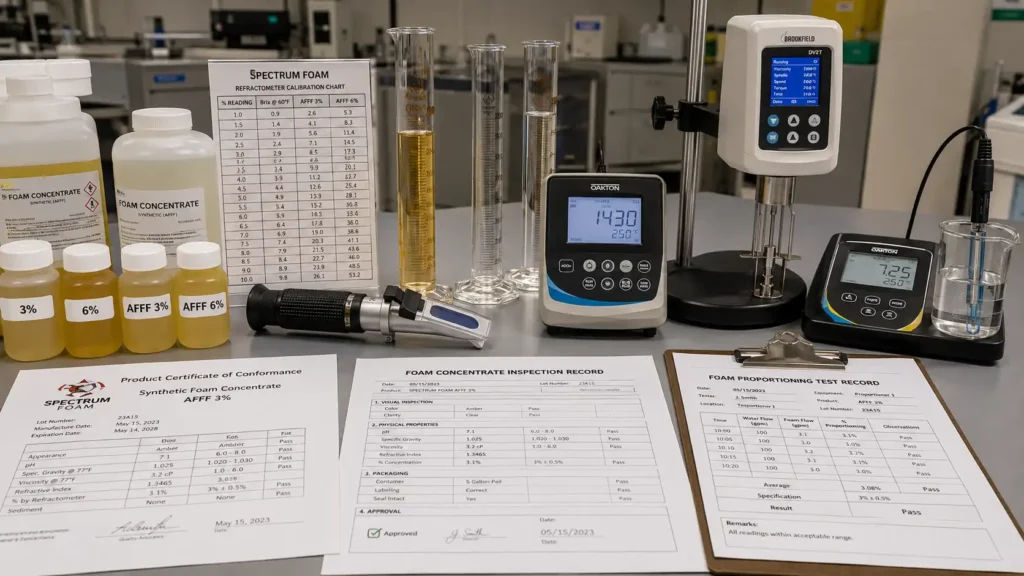
The percentage shown on the product label represents the nominal quantity of concentrate required in the foam solution.
1% Foam Concentrate
A 1% concentrate requires less stored concentrate to produce the same total volume of foam solution.
Potential advantages include:
- Smaller concentrate storage requirements.
- Lower stored concentrate weight.
- Reduced concentrate consumption per unit of foam solution.
However, the proportioning equipment must be specifically suitable for accurate operation at 1%.
3% Foam Concentrate
A 3% ratio is widely used in fixed industrial systems and mobile firefighting equipment.
Conceptually, producing 1,000 liters of foam solution requires approximately 30 liters of concentrate and 970 liters of water.
The actual permissible concentration range must follow the manufacturer’s instructions, relevant approvals, and the applicable testing procedure.
6% Foam Concentrate
A 6% concentrate requires twice as much stored concentrate as a 3% product to produce the same quantity of foam solution.
Many older systems may still use 6% concentrate. However, changing to a different ratio requires an assessment of the proportioner, bladder tank, storage capacity, concentrate piping, and required discharge duration.
Foam Concentrate for Hydrocarbon Fuels and Polar Solvents
Fuel classification is one of the most important factors in foam selection.
Hydrocarbon Fuels
Hydrocarbon fuels generally do not mix with water.
Examples include:
- Crude oil.
- Gasoline.
- Diesel.
- Kerosene.
- Aviation fuel.
- Mineral oil.
- Hydrocarbon solvents.
AFFF, approved fluorine-free synthetic foam, protein foam, or another suitable concentrate may be used when the product is tested and approved for the fuel and application equipment.
Polar Solvents
Polar solvents can mix with water and may rapidly destroy ordinary foam blankets.
Examples include:
- Alcohols.
- Ketones.
- Selected esters.
- Acetone.
- Methanol.
- Ethanol.
These hazards generally require an alcohol-resistant concentrate tested for the specific fuel or fuel group.
The product should not be selected only because it is marketed as “chemical foam.” The facility’s safety data sheets and stored-material inventory should be reviewed to determine the actual fire hazard.
Relationship Between Foam Concentrate and a Foam Proportioner
A foam proportioner controls the quantity of concentrate introduced into the flowing water.
Common proportioning systems include:
- Bladder tank and ratio controller.
- Balanced-pressure proportioning.
- In-line balanced-pressure proportioning.
- Around-the-pump proportioning.
- In-line eductors.
- Direct injection systems.
The concentrate and proportioning equipment must be compatible. Important operating factors include:
- Concentrate viscosity.
- Water flow rate.
- Water pressure.
- Concentrate pressure.
- Temperature.
- Minimum system flow.
- Maximum system flow.
- Downstream back pressure.
- Metering-orifice size.
- Strainer condition.
Because a different concentrate may have different physical characteristics, every product change should be followed by a proportioning test.
Adiwarna’s foam solutions can integrate the concentrate with an appropriately selected foam proportioner system.
Relationship Between Foam Concentrate and a Bladder Tank
A bladder tank is a pressure vessel containing an elastomeric bladder filled with foam concentrate.
When the system operates, pressurized water enters the space surrounding the bladder. The water compresses the bladder and pushes the concentrate toward the ratio controller.
The functions can be summarized as follows:
- The bladder tank stores and transfers concentrate.
- The proportioner controls the mixing ratio.
- The fire pump supplies water.
- The discharge device aerates and applies the finished foam.
Adiwarna’s article about the bladder tank as a critical foam-system component explains this operating principle in greater detail.
Bladder tank sizing should consider:
- Total foam-solution demand.
- Required concentration.
- Discharge duration.
- Simultaneously operating zones.
- Residual concentrate.
- Design safety allowance.
- Refilling strategy.
Foam Concentrate for Tank Farm Protection

Tank farms are among the most common applications for fixed foam fire protection systems.
Foam solution may be distributed through:
- Foam chambers.
- Foam pourers.
- Fixed foam monitors.
- Mobile foam monitors.
- Foam-water sprinklers.
- Bund or dike discharge devices.
A foam chamber introduces finished foam relatively gently onto the liquid surface inside a fixed-roof storage tank. This reduces the risk of plunging the foam directly into the fuel.
Tank farm engineering should consider:
- Storage-tank diameter.
- Fuel surface area.
- Tank construction.
- Stored fuel.
- Application density.
- Required discharge duration.
- Number of foam chambers.
- Simultaneous cooling-water demand.
- Dike or bund protection.
- Available water supply.
- Concentrate storage capacity.
- Wind exposure.
A complete industrial foam fire fighting system can integrate the concentrate, proportioning system, foam chambers, monitors, deluge valves, fire pumps, and control equipment.
Foam Concentrate for Loading Racks
Loading racks may be exposed to fuel spills, hose failure, coupling damage, vehicle-related ignition, and process leaks.
Protection may use:
- Foam-water deluge systems.
- Fixed foam monitors.
- Foam sprinklers.
- Portable foam equipment.
- Spill-area nozzles.
- Hydrants with mobile foam equipment.
The concentrate must be compatible with both the handled fuel and the selected discharge method.
Flame detectors and gas detectors can also be integrated with the deluge valve, proportioning system, alarm equipment, and emergency shutdown system.
Foam Concentrate for Aircraft Hangars
Aircraft hangars contain wide open floor areas and may be exposed to aviation-fuel spill hazards.
Possible foam protection methods include:
- Low-expansion foam.
- High-expansion foam.
- Foam-water sprinklers.
- Fixed monitors.
- Deluge nozzles.
- Mobile response equipment.
Selection should consider:
- Aircraft type.
- Fuel load.
- Floor area.
- Drainage.
- Ventilation.
- Environmental restrictions.
- Activation strategy.
- Personnel evacuation.
- Required discharge duration.
The concentrate, generator, nozzle, sprinkler, and proportioner should be evaluated as one complete system.
Foam Concentrate Storage
Foam concentrate should be stored within the temperature range and conditions specified by the manufacturer.
Poor storage can affect:
- Viscosity.
- Product homogeneity.
- pH.
- Proportioning performance.
- Expansion ratio.
- Drainage time.
- Foam stability.
- Fire performance.
Good storage practices include:
- Using a compatible storage tank.
- Keeping the storage system closed.
- Preventing water or product contamination.
- Monitoring storage temperature.
- Clearly marking the product and batch.
- Recording the filling date.
- Keeping valves in their normal positions.
- Protecting the tank from corrosion.
- Providing secondary containment where required.
- Maintaining the safety data sheet and product certificates.
Different concentrates should not be mixed in the same tank without written manufacturer approval and a formal compatibility assessment.
Shelf Life and Quality Inspection
Foam concentrate can have a long shelf life when stored correctly. However, visual appearance alone is not sufficient to confirm that the product remains suitable for service.
Quality testing may evaluate:
- Appearance.
- Odor.
- Sediment.
- Separation.
- pH.
- Specific gravity.
- Viscosity.
- Expansion ratio.
- Drainage time.
- Proportioning performance.
- Fire performance where required.
The testing frequency and method should follow the manufacturer’s recommendations, applicable standards, facility procedures, and regulatory requirements.
Samples should be collected using a representative and contamination-free procedure.
Foam Proportioning Test
A proportioning test confirms that the correct amount of concentrate is being introduced into the water stream.
Possible testing methods include:
- Refractive-index measurement.
- Conductivity measurement.
- Flow measurement.
- Manufacturer-specific test kits.
- Approved laboratory testing.
A calibration curve is usually prepared using the actual water and concentrate used at the facility.
An incorrect concentration may be caused by:
- Incorrect metering orifice.
- Blocked strainer.
- Pressure imbalance.
- Excessive back pressure.
- Flow below the proportioner’s minimum operating range.
- Incorrect valve positions.
- Excessive concentrate viscosity.
- Inadequate foam pump performance.
- An uncalibrated flow meter.
Simply observing foam coming from a monitor does not prove that the concentration is correct. The foam solution must be measured.
Converting from AFFF to Fluorine-Free Foam
Converting an existing system from AFFF to fluorine-free foam generally requires more than emptying the tank and adding a new product.
A retrofit assessment may need to examine:
- Protected fuel characteristics.
- Required application density.
- Concentrate viscosity.
- Proportioner operating range.
- Foam pump performance.
- Bladder compatibility.
- Seal and gasket compatibility.
- Discharge devices.
- Residual contamination in the piping.
- Cleaning procedures.
- Environmental disposal.
- Updated product approvals.
- Proportioning tests.
- Discharge tests.
Some fluorine-free concentrates have different viscosity, expansion, and drainage characteristics. Existing equipment may therefore require modification or replacement.
Before conversion, the complete system should be evaluated according to the product’s approved equipment combinations and installation requirements.
Foam Concentrate Standards
Foam concentrate selection, storage, application, and maintenance should follow applicable technical standards, manufacturer requirements, product approvals, and environmental regulations.
Common references include:
- NFPA 11 for low-, medium-, and high-expansion foam systems.
- Requirements for foam-water sprinkler and spray systems.
- NFPA 20 for stationary fire pumps.
- NFPA 25 for inspection, testing, and maintenance of water-based systems.
- NFPA 72 for fire alarm and signaling systems.
- UL 162.
- FM Approval requirements.
- EN 1568.
- Manufacturer datasheets.
- Product safety data sheets.
- Environmental regulations.
- Company HSE requirements.
The selected standard edition and the product’s certification should be confirmed against project specifications and authority requirements.
Foam System Testing and Commissioning

Commissioning should demonstrate that the entire foam system operates according to the approved design basis.
Typical activities include:
- Visual inspection.
- Concentrate identification.
- Product-certificate verification.
- Storage-level inspection.
- Valve-alignment checks.
- Foam pump testing.
- Fire pump testing.
- Bladder tank inspection.
- Proportioner testing.
- Concentration testing.
- Pressure measurement.
- Flow measurement.
- Deluge valve testing.
- Foam monitor operation.
- Foam chamber inspection.
- Alarm testing.
- Cause-and-effect testing.
- Low-level alarm testing.
- Control-room interface testing.
- System restoration.
A full foam-discharge test may require significant concentrate replacement, containment, cleanup, and environmental controls.
Depending on the system, manufacturer, and authority requirements, an approved surrogate liquid or another accepted test method may be used.
Foam Concentrate Maintenance
Maintenance should not be limited to checking the quantity of concentrate in the tank.
A complete inspection may include:
- Product labels.
- Batch numbers.
- Storage conditions.
- Tank integrity.
- Bladder condition.
- Concentrate level.
- Product appearance.
- Sampling history.
- Laboratory test results.
- Valve positions.
- Strainer condition.
- Proportioning equipment.
- Foam pump condition.
- Piping leakage.
- Corrosion.
- Alarm status.
- Discharge-device condition.
- Maintenance documentation.
After testing, any concentrate used should be replenished. Valves, controllers, and interfaces must also be restored to their normal operating condition.
Common Foam Concentrate Selection Mistakes
Problems frequently occur when the concentrate is selected without understanding the actual fire hazard.
Common mistakes include:
- Selecting concentrate without identifying the fuel.
- Using ordinary AFFF on a polar solvent.
- Assuming all fluorine-free foams perform identically.
- Replacing 3% concentrate with a 1% product without evaluating the system.
- Ignoring compatibility listings.
- Mixing different concentrates.
- Ignoring viscosity.
- Failing to calculate the storage volume.
- Ignoring the required discharge duration.
- Skipping proportioning tests.
- Storing concentrate outside its approved temperature range.
- Failing to monitor product age and quality.
- Converting from AFFF without cleaning the system.
- Ignoring environmental regulations.
- Failing to prepare a disposal plan.
- Using incompatible discharge devices.
- Failing to update hydraulic calculations.
- Losing product certificates and safety data sheets.
These mistakes can produce an unstable foam blanket or inadequate performance against the protected fuel.
Tips for Selecting Foam Concentrate
Before selecting a product, the owner and engineer should answer several important questions:
- What fuel or chemical is being protected?
- Is it a hydrocarbon or polar solvent?
- Will the concentrate be used in a fixed or mobile system?
- What concentration is required?
- What is the operating flow range?
- What proportioning system is installed?
- What discharge device will be used?
- What application density is required?
- What discharge duration must be provided?
- Will the system use fresh water, brackish water, or seawater?
- Are UL or FM approvals required?
- Are PFAS restrictions applicable?
- How will test discharge be contained and disposed of?
- Is the product available for future refill?
- Is it compatible with the existing hardware?
Adiwarna provides foam concentrate products and integrated foam-system solutions based on the protected hazard, proportioning method, and application equipment.
Why Choose PT Adiwarna Anugerah Abadi?
PT Adiwarna Anugerah Abadi can help companies select a concentrate according to fuel type, protected area, application density, required duration, water supply, and project standards.
The service scope may include:
- Site surveys.
- Fire risk assessments.
- Fuel and chemical analysis.
- Foam concentrate selection.
- Hydraulic calculations.
- Foam-demand calculations.
- Bladder tank sizing.
- Proportioner selection.
- Procurement.
- Installation.
- Testing and commissioning.
- Concentration testing.
- Preventive maintenance.
- Existing-system assessment.
- Conversion to fluorine-free foam.
Through its foam systems for high-risk areas, Adiwarna can integrate foam concentrate with fire pumps, bladder tanks, proportioners, deluge valves, foam monitors, foam chambers, fire alarm systems, and control equipment.
For projects requiring a complete scope, Adiwarna EPC Fire Protection can support engineering, procurement, installation, testing, commissioning, and maintenance.
Companies requiring product or system consultation can contact PT Adiwarna Anugerah Abadi through the Adiwarna website.
Conclusion
Foam concentrate is the primary extinguishing medium used in foam fire fighting systems for flammable-liquid fires. The concentrate is mixed with water through proportioning equipment before being applied through monitors, chambers, sprinklers, generators, or nozzles.
Product selection must consider the protected fuel, mixing ratio, application density, required duration, water supply, environmental requirements, and compatibility of the complete system.
AFFF may be suitable for selected hydrocarbon risks when permitted and correctly designed, while polar solvents generally require an alcohol-resistant product. Fluorine-free foam is also increasingly available, but conversion still requires engineering evaluation and system testing.
Reliable protection depends on more than the concentrate itself. Fire pumps, bladder tanks, proportioners, piping, valves, discharge devices, alarm systems, commissioning, and maintenance must operate as one coordinated system.
PT Adiwarna Anugerah Abadi is ready to support foam selection, procurement, installation, testing, conversion, and maintenance for tank farms, refineries, fuel terminals, petrochemical plants, aircraft hangars, and oil and gas facilities.