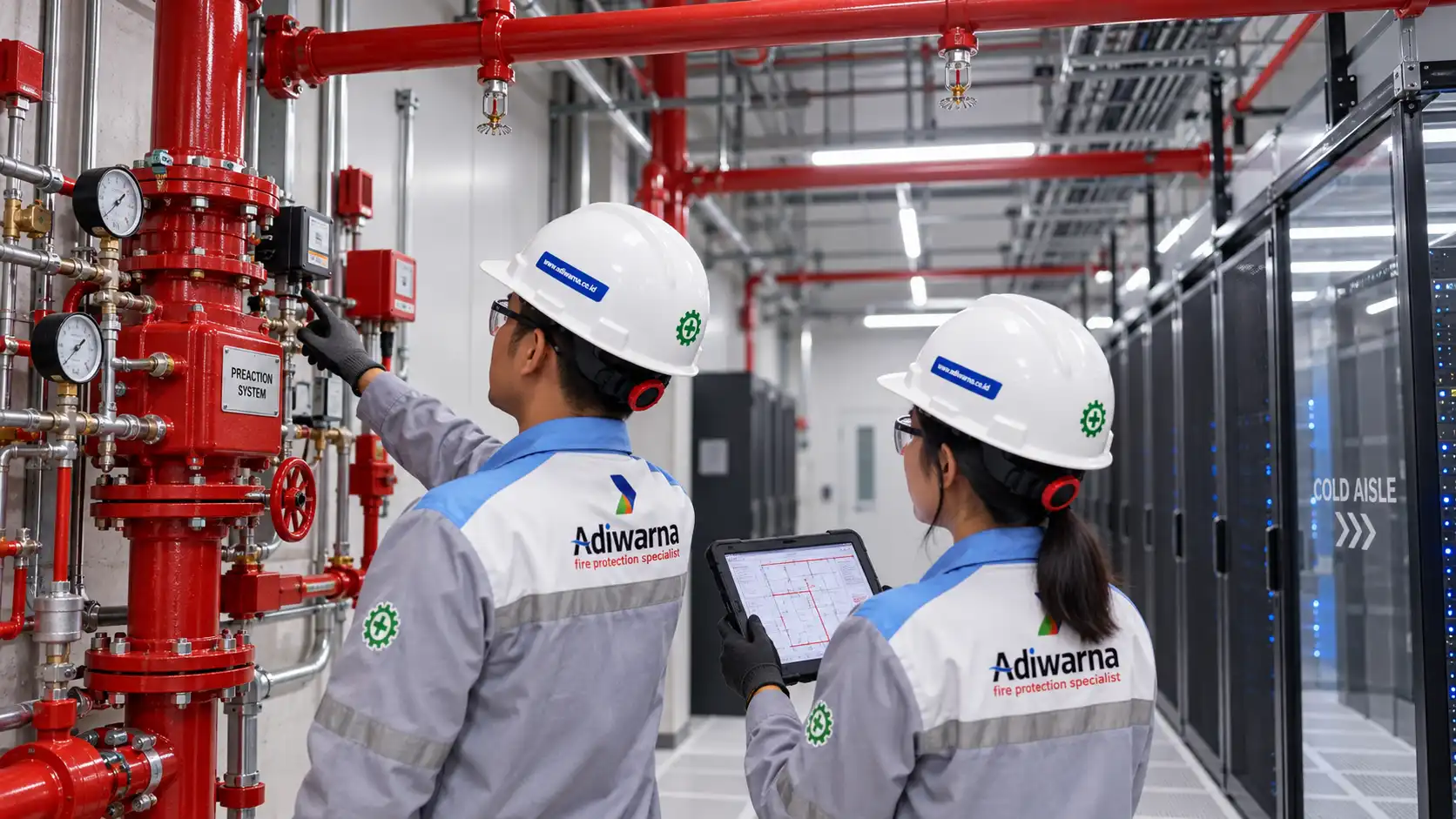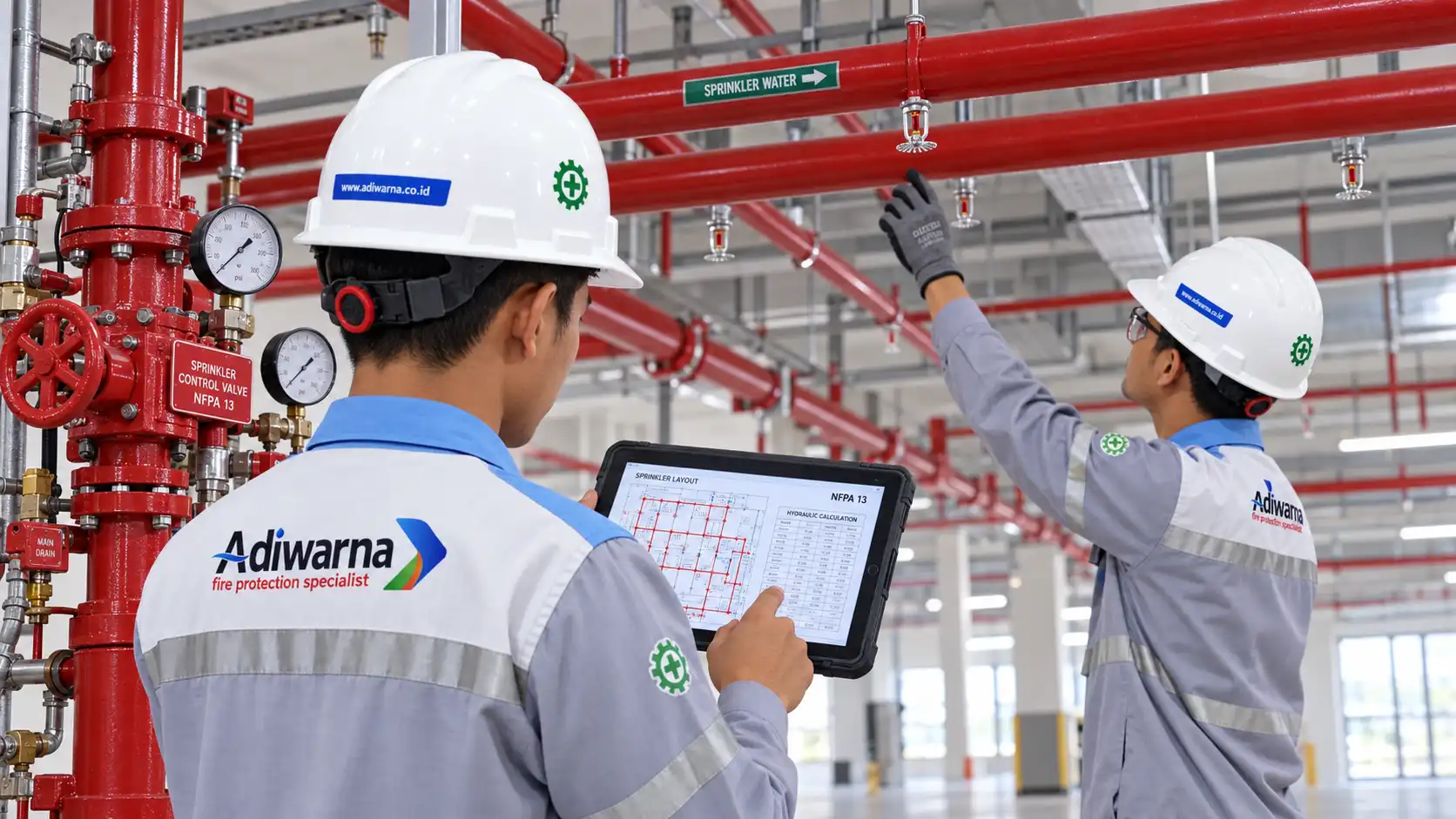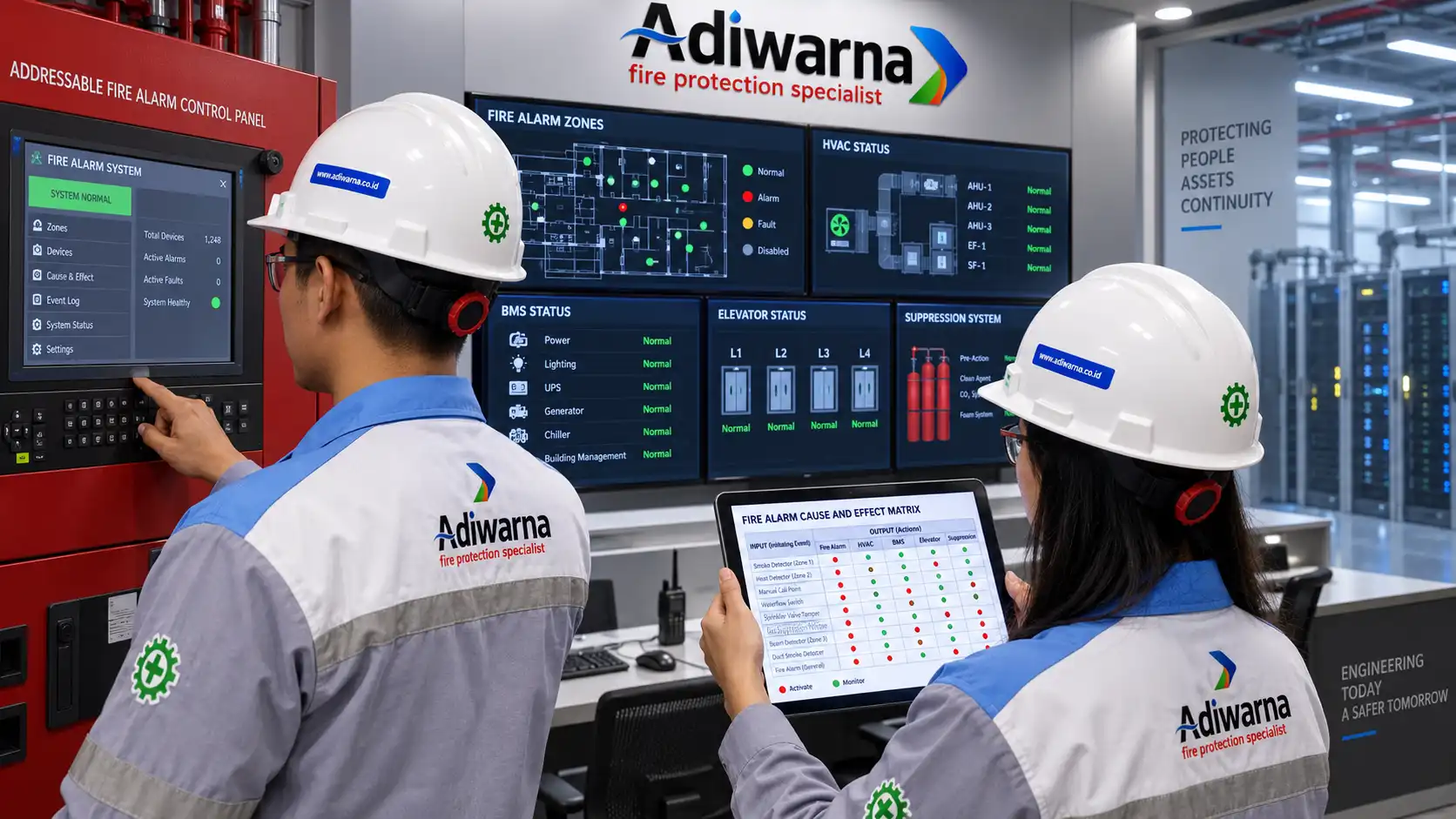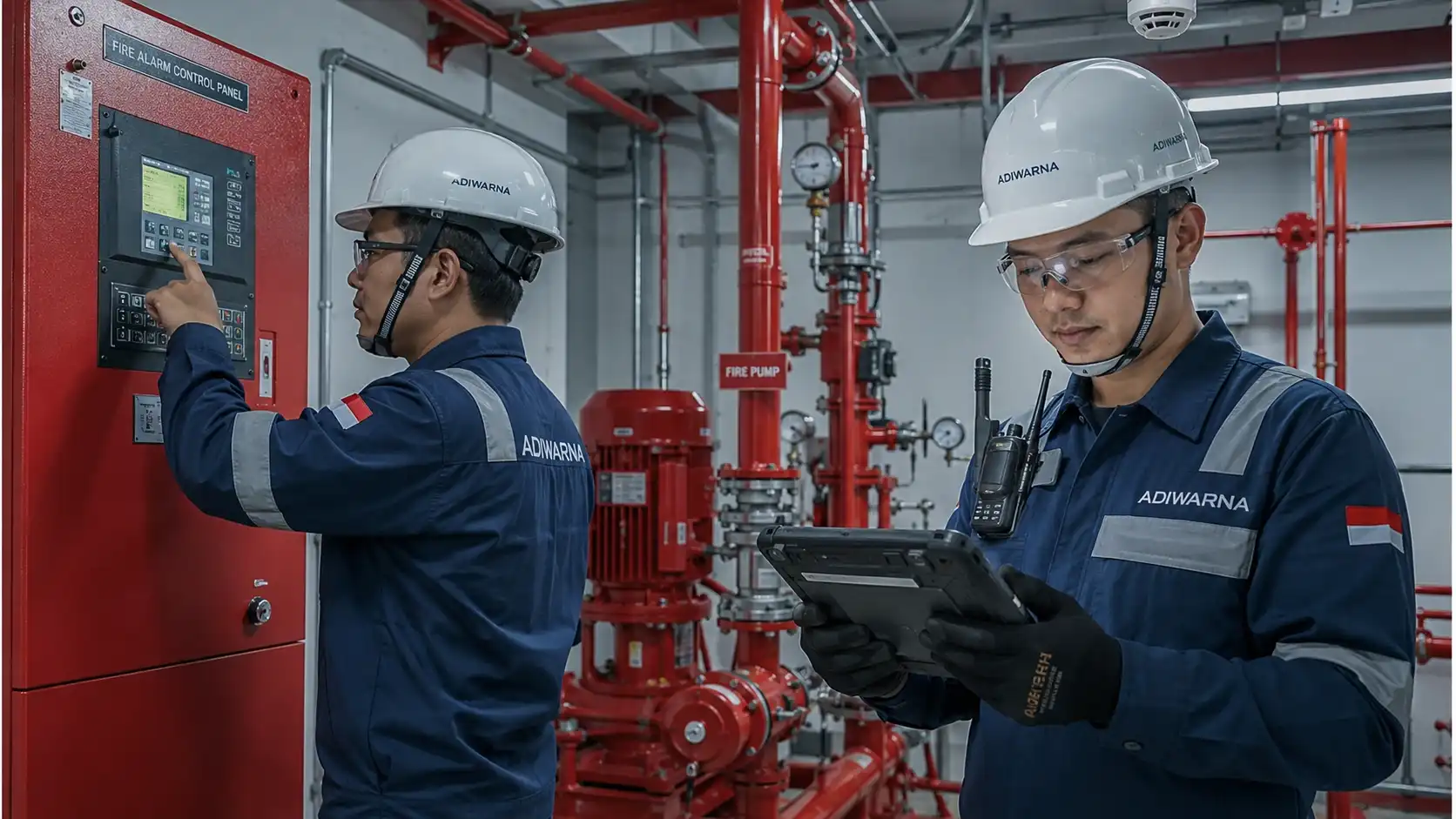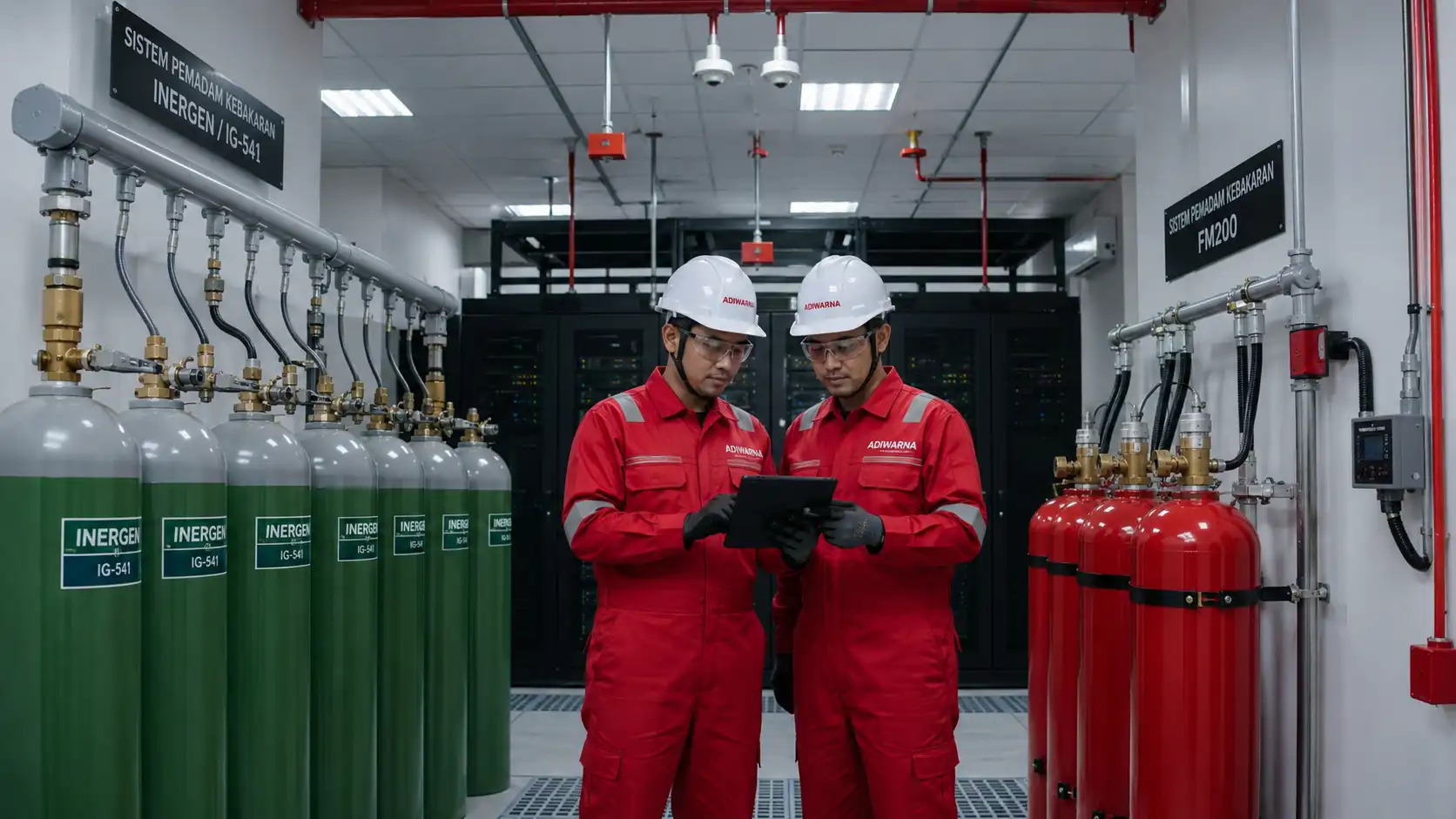

A hydrant pump supplies the water flow and pressure required for a fire hydrant network to operate effectively during an emergency. Without a correctly designed pump, water from the fire water reservoir may not reach hydrant pillars, hydrant boxes, hose reels, sprinklers, or the most remote firefighting point at sufficient pressure.
In technical terminology, a pump serving a hydrant network is generally known as a fire pump. It may serve only the hydrant system or form part of an integrated water-based fire protection network that also supplies sprinklers, water spray systems, deluge systems, and foam-water systems.
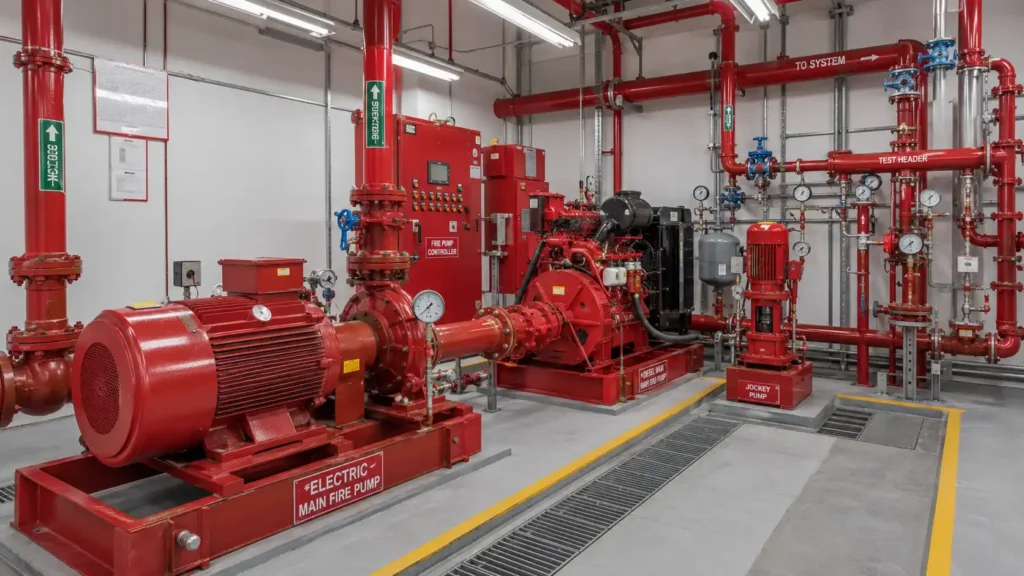
A typical fire pump set consists of an electric main fire pump, a diesel main fire pump, and a jockey pump. Each unit performs a different function, but all three must operate as one coordinated system through pressure switches, controllers, valves, alarms, and fire water piping.
PT Adiwarna Anugerah Abadi provides fire pump systems for commercial buildings and industrial facilities, including end-suction pumps, horizontal split-case pumps, vertical turbine pumps, multistage pumps, and jockey pumps. The service scope can include engineering, procurement, installation, testing, commissioning, and maintenance.
What Is a Hydrant Pump?
A hydrant pump is a dedicated fire protection pump that increases water pressure and transfers water from a fire water tank, reservoir, or another approved source into the firefighting network.
Unlike an ordinary utility pump, a fire pump must remain ready for emergency operation even when it is rarely used outside scheduled tests.
When a hydrant valve opens, pressure in the fire water piping decreases. The controller detects the pressure reduction through a pressure switch and starts the appropriate pump according to the established operating sequence.
The main functions of a hydrant pump include:
- Supplying the required firefighting water flow.
- Maintaining network pressure while hydrants are in operation.
- Delivering water to remote or elevated firefighting points.
- Supporting hydrant boxes, hydrant pillars, hose reels, and sprinklers.
- Compensating for inadequate source-water pressure.
- Supporting manual and automatic firefighting operations.
- Providing redundancy if the primary power source fails.
NFPA 20 provides widely used requirements for selecting and installing stationary fire pumps.
Why Is a Hydrant Pump Important?
A hydrant system requires both sufficient flow and pressure. A large amount of water is ineffective when pressure is too low, while high pressure without adequate flow cannot sustain firefighting operations.
In a high-rise building, the pump must overcome vertical elevation. In a large industrial facility, it must also overcome pressure losses caused by long piping runs, fittings, valves, and the distance to the hydraulically most remote outlet.
A dedicated fire pump is also important when the municipal water network cannot provide a reliable primary fire protection supply. In such cases, a fire water tank and fire pump become the dedicated water source for the protection system.
The Adiwarna article about the fire fighting pump as the heart of a fire protection system explains that the pump increases pressure in hydrant and sprinkler networks when the available water source cannot satisfy system demand.
How a Hydrant Pump Works

A hydrant pump operates by monitoring pressure inside the fire water network. Under normal standby conditions, the piping remains pressurized, usually with assistance from the jockey pump.
When a small pressure reduction occurs, the jockey pump starts first. Minor pressure loss can result from small leaks, system testing, temperature changes, or limited water use.
When pressure continues to fall and the jockey pump cannot restore it, the electric main fire pump starts. This unit supplies the high flow required by hydrants or other water-based fire protection systems.
If the electric pump fails or the electrical supply becomes unavailable, the diesel fire pump can provide an independent pumping source.
A typical operating sequence is:
- The hydrant network remains at standby pressure.
- The jockey pump maintains normal pressure.
- A hydrant valve, sprinkler, or another outlet begins discharging water.
- Network pressure decreases.
- The pressure switch sends a signal to the pump controller.
- The jockey pump starts for a minor pressure reduction.
- The main fire pump starts if pressure continues to fall.
- Water is transferred from the reservoir into the fire protection network.
- Pump-running and alarm signals are transmitted to the fire alarm panel or control room.
- The system is restored to standby condition through the approved procedure.
Pump start and stop settings must not be selected arbitrarily. They should reflect hydraulic calculations, normal system pressure, pump characteristics, controller requirements, and the project’s operating philosophy.
Hydrant Pump and Jockey Pump
A hydrant pump system uses a jockey pump to maintain pressure without repeatedly starting the main fire pump.
A jockey pump has a much smaller capacity than the main pump. It is not intended to supply the principal firefighting demand. Instead, it compensates for minor pressure losses and prevents unnecessary operation of the electric or diesel main pump.
A correctly selected jockey pump helps:
- Maintain standby pressure.
- Reduce unnecessary main-pump starts.
- Limit wear on the main fire pump.
- Indicate potential network leakage.
- Keep the hydrant network ready for emergency operation.
Adiwarna’s explanation of how a jockey pump works describes how the unit starts after a minor pressure reduction and restores the system without replacing the function of the main fire pump.
Main Components of a Hydrant Pump System
A complete system includes more than the pump and its driver. Mechanical, electrical, instrumentation, and control components must operate together.
Common components include:
- Fire water tank or reservoir.
- Electric main fire pump.
- Diesel main fire pump.
- Jockey pump.
- Electric fire pump controller.
- Diesel fire pump controller.
- Jockey pump controller.
- Suction header.
- Discharge header.
- Isolation valves.
- Check valves.
- Pressure gauges.
- Pressure switches.
- Flow meter or flow-test arrangement.
- Relief valve when required.
- Test header.
- Drain piping.
- Diesel fuel tank.
- Diesel starting batteries.
- Battery chargers.
- Diesel exhaust system.
- Pump-room ventilation.
- Fire alarm and control-room interfaces.
- Pipe supports and approved flexible connections.
The pump room must also provide sufficient clearance for inspections, valve operation, component removal, and maintenance.
Types of Hydrant Pumps by Function
Electric Main Fire Pump
An electric fire pump uses an electric motor as its driver. It is commonly selected as the primary pump because it provides stable performance, rapid starting, and straightforward integration with monitoring systems.
Its advantages include:
- Automatic starting through a pressure switch.
- Relatively quiet operation.
- No fuel-storage requirement.
- Lower exhaust and emissions inside the pump room.
- Comparatively straightforward driver maintenance.
However, the electrical supply must be sufficiently reliable. The fire protection system should not lose its entire pumping capability because of a building power failure.
Diesel Main Fire Pump

A diesel fire pump uses a diesel engine and can operate independently of the main electrical supply.
This pump is particularly valuable where redundancy is required or where a fire could interrupt the building’s electrical network.
A diesel pump installation commonly includes:
- Diesel engine.
- Fuel tank.
- Dual starting batteries.
- Battery chargers.
- Cooling system.
- Exhaust piping.
- Diesel fire pump controller.
- Fuel-level monitoring.
- Pump-room ventilation.
Adiwarna’s article about diesel fire pumps for industrial protection explains how an independent diesel-driven unit supports high-rise buildings, factories, warehouses, power plants, and oil and gas facilities.
Jockey Pump
The jockey pump maintains standby pressure in the hydrant network. Its capacity is smaller because it is not intended to satisfy the main firefighting demand.
Selection should consider:
- Normal system pressure.
- Expected minor pressure losses.
- Small leakage capacity.
- Main pump start settings.
- Short-cycling risk.
- Maximum system pressure.
An oversized jockey pump may prevent the main pump from starting when a meaningful flow demand occurs. An undersized unit may operate too frequently or fail to restore system pressure.
Types of Hydrant Pumps by Construction
Horizontal Split-Case Pump
A horizontal split-case pump has a casing divided along its horizontal axis. This arrangement allows internal inspection without removing the complete suction and discharge piping.
The pump is commonly used for high-flow applications and may be driven by either an electric motor or diesel engine.
Adiwarna offers fire pump options that include horizontal split-case models for a wide range of capacities and project approval requirements.
End-Suction Pump
An end-suction pump has its inlet at the end of the pump casing, while discharge is usually located at the top or side.
Potential benefits include:
- Compact construction.
- Relatively straightforward installation.
- Suitability for moderate-capacity applications.
- Accessible maintenance.
Its suitability must still be confirmed through the required pump curve, hydraulic demand, suction conditions, and project approval requirements.
Vertical Turbine Pump
A vertical turbine pump is used when the water source is below the pump elevation, such as an underground reservoir, well, or selected open water source.
Important design factors include:
- Water-source depth.
- Minimum operating water level.
- Required submergence.
- Column length.
- Suction-bell arrangement.
- Vortex prevention.
- Structural support.
- Maintenance access.
Vertical In-Line Pump
A vertical in-line pump has suction and discharge connections arranged along the same piping line. It can reduce the required floor area.
However, the design must still consider maintenance clearance, piping loads, vibration, capacity, and equipment listing.
Multistage Pump
A multistage pump uses several impellers to produce a higher discharge head. It can be applied where significant pressure is required, such as in high-rise buildings or networks with considerable elevation differences.
Its use requires careful consideration of:
- Maximum component pressure.
- Pressure zoning.
- Pressure-reducing valves.
- Pipe pressure ratings.
- Lower-floor overpressure.
- System operating limits.
Relationship Between the Hydrant Pump and Fire Water Tank
The fire water tank stores water dedicated to the fire protection system. The pump draws water through the suction piping and transfers it into the hydrant network.
Tank capacity should not be determined only from building size. The calculation may need to include:
- Hydrant system flow.
- Sprinkler system demand.
- Deluge or water spray demand.
- Foam-water system demand.
- Simultaneous operating systems.
- Required operating duration.
- Applicable standards and authority requirements.
- Automatic tank-refill capability.
- The selected design fire scenario.
The suction arrangement must also avoid turbulence, air entry, excessive negative pressure, and vortex formation.
Hydraulic Calculations for a Hydrant Pump
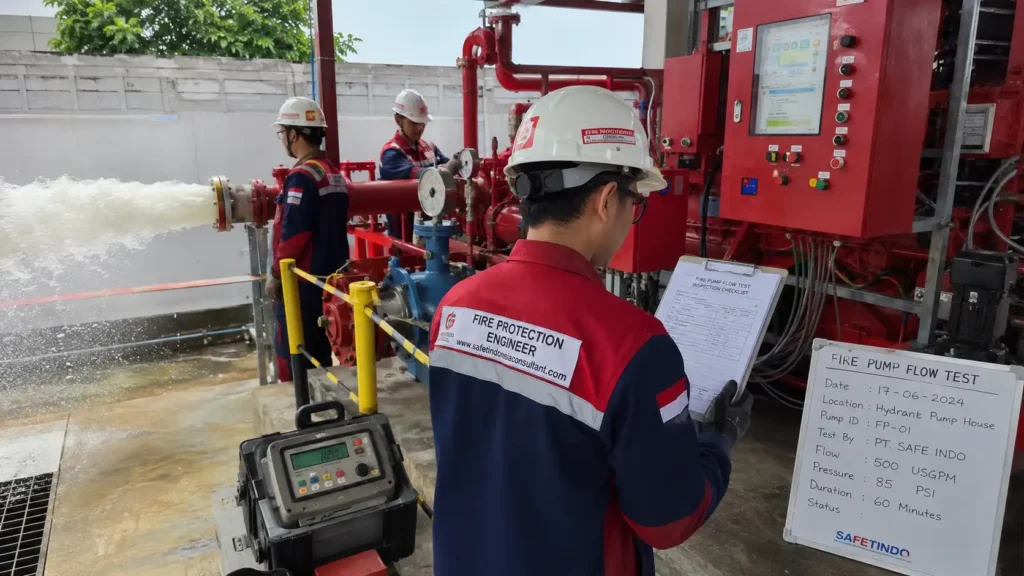
Pump selection should be based on hydraulic calculations rather than a general estimate of building area.
The calculation establishes the flow and pressure required under the most demanding design condition. Engineers normally evaluate the most remote or highest hydrant outlet.
Pressure losses may include:
- Pipe length.
- Pipe diameter.
- Elbows and tees.
- Isolation valves.
- Check valves.
- Backflow-prevention devices.
- Elevation.
- Fire hoses.
- Nozzles.
- Hydrant pillars.
- Landing valves.
- Flow meters.
- Other systems operating simultaneously.
The calculated demand is compared with the manufacturer’s pump curve. The pump operating point must remain within the acceptable performance range.
A fire pump should not be selected only from the highest number shown in a catalogue. Performance should be reviewed at churn, rated flow, and higher-flow conditions required by the selected standard and project criteria.
Fire Pump Controller
The fire pump controller receives pressure-switch signals and manages pump starting. Electric and diesel pumps use different controller configurations.
Controller functions may include:
- Automatic start.
- Manual start.
- Emergency manual operation.
- Electrical-supply monitoring.
- Phase-failure indication.
- Diesel engine starting sequence.
- Starting-battery monitoring.
- Battery-charger monitoring.
- Low-fuel indication.
- Pump-running indication.
- Controller trouble indication.
- Remote alarm outputs.
Important signals should be transmitted to the fire alarm panel or facility control room so operators can identify pump operation, controller failure, power loss, or diesel engine problems.
Requirements for a Proper Fire Pump Room
The pump room should be designed specifically to protect the equipment and provide safe access during inspections and emergencies.
Important considerations include:
- Safe and direct access.
- Fire separation from surrounding risks.
- Adequate floor drainage.
- Sufficient ventilation.
- Normal and emergency lighting.
- Maintenance clearance.
- Flood protection.
- Suitable room temperature.
- Safe diesel exhaust routing.
- Correct fuel-tank placement.
- Good housekeeping.
- Clear valve identification.
- System diagrams and operating instructions.
- Prohibition of unrelated storage.
A fire pump room should not be used as a general warehouse. Stored materials can block valves, controllers, test headers, and maintenance access.
Hydrant Pump Standards
System design should consider technical standards, local regulations, fire department requirements, insurance criteria, and manufacturer instructions.
Common references include:
- NFPA 20 for stationary fire pump installations.
- NFPA 25 for inspection, testing, and maintenance of water-based fire protection systems.
- NFPA 14 for standpipe and hose systems.
- NFPA 24 for private fire service mains.
- Applicable Indonesian National Standards.
- Local fire department requirements.
- Insurer requirements.
- Product listings and approvals.
- Pump, engine, and controller manuals.
NFPA 20 primarily addresses pump selection and installation, while NFPA 25 supports the ongoing inspection, testing, and maintenance program.
Hydrant Pump Testing and Commissioning
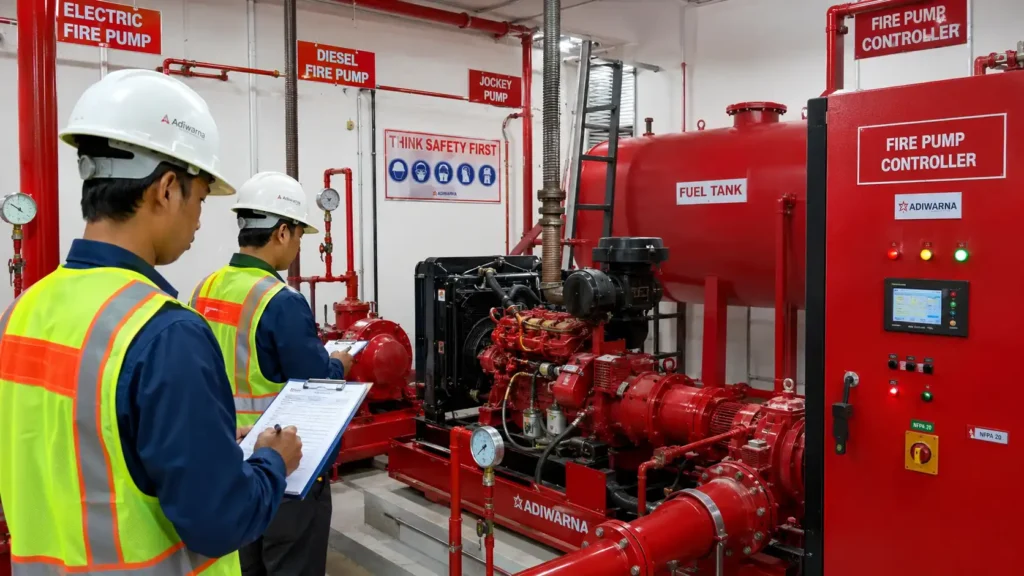
Testing and commissioning confirm that the pump can meet the approved performance requirements.
Initial inspections may include:
- Pump and driver alignment.
- Coupling condition.
- Pipe supports.
- Valve positions.
- Suction conditions.
- Electrical connections.
- Earthing.
- Diesel fuel system.
- Starting batteries and chargers.
- Controller settings.
- Pressure-switch settings.
- Instrument calibration.
- Direction of rotation.
- Lubrication.
- Cooling and exhaust arrangements.
The pump should then be tested under several operating conditions, including:
- No-flow or churn condition.
- Rated flow.
- Higher flow according to the acceptance-test procedure.
- Automatic starting.
- Manual starting.
- Diesel or alternate power operation.
- Alarm and monitoring functions.
- Controller-failure simulations.
- Flow-meter or test-header operation.
- System restoration.
Recorded performance should be compared with the approved pump curve.
The commissioning report should normally include:
- Flow rate.
- Suction pressure.
- Discharge pressure.
- Net pump pressure.
- Motor voltage and current.
- Diesel engine speed.
- Fuel condition.
- Vibration.
- Alarm status.
- Controller response.
- Pump-curve comparison.
- Identified deficiencies and corrective actions.
Hydrant Pump Flow Testing
A flow test verifies that the fire pump can produce the required flow and pressure.
Testing may be performed through a test header or flow-meter loop. Water is discharged in a controlled manner while the flow and pressure are recorded at several operating points.
Potential problems identified during a flow test include:
- Reduced pump capacity.
- Damaged impeller.
- Restricted suction.
- Partially closed valves.
- Inaccurate flow meter.
- Incorrect diesel engine speed.
- Unstable motor voltage.
- Pipe blockage.
- Incorrect pump rotation.
- Performance inconsistent with the approved curve.
A pump that starts successfully is not necessarily in acceptable condition. Performance testing cannot be replaced by a simple start test.
Inspection and Maintenance
Fire pumps rarely operate during normal building activities, but they must remain ready for an emergency. Regular inspection and testing are therefore essential.
Electric pump checks may include:
- Controller condition.
- Power supply.
- Voltage and phase status.
- Pump-room condition.
- Suction and discharge pressure.
- Leakage.
- Bearings.
- Coupling guard.
- Automatic-start function.
- Alarm signals.
Diesel pump checks may include:
- Fuel level.
- Engine oil.
- Coolant.
- Battery voltage.
- Battery chargers.
- Engine temperature.
- Exhaust system.
- Starting sequence.
- Engine speed.
- Leakage.
- Alarm status.
Jockey pump checks may include:
- Start and stop pressures.
- Short cycling.
- Mechanical seal condition.
- Controller condition.
- Check-valve performance.
- Network leakage.
- Ability to restore standby pressure.
After testing, technicians should confirm that all valves, controllers, switches, and alarm circuits have been returned to their normal condition.
Signs of Hydrant Pump Problems
Conditions that require immediate investigation include:
- The pump does not start automatically.
- The pump frequently starts and stops.
- Discharge pressure has decreased.
- The jockey pump runs continuously.
- The diesel engine is difficult to start.
- The battery charger shows a fault.
- The controller indicates trouble.
- Excessive pump vibration.
- Abnormal bearing noise.
- Mechanical seal leakage.
- Unstable suction pressure.
- Abnormal diesel exhaust smoke.
- Difficult valve operation.
- Flow-test results below the pump curve.
- Missing alarm signals at the control room.
Frequent jockey pump operation may indicate small system leaks, a leaking check valve, incorrect pressure-switch settings, or another pressure-maintenance problem.
Common Installation Mistakes
Common errors include:
- Selecting pump capacity without hydraulic calculations.
- Using a utility pump as a dedicated fire pump.
- Installing undersized suction piping.
- Providing too many fittings near the pump suction.
- Leaving the suction valve partially closed.
- Failing to provide a redundant pump arrangement.
- Using an unsuitable controller.
- Providing insufficient fire water storage.
- Installing an undersized diesel fuel tank.
- Providing inadequate pump-room ventilation.
- Routing diesel exhaust unsafely.
- Providing poor drainage.
- Using the pump room as storage.
- Failing to coordinate pressure-switch settings.
- Oversizing the jockey pump.
- Omitting a flow-test arrangement.
- Failing to transmit alarms to the control room.
- Skipping acceptance testing.
- Failing to retain the approved pump curve.
- Providing incomplete maintenance records.
These errors may result in a system that appears complete but cannot provide the required flow and pressure during a fire.
Tips for Selecting a Hydrant Pump
Before selecting a pump, the owner and engineer should review:
- Required flow.
- Total dynamic head.
- Water source.
- Suction conditions.
- Building elevation.
- Distance to remote hydrants.
- Connected sprinkler or deluge systems.
- Simultaneous system demand.
- Available power sources.
- Installation space.
- UL or FM approval requirements.
- NFPA and Indonesian standard requirements.
- Spare-parts availability.
- Service support.
- Future facility expansion.
- Lifecycle cost.
Adiwarna provides several fire pump types for buildings and industrial facilities. Final selection should reflect hydraulic demand and site conditions rather than only equipment price.
Hydrant Pumps for High-Rise Buildings
High-rise buildings face significant pressure challenges because of elevation.
When one pump supplies an entire tall building without suitable pressure management, lower floors may experience excessive pressure.
Possible solutions include:
- Pressure zoning.
- Intermediate fire water tanks.
- Booster fire pumps.
- Pressure-reducing valves.
- Multistage pumps.
- Separate risers.
- Break tanks.
The correct arrangement depends on building height, maximum equipment pressure, standpipe requirements, and the fire department’s operating strategy.
Hydrant Pumps for Industrial Facilities
Factories, warehouses, refineries, power plants, and oil and gas facilities may use one fire water network to supply several systems.
The pump may need to serve:
- Hydrant pillars.
- Fire water monitors.
- Hydrant boxes.
- Sprinklers.
- Deluge systems.
- Transformer water spray.
- Foam-water systems.
- Storage-tank cooling systems.
Simultaneous demand is therefore a critical design consideration. The pumps and water storage must support the approved design fire scenario rather than only one operating hydrant.
Adiwarna’s industrial fire fighting system services can integrate fire pumps with hydrants, sprinklers, deluge systems, foam systems, alarms, and fire water storage.
Why Choose PT Adiwarna Anugerah Abadi?
PT Adiwarna Anugerah Abadi can help companies develop fire pump systems according to facility type, hydraulic demand, water source, and project standards.
The service scope may include:
- Site surveys.
- Fire risk assessments.
- Hydraulic calculations.
- Pump selection.
- Fire water tank calculations.
- Engineering design.
- Equipment procurement.
- Pump-room installation.
- Controller integration.
- Testing and commissioning.
- Flow testing.
- Troubleshooting.
- Preventive maintenance.
- Repairs and system upgrades.
For complete project execution, Adiwarna EPC Fire Protection can support engineering, procurement, construction, testing, commissioning, and maintenance within one coordinated scope.
Companies requiring design, installation, testing, or maintenance support can contact PT Adiwarna Anugerah Abadi through the Adiwarna contact page.
Conclusion
A hydrant pump is the heart of a water-based fire protection system. It ensures that water reaches hydrant boxes, hydrant pillars, sprinklers, water spray systems, and other firefighting equipment at the required flow and pressure.
A standard fire pump set typically uses a jockey pump to maintain standby pressure, an electric main fire pump as the primary high-flow unit, and a diesel fire pump as an independent or standby pumping source.
However, system reliability depends on more than pump capacity. Hydraulic calculations, fire water storage, suction arrangements, controllers, valves, pressure switches, pump-room conditions, alarm monitoring, testing, and maintenance must all be planned as one integrated system.
With proper engineering, the pump system can start automatically, maintain an adequate water supply, and support firefighting operations during an emergency.
PT Adiwarna Anugerah Abadi is ready to support fire pump design, procurement, installation, testing, commissioning, flow testing, and maintenance for commercial buildings and industrial facilities.