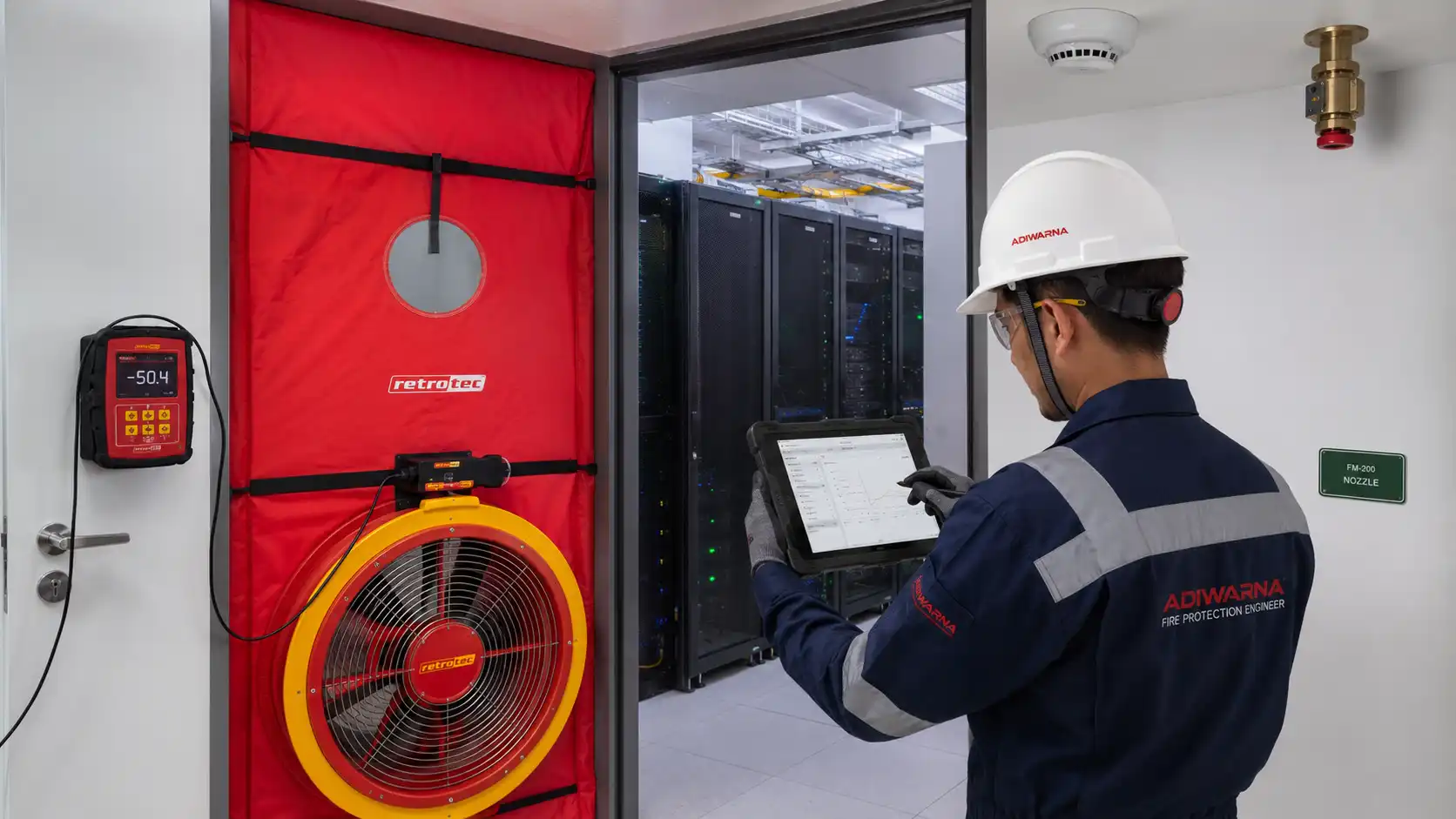

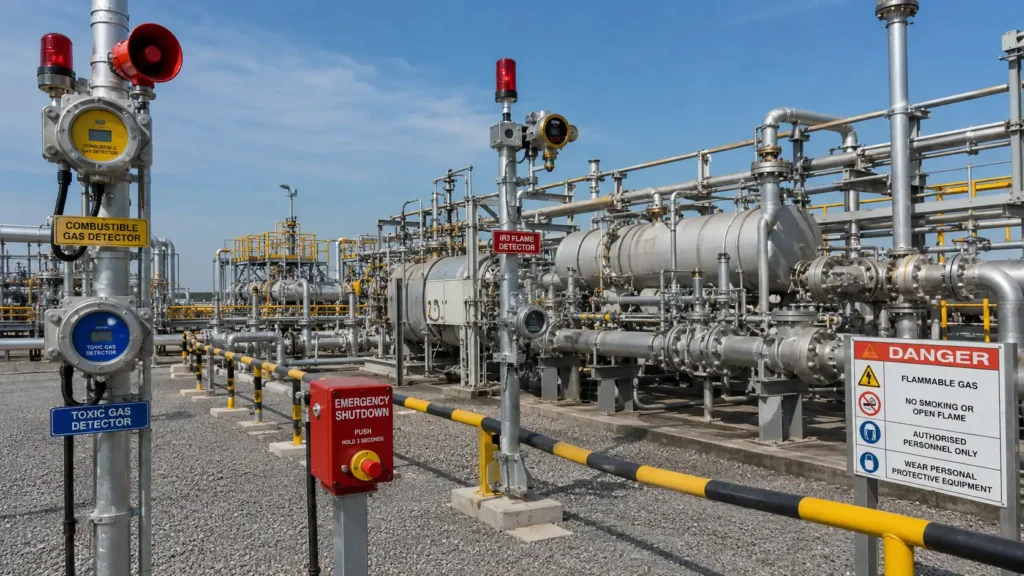
Fire and gas detection is an integrated safety system designed to detect fire, open flames, combustible gas leaks, toxic gases, and unsafe oxygen conditions in industrial facilities. After identifying a hazardous condition, the system generates alarms and can initiate automatic safety actions according to a predetermined response strategy.
The system is particularly important for oil and gas facilities, petrochemical plants, refineries, chemical plants, power plants, tank farms, loading terminals, compressor stations, battery rooms, generator rooms, and process areas with significant fire or explosion hazards.
Unlike an ordinary building fire alarm system, an industrial fire and gas system does not only monitor smoke and heat detectors. It may also receive input from flame detectors, combustible gas detectors, toxic gas detectors, oxygen detectors, manual call points, and emergency push buttons.
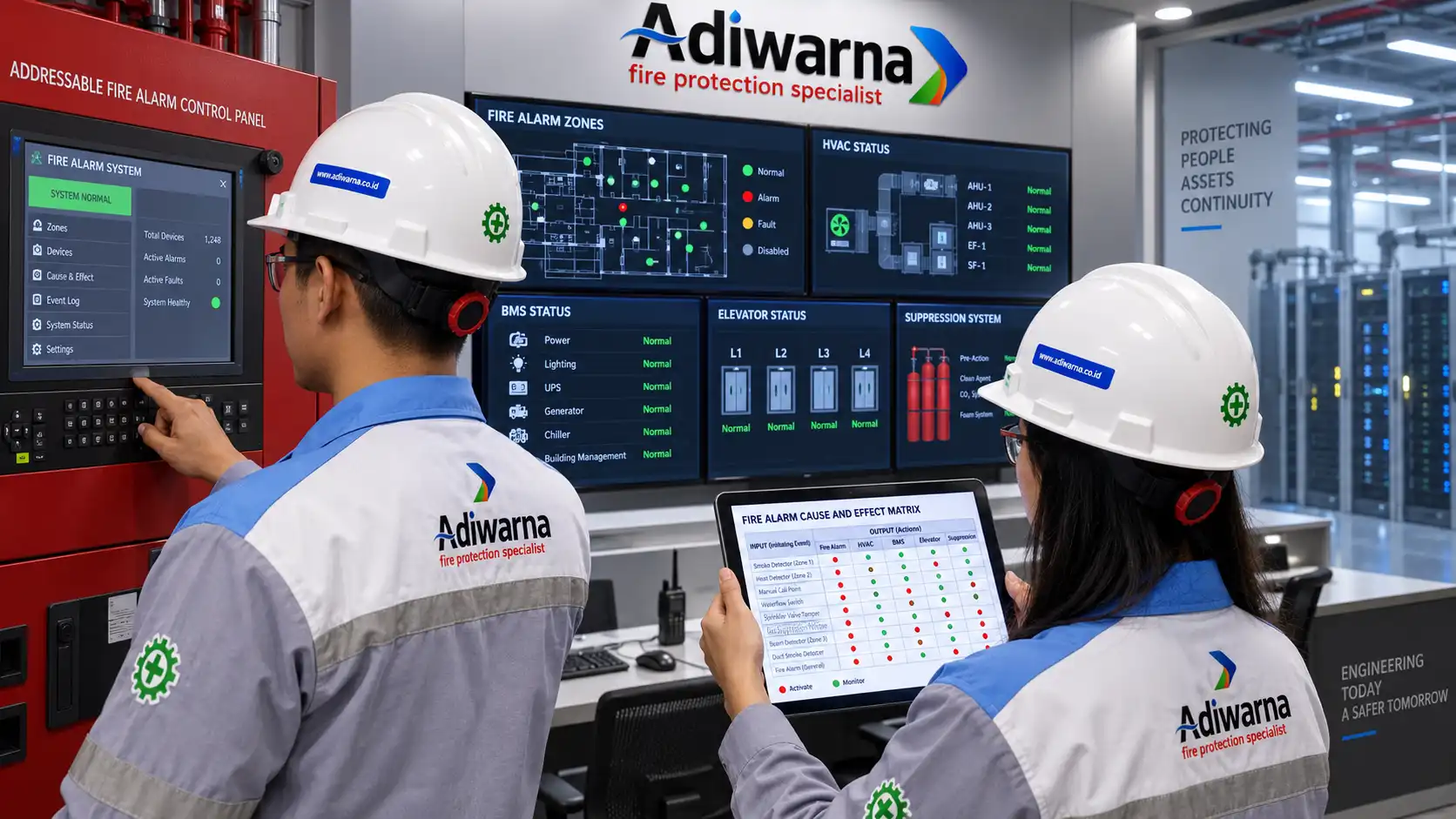
Signals from these devices are transmitted to a fire and gas controller. The controller can then activate sirens, beacons, ventilation fans, deluge valves, foam systems, fire pumps, or emergency shutdown functions according to the approved cause-and-effect matrix.
Adiwarna’s industrial gas detector solutions can be integrated with flame detection, fire alarms, deluge systems, foam systems, ventilation equipment, emergency shutdown systems, and control-room monitoring.
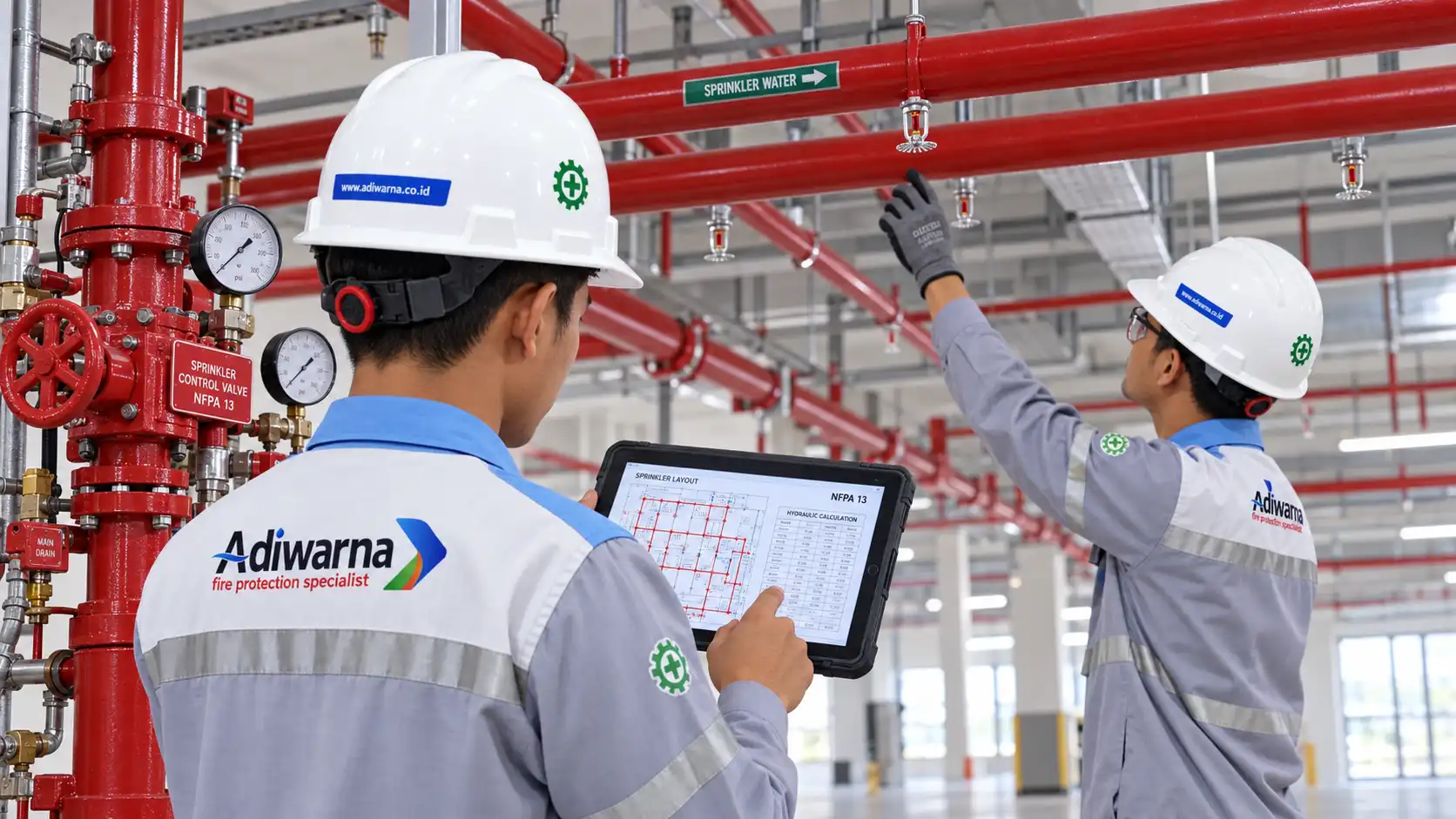
PT Adiwarna Anugerah Abadi also provides an integrated oil and gas fire protection system that combines detection, alarm, suppression, hydrants, foam systems, deluge systems, fire pumps, and emergency response equipment.
What Is a Fire and Gas Detection System?
A fire and gas detection system is a network of field devices, controllers, alarms, interfaces, and output equipment that continuously monitors fire conditions and hazardous atmospheres.
The system generally performs two primary functions:
- Fire detection, which identifies flames, smoke, heat, or other signs of combustion.
- Gas detection, which identifies combustible gas, toxic gas, oxygen deficiency, or oxygen enrichment.
When a detector reading exceeds a predefined threshold, the signal is sent to the fire and gas controller. The controller compares the reading with the programmed alarm set points and safety logic.
The system may display several operating conditions, including:
- Normal.
- Low alarm.
- High alarm.
- Fire alarm.
- Confirmed fire.
- Detector fault.
- Communication failure.
- Inhibited.
- Bypassed.
- Maintenance mode.
- Emergency shutdown initiated.
This information allows operators to understand not only that an alarm has occurred, but also the hazard type, detector location, alarm level, and automatic safety actions currently in progress.
Why Is Fire and Gas Detection Important?
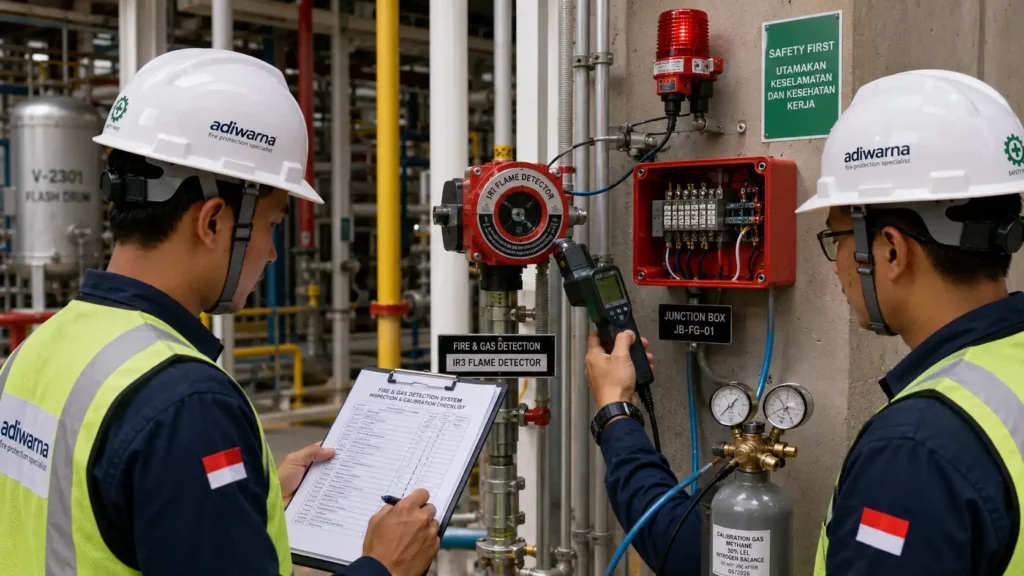
Gas leaks are not always visible. Some gases are also colorless, while a person’s ability to recognize odor cannot be considered a reliable detection method.
Industrial fires can also develop very quickly. Pressurized hydrocarbon releases, combustible gas leaks, hot surfaces, electrical sparks, and combustion processes may escalate into serious incidents within a short period.
A detection system can provide warning before a condition develops into a fire, explosion, or dangerous personnel exposure. Operators then have additional time to isolate the area, evacuate personnel, shut down equipment, or activate a fire suppression system.
IEC 60079-29-0 covers general requirements, test methods, and performance criteria for equipment used to detect combustible gases, oxygen conditions, and toxic gases in industrial and commercial safety applications.
How Fire and Gas Detection Works
The process begins with detectors installed at strategic risk locations. Each detector continuously monitors the surrounding atmosphere or protected area and converts the measurement into an electrical or digital communication signal.
A typical operating sequence includes:
- A detector identifies flame, gas, smoke, heat, or an abnormal oxygen condition.
- The signal is transmitted to the fire and gas controller.
- The controller compares the reading with the alarm set points.
- Alarm information appears on the local panel and control-room workstation.
- Sirens, beacons, or alarm strobes activate.
- Operators receive information about the hazard type and location.
- Automatic outputs operate according to the cause-and-effect matrix.
- Status signals are transmitted to the DCS, ESD, fire alarm panel, or BMS.
- The event is stored in the system history.
- The system is restored after the area has been declared safe.
In high-risk facilities, activation of one detector may not immediately initiate fire suppression or process shutdown. Voting arrangements such as 1oo2, 2oo2, or 2oo3 may be used to balance rapid response against the risk of unwanted activation.
The correct voting logic must be established through hazard analysis and should not simply be copied from another facility.
Main Components of Fire and Gas Detection
A complete system contains input devices, processing equipment, communication networks, alarm devices, and output interfaces.
Common components include:
- Combustible gas detectors.
- Toxic gas detectors.
- Oxygen detectors.
- Flame detectors.
- Smoke detectors.
- Heat detectors.
- Manual call points.
- Emergency push buttons.
- Fire and gas controllers.
- Fire alarm control panels.
- Input and output modules.
- Alarm beacons.
- Sirens or horns.
- Alarm strobes.
- Junction boxes.
- Marshalling cabinets.
- Control-room workstations.
- DCS interfaces.
- Emergency shutdown interfaces.
- Ventilation control interfaces.
- Deluge or foam release interfaces.
- Power supplies.
- Backup batteries.
- Uninterruptible power supplies.
- Communication networks.
- Event loggers.
Every component should be selected according to the target hazard, environmental conditions, hazardous-area classification, operating temperature, corrosive atmosphere, and system integration requirements.
Fire and Gas Detection for Oil and Gas Facilities
Fire and gas detection is essential in oil and gas facilities because these areas may contain combustible hydrocarbons, toxic gases, pressurized process equipment, and potential ignition sources.
Areas commonly protected include:
- Process units.
- Compressor stations.
- Pump areas.
- Loading racks.
- Tank farms.
- Fuel-transfer stations.
- Pipe racks.
- Wellhead facilities.
- Refineries.
- Petrochemical plants.
- Marine terminals.
- Utility areas.
- Generator enclosures.
- Turbine enclosures.
A combustible gas detector provides warning when the gas concentration approaches a hazardous level. A flame detector identifies radiation produced by an open flame, while a toxic gas detector monitors conditions that could endanger personnel.
Detector placement should consider potential leakage sources, ventilation, prevailing wind direction, gas density, hazardous-area classification, and maintenance accessibility.
Companies can integrate these functions through Adiwarna’s gas detector protection for industrial facilities and industrial flame detector solutions.
Fire and Gas Detection in a Cause-and-Effect Matrix
Fire and gas detection does more than generate alarms. It may also initiate automatic actions according to an approved cause-and-effect matrix.
Possible input conditions include:
- High combustible gas alarm.
- High-high combustible gas alarm.
- Toxic gas alarm.
- Oxygen-deficiency alarm.
- Flame detector alarm.
- Confirmed flame detection.
- Heat detector alarm.
- Manual emergency push-button activation.
- Detector fault.
- Power-supply failure.
Possible output actions include:
- Activating sirens and beacons.
- Generating alarms in the control room.
- Starting ventilation fans.
- Stopping normal ventilation.
- Closing fire dampers.
- Shutting down compressors.
- Isolating fuel valves.
- Initiating emergency process shutdown.
- Starting fire pumps.
- Opening deluge valves.
- Activating foam systems.
- Releasing access-controlled doors.
- Transmitting status to the DCS or BMS.
- Initiating an evacuation alarm.
Every relationship between an input and output must be clearly documented. The complete logic should then be verified through integrated system testing.
Combustible Gas Detector
A combustible gas detector measures the concentration of flammable gas or vapor. Its reading is commonly displayed as a percentage of the lower explosive limit, or LEL.
Target gases and vapors may include:
- Methane.
- Propane.
- Butane.
- Hydrogen.
- Natural gas.
- LPG.
- LNG vapor.
- Hydrocarbon vapor.
- Selected solvent vapors.
Different sensor technologies may be used depending on the target gas and installation conditions. Detector selection should therefore consider response time, cross-sensitivity, poisoning resistance, environmental exposure, and calibration requirements.
Both fixed and portable gas detectors may be used, depending on the facility risk and operating procedure.
Toxic Gas Detector
A toxic gas detector monitors gases that can harm personnel even when their concentrations remain below combustible levels.
Common target gases include:
- Hydrogen sulfide.
- Carbon monoxide.
- Ammonia.
- Chlorine.
- Sulfur dioxide.
- Nitrogen dioxide.
- Hydrogen cyanide.
- Other process-specific toxic gases.
Alarm set points should consider occupational exposure limits, emergency response procedures, exposure duration, and facility safety requirements.
Detector technology must also be suitable for the target gas. A sensor designed for one gas may respond differently or become affected by other chemicals present in the same environment.
Oxygen Detector
An oxygen detector identifies oxygen deficiency or oxygen enrichment.
Oxygen deficiency may result from:
- Inert gas discharge.
- Nitrogen purging.
- Gas leakage that displaces normal air.
- Oxidation processes.
- Confined-space conditions.
- Inadequate ventilation.
Oxygen enrichment can also create a hazardous condition because many materials burn more easily in an oxygen-rich atmosphere.
The system should therefore distinguish between oxygen-deficient and oxygen-enriched conditions according to the facility’s safety philosophy.
Flame Detector
A flame detector identifies radiant energy produced by an open flame. It is useful where a fire may develop before smoke or heat reaches conventional detectors.
Common technologies include:
- Ultraviolet detectors.
- Infrared detectors.
- UV/IR detectors.
- Dual infrared detectors.
- Triple infrared or IR3 detectors.
- Multi-spectrum detectors.
Each technology has different sensitivity, response time, field of view, detection range, and potential false-alarm sources.
Flame detectors are commonly installed in:
- Process areas.
- Pump stations.
- Compressor areas.
- Loading bays.
- Tank farms.
- Turbine enclosures.
- Fuel-storage areas.
- Petrochemical installations.
Adiwarna’s industrial flame detector solutions can be integrated with fire alarms, deluge systems, foam systems, and emergency shutdown functions.
Point Gas Detector and Open-Path Gas Detector
A point gas detector measures gas concentration at the sensor location. It is normally installed near likely leakage sources or expected gas travel paths.
Typical point-detector locations include:
- Valves.
- Flanges.
- Pump seals.
- Compressors.
- Sampling points.
- Storage areas.
- Process equipment.
An open-path gas detector uses an optical beam between a transmitter and receiver or reflector. It monitors gas across a longer open area rather than only at one sensor point.
Open-path detectors may be considered for:
- Process-area perimeters.
- Loading terminals.
- Tank farms.
- Pipe racks.
- Offshore decks.
- Areas where a gas cloud may develop.
Selection should not be based only on detector range. Engineers must also consider the target gas, possible release direction, obstructions, vibration, sunlight, weather, and calibration accessibility.
Fire and Gas Controller
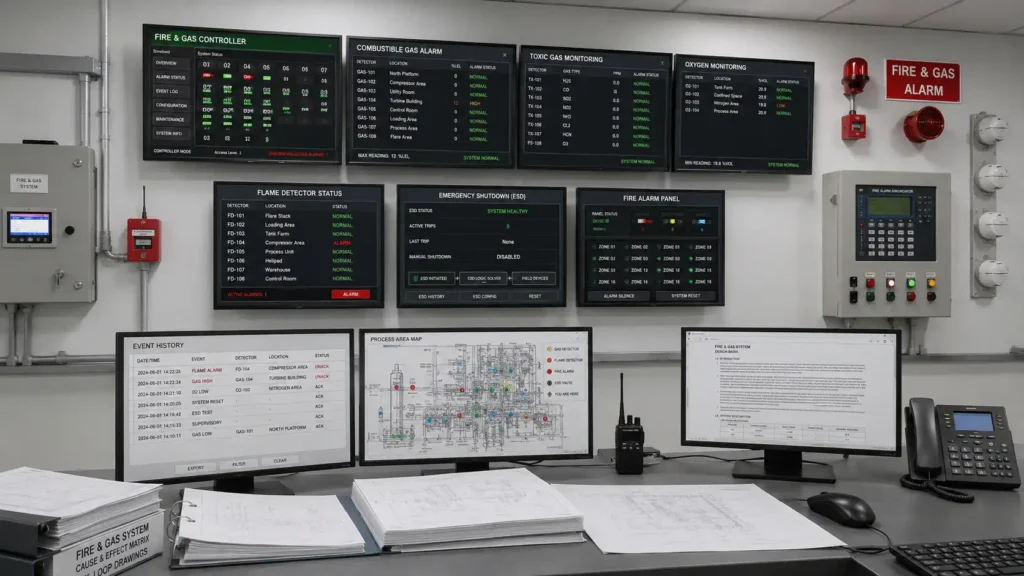
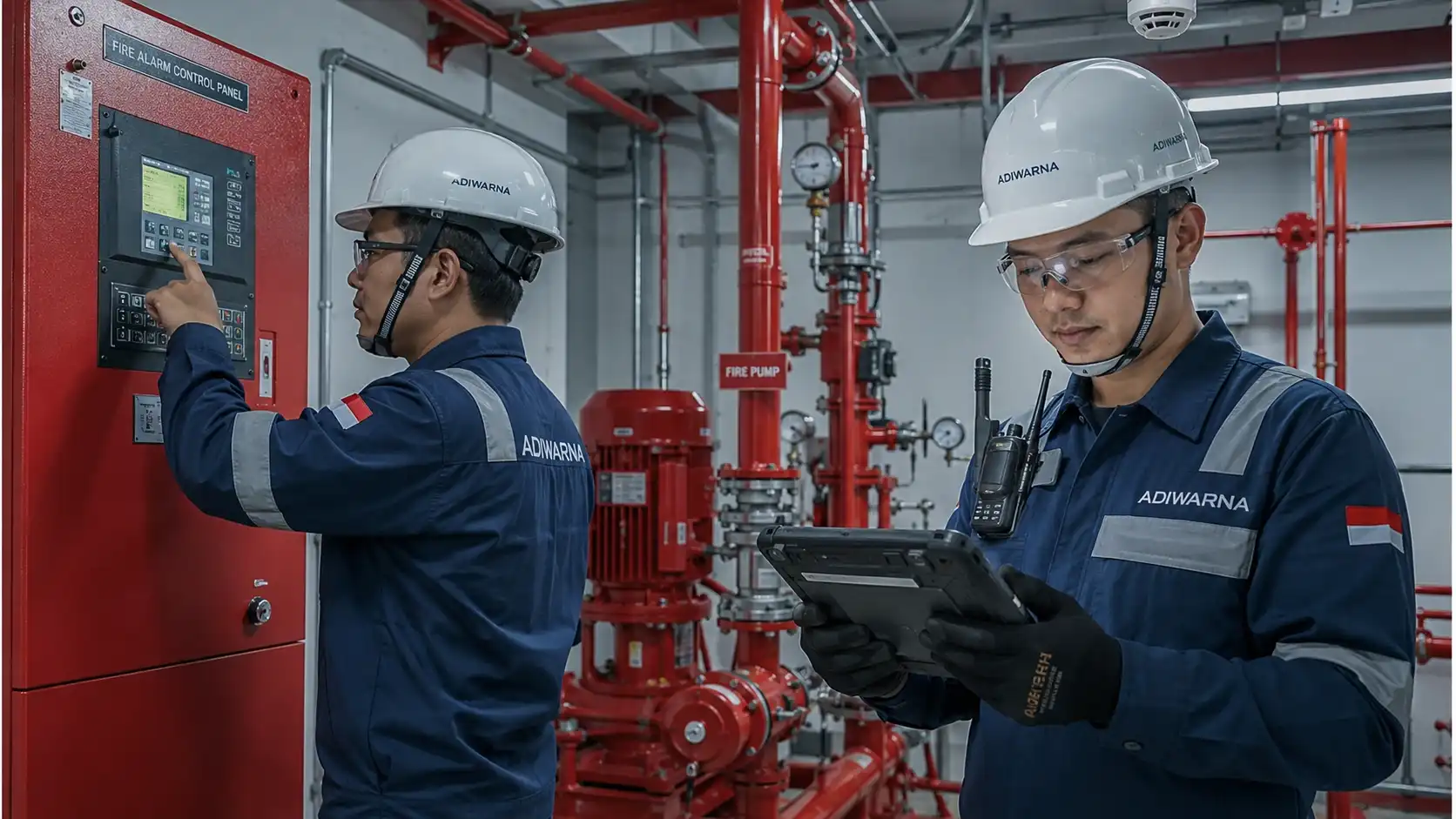
The fire and gas controller is the central processing unit for detector signals. It may operate independently or communicate with the DCS, safety instrumented system, fire alarm panel, and emergency shutdown system.
Its functions may include:
- Reading detector signals.
- Displaying gas concentrations.
- Processing alarm set points.
- Monitoring detector faults.
- Executing voting logic.
- Activating alarm outputs.
- Initiating shutdown logic.
- Recording event history.
- Transmitting data to the control room.
- Supervising power and communication faults.
Every detector should have a clear tag number and location description. Operators should be able to see that an alarm originates from a specific detector in the compressor area rather than receiving only a general “gas alarm” indication.
For fire alarm and signaling integration, NFPA 72 provides requirements related to alarm systems, communication pathways, notification, supervision, testing, and maintenance.
Alarm Levels and Automatic Actions
A gas detection system commonly uses more than one alarm threshold.
| Condition | Possible Designed Response |
|---|---|
| Low gas alarm | Local and control-room warning |
| High gas alarm | Area alarm and ventilation activation |
| High-high gas alarm | Process isolation or emergency shutdown |
| Toxic gas alarm | Evacuation, respiratory protection, and area isolation |
| Oxygen deficiency | Entry restriction and ventilation activation |
| Flame alarm | Fire alarm and logic verification |
| Confirmed fire | Deluge, foam, shutdown, and evacuation sequence |
| Detector fault | Maintenance notification and compensating measures |
Alarm values should not be generalized across all facilities. Set points must reflect the target gas, risk assessment, safety philosophy, regulations, and manufacturer recommendations.
Gas Detector Placement
Detector placement is one of the most important aspects of engineering.
Factors that need to be assessed include:
- Potential leakage sources.
- Target gas.
- Gas density relative to air.
- Process pressure.
- Release temperature.
- Prevailing wind direction.
- Natural and mechanical ventilation.
- Equipment obstructions.
- Detector mounting height.
- Air velocity.
- Occupied areas.
- Maintenance access.
- Flooding exposure.
- Corrosion.
- Vibration.
- Flame detector field of view.
A gas that is lighter than air does not automatically mean that the detector should simply be installed at the highest possible point. Pressurized releases, gas temperature, ventilation patterns, and room geometry can significantly influence dispersion.
Detector mapping should therefore be based on hazard analysis, process layout, ventilation characteristics, and credible leakage scenarios.
Hazardous Areas and Explosion-Proof Equipment
Equipment installed where an explosive atmosphere may occur must be suitable for the relevant hazardous-area classification.
The design should verify:
- Zone or division classification.
- Gas group.
- Temperature class.
- Equipment protection level.
- Ex certification.
- Ingress-protection rating.
- Cable glands.
- Junction boxes.
- Earthing.
- Environmental rating.
- Corrosion resistance.
Installing an explosion-proof detector alone is not sufficient. Cable glands, conduits, junction boxes, wiring methods, and installation workmanship must also comply with the hazardous-area requirements.
Integration with the Emergency Shutdown System
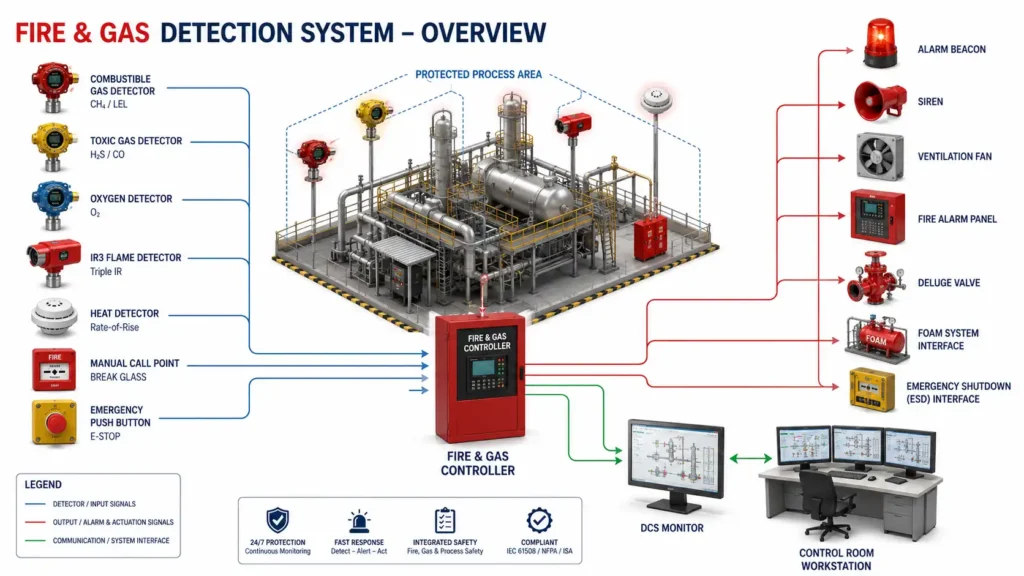
When gas concentration reaches a dangerous level, the fire and gas controller may transmit a command to the emergency shutdown system.
Possible actions include:
- Stopping compressors.
- Shutting down pumps.
- Closing emergency isolation valves.
- Stopping fuel transfer.
- Isolating selected electrical equipment.
- Depressurizing process equipment.
- Activating ventilation.
- Stopping non-essential equipment.
Automatic shutdown can affect both process safety and operational continuity. The logic should therefore be developed through hazard and operability studies, layer-of-protection analysis, and functional-safety reviews where required.
Integration with Deluge and Foam Systems
In high-hazard areas, confirmed flame detection may be used as an input for deluge or foam-system activation.
A possible operating sequence is:
- A flame detector identifies a fire.
- A second detector confirms the condition.
- The controller processes the voting logic.
- Sirens and beacons activate.
- The fire pump receives a start signal.
- The deluge or foam control valve opens.
- Water spray or foam solution is discharged.
- The control room receives discharge confirmation.
Adiwarna’s deluge valve solutions and industrial foam systems can be integrated with fire detection, fire pumps, releasing controls, and alarm monitoring.
Integration with Ventilation Systems
Gas detectors may also control ventilation in generator rooms, battery rooms, chemical-storage areas, and enclosed process spaces.
Depending on the target gas and safety strategy, an alarm may:
- Start an exhaust fan.
- Increase ventilation capacity.
- Close a recirculation damper.
- Stop selected fresh-air intake systems.
- Isolate the affected area.
- Generate a restricted-entry alarm.
The ventilation response must match the properties of the target gas. Incorrectly designed ventilation may spread gas into another area or direct it toward an ignition source.
Fire and Gas Detection Standards
System design should follow applicable standards, local regulations, manufacturer instructions, project specifications, and facility safety requirements.
Common references include:
- IEC 60079-29-0 for general requirements and testing of gas-detection equipment.
- IEC 60079-29-2 for detector selection, installation, use, and maintenance.
- IEC 60079-29-3 for safety-related fixed gas-detection systems.
- IEC 60079-14 for electrical installations in explosive atmospheres.
- IEC 62990-2 for toxic gas detectors in workplace atmospheres.
- NFPA 72 for fire alarm and signaling systems.
- NFPA 4 for integrated fire protection and life-safety system testing.
- Local fire-safety regulations.
- Occupational health requirements.
- Manufacturer datasheets.
- Product certifications.
- Company HSE standards.
The selected edition and its applicability should be confirmed against the project requirements and local authority expectations.
Fire and Gas Detection Engineering Stages
Engineering should begin with a clear understanding of the industrial process and credible hazard scenarios.
Typical stages include:
- Collecting process information.
- Conducting hazard identification.
- Reviewing the hazardous-area classification.
- Identifying target gases and fire scenarios.
- Selecting detector technologies.
- Completing detector-coverage studies.
- Establishing alarm set points.
- Developing the cause-and-effect matrix.
- Establishing voting logic.
- Designing the controller architecture.
- Calculating power requirements.
- Designing cables and junction boxes.
- Designing system interfaces.
- Preparing material specifications.
- Developing installation drawings.
- Preparing testing procedures.
- Preparing the commissioning plan.
- Developing the maintenance strategy.
Typical engineering documents include:
- Detector layouts.
- Detector-mapping reports.
- Instrument indexes.
- Input-output lists.
- Cable schedules.
- Junction-box schedules.
- Cause-and-effect matrices.
- Control philosophies.
- Loop diagrams.
- Wiring diagrams.
- Alarm set-point lists.
- Hazardous-area certificates.
- Testing procedures.
- As-built drawings.
Testing and Commissioning
Testing must demonstrate that detectors identify the intended hazards and that every output responds according to the approved logic.
Typical activities include:
- Visual inspection.
- Cable-continuity testing.
- Insulation testing according to approved procedures.
- Detector-address verification.
- Gas calibration.
- Bump testing.
- Flame-detector functional testing.
- Heat-detector testing.
- Manual call-point testing.
- Alarm-beacon testing.
- Siren audibility testing.
- Controller-fault simulation.
- Low- and high-alarm verification.
- Voting-logic testing.
- DCS interface testing.
- Emergency shutdown testing.
- Ventilation interface testing.
- Deluge-release simulation.
- Foam-system interface testing.
- Fire-pump monitoring testing.
- Cause-and-effect testing.
- Event-history verification.
- Main-power failure testing.
- Backup-battery testing.
- Documentation review.
Integrated testing is especially important because individual systems may perform correctly on their own but fail when exchanging signals with other protection and process systems.
Calibration and Bump Testing
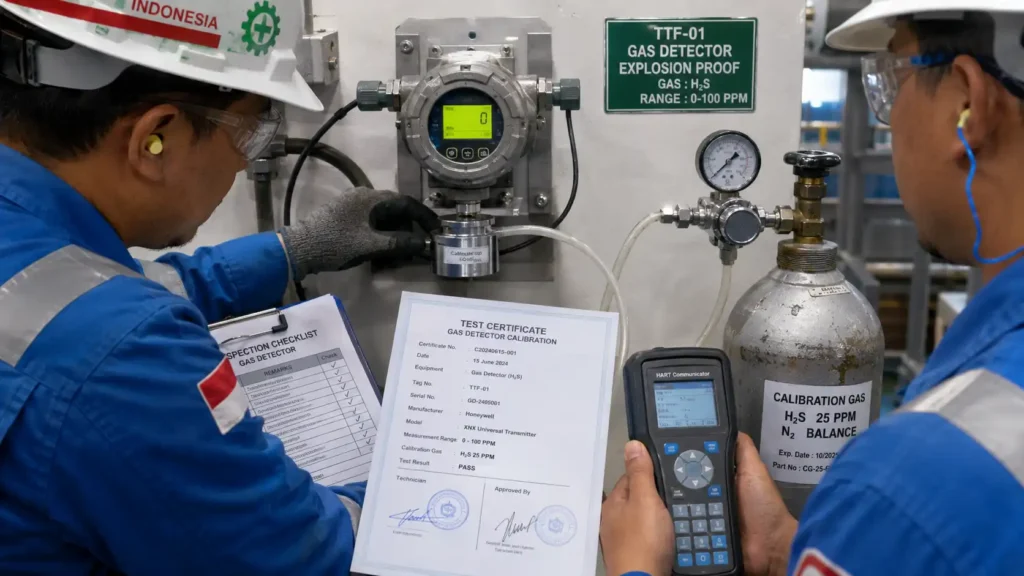
Bump testing and calibration serve different purposes.
A bump test briefly exposes the sensor to a known test gas to confirm that the detector, alarm, and output response operate correctly.
Calibration adjusts the detector reading so it corresponds accurately with a known reference-gas concentration.
The maintenance program should consider:
- Manufacturer recommendations.
- Sensor technology.
- Target gas.
- Environmental conditions.
- Contaminant exposure.
- Alarm history.
- Safety criticality.
- Regulatory requirements.
- Previous test results.
The calibration gas cylinder must have the correct gas type, concentration, regulator, hose, and expiration date.
A detector that appears normal on the controller may still have reduced sensitivity. Functional testing is therefore necessary even when no fault is displayed.
Fire and Gas Detection Maintenance
The system requires periodic maintenance to ensure detectors, alarms, controllers, and interfaces remain operational.
Routine checks may include:
- Sensor condition.
- Detector housing.
- Optical windows.
- Sample inlets.
- Calibration status.
- Sensor-life indication.
- Detector fault history.
- Cable glands.
- Junction boxes.
- Corrosion.
- Mounting alignment.
- Flame detector field of view.
- Controller status.
- Alarm beacons.
- Sirens.
- Backup power.
- Communication networks.
- DCS and ESD interfaces.
- Inhibit and bypass records.
- Maintenance documentation.
Changes to process equipment or facility layout should trigger a detector-coverage review. A detector that was previously effective may become obstructed after new piping, walls, canopies, or equipment are installed.
Common Fire and Gas Detection Project Mistakes
Common mistakes include:
- Positioning detectors without hazard analysis.
- Selecting a sensor that is unsuitable for the target gas.
- Ignoring cross-sensitivity.
- Failing to consider wind and ventilation.
- Allowing structures to obstruct detectors.
- Pointing flame detectors toward false-alarm sources.
- Using unsuitable alarm set points.
- Failing to establish voting logic.
- Preparing an incomplete cause-and-effect matrix.
- Not testing emergency shutdown functions.
- Using equipment unsuitable for the hazardous-area classification.
- Installing incorrect cable glands or junction boxes.
- Providing inadequate maintenance access.
- Failing to calibrate detectors.
- Leaving detectors permanently inhibited.
- Failing to update layouts after facility modifications.
- Not retaining event-history records.
- Failing to provide spare sensors.
- Skipping integrated testing.
- Providing incomplete commissioning records.
Installing more detectors does not automatically provide better protection. System effectiveness depends on detector technology, placement, alarm logic, integration, testing, and maintenance.
Benefits of Fire and Gas Detection
A properly designed system can provide several benefits:
- Detecting gas leaks before ignition.
- Warning personnel about toxic gas exposure.
- Identifying oxygen-deficient conditions.
- Detecting flames rapidly.
- Supporting emergency shutdown.
- Activating ventilation automatically.
- Integrating with deluge and foam systems.
- Identifying the hazard location.
- Supporting operator response.
- Reducing incident escalation.
- Supporting HSE audits.
- Protecting business continuity.
- Providing event history for incident investigation.
These benefits can only be achieved when detectors, controllers, alarm devices, output interfaces, and emergency procedures operate as one coordinated system.
Why Choose PT Adiwarna Anugerah Abadi?
PT Adiwarna Anugerah Abadi can help companies develop fire and gas systems according to process conditions, target gases, hazardous-area classifications, fire scenarios, and emergency response requirements.
The scope of work may include:
- Site surveys.
- Fire and gas risk assessments.
- Detector selection.
- Detector mapping.
- Engineering design.
- Cause-and-effect matrix development.
- Controller selection.
- Procurement.
- Installation.
- Programming.
- Testing.
- Commissioning.
- Calibration.
- Preventive maintenance.
- System integration.
- Existing-system upgrades.
Adiwarna focuses on fire protection for facilities with specialized risks, including oil and gas, data centers, power plants, petrochemical facilities, and industrial plants. Services can cover design, procurement, installation, testing, commissioning, and maintenance.
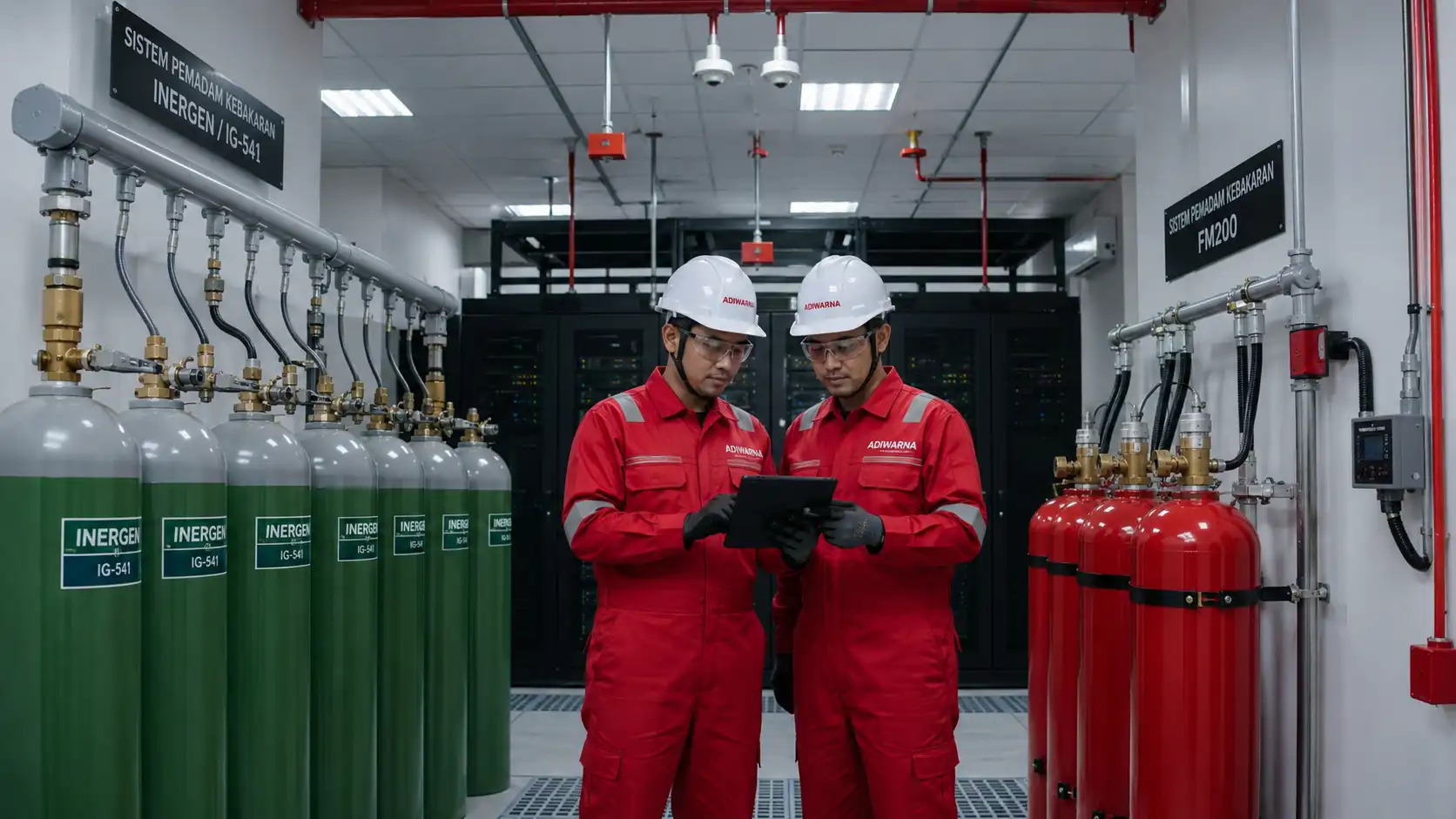
The system can also be integrated with Adiwarna’s fire alarm system solutions, hydrants, fire pumps, deluge systems, foam systems, and clean agent suppression systems.
For projects requiring a complete scope, Adiwarna EPC Fire Protection can support engineering, procurement, construction, testing, commissioning, and maintenance.
Companies requiring consultation can contact PT Adiwarna Anugerah Abadi through the Adiwarna contact page.
Conclusion
Fire and gas detection is an integrated safety system designed to identify fire, combustible gases, toxic gases, and hazardous oxygen conditions.
The system is particularly important for oil and gas facilities, petrochemical plants, refineries, power plants, chemical facilities, tank farms, loading terminals, and other high-risk industrial operations.
However, reliability does not depend only on detector quality. It also requires hazard analysis, accurate detector placement, suitable alarm set points, voting logic, a complete cause-and-effect matrix, reliable controllers, emergency shutdown interfaces, testing, calibration, and preventive maintenance.
With proper engineering, the system can provide early warning, activate alarms, control ventilation, initiate shutdown actions, and release deluge or foam systems before a hazardous condition develops into a major incident.
PT Adiwarna Anugerah Abadi is ready to support the design, procurement, installation, programming, testing, commissioning, calibration, and maintenance of integrated fire and gas detection systems for industrial facilities.
Fire and Gas Detection FAQ
What is the difference between a fire alarm system and fire and gas detection?
A fire alarm system primarily focuses on fire detection and occupant notification. A fire and gas system also monitors combustible gases, toxic gases, oxygen levels, and flames and may interface with emergency shutdown and process-safety systems.
Can a gas detector prevent an explosion?
A gas detector does not eliminate the source of a leak. However, it can provide early warning and initiate ventilation, isolation, or shutdown before the gas reaches a more dangerous concentration.
Is a flame detector the same as a smoke detector?
No. A flame detector identifies radiation produced by an open flame, while a smoke detector identifies smoke particles or combustion products.
Where should a gas detector be installed?
Its location should be determined according to the potential leakage source, target gas, ventilation, gas density, airflow, hazardous-area classification, and release scenario. Placement should not be based only on whether the gas is lighter or heavier than air.
Why does a detector require calibration?
Sensor sensitivity can change because of age, environmental conditions, contamination, or previous gas exposure. Calibration confirms that the detector reading remains accurate against a known reference gas.