
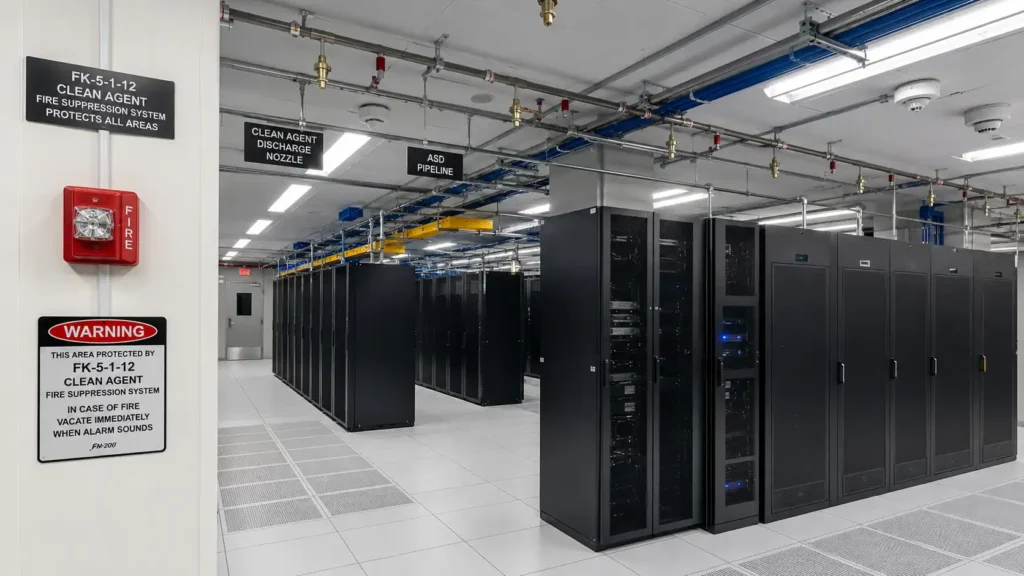
Novec 1230 is a widely recognized trade name for a clean extinguishing agent based on the FK-5-1-12 compound. It is commonly used in total-flooding fire suppression systems protecting data centers, server rooms, telecommunications facilities, electrical rooms, control rooms, museums, archives, and other critical environments where water or extinguishing residue could cause significant secondary damage.
As a clean agent, FK-5-1-12 is electrically non-conductive and leaves no residue after vaporization. Therefore, it can suppress a fire without soaking servers, control panels, network equipment, documents, or other sensitive assets. The NFPA overview of clean agent systems explains why these systems are particularly relevant for valuable electronic equipment and occupied critical spaces.
However, it is important to understand that Novec 1230 is a 3M trademark, while FK-5-1-12 is the generic designation for the extinguishing agent. Following 3M’s decision to exit PFAS manufacturing by the end of 2025, new projects should verify agent availability, system approval, refill support, product traceability, and long-term lifecycle support before specifying the Novec brand.
For new FK-5-1-12 applications, PT Adiwarna Anugerah Abadi provides the GEMTEX GEM1230 clean agent fire suppression system, an engineered total-flooding solution developed for critical asset protection.
What Is Novec 1230?
Novec 1230 is a commercial name historically associated with FK-5-1-12, a halocarbon clean agent stored as a liquid and discharged through a network of pipes and engineered nozzles.
When the suppression system activates, the agent is released from one or more cylinders and distributed throughout the protected enclosure. It rapidly changes into a gaseous state and spreads across the room volume to suppress the fire.
The system is generally designed as a total-flooding system. This means that the required agent quantity is calculated according to the complete protected volume, which may include:
- The main occupied room.
- Raised-floor voids.
- Ceiling voids.
- Cable trenches.
- Enclosed equipment areas.
- Other connected spaces included in the hazard.
Adiwarna provides FK-5-1-12 protection through the GEMTEX GEM1230 system, which combines agent cylinders, valves, distribution piping, discharge nozzles, detection, and releasing controls.
How Does Novec 1230 Extinguish Fire?

FK-5-1-12 suppresses fire primarily by absorbing heat from the combustion process. When sufficient heat energy is removed, the combustion reaction can no longer sustain itself and the fire is controlled.
Unlike inert gas systems, which work mainly by reducing oxygen concentration, FK-5-1-12 primarily acts through heat absorption and interaction with the combustion process.
A typical operating sequence includes:
- A smoke detector or aspirating smoke detection system identifies an early fire condition.
- The signal is transmitted to the releasing control panel.
- A first-stage alarm warns operators and building occupants.
- A second detector confirms the event through cross-zone logic.
- Pre-discharge sounders and strobes activate.
- HVAC equipment and dampers respond according to the cause-and-effect matrix.
- A solenoid or actuator opens the cylinder valve.
- The agent flows through the distribution piping.
- Discharge nozzles distribute the agent throughout the enclosure.
- A pressure switch confirms agent release to the control panel.
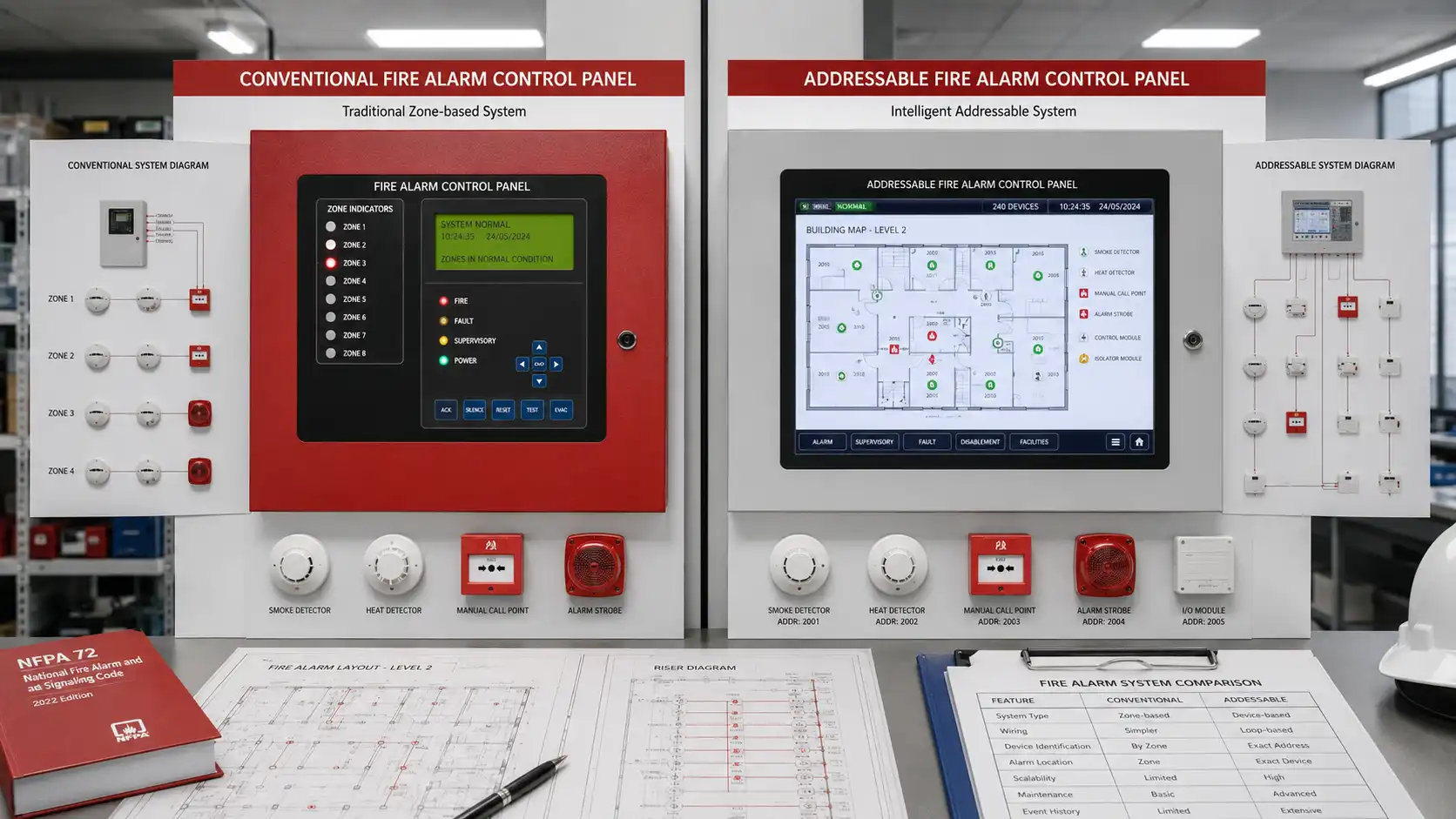
The suppression system should be integrated with a reliable fire alarm system so detectors, warning devices, manual release stations, abort switches, control interfaces, and releasing circuits operate in a coordinated sequence.
Why Is Novec 1230 Used for Electronic Assets?
Water is highly effective for many fire hazards. However, discharging water inside a server room, control room, telecommunications facility, or electrical room can cause severe secondary damage.
FK-5-1-12 does not leave powder, liquid residue, or corrosive deposits after discharge. Its electrically non-conductive properties also make it suitable for protecting energized electronic equipment when the system is properly designed and installed.
Assets commonly protected by clean agent systems include:
- Server racks.
- Network switches.
- Data storage systems.
- UPS systems.
- Electrical switchgear.
- Control panels.
- Telecommunications equipment.
- Process instrumentation.
- Important archives.
- Museum collections.
- Laboratory equipment.
- Process control rooms.
For information technology environments, the clean agent system can become part of a wider data center fire protection strategy that combines early detection, alarm notification, automatic suppression, enclosure management, and emergency response procedures.
Novec 1230 for Data Centers and Server Rooms
Novec 1230 became widely known as a clean agent option for data centers because it can suppress fire without leaving residue on IT equipment.
However, effective protection requires more than placing cylinders and nozzles near the server room. Engineering must consider:
- Server room volume.
- Raised-floor volume.
- Ceiling voids.
- Hot-aisle and cold-aisle arrangements.
- Cooling-system airflow.
- Cable penetrations.
- Doors and other openings.
- Detector sensitivity.
- HVAC shutdown.
- Pressure relief.
- Agent retention time.
- System redundancy.
- Building management system integration.
Early warning is also essential. Aspirating smoke detection can identify small airborne smoke particles before a fire develops into a larger incident.
Adiwarna’s data center fire protection solutions can integrate early detection, clean agent cylinders, releasing controls, distribution nozzles, room integrity testing, alarms, and emergency response procedures.
Novec 1230 for Electrical Rooms and Control Rooms
Novec 1230 and other approved FK-5-1-12 systems can also protect electrical rooms and control rooms containing equipment that should not be exposed to water or dry chemical powder.
Typical fire hazards in these areas include:
- Electrical short circuits.
- Overheating.
- Loose electrical connections.
- Circuit overload.
- Insulation failure.
- Battery-system faults.
- Cable termination defects.
- Equipment aging.
- Ventilation failure.
An automatic clean agent system can help control a fire before it spreads to neighboring panels or control equipment. Nevertheless, detector selection, release logic, enclosure integrity, and emergency power procedures must reflect the facility’s actual operating conditions.
Main Components of a Novec 1230 System
An FK-5-1-12 suppression system consists of mechanical, electrical, detection, and control components that must operate as one integrated package.
Agent Cylinders
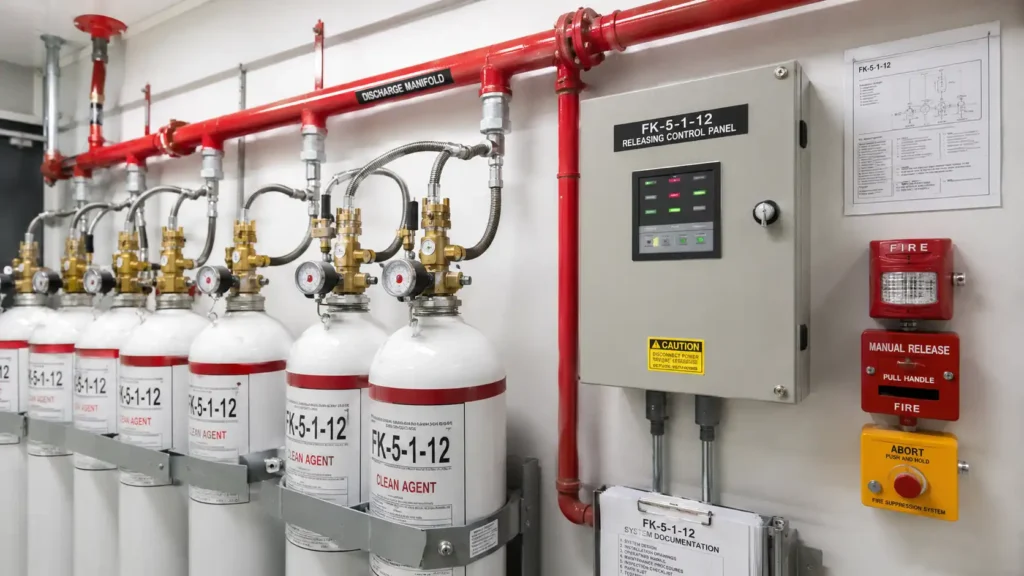
The cylinders store the clean agent as a liquid, normally super-pressurized with nitrogen. Cylinder size and quantity are calculated according to the required agent mass and the system configuration.
Cylinder Valve and Actuator
The cylinder valve controls agent release. Activation may use an electric solenoid, pneumatic actuator, mechanical actuator, or manual release mechanism, depending on the approved design.
Distribution Piping
The piping transfers the agent from the storage cylinders to the discharge nozzles. Pipe diameter and routing must follow an approved flow calculation method or manufacturer calculation software.
Discharge Nozzles
The discharge nozzles distribute the agent throughout the enclosure. Nozzle orifice sizes must match the hydraulic calculation so the required agent quantity is delivered within the specified discharge period.
Releasing Control Panel
The releasing panel receives detector signals and executes the cause-and-effect logic. It controls alarm stages, discharge delays, releasing circuits, abort functions, and system interfaces.
Fire Detection Devices
The detection system may include:
- Photoelectric smoke detectors.
- Aspirating smoke detectors.
- Multi-criteria detectors.
- Heat detectors.
- Linear heat detection for selected applications.
Manual Release Station
The manual release station enables authorized personnel to activate the suppression system directly when necessary.
Abort Switch
An abort switch may delay agent release while it is continuously operated, depending on the approved system philosophy and applicable standards.
Alarm and Warning Devices
Sounders, horns, bells, and strobes warn personnel before the clean agent is discharged. Warning signs should also be installed at entrances and near the cylinder installation.
Pressure Relief Vent
Agent discharge can cause a rapid pressure change inside the protected enclosure. A pressure relief vent may therefore be required to protect doors, walls, ceilings, and other building elements.
Fire Alarm and BMS Interfaces
Alarm, trouble, supervisory, release, and pressure-switch signals may be transmitted to the master fire alarm control panel, building management system, or facility control room.
Difference Between Novec 1230, FK-5-1-12, and GEM1230
These terms are often used interchangeably, even though they do not mean exactly the same thing.
| Term | Explanation |
|---|---|
| Novec 1230 | 3M trade name historically used for an FK-5-1-12 fire protection fluid |
| FK-5-1-12 | Generic clean agent designation |
| GEM1230 | GEMTEX engineered fire suppression system using FK-5-1-12 |
| Clean agent system | General category of electrically non-conductive, residue-free fire suppression systems |
Because 3M announced its exit from PFAS manufacturing by the end of 2025, new project specifications should not use the term “Novec 1230” without confirming:
- Agent manufacturer.
- Product source.
- System approval.
- Cylinder and valve compatibility.
- Refill availability.
- Serial traceability.
- Spare-parts support.
- Long-term lifecycle availability.
For current applications, Adiwarna offers GEMTEX GEM1230 as an engineered FK-5-1-12 solution for critical facilities.
Novec 1230 Compared with FM-200
FK-5-1-12 and HFC-227ea, commonly associated with FM-200, are both halocarbon clean agents. However, they have different physical properties, design concentrations, environmental characteristics, storage calculations, and approved hardware.
| Aspect | FK-5-1-12 | HFC-227ea |
|---|---|---|
| Common name | Novec 1230 or another FK-5-1-12 brand | FM-200 or another HFC-227ea brand |
| Agent category | Halocarbon clean agent | Halocarbon clean agent |
| Residue | No residue | No residue |
| Electrical conductivity | Non-conductive | Non-conductive |
| Typical applications | Data centers, electrical rooms, archives, control rooms | Data centers, electrical rooms, archives, control rooms |
| System design | Requires FK-5-1-12 calculations and listed components | Requires HFC-227ea calculations and listed components |
| Direct interchangeability | Not permitted without redesign | Not permitted without redesign |
An existing suppression system cannot be converted from one agent to another simply by refilling its cylinders. The following items must be reassessed:
- Agent quantity.
- Cylinder capacity.
- Cylinder valves.
- Discharge nozzles.
- Distribution piping.
- Flow calculations.
- Design concentration.
- Pressure requirements.
- Product approvals.
- Hardware compatibility.
As another clean agent option, Adiwarna provides the GEMTEX GEM200 HFC-227ea system for critical asset protection.
Novec 1230 Compared with Inert Gas
Inert gas suppression systems use nitrogen, argon, or a mixture of inert gases to reduce oxygen concentration until combustion can no longer continue. FK-5-1-12, in contrast, primarily suppresses fire through heat absorption.
| Aspect | FK-5-1-12 | Inert Gas |
|---|---|---|
| Primary mechanism | Heat absorption | Oxygen reduction |
| Storage | Liquefied clean agent in cylinders | High-pressure gas cylinders |
| Cylinder space | Often more compact | May require more cylinders |
| Pressure relief | Must be evaluated | Particularly important because of discharge volume |
| Residue | None | None |
| Typical application | Electronic and critical rooms | Electronic and critical rooms |
The selection should consider:
- Available cylinder storage space.
- Distribution-pipe pressure.
- Required pressure relief.
- Occupant safety.
- Agent supply.
- Refill support.
- Project approval.
- Maintenance capability.
Adiwarna also provides inert gas fire suppression solutions for critical facilities requiring residue-free protection.
Room Integrity Testing for Novec 1230 Systems

A clean agent system can only perform effectively if the required concentration remains inside the protected enclosure for the necessary period. Therefore, room integrity testing is a critical part of commissioning and lifecycle maintenance.
A blower door fan is normally installed temporarily at the room entrance. The test measures air leakage and uses the results to estimate the clean agent retention time.
Common leakage locations include:
- Door gaps.
- Cable penetrations.
- Raised-floor openings.
- Ceiling voids.
- HVAC ducts.
- Dampers.
- Wall penetrations.
- Pipe penetrations.
- Window frames.
- Access panels.
- Drain openings.
The NFPA explanation of room integrity for gaseous fire suppression systems highlights the importance of maintaining agent concentration after discharge.
Room integrity testing should be repeated when major changes are made to the enclosure, including new cable openings, HVAC modifications, door replacement, wall alterations, or raised-floor changes.
Integration with the Fire Alarm System
An FK-5-1-12 system should be integrated with reliable detection and releasing controls.
Cross-zone detection is commonly used. Under this arrangement, one detector initiates the first-stage alarm, while a second detector from another detection zone confirms the release condition.
A cause-and-effect matrix may include:
- First-stage fire alarm.
- Confirmed fire condition.
- Pre-discharge warning.
- Discharge delay.
- HVAC shutdown.
- Damper closure.
- Door release.
- Equipment shutdown.
- Agent discharge.
- Pressure-switch confirmation.
- Fire alarm indication.
- BMS notification.
- Remote control room monitoring.
Every programmed function should be tested during commissioning. Operators should also understand the difference between:
- Alarm.
- Supervisory condition.
- Trouble condition.
- Pre-discharge status.
- Agent-released status.
- System-disabled status.
Standards for Novec 1230 and FK-5-1-12 Systems
Clean agent systems must comply with relevant standards, product approvals, local regulations, and manufacturer instructions.
Common references include:
- NFPA 2001 for clean agent fire extinguishing systems.
- ISO 14520-1:2023 for general requirements covering gaseous fire-extinguishing systems.
- ISO 14520-5 for FK-5-1-12 extinguishing systems.
- NFPA 72 for fire alarm and signaling systems.
- Applicable UL or FM approvals.
- Manufacturer design manuals.
- Local fire safety regulations.
- Insurance requirements.
- Project technical specifications.
NFPA 2001 covers total-flooding and local-application clean agent systems. ISO 14520 provides requirements related to system design, installation, testing, maintenance, and safety.
Important Design Factors
System design should not be based only on floor area. Engineers need to calculate the net enclosure volume and evaluate all connected spaces.
Important factors include:
- Hazard classification.
- Room volume.
- Ceiling height.
- Raised-floor volume.
- Ceiling void volume.
- Design concentration.
- Minimum extinguishing concentration.
- Safety factors.
- Ambient temperature.
- Site altitude.
- Ventilation.
- Door openings.
- Cable penetrations.
- Cylinder location.
- Distribution-pipe length.
- Number of discharge nozzles.
- Agent discharge time.
- Pressure relief requirements.
- Detector arrangement.
- Release logic.
- Occupancy.
- Emergency procedures.
- Future room modifications.
- Agent refill availability.
For projects developed after 3M’s manufacturing exit, owners should also verify:
- Agent brand.
- Certificate of conformity.
- Product listing.
- Batch and serial traceability.
- Source of supply.
- Refill capability.
- Long-term manufacturer support.
Testing and Commissioning
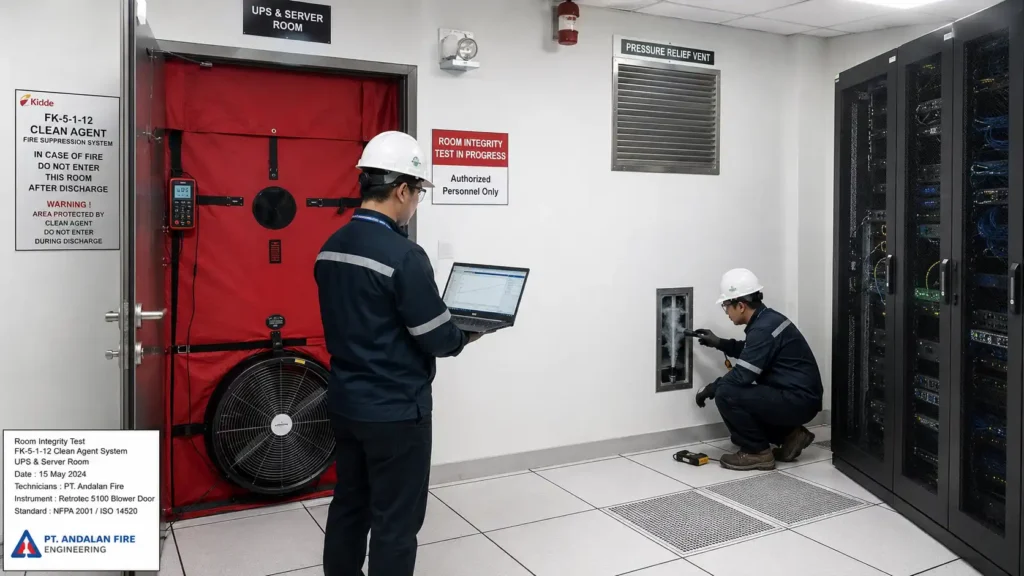
Testing and commissioning confirm that all mechanical, electrical, detection, alarm, and control components operate according to the approved design.
Common activities include:
- Visual inspection.
- Cylinder pressure or weight verification.
- Cylinder valve inspection.
- Actuator inspection.
- Flexible-hose inspection.
- Distribution-pipe inspection.
- Nozzle-orifice verification.
- Detector activation testing.
- Detection-loop testing.
- Releasing-panel testing.
- Manual-release testing.
- Abort-switch testing.
- Sounder and strobe testing.
- Discharge-delay verification.
- Solenoid-circuit testing.
- Pressure-switch testing.
- HVAC shutdown testing.
- BMS interface testing.
- Cause-and-effect testing.
- Room integrity testing.
- Documentation review.
A full agent discharge is not always performed during commissioning because it requires controlled safety procedures and subsequent agent replacement. Instead, testing may use release-circuit simulation, pneumatic checks, airflow tests, functional tests, and room integrity testing according to the approved procedure.
The commissioning report should include:
- Detector addresses.
- Cylinder information.
- Agent quantity.
- Nozzle data.
- Distribution-pipe calculations.
- Cause-and-effect verification.
- Room integrity results.
- Panel test records.
- Interface test records.
Novec 1230 System Maintenance
The clean agent system must be inspected regularly so it remains ready for emergency operation.
Typical checks include:
- Cylinder pressure or weight.
- Cylinder physical condition.
- Cylinder valves and actuators.
- Flexible discharge hoses.
- Distribution piping.
- Nozzle obstruction.
- Releasing control panel.
- Backup batteries.
- Detector condition.
- Manual release station.
- Abort switch.
- Alarm devices.
- Pressure switches.
- Warning signage.
- Room sealing.
- HVAC interfaces.
- Event history.
- Previous maintenance records.
Any room modification should trigger a system review. Additional cable penetrations, new doors, HVAC changes, or altered walls can affect both room volume and leakage.
Older systems using the 3M Novec 1230 brand should also have a documented lifecycle plan covering:
- Agent refill availability.
- Agent recovery.
- Spare components.
- Cylinder servicing.
- Manufacturer support.
- Retrofit options.
- Conversion to another approved agent.
Must Existing Novec 1230 Systems Be Replaced?
Not necessarily. The end of 3M’s production does not automatically mean every installed system must be removed immediately.
An existing system can be evaluated based on:
- Cylinder condition.
- Agent quantity.
- Original listing and approval.
- Valve support.
- Spare-part availability.
- Refill availability.
- Manufacturer support.
- Room integrity.
- Fire alarm compatibility.
- Local regulatory requirements.
- Insurance acceptance.
- Lifecycle cost.
However, the owner should prepare a contingency plan for accidental discharge, agent leakage, or cylinder servicing. Refilling the system may become more difficult than when the branded product was actively manufactured.
Potential alternatives may include:
- FK-5-1-12 from another approved manufacturer.
- HFC-227ea.
- Inert gas.
- Another approved clean agent.
Any replacement requires engineering redesign, flow calculations, compatibility checks, authority approval, and updated commissioning documentation.
Common Mistakes in Novec 1230 Projects
Common mistakes include:
- Treating Novec 1230 and FK-5-1-12 as identical brand names.
- Failing to verify agent availability after 2025.
- Using cylinders or valves without clear approvals.
- Excluding raised floors or ceiling voids from calculations.
- Ignoring cable penetrations.
- Failing to provide pressure relief.
- Skipping room integrity testing.
- Using inappropriate detector logic.
- Installing the abort switch incorrectly.
- Blocking discharge nozzles with equipment.
- Failing to test HVAC shutdown.
- Preparing an incomplete cause-and-effect matrix.
- Failing to back up panel programming.
- Having no agent refill strategy.
- Changing the extinguishing agent without redesign.
- Failing to reevaluate the system after renovation.
- Providing incomplete commissioning records.
A gaseous suppression system should never be evaluated only by counting its cylinders. Reliability depends on the complete engineering, detection, releasing, distribution, enclosure, testing, and maintenance process.
Benefits of FK-5-1-12 Clean Agent Protection
A properly engineered system provides several advantages:
- Rapid fire suppression in enclosed rooms.
- No residue after discharge.
- Electrically non-conductive properties.
- Reduced secondary damage.
- Protection for electronic assets.
- Compatibility with total-flooding applications.
- Integration with fire alarms and BMS.
- Support for business continuity.
- Reduced post-discharge cleanup.
- Continuous automatic protection.
These benefits depend heavily on enclosure integrity and correct system design. A room that loses agent rapidly through uncontrolled leakage may not maintain the required suppression concentration.
Why Choose PT Adiwarna Anugerah Abadi?
PT Adiwarna Anugerah Abadi can help owners evaluate clean agent requirements according to room size, asset type, fire hazard, enclosure condition, system approval, and agent availability.
The scope of work can include:
- Site surveys.
- Hazard assessment.
- Clean agent selection.
- System calculations.
- Cylinder sizing.
- Piping and nozzle calculations.
- Fire alarm integration.
- Equipment installation.
- Testing and commissioning.
- Room integrity testing.
- Operator training.
- Preventive maintenance.
- Existing-system assessment.
- Retrofit and system upgrades.
For FK-5-1-12 applications, Adiwarna provides GEMTEX GEM1230. Owners can also consider the GEMTEX GEM200 HFC-227ea system or an inert gas fire suppression system based on project requirements.
For complete projects, Adiwarna EPC Fire Protection services can integrate engineering, procurement, installation, fire detection, clean agent suppression, testing, commissioning, and maintenance.
Conclusion
Novec 1230 is a widely recognized trade name for the FK-5-1-12 clean extinguishing agent. It has been used to protect data centers, server rooms, electrical rooms, control rooms, museums, archives, and other critical facilities without leaving residue on protected assets.
However, 3M ended PFAS manufacturing, including the relevant Novec product line, by the end of 2025. Therefore, new projects must distinguish between the Novec 1230 brand and the generic FK-5-1-12 agent while carefully reviewing product availability, approvals, refill support, and long-term lifecycle requirements.
System reliability also depends on more than the extinguishing agent. Design concentration, cylinders, distribution piping, discharge nozzles, detectors, releasing controls, pressure relief, room integrity, commissioning, and maintenance must function as one integrated system.
PT Adiwarna Anugerah Abadi is ready to support clean agent system design, installation, testing, room integrity testing, maintenance, and migration to an appropriate suppression solution for each critical facility.
Novec 1230 FAQ
Is Novec 1230 the same as FK-5-1-12?
Novec 1230 is a 3M trade name, while FK-5-1-12 is the generic extinguishing agent designation. Other manufacturers may supply approved FK-5-1-12 systems under different brands.
Is Novec 1230 still manufactured?
3M announced its exit from PFAS manufacturing by the end of 2025. Availability of remaining branded stock, service support, or refill supplies should be confirmed with the system manufacturer or authorized supplier.
Must an existing system be replaced immediately?
Not always. Existing systems should be evaluated according to condition, approvals, spare-part support, refill availability, room integrity, and operational requirements.
Is FK-5-1-12 suitable for server rooms?
FK-5-1-12 is electrically non-conductive and leaves no residue, making it suitable for electronic equipment when the system is properly designed, installed, and maintained.
Why is room integrity testing necessary?
The test evaluates whether the enclosure can retain the required clean agent concentration for the specified period. Excessive leakage can allow the agent to escape too quickly.