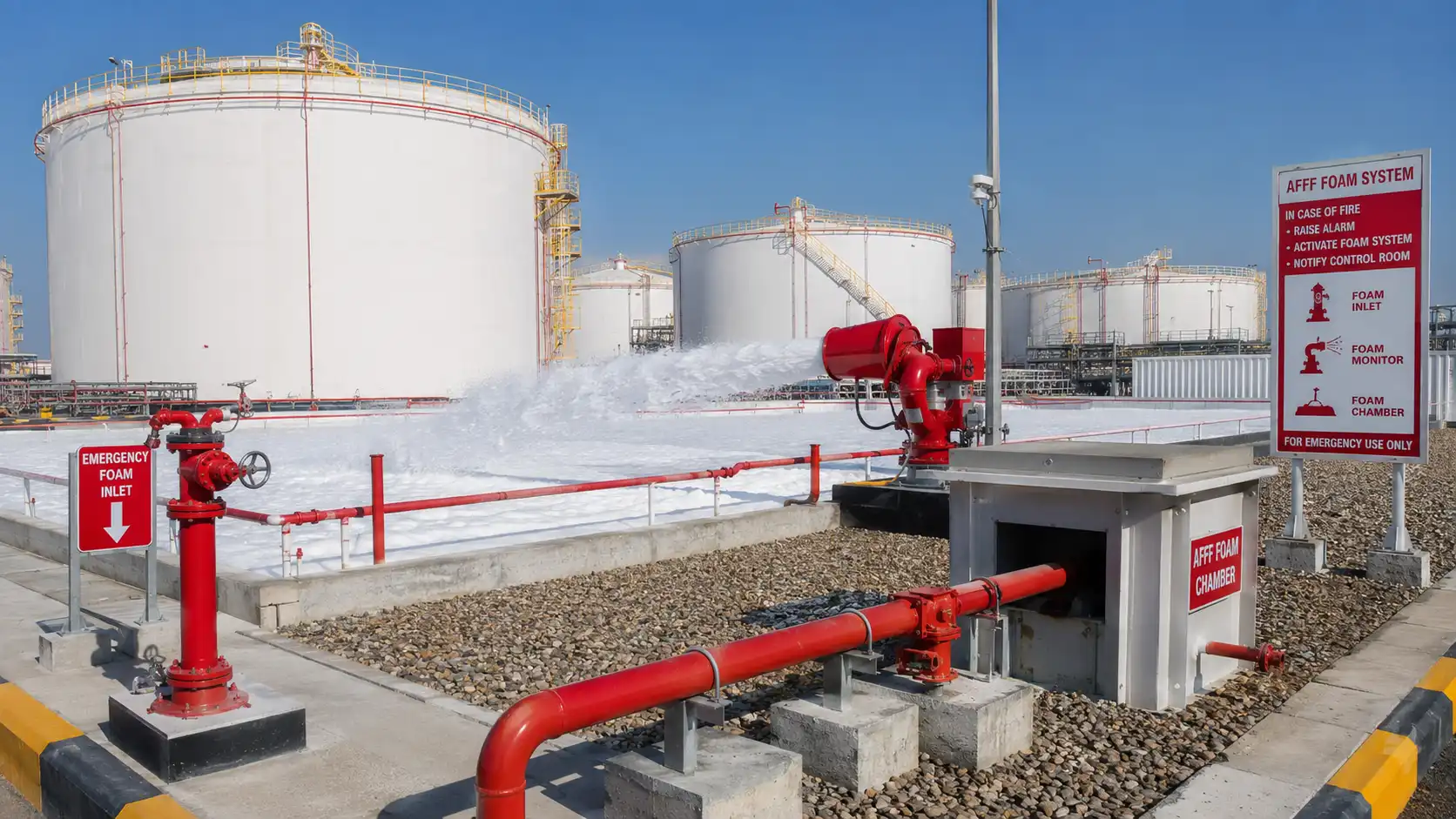

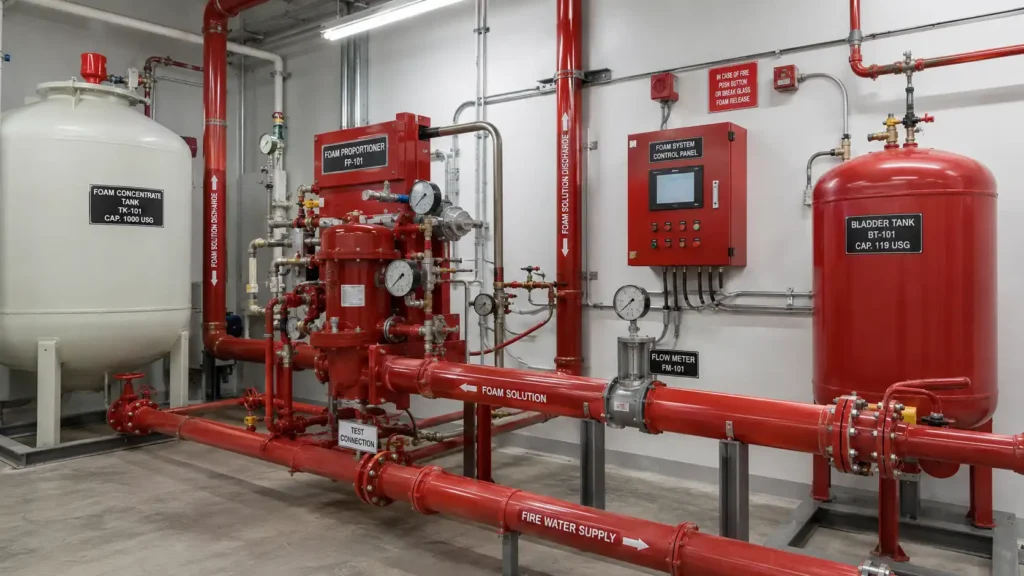
A foam proportioner is a device that introduces foam concentrate into a water stream at a specified ratio so the fire protection system can produce an effective foam solution. Therefore, this component plays an essential role in foam fire fighting systems protecting tank farms, refineries, fuel terminals, petrochemical plants, aircraft hangars, loading areas, and other high-risk industrial facilities.
Foam concentrate cannot normally be applied directly to a fire without first being mixed with water. The proportioning device must introduce the correct amount of concentrate, such as 1%, 3%, or 6%, depending on the product specification and protected fuel.
When the concentration is too low, the finished foam may not form a stable blanket. Conversely, excessive concentration can waste concentrate, affect hydraulic performance, and reduce the system’s available operating duration.
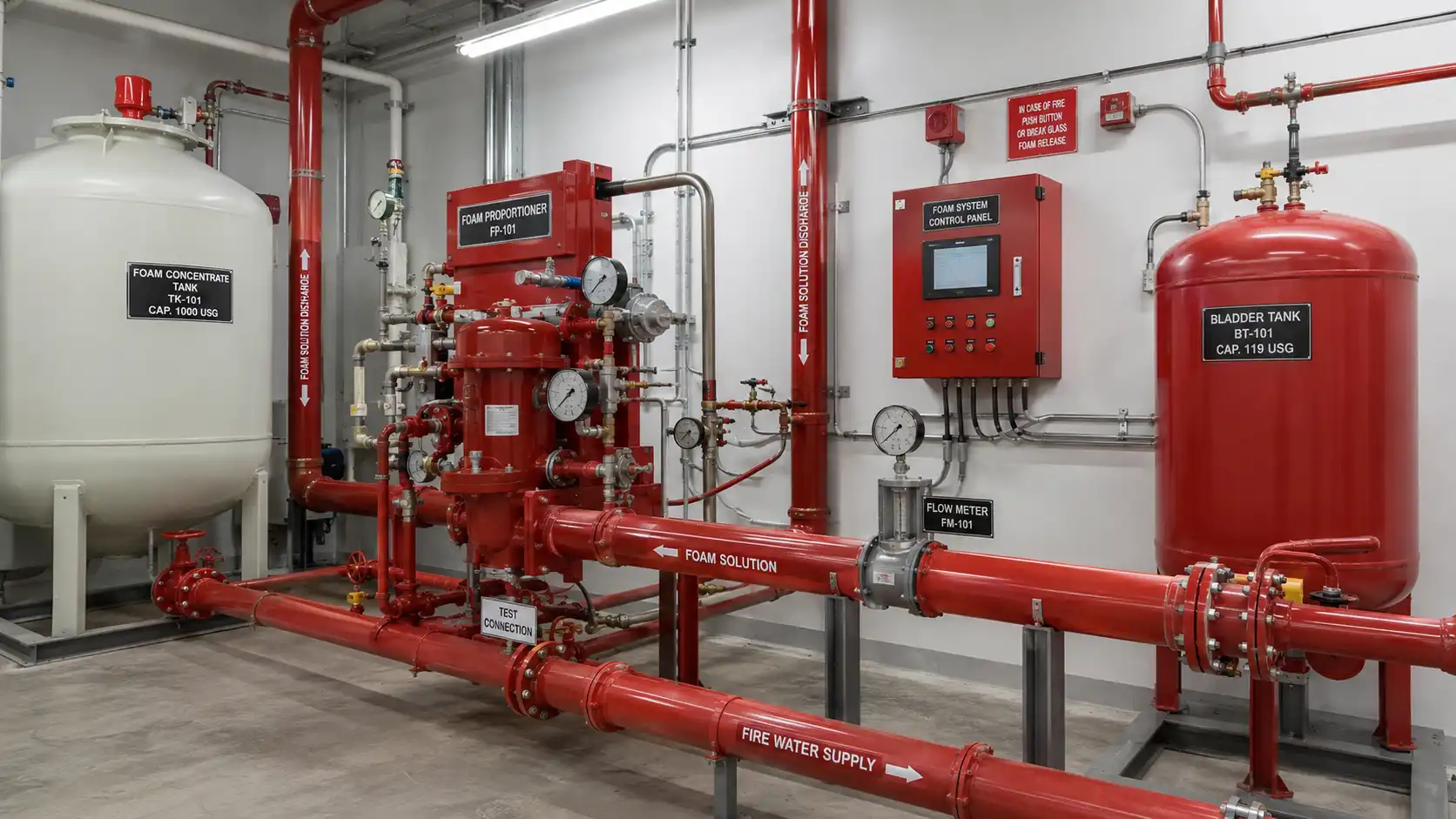
As part of an integrated solution, Adiwarna’s foam fire fighting system for high-risk areas can combine the proportioning equipment with fire pumps, bladder tanks, deluge valves, foam monitors, foam chambers, detection systems, and control panels.
What Is a Foam Proportioner?

A foam proportioner is a mechanical or electronically controlled device that introduces foam concentrate into flowing water at a predetermined percentage. The mixture of water and concentrate is known as foam solution.
The foam solution subsequently travels through the distribution piping to a discharge device. Depending on the application, air may then be introduced to create finished foam that spreads over the fuel surface.
A typical operating sequence includes:
- A fire pump supplies water from the fire water tank.
- Water enters the proportioning device.
- Foam concentrate is drawn or pumped into the water stream.
- Water and concentrate mix at the specified percentage.
- Foam solution flows through the distribution piping.
- A foam monitor, chamber, sprinkler, or nozzle discharges the solution.
- Finished foam forms a blanket over the fuel surface.
The foam blanket helps separate fuel from oxygen, suppress flammable vapors, reduce heat, and minimize the possibility of reignition.
Facilities requiring a complete industrial protection network can integrate the proportioning equipment with Adiwarna’s industrial fire fighting system, including fire pumps, hydrants, fire water piping, sprinklers, valves, and monitoring equipment.
Why Is Proportioning Accuracy Important?
The performance of a foam system is not determined only by the type of concentrate. Its effectiveness also depends on whether the correct concentrate percentage is introduced into the water stream.
For example, a 3% concentrate is designed to operate at the concentration specified by its manufacturer. In principle, the system mixes approximately three parts concentrate with ninety-seven parts water.
However, the actual concentration should never be assumed based only on valve position or pump capacity. It must be verified through a proportioning test during commissioning and periodically during the system lifecycle.
Incorrect concentration may cause:
- Slow foam blanket formation.
- Poor vapor suppression.
- Unstable or rapidly collapsing foam.
- Reduced foam monitor throw.
- Excessive concentrate consumption.
- Insufficient operating duration.
- Unsuitable performance against the protected fuel.
- Failure to meet acceptance-test requirements.
Therefore, equipment selection, hydraulic calculations, pressure balancing, valve arrangement, and concentration testing must be treated as one coordinated engineering process.
Foam Proportioner in an Industrial Foam System
A foam proportioner operates as part of a larger fire protection system. It must function together with the fire water supply, concentrate storage, pumps, valves, distribution piping, control equipment, and foam discharge devices.
Typical supporting components include:
- Fire water tank.
- Electric fire pump.
- Diesel fire pump.
- Jockey pump.
- Foam concentrate tank.
- Bladder tank.
- Foam concentrate pump.
- Ratio controller.
- Deluge valve.
- Isolation and check valves.
- Pressure gauges.
- Flow meters.
- Foam solution piping.
- Foam monitors.
- Foam chambers.
- Foam sprinklers.
- Foam nozzles.
- Releasing control panel.
- Fire alarm interface.
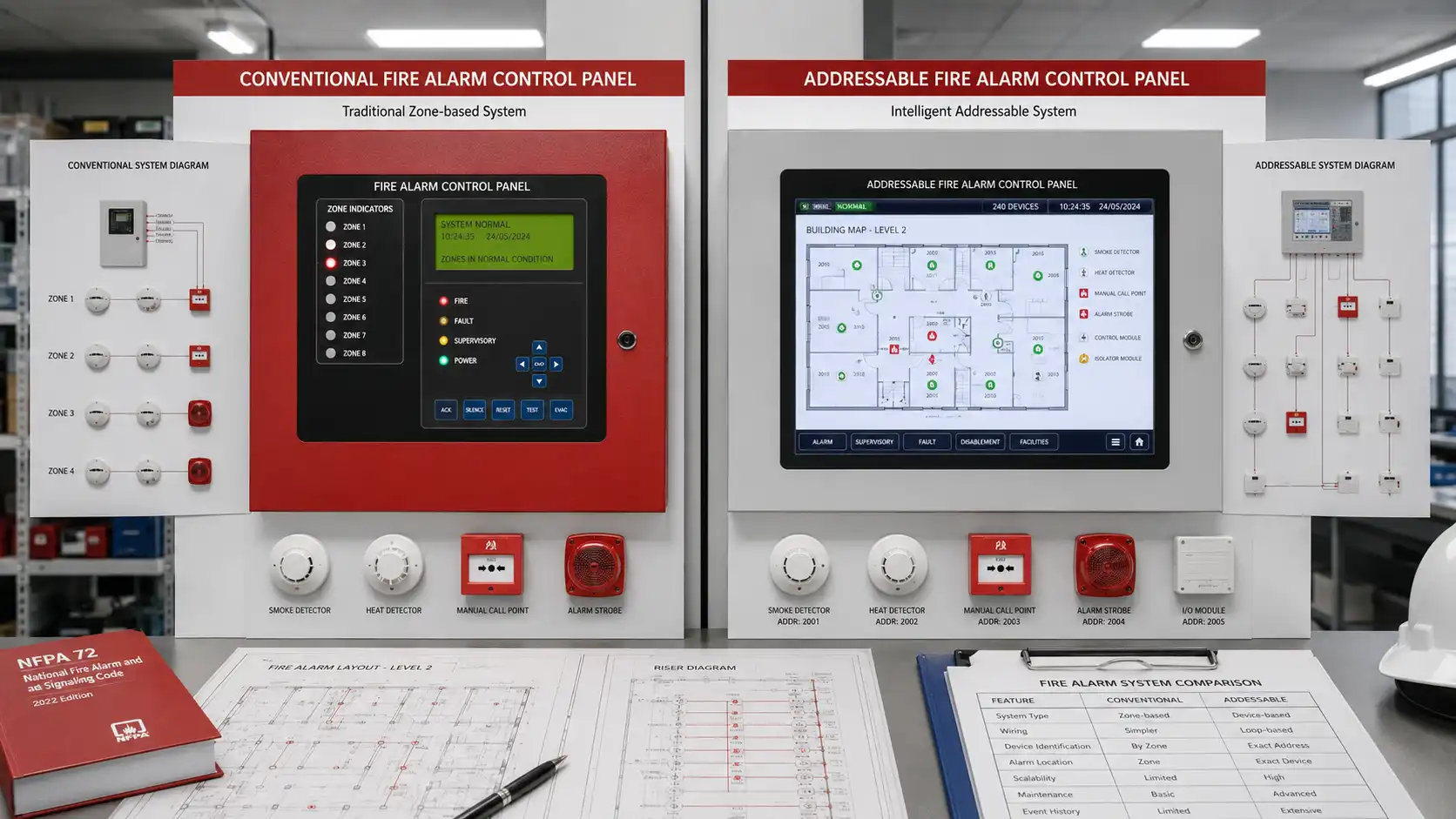
For facilities requiring integrated detection and system activation, Adiwarna’s fire alarm system solutions can connect detectors, releasing panels, alarms, deluge valves, and control-room monitoring.
Foam Proportioner and Mixing-Ratio Accuracy
A foam proportioner must maintain the required concentration within its specified pressure and flow range. Every model therefore has a minimum and maximum operating flow.
When the water flow is below the minimum requirement, the venturi effect or internal metering mechanism may not operate correctly. On the other hand, excessive flow can create unacceptable pressure loss or inaccurate concentrate induction.
Factors affecting proportioning accuracy include:
- Water flow rate.
- Water inlet pressure.
- Foam concentrate pressure.
- Concentrate viscosity.
- Concentrate temperature.
- Ratio-controller size.
- Control-valve position.
- Concentrate piping length and diameter.
- Piping friction loss.
- Active discharge-device quantity.
- Discharge-device back pressure.
- Strainer condition.
- Instrument calibration.
Because foam concentrates have different physical properties, changing the product without a technical evaluation can affect system performance. The existing installation should be reviewed for viscosity, pressure requirements, material compatibility, and proportioning range before a new concentrate is introduced.
Types of Foam Proportioners
Foam systems do not all use the same proportioning technology. The selected method should match the system capacity, protected hazard, required operating duration, flow variation, foam type, and discharge arrangement.
1. Bladder Tank and Ratio Controller
A bladder tank is a pressure vessel containing a flexible internal bladder filled with foam concentrate. When pressurized water enters the space around the bladder, it compresses the bladder and forces concentrate toward the ratio controller.
The ratio controller meters the concentrate into the water stream at the specified percentage. This arrangement does not normally require a separate foam concentrate pump.
Common advantages include:
- Relatively straightforward operation.
- No dedicated foam pump required.
- Suitable for fixed foam systems.
- Compatible with many deluge and foam-water arrangements.
- Operation driven by available fire water pressure.
However, the available concentrate volume is limited by the bladder-tank capacity. The bladder, valves, piping, ratio controller, and concentrate must also be compatible.
The Adiwarna article on the bladder tank as a critical foam-system component explains how pressurized water compresses the internal bladder and transfers concentrate toward the proportioning equipment.
2. Balanced Pressure Proportioning System
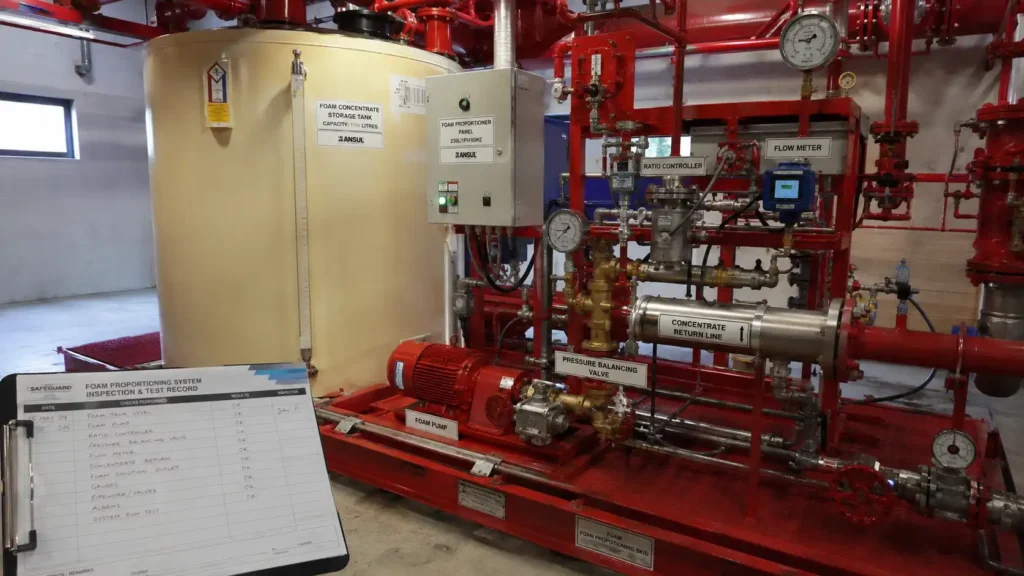
A balanced pressure system uses a foam pump to supply concentrate to the proportioner. Pressure-balancing equipment keeps the concentrate pressure approximately equal to the water pressure at the mixing point.
This system is suitable for large installations or applications requiring extended operating periods. Concentrate can be stored in an atmospheric tank and supplied through a dedicated pump.
Potential advantages include:
- Suitable for high-capacity installations.
- Can serve several protection zones.
- Compatible with fixed monitors and deluge networks.
- Greater flexibility for large industrial facilities.
- Atmospheric concentrate storage can simplify large-volume capacity.
However, it requires additional equipment such as:
- Foam concentrate pump.
- Pressure-balancing valve.
- Relief valve.
- Concentrate return line.
- Pump controller.
- Power supply or engine drive.
- Additional instrumentation.
As a result, design, testing, and maintenance are more complex than a basic bladder-tank arrangement.
3. In-Line Balanced Pressure Proportioner
An in-line balanced pressure proportioner maintains concentrate pressure in relation to the water pressure at a remote mixing point. It can support several zones with different hydraulic conditions.
This arrangement offers flexibility for extensive piping networks. Nevertheless, designers must carefully calculate friction losses, minimum flow, valve operation, and the hydraulically most demanding zone.
4. Around-the-Pump Proportioner
An around-the-pump proportioner diverts part of the fire pump discharge through an eductor. The resulting venturi effect draws concentrate into the stream before the solution returns to the pump suction.
This method may be found on fire-fighting vehicles or selected fixed arrangements. However, it can be sensitive to suction conditions, inlet pressure, pump operating point, and changes in system flow.
The system must be operated within the manufacturer’s limitations so proportioning does not adversely affect the main fire pump.
5. In-Line Eductor
An in-line eductor uses the venturi effect produced by flowing water to draw concentrate from a container or storage tank. It is comparatively simple and is frequently used for portable foam equipment or fixed-flow applications.
Its advantages may include:
- Simple design.
- No separate concentrate pump.
- Suitable for portable applications.
- Practical for a defined flow and nozzle combination.
However, an eductor is highly sensitive to back pressure. Excessively long hose, incorrect nozzle selection, high elevation, or excessive downstream friction loss can prevent proper concentrate induction.
6. Direct Injection Proportioning System
A direct injection system uses a concentrate pump and controller to inject foam concentrate directly into the water stream. Flow meters and electronic controls can regulate concentrate flow according to actual water demand.
This technology can support a wider operating range and adapt to changing system flow. It may be used on fire-fighting vehicles, industrial skids, or systems requiring more flexible concentration control.
However, direct injection requires:
- Reliable power supply.
- Flow instrumentation.
- Controller calibration.
- Foam concentrate pump.
- Sensors and control logic.
- Specialized maintenance.
- Accurate commissioning procedures.
Difference Between a Foam Proportioner and a Bladder Tank
A bladder tank and proportioner have different functions, although they often operate together.
The bladder tank stores foam concentrate and transfers it using water pressure. The proportioner meters the required amount of concentrate into the water stream.
Their functions can be summarized as follows:
- Bladder tank: concentrate storage and pressure transfer.
- Foam proportioner: control of the mixing percentage.
- Ratio controller: metering and mixing component in selected systems.
- Discharge device: application of foam solution to the hazard.
An undersized bladder tank may run out of concentrate before the required discharge duration is completed. Meanwhile, an incorrectly sized ratio controller may not achieve the required concentration across the operating flow range.
Engineers therefore need to calculate:
- Total foam-solution demand.
- Required concentrate percentage.
- Discharge duration.
- Number of operating zones.
- Simultaneous system demand.
- Safety allowance.
- Residual concentrate volume.
- Minimum and maximum system flow.
- Available hydraulic pressure.
Compatibility with Foam Concentrate
The proportioning equipment must be suitable for the selected foam concentrate. Different products may have different concentration requirements, viscosities, operating temperatures, and flow characteristics.
Common foam concentrate categories include:
- AFFF.
- AR-AFFF.
- Fluorine-free foam.
- Protein foam.
- Fluoroprotein foam.
- High-expansion foam concentrate.
- Class A foam.
- Wetting agents.
Adiwarna offers foam concentrate products for industrial, marine, aviation, petrochemical, transportation, and oil and gas applications.
Foam concentrates rated at 1%, 3%, and 6% should not be treated as directly interchangeable. A system originally designed for 3% concentrate must be technically evaluated before changing to a 1%, 6%, or fluorine-free product.
Foam Proportioner for Tank Farm Protection
In a tank farm, the proportioning system may supply foam solution to foam chambers, foam pourers, fixed monitors, mobile monitors, or bund-area protection systems.
A foam chamber is normally installed on a fixed-roof tank to introduce foam gently onto the fuel surface. Meanwhile, foam monitors can protect bund areas, loading points, transfer equipment, and open industrial zones.
Important design considerations include:
- Storage-tank diameter.
- Fuel surface area.
- Fuel characteristics.
- Number of foam chambers.
- Required application rate.
- Operating duration.
- Monitor throw distance.
- Available water supply.
- Concentrate storage capacity.
- Simultaneous system demand.
- Cooling-water requirements.
The complete arrangement can be developed through Adiwarna’s foam fire fighting system, integrating concentrate storage, proportioning equipment, pumps, chambers, monitors, and control systems.
Foam Proportioner for Oil and Gas Facilities
Oil and gas facilities may use foam proportioning systems for:
- Loading racks.
- Fuel-transfer stations.
- Process areas.
- Pump stations.
- Marine jetties.
- Tank farms.
- Refineries.
- Hydrocarbon storage areas.
- Spill-containment zones.
- Petrochemical processing facilities.
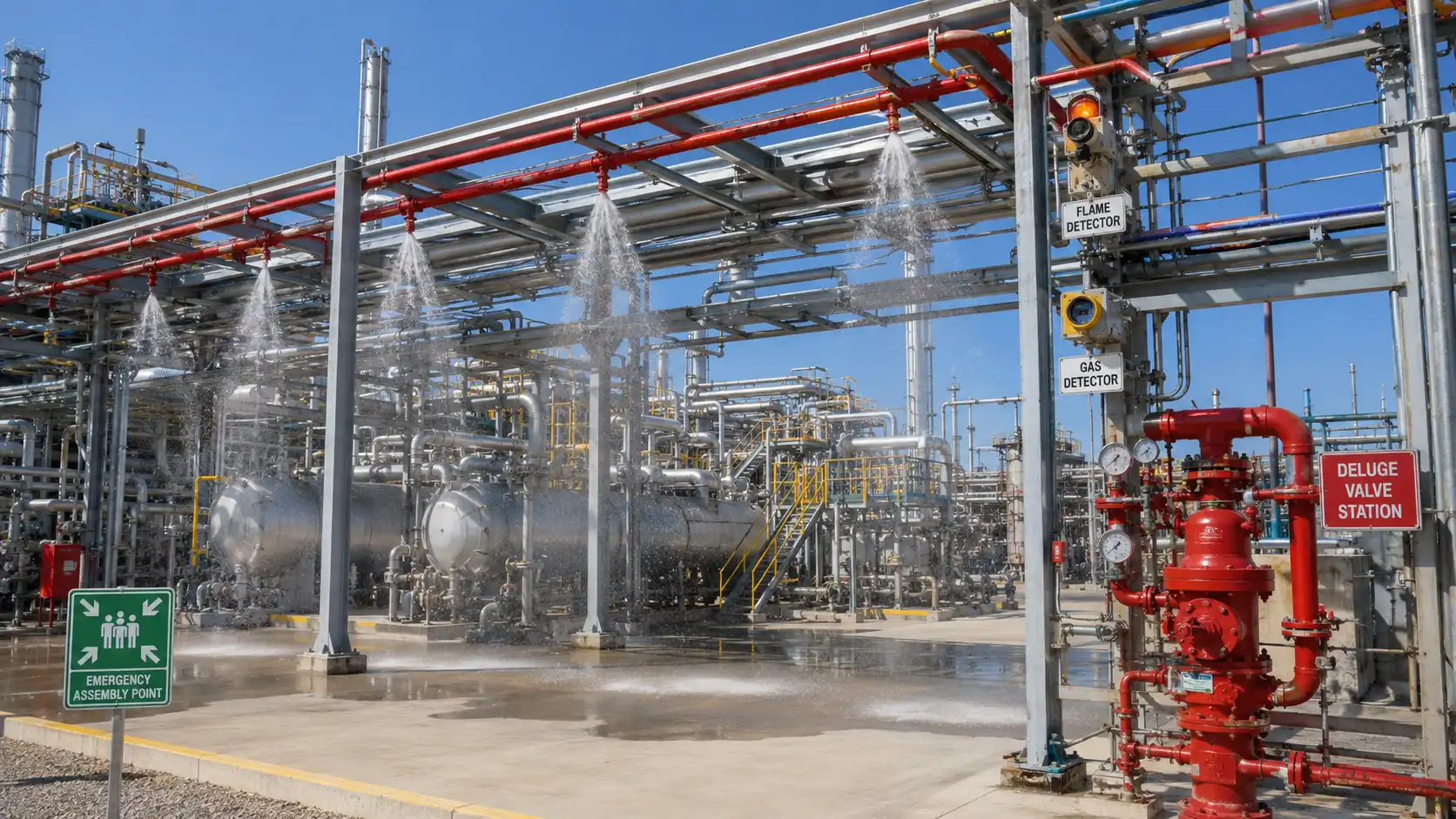
The foam system can be integrated with flame detectors, gas detectors, deluge valves, fire and gas controllers, fire pumps, emergency shutdown systems, and control-room monitoring.
When a valid detector signal is received, the releasing system can open the deluge or foam control valve. The proportioning system then introduces concentrate into the water stream and supplies foam solution to the designated discharge devices.
Application in Aircraft Hangars
Aircraft hangars have large floor areas and may be exposed to aviation-fuel spill hazards. Depending on the facility design, protection may use foam-water sprinklers, deluge nozzles, fixed foam monitors, or high-expansion foam systems.
The proportioning system must supply the correct concentration from the beginning of discharge. It must also provide consistent distribution throughout the protected area.
Important factors include:
- Hangar floor area.
- Aircraft type and size.
- Fuel load.
- Drainage system.
- Foam concentrate type.
- Environmental requirements.
- Activation strategy.
- Required discharge duration.
- Ventilation.
- Emergency response access.
Integration with a Deluge Valve
Foam proportioning equipment is frequently integrated with a deluge system. In this arrangement, a fire detector or manual release station initiates the deluge valve.
After the valve opens, water flows through the proportioner or ratio controller. Foam concentrate then enters the water stream and forms foam solution.
The solution can be distributed through:
- Open foam sprinklers.
- Foam-water spray nozzles.
- Fixed foam monitors.
- Foam chambers.
- Fixed discharge outlets.
For facilities requiring simultaneous area protection, Adiwarna’s deluge valve solutions can be integrated with foam proportioning equipment, detectors, releasing panels, and fire alarm monitoring.
The complete activation sequence should be documented in a cause-and-effect matrix. The control room may also monitor valve position, foam-pump status, waterflow, pressure switches, alarms, and low concentrate level.
Integration with Fire Pumps
The fire pump supplies the water pressure and flow required by the proportioning system. Therefore, its performance curve must match the operating requirements of the foam system.
A typical fire pump set may include:
- Electric fire pump.
- Diesel fire pump.
- Jockey pump.
- Fire pump controllers.
- Suction header.
- Discharge header.
- Flow-test arrangement.
NFPA 20 is commonly referenced for stationary fire pump installations. The pump capacity should be checked against the total demand of all systems expected to operate simultaneously.
Large pressure variations can affect proportioning accuracy. Therefore, designers should evaluate minimum flow, rated flow, maximum demand, residual pressure, and pressure loss through the proportioning equipment.
Foam Proportioner Technical Standards
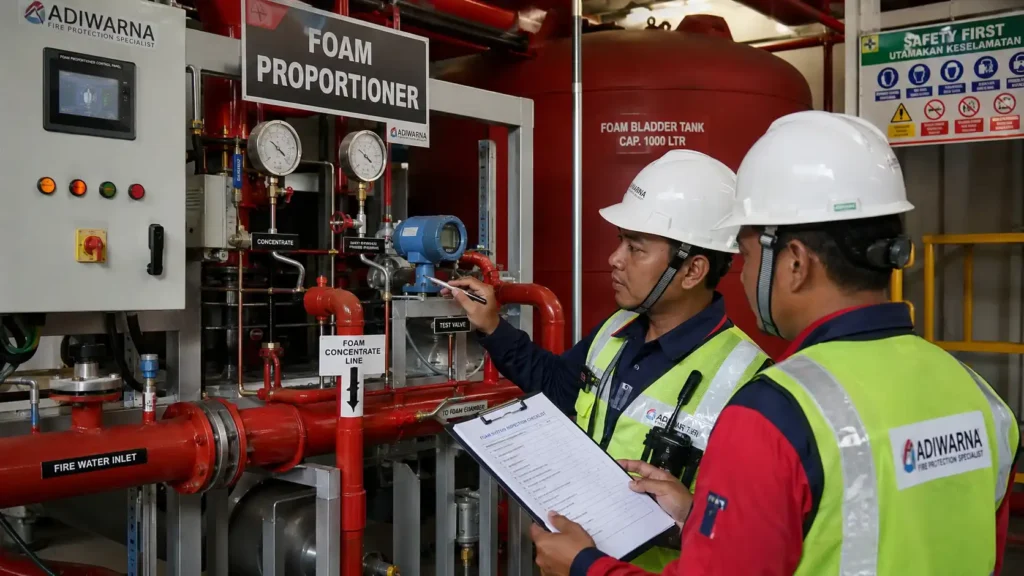
System design should follow applicable standards, authority requirements, insurance specifications, local regulations, product approvals, and manufacturer instructions.
Common references include:
- NFPA 11 for low-, medium-, and high-expansion foam.
- NFPA 16 for foam-water sprinkler and spray systems.
- NFPA 20 for stationary fire pumps.
- NFPA 25 for inspection, testing, and maintenance of water-based systems.
- NFPA 72 for fire alarm and signaling systems.
- Manufacturer datasheets and installation manuals.
- Product compatibility listings.
- Environmental and company HSE requirements.
- Applicable Indonesian regulations and standards.
The concentrate, proportioner, storage tank, valve, and discharge device should be selected as a compatible system package when the project requires listed or approved equipment combinations.
Important Selection Factors
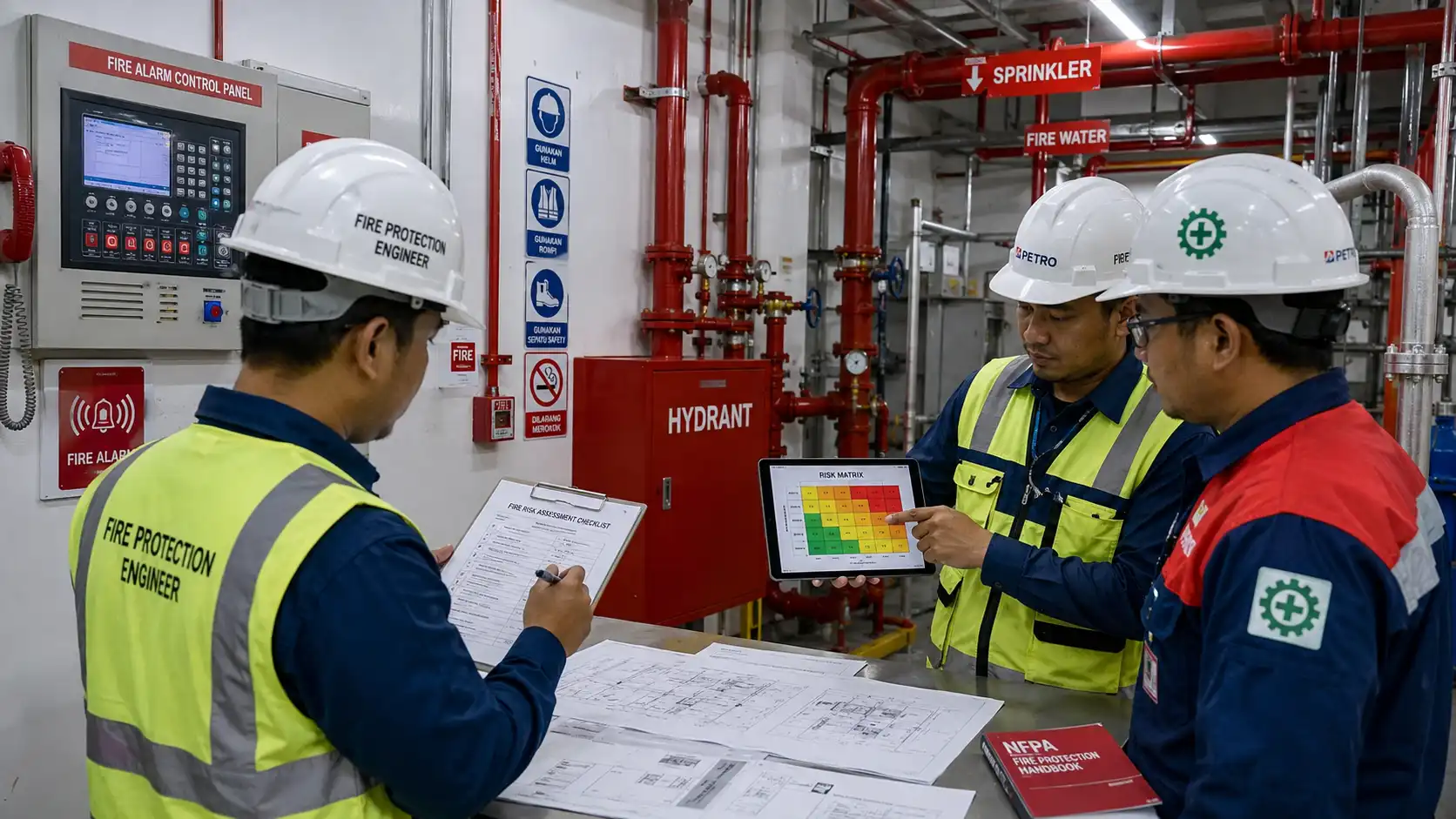
Selecting the correct proportioning device begins with hazard analysis and a defined fire scenario. Engineers need to understand the protected fuel, operating area, discharge arrangement, and required duration.
Important factors include:
- Foam concentrate type.
- Required 1%, 3%, or 6% concentration.
- Concentrate viscosity.
- Minimum and maximum system flow.
- Available water pressure.
- Required concentrate pressure.
- Total foam-solution demand.
- Operating duration.
- Number of protected zones.
- Simultaneous demand.
- Discharge-device type.
- Downstream back pressure.
- Piping friction loss.
- Ambient temperature.
- Hazardous-area classification.
- Material compatibility.
- Corrosion resistance.
- Maintenance access.
- Environmental requirements.
- Availability of spare parts.
A proportioner should be sized for its entire operating range, not only the maximum system demand. Oversized equipment may fail to proportion correctly at minimum flow.
Hydraulic Calculations
Hydraulic calculations confirm that water and foam solution reach each discharge point at the required flow and pressure.
The calculation should consider:
- Flow at each nozzle or monitor.
- Total system demand.
- Pipe diameters.
- Fitting equivalent lengths.
- Elevation differences.
- Proportioner pressure loss.
- Deluge-valve pressure loss.
- Minimum discharge pressure.
- Fire pump operating point.
- Residual pressure.
- Simultaneous demand from other systems.
Pressure loss through the proportioning device must not be ignored. If the drop is excessive, the most remote nozzle may not produce the required discharge pattern.
Conversely, equipment sized only for maximum flow may not operate accurately when fewer discharge devices are active. Therefore, the selected device must match both minimum and maximum operating conditions.
Testing and Commissioning
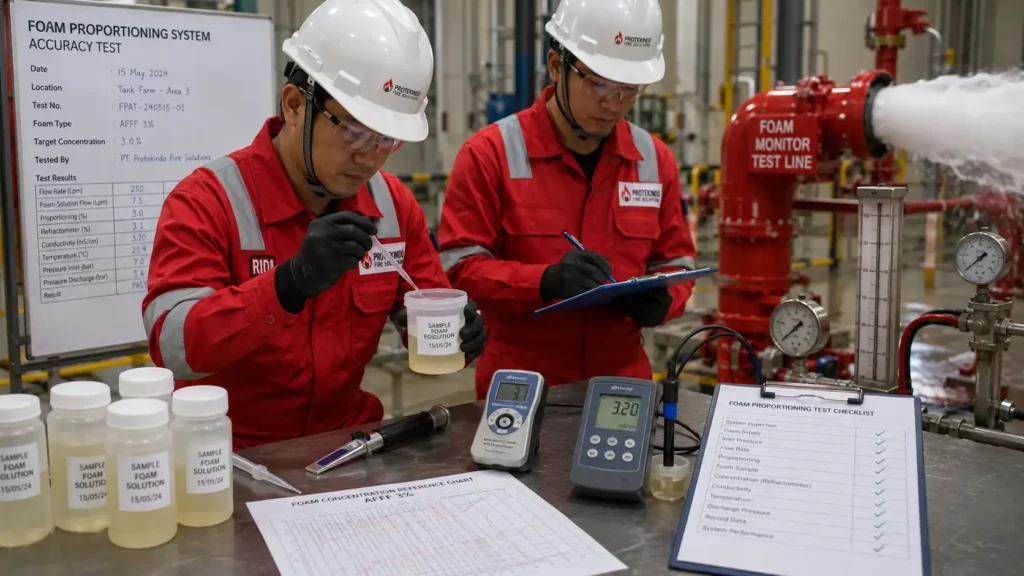
Testing and commissioning must demonstrate that the system produces the required foam concentration. Confirming only that water or foam exits a monitor is not sufficient.
Typical commissioning activities include:
- Visual inspection.
- Pipe flushing.
- Hydrostatic pressure testing.
- Valve-alignment verification.
- Fire pump performance testing.
- Foam pump testing.
- Bladder-tank inspection.
- Proportioner flow testing.
- Foam concentration testing.
- Pressure measurement.
- Foam monitor discharge testing.
- Deluge-valve activation testing.
- Alarm integration testing.
- Cause-and-effect testing.
- Low-level alarm testing.
- Control-room signal verification.
- Reset and restoration testing.
- Documentation review.
Foam-solution concentration can be checked using an approved method such as refractive-index or conductivity comparison. Test samples should be evaluated against a calibration curve prepared with the actual concentrate and water used at the facility.
When results fall outside the acceptable range, possible causes include:
- Pressure imbalance.
- Incorrect valve setting.
- Blocked strainer.
- Incorrect orifice size.
- Concentrate viscosity outside the design range.
- Excessive back pressure.
- Incorrect flow-meter calibration.
- Wrong pump operating point.
All discrepancies should be corrected before final system handover.
Foam Proportioner Maintenance
The system requires periodic inspection to remain ready for emergency operation. Maintenance should not focus only on the concentrate level.
Components that require attention include:
- Proportioner body.
- Ratio controller.
- Metering orifice.
- Strainer.
- Foam control valve.
- Bladder condition.
- Foam concentrate pump.
- Pressure gauges.
- Flow meters.
- Check valves.
- Isolation valves.
- Concentrate level.
- Concentrate quality.
- Piping condition.
- Leakage.
- Corrosion.
- Control panel.
- Alarm interfaces.
- Foam discharge devices.
After testing, every valve must be restored to its normal position. Used concentrate should be replenished, and the control panel should be checked to confirm that no circuit remains disabled or in trouble condition.
A professionally managed EPC fire protection project can include engineering, procurement, installation, testing, commissioning, documentation, and maintenance planning for the complete foam system.
Converting to Fluorine-Free Foam
Changing from AFFF to fluorine-free foam may require more than simply replacing the liquid in the storage tank. The new concentrate may have different viscosity, flow, application, and proportioning characteristics.
The conversion assessment may need to include:
- Cleaning the concentrate tank and piping.
- Seal and gasket compatibility.
- Operating viscosity.
- Proportioner flow range.
- Minimum system flow.
- Discharge-device compatibility.
- Required application rate.
- Foam quality.
- Proportioning test results.
- Fire-performance approvals.
- Disposal of the previous concentrate.
- Environmental procedures.
The entire package—including concentrate, storage, proportioner, piping, and discharge devices—should be reviewed before conversion.
Common Foam Proportioner Project Mistakes
Design or installation errors can result in a visually complete system that does not produce the correct foam solution.
Common problems include:
- Selecting the wrong foam concentration.
- Oversizing the proportioner.
- Failing to meet minimum flow.
- Pressure imbalance.
- Installing the device in the wrong direction.
- Blocked concentrate strainers.
- Excessive back pressure.
- Undersized concentrate storage.
- Excessively long concentrate piping.
- Incorrect concentrate-pipe diameter.
- Insufficient foam-pump pressure.
- Using incompatible concentrate.
- Changing foam type without reevaluation.
- Failing to prepare a calibration curve.
- Skipping concentration testing.
- Leaving valves in the wrong position.
- Not testing the cause-and-effect sequence.
- Incomplete commissioning records.
- Insufficient maintenance access.
Avoiding these issues helps maintain stable foam concentration and improves emergency readiness.
Benefits of a Properly Designed Proportioning System
Accurate foam proportioning provides several operational and safety benefits.
First, the foam blanket can form according to the concentrate’s intended performance. Therefore, fuel separation, vapor suppression, and resistance to reignition can be improved.
Second, concentrate consumption becomes more controlled. The system avoids excessive usage caused by over-proportioning.
Third, concentrate storage and operating duration become easier to predict. This is important for facilities that must sustain foam discharge for a specified period.
Fourth, proportioning-test results can support HSE audits, insurance reviews, authority inspections, and maintenance records.
Finally, an integrated system allows operators to monitor pumps, valves, concentrate levels, alarm signals, and system discharge status from the control room.
Why Choose PT Adiwarna Anugerah Abadi?
PT Adiwarna Anugerah Abadi can help companies design foam proportioning systems according to fuel type, protected area, application rate, flow demand, and foam concentrate characteristics.
The scope of service can include:
- Site surveys.
- Hazard analysis.
- Engineering design.
- Hydraulic calculations.
- Equipment selection.
- Procurement.
- Installation.
- Testing.
- Commissioning.
- Operator training.
- Preventive maintenance.
- Troubleshooting.
- System upgrades.
Adiwarna’s foam system solutions can support tank farms, refineries, oil and gas facilities, fuel storage areas, petrochemical plants, chemical facilities, and other high-risk industrial operations.
The system can be integrated with bladder tanks, fire pumps, deluge valves, foam monitors, foam chambers, hydrants, and fire alarm equipment. For consultation, design, installation, testing, or maintenance requirements, companies can contact PT Adiwarna Anugerah Abadi through the Adiwarna contact page.
Conclusion
A foam proportioner is a critical component that controls the ratio of foam concentrate introduced into the water stream. Therefore, it directly affects the quality of the foam solution supplied to monitors, chambers, sprinklers, and nozzles.
However, system reliability does not depend on the proportioner alone. Performance is also influenced by the concentrate type, fire water supply, fire pumps, bladder tank, foam pump, hydraulic calculations, discharge devices, commissioning, and maintenance.
With proper engineering, a foam system can protect tank farms, refineries, loading terminals, aircraft hangars, petrochemical facilities, and oil and gas sites from flammable-liquid fire hazards.
PT Adiwarna Anugerah Abadi is ready to support the planning, installation, testing, commissioning, and maintenance of integrated foam fire fighting systems designed for each facility’s specific risk.
Foam Proportioner FAQ
What is the main function of a foam proportioner?
Its main function is to introduce foam concentrate into a water stream at a specified percentage, producing the foam solution required for fire suppression.
What is the difference between a proportioner and a bladder tank?
A bladder tank stores and transfers foam concentrate using water pressure. A proportioner regulates the amount of concentrate entering the water stream.
Can a proportioner designed for 3% foam be used with 1% foam?
Not automatically. The orifice, ratio controller, operating flow range, concentrate viscosity, and system compatibility must be evaluated before changing the concentrate.
How is proportioning accuracy tested?
Foam-solution samples can be tested using methods such as refractive-index or conductivity measurement. Results are compared with a calibration curve prepared from the actual concentrate and water.
Does every foam proportioner require a foam pump?
No. Bladder-tank systems and eductors can operate without a dedicated concentrate pump. Balanced-pressure and direct-injection systems normally require one.