
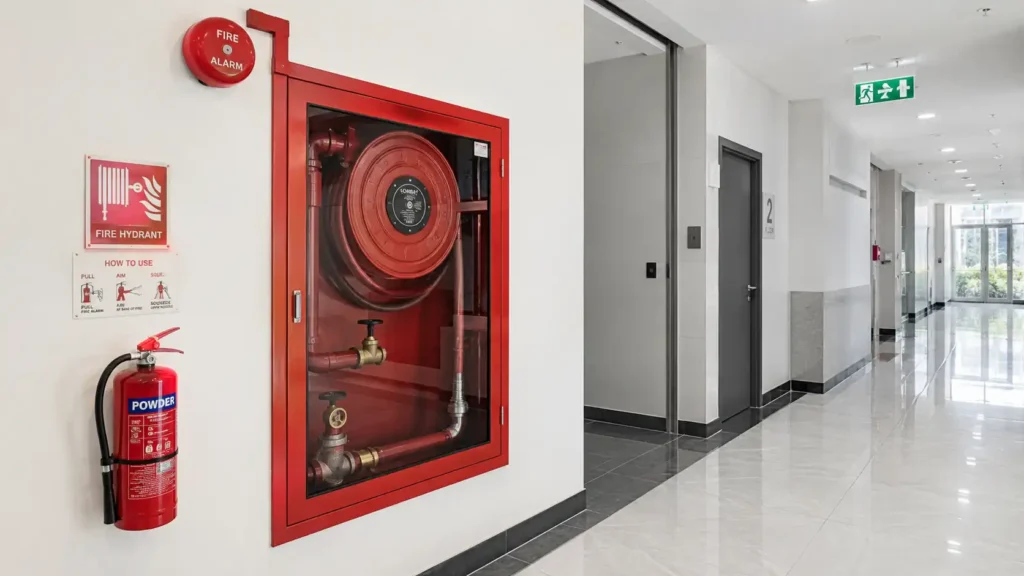
Hydrant box is a fire fighting equipment cabinet used to store fire hoses, nozzles, valves, couplings, and hydrant accessories so they can be accessed quickly during an emergency. Therefore, this equipment becomes an important part of the hydrant system in commercial buildings, factories, warehouses, apartments, hotels, hospitals, malls, industrial areas, and public facilities.
In addition, a hydrant system does not only require pumps, pipes, and water supply. Instead, the equipment at each fire fighting point must also be arranged properly so firefighters, security teams, or trained operators can take the hose and nozzle quickly.
With proper placement, the cabinet helps accelerate the initial fire response. Furthermore, the fire brigade, building operators, or emergency response teams can use the equipment for manual fire suppression.
For water-based fire fighting system needs, PT Adiwarna Anugerah Abadi provides Industrial Fire Fighting System solutions covering hydrant systems, fire pumps, fire water tanks, piping, valves, testing, commissioning, service, and maintenance.
Why Is a Hydrant Box Important?
Hydrant box is important because hydrant equipment must be available in a location that is visible and easy to access. Without the right cabinet, fire hoses, nozzles, or valves can be scattered, damaged, dirty, or difficult to find during an emergency.
In addition, fire emergencies often require a fast response during the first few minutes. Therefore, manual fire fighting equipment must be ready to use without obstruction.
Inside buildings, hydrant cabinets are usually installed in corridors, emergency stair areas, service lobbies, basements, parking areas, and other strategic points. Meanwhile, in outdoor areas, the cabinet can be placed near hydrant pillars, fire access roads, or high-risk areas.
Because its function is directly related to fire fighting readiness, the type, size, material, and installation location must be planned from the engineering stage. Thus, the hydrant system can be used effectively when needed.
Main Function of a Hydrant Box
The main function of this equipment is to store fire fighting tools so they remain safe, neat, and ready to use. In addition, the cabinet helps protect equipment from dust, impact, weather, corrosion, or improper use.
Besides that, the cabinet makes fire fighting points easier to identify. Because it is usually red and clearly labeled, users can recognize it quickly during an emergency.
In some applications, the cabinet can also be equipped with glass, locks, alarm switches, or usage instruction labels. With these additions, building operators can monitor access while keeping the equipment in place.
With these functions, a hydrant cabinet is not merely a storage box. Instead, it becomes part of the overall readiness of the fire fighting system.
Common Components Stored Inside a Hydrant Box
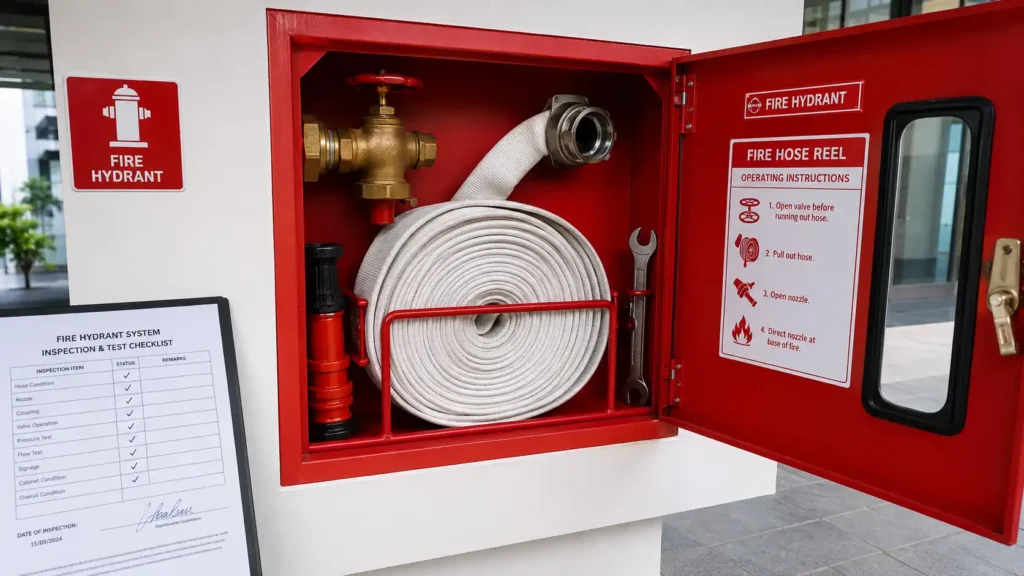
The contents of the cabinet may vary depending on building type, project standards, and system design. Therefore, specifications must be adjusted to field requirements.
Common components include:
- Fire hose.
- Hose rack or hose reel for certain applications.
- Nozzle.
- Landing valve.
- Hose valve.
- Coupling.
- Spanner.
- Branch pipe.
- Fire hose support.
- Glass panel.
- Key lock.
- Instruction label.
- Alarm switch for certain types.
- Fire extinguisher in some combined configurations.
In addition to the main components, some projects may also require additional accessories such as pressure gauges, drains, or special connections. Therefore, the design must refer to the hydrant system drawings and facility operational needs.
Hydrant Box for High-Rise Buildings and Industrial Areas
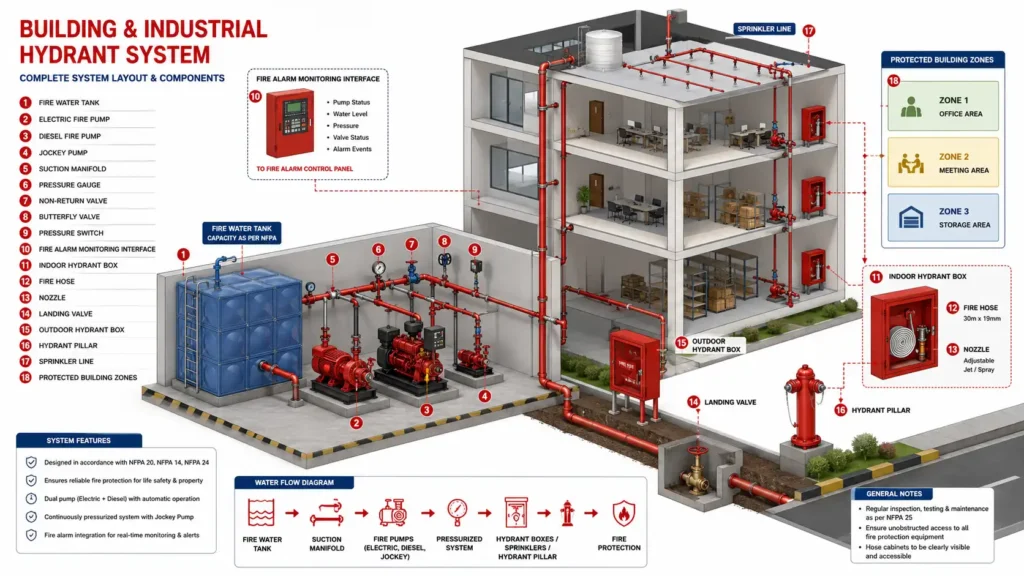
Hydrant box is used in high-rise buildings because the hydrant system must provide fire fighting access on each floor. Therefore, cabinets are usually placed in locations that are easy to reach from evacuation routes and circulation areas.
In commercial buildings, this equipment can be found in corridors, service rooms, basements, parking areas, and near emergency stairs. In addition, the number and distance between cabinets must match the coverage area and the hose length used.
In industrial areas, hydrant cabinets are often used to protect warehouses, production areas, utility rooms, workshops, generator rooms, chemical storage areas, and loading areas. Because industrial fire risks are more complex, the design must consider material types, fire access, and operational activity patterns.
For broader industrial facility needs, Adiwarna provides Industrial Fire Protection Contractor services so the system can be designed based on actual field risks.
Hydrant Box in an Integrated Hydrant System
Hydrant box works as an access point for fire fighting equipment within the hydrant network. Therefore, this equipment must be conceptually connected to fire pumps, fire water tanks, piping, valves, hydrant pillars, and fire brigade connections.
First, the fire pump provides water pressure and flow according to the design requirements. Then, water flows through the piping network to hydrant points inside or outside the building.
After that, personnel open the cabinet, take the hose, attach the nozzle, and connect the equipment to the valve. As a result, water can be directed manually to the fire point.
To ensure this process works properly, all components must be tested during commissioning. In addition, building operators need to understand the usage procedure so emergency response is not delayed.
Types of Hydrant Box Based on Installation Location
Hydrant cabinets can be classified based on their installation location. Therefore, material, finishing, size, and environmental protection must be adjusted accordingly.
Common types include:
- Indoor hydrant cabinet.
- Outdoor hydrant cabinet.
- Wall-mounted cabinet.
- Free-standing cabinet.
- Recessed cabinet.
- Surface-mounted cabinet.
- Fire hose cabinet.
- Combined cabinet with fire extinguisher.
- Stainless steel cabinet.
- Mild steel cabinet.
In addition, the door design can use glass, solid panels, or a combination of both. The selection should consider safety, accessibility, visibility, and area conditions.
Indoor Hydrant Box
An indoor cabinet is usually installed inside a building. Therefore, its design must match architectural layouts, evacuation routes, and user accessibility.
In indoor areas, the cabinet is often mounted on a wall or partially recessed into the wall. With this method, circulation space remains neat and less obstructed.
In addition, indoor cabinets usually protect equipment from dust and daily operational disturbances. However, the installation location must still be clearly visible and must not be blocked by furniture, partitions, or stored goods.
To keep the system ready for use, periodic inspections must confirm that hoses, nozzles, valves, and accessories are complete. If any component is missing or damaged, replacement must be carried out immediately.
Outdoor Hydrant Box

An outdoor cabinet is used in external areas such as factory yards, tank farms, loading areas, utility yards, and locations near hydrant pillars. Therefore, the material must be more resistant to weather, heat, rain, dust, and corrosion.
Usually, outdoor cabinets require strong finishing, sturdy doors, and placement that does not interfere with fire vehicle access. In addition, the position must be clearly visible from inspection routes or emergency access roads.
In industrial areas, outdoor cabinets can be placed near hydrant pillars so fire hoses and nozzles are ready for use. As a result, manual fire fighting can be performed more quickly.
However, outdoor installation also requires more disciplined maintenance. This is because weather and industrial environments can accelerate damage to paint, hinges, locks, glass, and equipment stored inside the cabinet.
Difference Between Hydrant Box, Hydrant Pillar, and Fire Hose Reel
Many people still assume that all hydrant components have the same function. However, each device has a different role in the fire fighting system.
A hydrant cabinet stores equipment such as fire hoses, nozzles, couplings, and valves. Meanwhile, a hydrant pillar is a water supply point that is usually installed outside buildings or in industrial areas.
A fire hose reel has a hose rolled on a reel and is usually used for initial response in certain areas. Unlike the fire hose stored in a cabinet, the hose reel is easier for trained users to pull out for small-scale initial fire suppression.
By understanding these differences, building owners can select the right equipment. In addition, coordination between cabinets, pillars, hose reels, and piping networks can be planned more effectively.
Integration with Fire Pump and Fire Water Tank
A hydrant system requires a stable water supply. Therefore, the hydrant cabinet must be part of a network supported by fire pumps and fire water tanks.
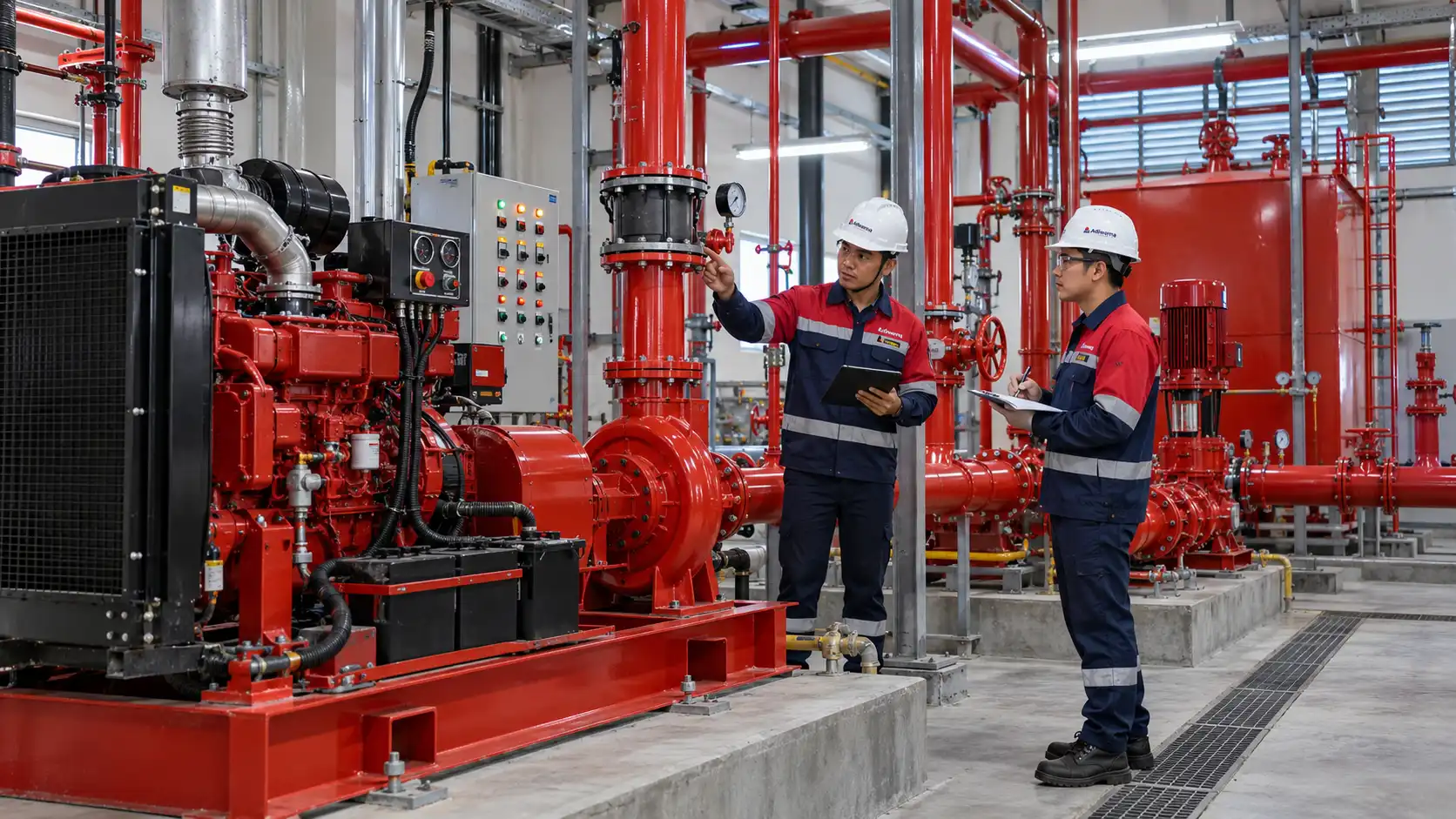
The fire pump provides water pressure and flow. Meanwhile, the fire water tank provides fire fighting water reserves according to the required operating duration.
If the pump is not strong enough, water from the hose will not reach the fire point effectively. Conversely, if the pressure is too high without proper control, the equipment can become difficult to operate and may endanger personnel.
Therefore, hydraulic calculations are very important. With proper design, every hydrant point can receive the required pressure and flow for fire fighting.
Integration with Fire Alarm and Monitoring
In some buildings, hydrant cabinets can be connected to the alarm system through switches or monitoring devices. As a result, operators can know when a cabinet is opened or when the equipment is used.
In addition, the fire alarm system can also monitor flow switches, pressure switches, tamper switches, or fire pump status. This information helps operators understand the fire fighting system condition more quickly.
For fire alarm integration, Fire Alarm System Adiwarna can support panel design, detectors, alarm devices, modules, monitoring, and commissioning.
With proper integration, the hydrant system is not only physically available. Instead, its status can also be monitored as part of the building safety system.
Technical Standards to Consider
Hydrant system design and supporting equipment must consider relevant standards and regulations. Therefore, cabinet selection should not be based only on size or price.
In general, NFPA 14 is often used as a reference for standpipe and hose systems. In addition, NFPA 20 can be used as a reference for fire pump installation, while NFPA 24 relates to private fire service mains.
For projects in Indonesia, SNI, fire department requirements, building safety regulations, insurance requirements, and company internal standards should also be considered. Thus, the design can meet technical requirements and local obligations.
Items that are usually reviewed include installation location, coverage area, hose size, nozzle type, working pressure, cabinet material, signage, fire access, and inspection procedures.
Important Factors in Hydrant Box Selection
The selection of a hydrant cabinet must consider field conditions and system requirements. Therefore, specifications should not be too generic.
Important factors include:
- Indoor or outdoor location.
- Corrosion risk.
- Fire hose size.
- Nozzle type.
- Valve type.
- Cabinet material.
- Plate thickness.
- Paint finishing.
- Door type.
- Signage visibility.
- User access.
- Installation height.
- Coverage area.
- Maintenance access.
- Alarm integration requirements.
- Project requirements.
In addition, the owner needs to ensure that the cabinet does not obstruct evacuation routes. Instead, the equipment must be easy to reach without disturbing the movement of people and emergency personnel.
Proper Hydrant Box Placement
Cabinet placement must be designed based on building layout, hose length, and risk points. Therefore, the location should not be selected only because a wall space is available.
In buildings, the equipment should be placed in areas that are clearly visible from circulation routes. In addition, locations near emergency stairs or main corridors are often effective choices.
In industrial areas, placement must consider vehicle access, evacuation routes, potential fire sources, production areas, and flammable material locations. Thus, the equipment can be used without obstruction during emergencies.
If the location changes because of renovation or layout modification, the coverage area must be re-evaluated. Therefore, as-built drawings and field inspections must always be updated.
Testing and Commissioning
Testing and commissioning are required to ensure that all equipment is ready for use. Therefore, inspection should not stop at the cabinet’s physical appearance.
Important activities usually include:
- Visual inspection.
- Hose completeness inspection.
- Nozzle inspection.
- Coupling inspection.
- Valve inspection.
- Flow test.
- Pressure test.
- Hose deployment test.
- Cabinet door operation test.
- Signage verification.
- Drain check.
- Fire pump operation test.
- Integration test if monitoring is available.
- Documentation review.
In addition, test results must be recorded in an official report. With this documentation, owners, contractors, consultants, and HSE teams can confirm that the system is ready for use.
If pressure or flow does not meet the design requirements, correction must be completed before handover. Therefore, commissioning becomes an important stage in hydrant installation quality.
Hydrant Box Maintenance
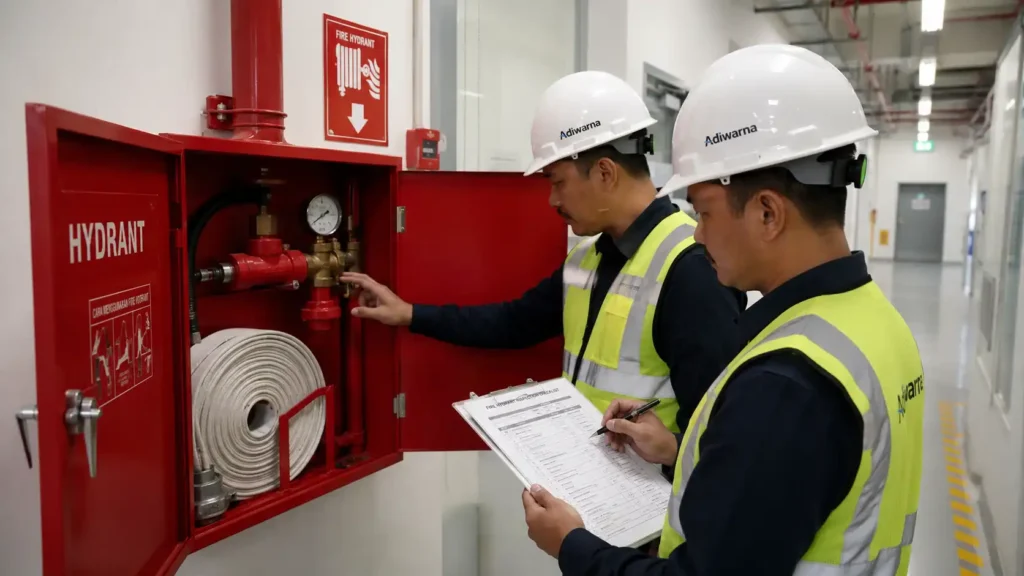
Hydrant box requires periodic maintenance so the equipment inside remains complete and ready to use. Therefore, inspections must be performed regularly, not only during audits or after an incident.
Common checks include cabinet condition, glass, doors, hinges, locks, paint, labels, hoses, nozzles, couplings, valves, and spanners. In addition, technicians must ensure that no unrelated items are stored inside the cabinet.
In outdoor areas, inspection must be more thorough because weather can cause rust, peeling paint, or stuck components. Therefore, hinge lubrication, repainting, and component replacement must be carried out if damage is found.
With proper maintenance, equipment can be used more quickly when a fire occurs. Conversely, a poorly maintained cabinet can become a serious obstacle during an emergency.
Common Mistakes in Hydrant Box Installation
Many problems occur because cabinet installation does not consider operational aspects. Therefore, design and installation must be reviewed comprehensively.
Common mistakes to avoid include:
- The location is difficult to see.
- The cabinet is blocked by stored goods.
- The size does not match the hose.
- The material is not suitable for outdoor use.
- The door is difficult to open.
- The hose is incomplete.
- The nozzle is missing or damaged.
- The coupling is not compatible.
- The valve is stuck.
- The signage is unclear.
- No routine inspection is performed.
- Maintenance access is limited.
- No testing documentation is available.
- Coverage is not re-evaluated after renovation.
By avoiding these mistakes, the hydrant system can work more effectively. In addition, emergency response teams can use the equipment without wasting time.
Benefits of Hydrant Box for Buildings and Companies
A hydrant cabinet provides many benefits for buildings and companies. First, it helps store fire fighting equipment at clear and accessible points.
In addition, the cabinet protects equipment from damage, loss, dust, and operational disturbances. Thus, the service life of hoses, nozzles, and accessories can be better maintained.
Furthermore, a well-organized system also supports HSE audits, authority inspections, and insurance reviews. Therefore, documentation for location, content, testing, and maintenance must be managed properly.
Finally, this equipment helps improve facility readiness for fire emergencies. Therefore, investment in a complete hydrant system provides both safety value and operational value.
Why Choose PT Adiwarna Anugerah Abadi?
PT Adiwarna Anugerah Abadi can help companies design and install hydrant systems as part of integrated fire protection. In addition, Adiwarna understands the needs of various facilities such as commercial buildings, factories, warehouses, data centers, hotels, hospitals, apartments, and industrial areas.
With the right engineering approach, every component can be selected based on risk, standards, building layout, water capacity, system pressure, and operational needs. Therefore, the system is not only installed but also tested, maintained, and ready for use during emergencies.
For projects that require full integration, EPC Fire Protection Adiwarna can support engineering, procurement, construction, testing, commissioning, service, and maintenance.
If your company needs hydrant system design, installation, testing, commissioning, service, or maintenance, consult your project requirements through the Adiwarna Contact Page.
Conclusion
Hydrant box is an important component in a hydrant system because it stores fire fighting equipment so it remains neat, safe, and ready to use. Therefore, this equipment is highly relevant for commercial buildings, industrial facilities, warehouses, hotels, hospitals, apartments, malls, and public areas.
However, system reliability is not determined only by the presence of the cabinet. Instead, fire fighting performance depends heavily on hydrant network design, fire pumps, water supply, installation location, hose completeness, testing, commissioning, and maintenance.
With proper planning, a hydrant system can help accelerate fire response and protect people, assets, operations, and company reputation. Therefore, PT Adiwarna Anugerah Abadi is ready to help deliver professional, integrated, and risk-based fire fighting solutions.