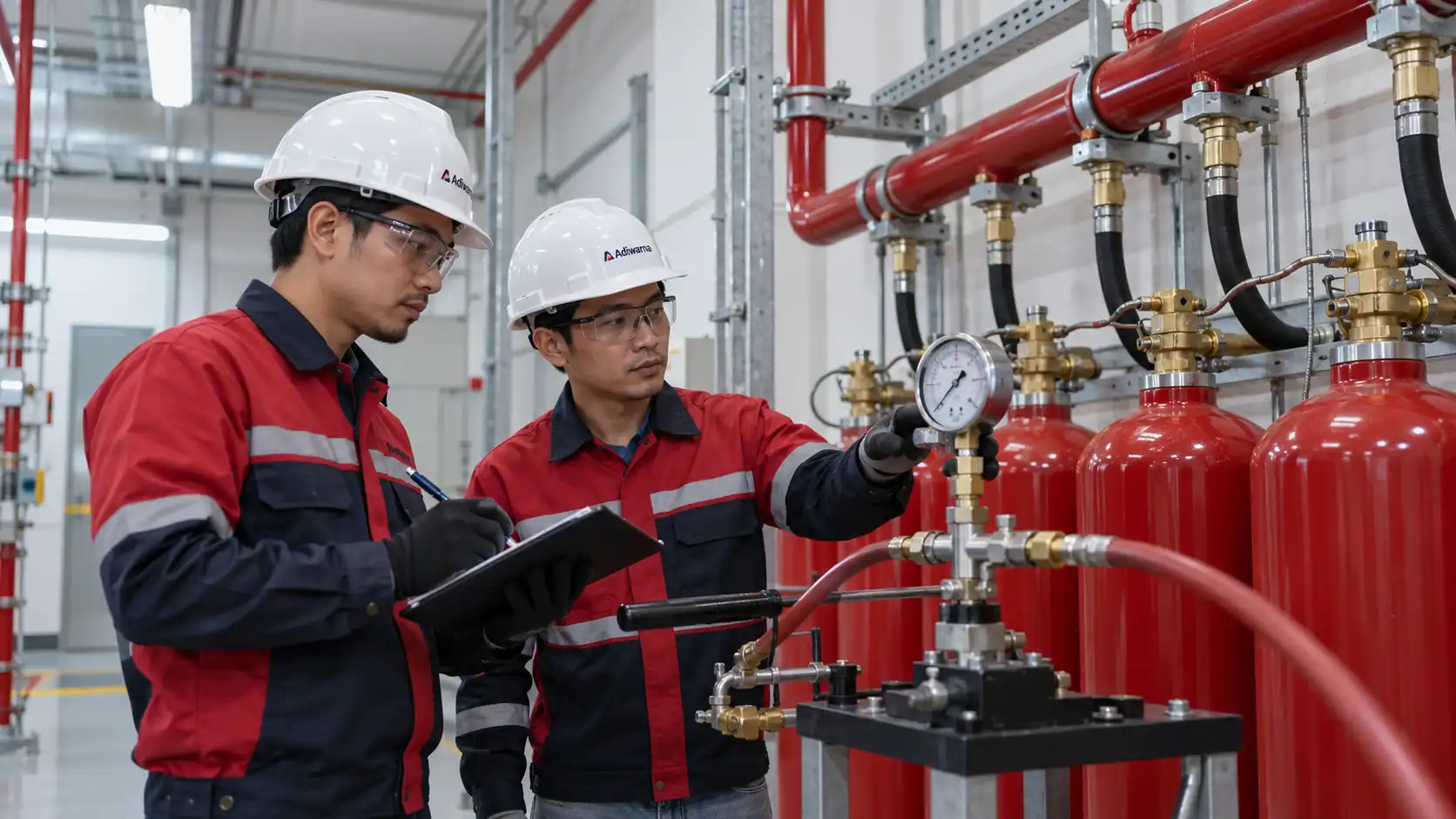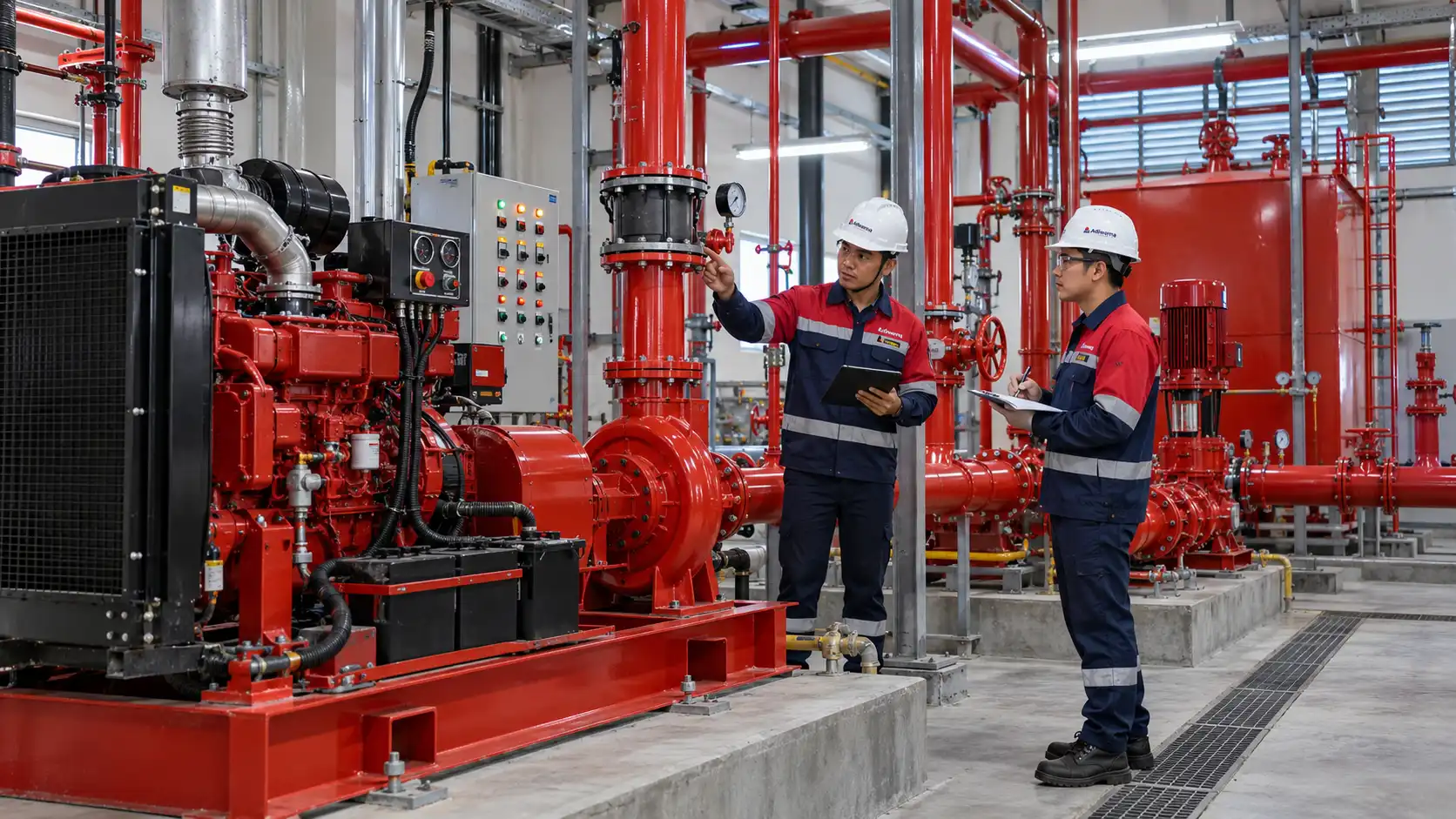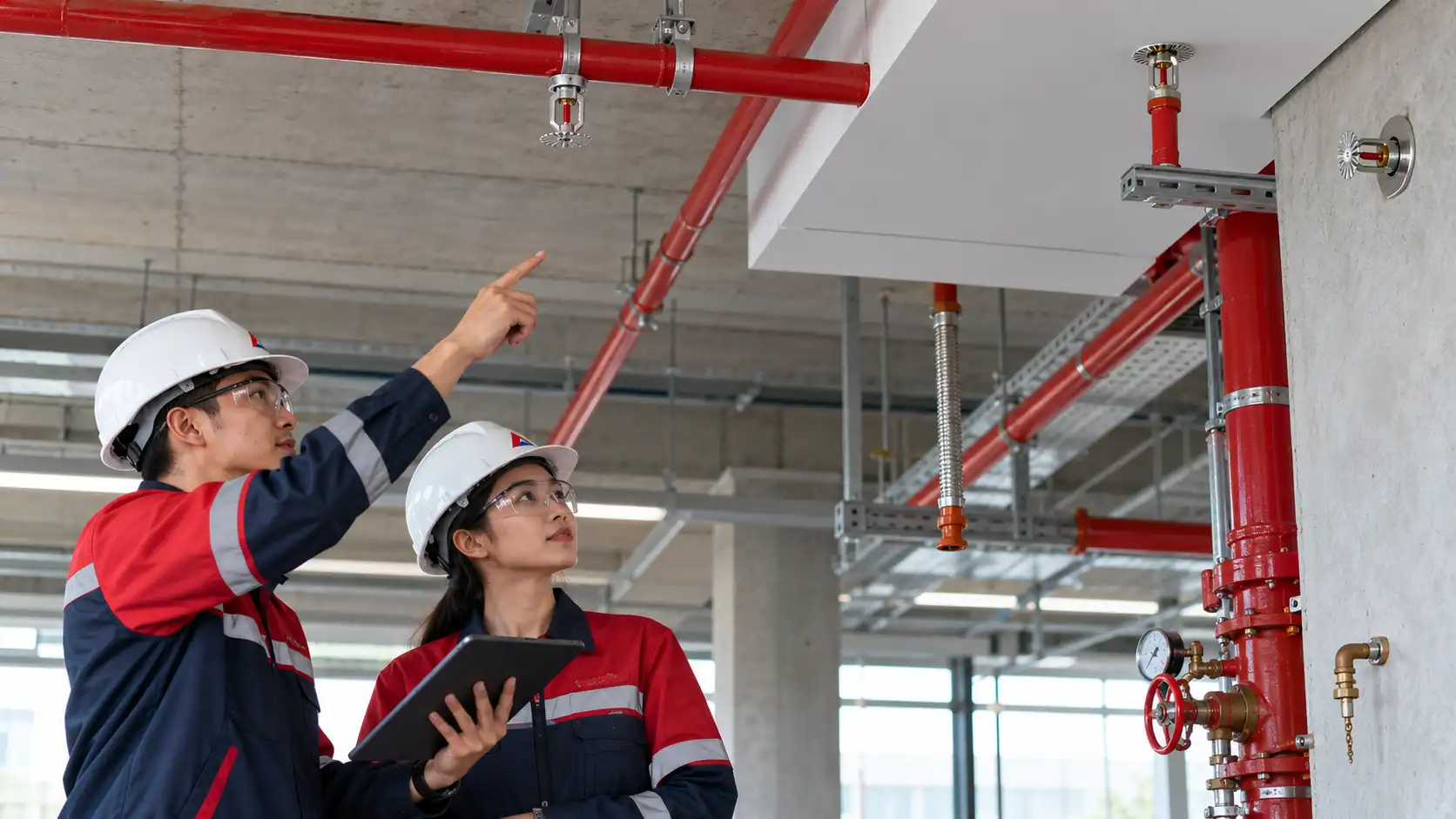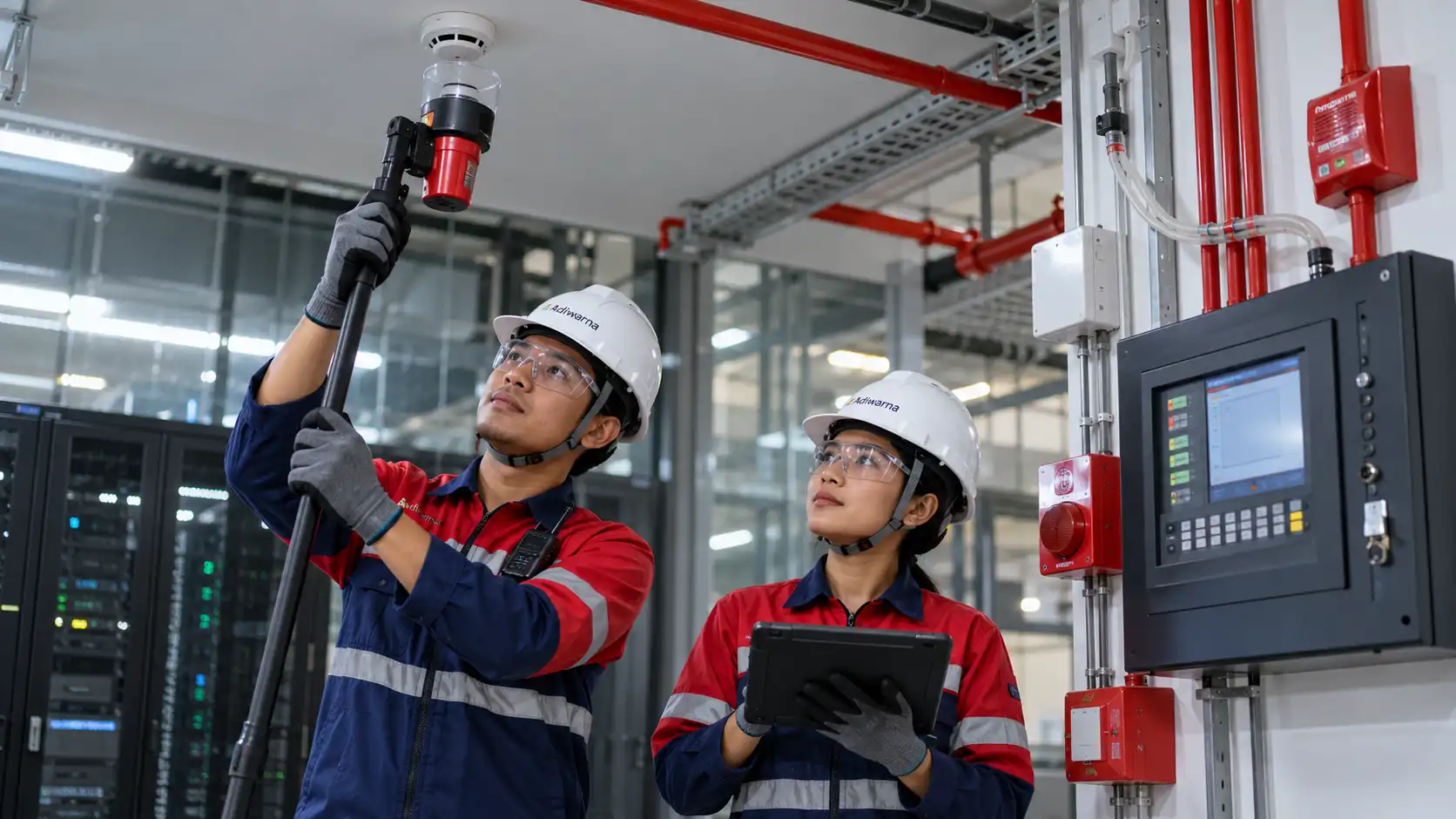

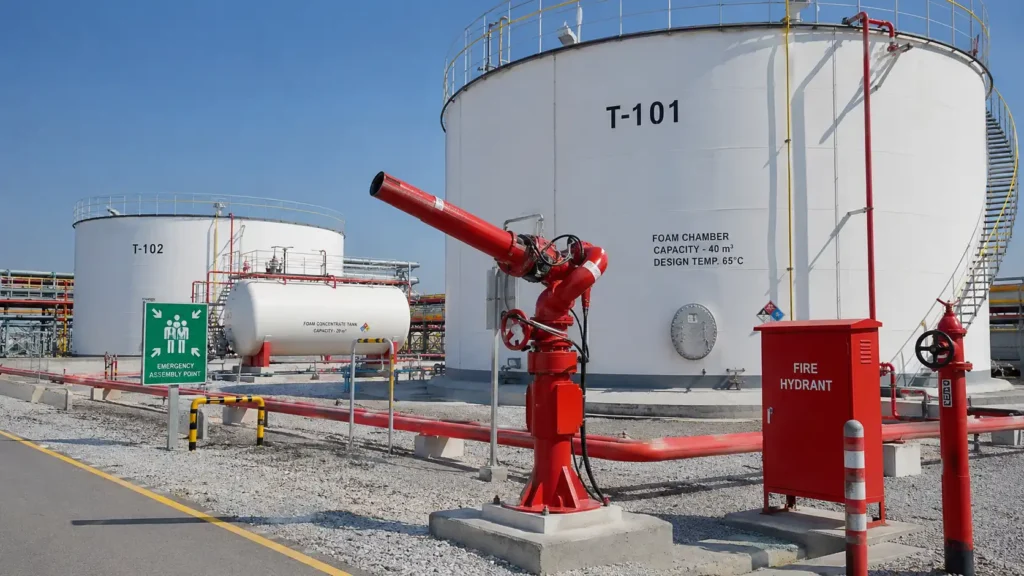
Foam fire fighting system is a foam-based fire suppression system designed to control and extinguish fires involving liquid fuels, flammable liquids, and high-risk industrial areas. Therefore, this system is widely used in oil & gas facilities, tank farms, refineries, chemical plants, loading terminals, jetties, chemical warehouses, power plants, and fuel storage facilities.
In addition, flammable liquid fires are not always effectively controlled by water alone. This is because water can spread certain fuels, while foam works by forming a blanket over the liquid surface.
With this foam blanket, oxygen supply can be reduced, flammable vapor can be suppressed, and heat can be controlled. Therefore, a foam system becomes an important solution for areas with hydrocarbon fire risks or certain chemical liquid hazards.
For industrial fire protection needs, PT Adiwarna Anugerah Abadi provides Foam System solutions that can be integrated with hydrant systems, fire pumps, deluge systems, fire alarms, and other fire protection systems.
Why Is a Foam Fire Fighting System Important?
Foam fire fighting system is important because several types of industrial fires require special extinguishing methods. Therefore, areas that store liquid fuels, solvents, chemical liquids, or hydrocarbon products must have a system designed according to the risk characteristics.
In addition, fires on liquid surfaces can continuously generate flammable vapor. If this vapor is not suppressed, the fire may reignite even after suppression has been performed.
With foam application, the fuel surface can be covered by a foam layer. As a result, contact between fuel and oxygen can be reduced, while cooling also helps control temperature.
However, foam selection should not be done randomly. This is because fuel type, surface area, application rate, discharge device, operating duration, and foam concentrate capacity must be calculated properly.
How a Foam Fire Fighting System Works
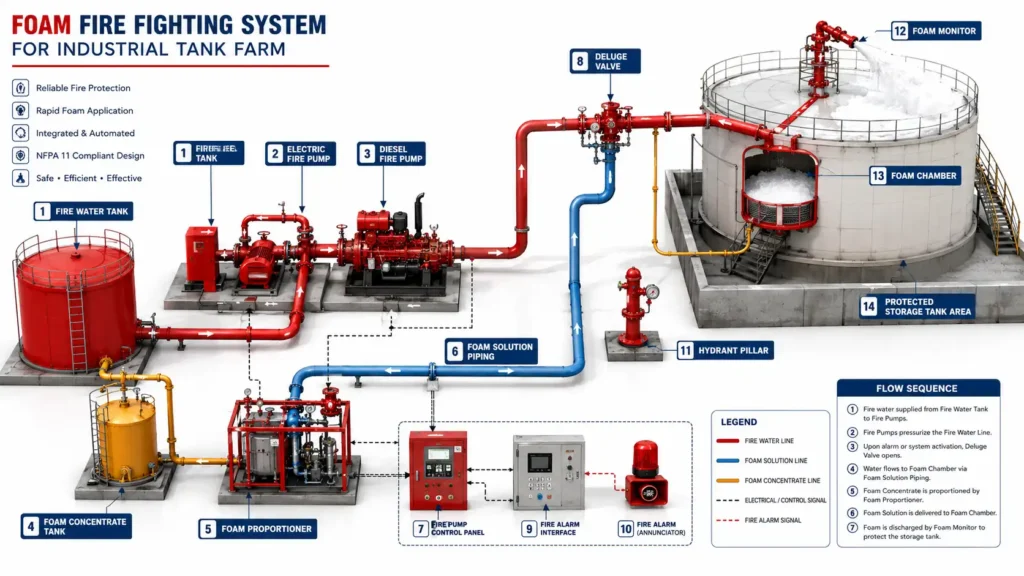
Foam fire fighting system works by mixing water, foam concentrate, and air to produce firefighting foam. First, the fire pump delivers water through the fire protection piping network.
Then, foam concentrate is introduced into the water flow through a foam proportioning system. After that, the water and foam mixture travels to discharge devices such as foam monitors, foam chambers, foam pourers, foam nozzles, or deluge nozzles.
Next, air enters the mixture so foam solution or finished foam is produced according to the equipment type. Thus, foam can spread over the fuel surface and help extinguish the fire.
Because this mechanism depends on hydraulic calculation and foam concentration, the system must be tested periodically. In addition, foam concentrate quality must also be checked so suppression performance remains reliable.
Main Components of a Foam Fire Fighting System
A foam system consists of several connected components. Therefore, every component must be designed according to the capacity and possible fire scenarios.
Common main components include:
- Fire water tank.
- Electric fire pump.
- Diesel fire pump.
- Jockey pump.
- Foam concentrate tank.
- Foam bladder tank.
- Foam proportioner.
- Foam pump.
- Foam monitor.
- Foam chamber.
- Foam pourer.
- Foam nozzle.
- Deluge valve.
- Control valve.
- Isolation valve.
- Test valve.
- Pressure gauge.
- Flow meter.
- Fire water piping.
- Foam solution piping.
- Fire alarm interface.
- Manual release station.
- Control panel.
In addition, the system also requires engineering documents such as hydraulic calculations, foam demand calculations, piping layouts, cause-and-effect matrices, and testing procedures. Thus, system performance can be technically verified.
Foam Fire Fighting System for Tank Farms and Oil & Gas
Foam fire fighting system is highly relevant for tank farms and oil & gas facilities because these areas have fire risks involving fuel, crude oil, condensate, solvents, and other hydrocarbon products. Therefore, the protection system must provide a fast, targeted, and fuel-appropriate response.
In tank farms, foam can be applied through foam chambers, foam pourers, foam monitors, or mobile foam equipment. In addition, tank cooling systems can use water spray or hydrant networks to prevent heat escalation.
Meanwhile, in oil & gas facilities, the foam system can work together with hydrant pillars, fire water monitors, deluge valves, gas detectors, flame detectors, and fire alarm control panels. With this integration, the protection system becomes more prepared for major fire scenarios.
For oil and gas facilities, Adiwarna also provides Oil and Gas Fire Protection System solutions so detection, alarm, suppression, and emergency response can be designed as one integrated system.
Foam Fire Fighting System in Integrated Fire Protection
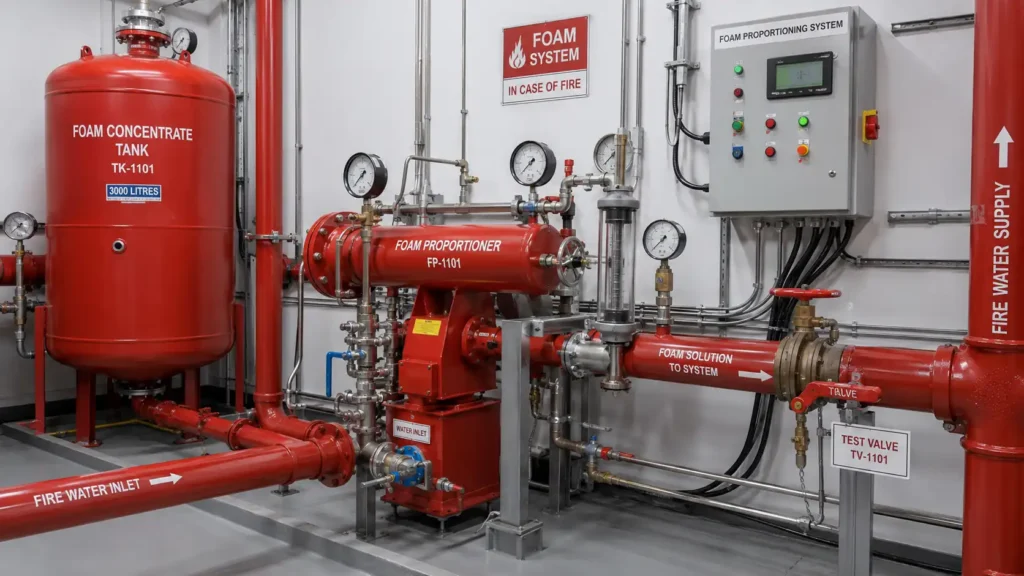
Foam fire fighting system usually does not stand alone. Instead, this system becomes part of a broader fire protection system connected to fire pumps, hydrants, deluge systems, detectors, alarms, and control rooms.
First, a detector or operator identifies a fire condition. Then, the signal can be sent to a panel to activate alarms, open deluge valves, or command the suppression system.
After that, the fire pump delivers water at the required pressure and flow. Next, foam concentrate is mixed at the required ratio so the foam has proper extinguishing quality.
With correct integration, the suppression process becomes faster and more controlled. In addition, operators can monitor system status through a fire alarm panel, BMS, or fire command center.
Common Types of Foam
Foam concentrate is available in several types. Therefore, selection must consider the protected fuel, regulations, environmental requirements, and manufacturer recommendations.
Common foam types include:
- AFFF or aqueous film forming foam.
- AR-AFFF or alcohol-resistant AFFF.
- Protein foam.
- Fluoroprotein foam.
- Film forming fluoroprotein foam.
- Synthetic foam.
- High expansion foam.
- Medium expansion foam.
- Low expansion foam.
- Fluorine-free foam.
In addition, not every foam is suitable for every type of fire. For example, areas that store polar solvents usually require alcohol-resistant foam so the foam blanket does not break down quickly.
Therefore, material safety data sheets, fuel characteristics, and foam compatibility must be checked from the design stage. In this way, the system is not only installed but also truly matched to the fuel risk.
Low, Medium, and High Expansion Foam
Foam can be classified based on expansion ratio. Therefore, engineers need to understand the characteristics of each type before selecting the right application.
Low expansion foam produces foam with a low expansion volume. Usually, this type is used for tank farms, bund areas, loading areas, foam monitors, and open hydrocarbon applications.
Medium expansion foam produces a larger foam volume than low expansion foam. Therefore, this type can be used in certain areas that require wider coverage.
High expansion foam produces a very large foam volume. With this characteristic, it is often used in certain enclosed spaces such as warehouses, basements, tunnels, or areas requiring foam flooding.
However, each application must still be calculated specifically. This is because ventilation, room volume, material type, access, and fire scenario can affect foam performance.
Foam Monitor and Foam Chamber

A foam monitor is used to discharge foam from a certain distance. Therefore, this device is often installed in tank farms, loading terminals, jetties, bund areas, or outdoor areas requiring long-range coverage.
In addition, foam monitors may be fixed monitors, manual monitors, remote-controlled monitors, or mobile monitors. Thus, monitor selection must consider operator access and fire scenarios.
A foam chamber is used to introduce foam into a flammable liquid storage tank. Usually, this device is installed on the upper shell of the tank so foam can flow onto the liquid surface.
Because both devices have different functions, foam monitors and foam chambers cannot be selected only based on price. Instead, selection must follow risk design, area size, and foam application method.
Integration with Fire Pump and Hydrant System
A foam system requires a stable water supply. Therefore, fire pumps and fire water networks must be designed to provide the required pressure and flow.
Fire pumps can consist of electric fire pumps, diesel fire pumps, and jockey pumps. In addition, the fire water tank must have sufficient capacity to meet the system operating duration.
In many industrial facilities, the foam system is also connected to the hydrant system. With this integration, operators can use hydrant pillars, hoses, and monitors to support manual firefighting.
For water-based solutions, Adiwarna’s Industrial Fire Fighting System service can support integrated hydrant, sprinkler, fire pump, and fire water network design.
Integration with Fire Alarm and Detection System
A foam system can be integrated with fire alarm and detection systems so fire response becomes faster. For example, flame detectors, gas detectors, heat detectors, or manual call points can provide early signals.
Then, the panel can process the signal based on the cause-and-effect matrix. After that, alarms, sirens, strobes, valve actuation, or pump start signals can be activated according to the scenario.
However, automatic activation must be designed carefully. Therefore, some projects require alarm verification, manual confirmation, or specific interlocks so the system does not activate without a real need.
As a general reference for alarm systems, NFPA 72 is often used in fire alarm and signaling system design. Thus, alarm integration must follow clear and safe signaling principles.
Technical Standards to Consider
Foam system design must refer to relevant standards and technical guidelines. Therefore, the system should not be selected only based on pump capacity or tank size.
In general, NFPA 11 is often used as a reference for low, medium, and high expansion foam. In addition, standards such as NFPA 20 for fire pumps and NFPA 24 for fire service mains can also be considered according to project scope.
Besides NFPA standards, projects also need to consider local regulations, insurance requirements, company standards, environmental requirements, and manufacturer recommendations. Thus, the design can meet both technical and operational needs.
Important items that are usually reviewed include foam type, application rate, discharge duration, foam concentrate quantity, water demand, hydraulic calculation, proportioning accuracy, piping material, valve arrangement, and testing procedure.
Important Factors in Foam System Design
Foam system design must begin with risk analysis. Therefore, engineers need to understand fuel type, storage capacity, area layout, ignition sources, and firefighting access.
Important factors include:
- Type of flammable liquid.
- Flash point.
- Polar or non-polar solvent.
- Liquid surface area.
- Tank capacity.
- Bund area.
- Application rate.
- Discharge duration.
- Foam concentrate type.
- Water supply.
- Fire pump capacity.
- Proportioning method.
- Discharge device.
- Wind direction.
- Drainage.
- Environmental impact.
- Manual or automatic operation.
- Maintenance access.
In addition, coordination with HSE, operations, engineering, and insurance surveyor teams is very important. This is because each party has different needs that must be integrated into the final design.
Testing and Commissioning
Testing and commissioning are required so the foam system works according to design. Therefore, testing must cover mechanical, hydraulic, control, alarm, and foam quality aspects.
Important activities usually include:
- Visual inspection.
- Pipe flushing.
- Hydrostatic test.
- Flow test.
- Foam proportioning test.
- Foam quality test.
- Valve function test.
- Deluge valve trip test.
- Foam monitor test.
- Foam chamber inspection.
- Pump performance test.
- Alarm integration test.
- Manual release test.
- Cause-and-effect test.
- Documentation review.
In addition, test results must be recorded in an official report. With this documentation, owners, contractors, consultants, HSE teams, and insurance-related parties can assess system readiness.
If proportioning results are not correct, the system must be adjusted. This is because improper foam concentration can reduce suppression effectiveness.
Foam Fire Fighting System Maintenance
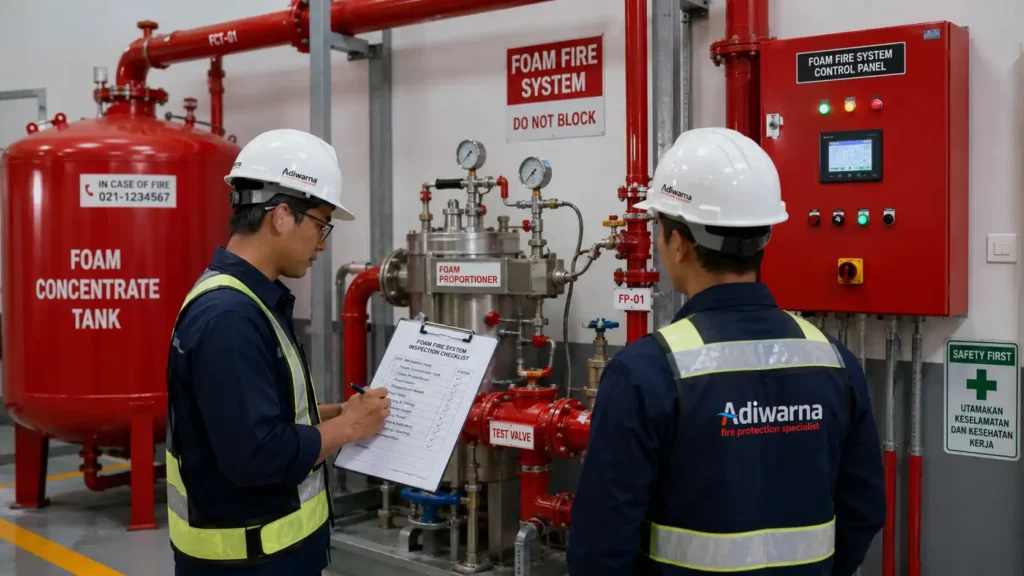
Foam fire fighting system requires periodic maintenance so it remains ready for emergencies. Therefore, inspection should not only cover piping and valves but also foam concentrate.
Common checks include foam tank condition, concentrate level, concentrate quality, valve position, pressure gauge, proportioner, foam pump, fire pump, nozzle, monitor, chamber, piping, and control panel. In addition, alarms and interlocks also need to be tested.
Foam concentrate can change in quality if stored too long or exposed to unsuitable environmental conditions. Therefore, foam sampling and testing should be carried out based on manufacturer recommendations.
With proper maintenance, the system can operate more reliably. Conversely, a system that is rarely tested may fail to generate foam with the required quality.
Common Mistakes in Foam System Projects
Many problems occur because foam systems are designed without complete risk analysis. Therefore, design must begin with fuel characteristics and fire scenarios.
Common mistakes to avoid include:
- Choosing the wrong foam type.
- Not calculating application rate.
- Insufficient foam concentrate quantity.
- Inadequate water supply.
- Unsuitable proportioner selection.
- Incorrect discharge device selection.
- Foam chamber not matching tank size.
- Foam monitor not reaching the risk area.
- Unclear valve arrangement.
- Alarm logic not tested.
- Testing only performed visually.
- Foam concentrate never tested.
- No maintenance access.
- Incomplete commissioning documentation.
By avoiding these mistakes, the system can provide better suppression performance. In addition, facilities can reduce the risk of failure during emergency conditions.
Benefits of Foam System for Companies
A foam system provides major benefits for companies with liquid fuel risks. First, the system helps control fires that are difficult to extinguish with water alone.
In addition, foam can suppress flammable vapor so the risk of reignition can be reduced. Thus, the firefighting process becomes more stable.
Furthermore, a properly designed system can protect high-value assets such as tanks, equipment, products, loading facilities, and production areas. Therefore, this system is very important for high-risk industries.
Finally, design, testing, and maintenance documentation can support HSE audits, insurance reviews, and compliance inspections. Therefore, investment in a foam system provides both safety value and business value.
Why Choose PT Adiwarna Anugerah Abadi?
PT Adiwarna Anugerah Abadi can help companies design foam systems as part of integrated industrial fire protection. In addition, Adiwarna understands the needs of high-risk facilities such as oil & gas, tank farms, refineries, petrochemical plants, chemical plants, warehouses, and power plants.
With the right engineering approach, every component can be selected based on risk, standards, fuel type, water capacity, application rate, and operational requirements. Therefore, the system is not only installed but also ready to be tested, maintained, and operated.
For projects that require full integration, EPC Fire Protection Adiwarna can support engineering, procurement, construction, testing, commissioning, service, and maintenance.
If your company needs foam system design, installation, testing, commissioning, service, or maintenance, consult your project needs through the Adiwarna Contact Page.
Conclusion
Foam fire fighting system is an important solution for protecting high-risk areas that contain flammable liquids, fuels, solvents, or hydrocarbon products. Therefore, this system is highly relevant for oil & gas facilities, tank farms, refineries, chemical plants, jetties, loading terminals, and chemical warehouses.
However, system reliability is not determined only by foam concentrate. Instead, performance depends heavily on design, application rate, water supply, proportioning system, discharge devices, testing, commissioning, and maintenance.
With proper planning, a foam system can help protect people, assets, production processes, and company reputation. Therefore, PT Adiwarna Anugerah Abadi is ready to help deliver professional, integrated, and risk-based fire protection solutions.