
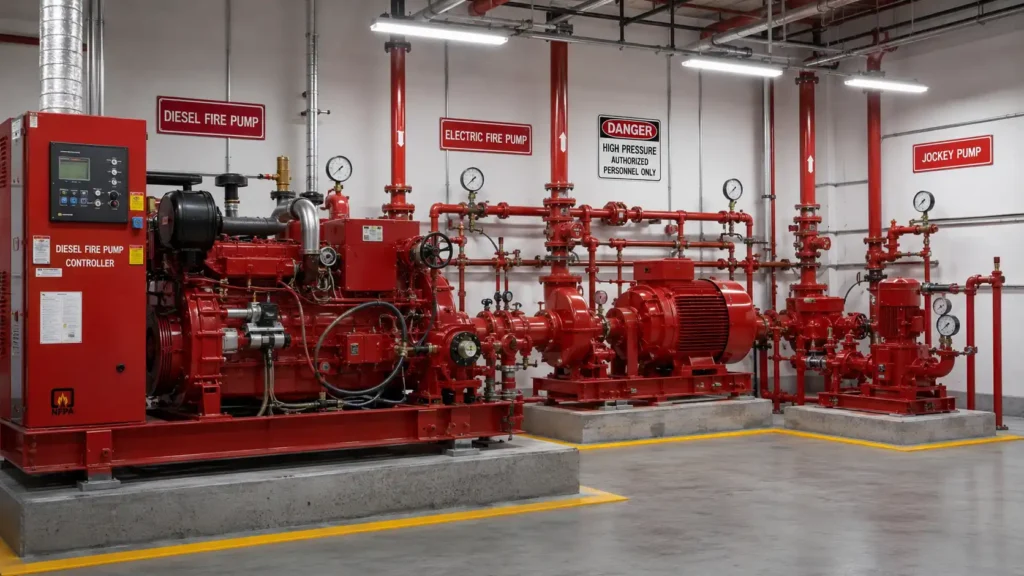
Diesel fire pump is a diesel engine-driven firefighting pump designed to maintain water supply when a fire fighting system requires high pressure and high flow. Therefore, this equipment becomes an important component for industrial facilities, high-rise buildings, factories, warehouses, oil & gas sites, power plants, and other high-risk areas.
In addition, a diesel-driven pump is often used as a backup pump when the main electrical supply is disrupted. As a result, the fire protection system can continue operating during a blackout, electrical panel failure, or power interruption affecting the electric pump.
In a fire fighting system, this pump usually works together with an electric fire pump, jockey pump, fire water tank, hydrant system, sprinkler system, deluge system, and foam system. Therefore, capacity planning, installation, testing, and maintenance must be carried out properly.
For integrated fire protection needs, PT Adiwarna Anugerah Abadi provides Industrial Fire Fighting System services covering design, procurement, installation, testing, commissioning, service, and maintenance.
Why Is a Diesel Fire Pump Important in a Fire Fighting System?
Diesel fire pump is important because a fire protection system should not depend entirely on electricity. If a fire occurs at the same time as a power failure, the electric pump may stop operating, and firefighting water supply may become unavailable.
Therefore, a diesel-driven pump functions as an independent power source. With a diesel engine, the pump can continue operating as long as fuel is available and its supporting systems remain in good condition.
In addition, industrial facilities often have fire risks that require a large volume of water. For example, tank farms, chemical plants, flammable material warehouses, production areas, and utility areas require stable water flow.
With a diesel pump installed, hydrant, sprinkler, deluge, or foam systems can receive sufficient water supply. As a result, firefighting efforts become faster, stronger, and more controlled.
Main Function of a Diesel Fire Pump
The main function of a diesel-driven fire pump is to provide water pressure and flow according to the fire protection design requirements. Therefore, pump capacity must be calculated based on the system demand it serves.
In addition, this pump helps maintain operational continuity during emergency conditions. If the electric pump fails, the diesel pump can take over the firefighting water supply function.
Furthermore, this equipment can support fire protection systems in areas where stable electrical power is limited. Thus, facilities can still maintain protection even when electrical infrastructure is not fully reliable.
In many projects, this pump becomes part of a complete fire pump package. Usually, the package includes an electric pump, diesel pump, jockey pump, controller, header, valves, pressure gauges, flow meter, and fuel system.
Main Components of a Diesel Fire Pump
A diesel-driven pump system consists of several important components. Therefore, each part must be inspected regularly to keep the system reliable.
Common main components include:
- Diesel engine.
- Fire pump.
- Diesel fire pump controller.
- Fuel tank.
- Battery starter.
- Battery charger.
- Cooling system.
- Exhaust system.
- Coupling.
- Base frame.
- Pressure gauge.
- Suction valve.
- Discharge valve.
- Check valve.
- Relief valve.
- Flow meter.
- Test header.
- Flexible connector.
- Fire pump room ventilation.
Besides mechanical components, the electrical control system is also very important. Therefore, the controller, battery, charger, and alarm status must always be ready for operation.
Diesel Fire Pump for Industrial Facilities

Diesel fire pump is widely used in industrial facilities because fire risks are usually more complex than in general buildings. In addition, area size, material type, production capacity, and process characteristics can increase firefighting water demand.
In manufacturing plants, the diesel pump can serve hydrants, sprinklers, and hose reels. Meanwhile, in oil & gas or petrochemical plants, the system can support deluge, foam monitors, hydrant pillars, and fire water networks.
Because every facility has different requirements, pump design must follow the actual hazard classification. Therefore, pump capacity should not be selected based only on a general estimate.
Adiwarna also provides Industrial Fire Protection Contractor services to help companies design fire protection systems according to actual field risks.
Diesel Fire Pump in a Fire Pump System
Diesel fire pump generally operates as part of a fire pump system that consists of several pumps with different roles. First, the jockey pump maintains pipeline pressure so the network does not frequently experience pressure drops.
Then, the electric fire pump operates as the main pump when there is firefighting water demand. However, if the power source fails or pressure is not fulfilled, the diesel pump can operate as a standby or backup pump.
With this configuration, the system has an additional reliability layer. Therefore, industrial facilities can maintain firefighting water supply even when one power source or pump system experiences trouble.
In addition, controller integration must be clearly designed so the pump operation sequence follows the intended logic. Therefore, pressure switches, alarm signals, and status monitoring must be tested during commissioning.
Difference Between Electric Fire Pump and Diesel Pump
An electric fire pump uses an electric motor as its main driver. Therefore, this pump requires stable electrical supply from the utility grid, generator, or emergency power system.
In contrast, a diesel pump uses a diesel engine as its power source. As a result, this equipment can operate independently from the main electrical system.
However, the diesel-driven system requires more attention to fuel, engine oil, coolant, battery, exhaust, and pump room ventilation. Therefore, mechanical maintenance must be carried out more thoroughly.
On the other hand, an electric pump is usually simpler for daily operation. Nevertheless, system reliability becomes stronger when electric and diesel pumps are used together according to the design requirements.
Technical Standards to Consider

Fire pump planning must refer to relevant technical standards. Therefore, design should not be based only on price or pump size.
In general, NFPA 20 is often used as a reference for stationary fire pump installation. In addition, NFPA 25 is widely used as a reference for inspection, testing, and maintenance of water-based fire protection systems.
Besides NFPA standards, projects may also refer to local regulations, insurance requirements, company standards, and manufacturer manuals. Thus, technical specifications must be prepared from the engineering stage.
Important points that are usually reviewed include pump capacity, working pressure, NPSH, suction pipe diameter, discharge pipe diameter, pipe material, valve arrangement, test header, drain, ventilation, fuel tank, and maintenance access.
Pump Capacity and Pressure
Pump capacity must be determined based on the required flow of the fire fighting system. Therefore, engineers need to calculate demand from hydrants, sprinklers, deluge systems, foam systems, or a combination of several systems.
Besides flow rate, pressure must also be calculated carefully. If the pressure is too low, water may not reach the firefighting point effectively.
Conversely, pressure that is too high can overload the pipe network and system components. Therefore, head loss, elevation, friction loss, and residual pressure calculations must be performed in detail.
With proper design, the pump can operate at the required duty point. As a result, the firefighting system has more stable performance during emergencies.
Fire Pump Room and Installation Requirements
The pump room must be designed so equipment is accessible, safe, and protected. In addition, the room must have sufficient ventilation to support diesel engine operation.
Because a diesel engine produces heat and exhaust gas, the exhaust system must be designed properly. Thus, the pump room will not experience heat or smoke accumulation that can affect operation.
In addition, the area around the pump must provide adequate working space. This is important so technicians can perform inspection, testing, and repair safely.
For projects that require complete integration, EPC Fire Protection Adiwarna can support engineering, procurement, construction, testing, and commissioning.
Fuel Tank and Fuel System
The fuel tank is an important component because the diesel engine requires sufficient fuel supply during emergencies. Therefore, tank capacity must be adjusted to operational requirements and project specifications.
In addition to capacity, fuel quality must also be considered. If the fuel is contaminated with water, dirt, or sludge, the engine may experience operational problems.
Therefore, the fuel system should include valves, filters, drains, level indicators, and inspection access. In addition, fuel filling records should be managed properly.
With proper fuel management, the diesel pump is more ready to operate when needed. Conversely, a poorly maintained fuel tank can become a source of system failure.
Battery, Starter, and Controller
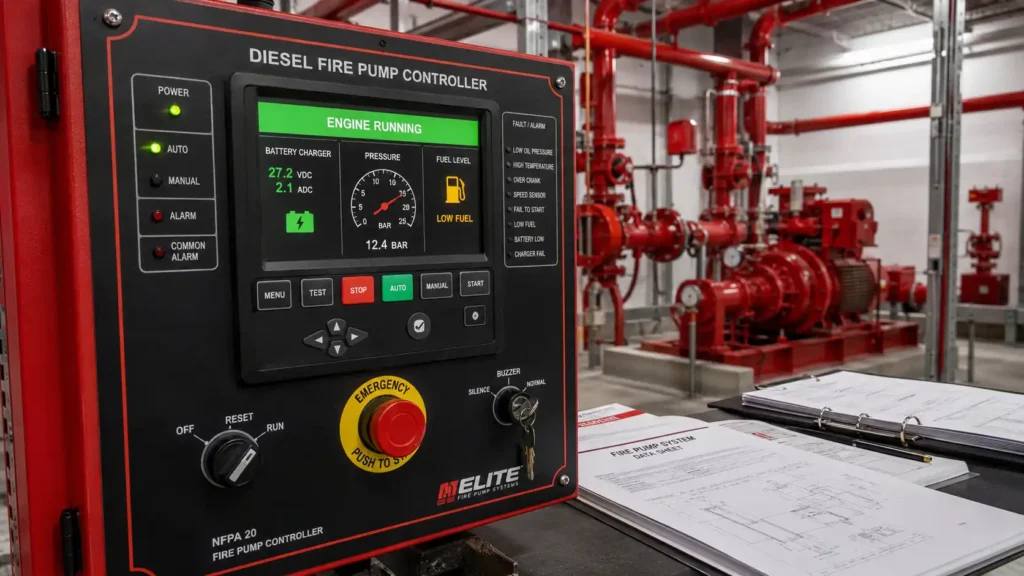
A diesel pump requires batteries for the starting process. Therefore, battery condition must always be checked so the engine can start when an alarm is activated.
In addition to batteries, the charger must also work properly. If the charger fails, the batteries may lose capacity, and the starting system becomes unreliable.
The controller manages starting, monitoring, alarms, and pump operating status. Therefore, signals such as engine running, fail to start, low fuel, low oil pressure, high water temperature, and battery failure must be monitored regularly.
With proper monitoring, potential problems can be identified before an emergency occurs. As a result, system reliability becomes higher.
Integration with Hydrant, Sprinkler, Deluge, and Foam System
A diesel-driven fire pump can support various water-based fire suppression systems. Therefore, pipe network design must consider all systems that will be served.
In a hydrant system, the pump supplies water to hydrant pillars, hydrant boxes, landing valves, or hose connections. Meanwhile, in a sprinkler system, the pump maintains pressure and flow so sprinklers can operate according to design.
For high-hazard areas, the pump can support deluge or foam systems. In addition, in tank farms, water supply is often used for foam monitors, cooling systems, and fire water ring mains.
Adiwarna provides Foam System solutions for high-risk protection needs such as oil storage, chemical plants, and fuel areas.
Testing and Commissioning
Testing and commissioning are required to ensure the pump works according to specifications. Therefore, testing should not be limited to visual inspection.
Important testing activities include:
- Alignment check.
- Rotation check.
- Battery starting test.
- No-flow test.
- Rated flow test.
- Peak flow test.
- Pressure test.
- Controller function test.
- Alarm signal test.
- Fuel system inspection.
- Exhaust system inspection.
- Vibration check.
- Integration test.
In addition, test results must be documented in an official report. With this documentation, owners, consultants, contractors, and HSE teams have a clear basis for system acceptance.
Diesel Fire Pump Maintenance

Diesel fire pump requires periodic maintenance so it remains ready to operate at all times. Therefore, weekly, monthly, and annual inspection schedules must be clearly prepared.
Common checks may include oil level, coolant, fuel, battery voltage, charger status, belt, hose, coupling, leakage, exhaust, ventilation, and controller condition. In addition, the pump must be tested so the engine does not remain idle for too long.
During testing, technicians need to observe pressure, vibration, engine sound, temperature, rpm, and controller response. Thus, early signs of failure can be detected faster.
If an alarm or abnormal condition is found, corrective action must be taken immediately. This is because delayed maintenance can cause pump failure during an emergency.
Common Mistakes in Selection and Installation
Some projects face problems because the pump is selected without proper system demand analysis. Therefore, flow and pressure calculations must be performed from the beginning.
Common mistakes include:
- Pump capacity does not match demand.
- Suction pipe diameter is too small.
- Valve arrangement is incorrect.
- Fuel tank capacity is insufficient.
- Pump room ventilation is inadequate.
- Exhaust system is not designed safely.
- Battery is not maintained.
- Controller is not tested.
- Test header is not available.
- Maintenance access is too narrow.
- Commissioning documentation is incomplete.
- Maintenance is not performed regularly.
By avoiding these mistakes, the fire pump system can operate more reliably. In addition, long-term repair costs can also be reduced.
Benefits of Using a Diesel Pump for Fire Protection
A diesel pump provides several important benefits for industrial facilities. First, the system has a backup power source when electricity is disrupted.
In addition, the pump can support large firefighting water demand. Therefore, the system becomes more prepared to handle fire incidents in high-risk areas.
Furthermore, this equipment improves fire water supply reliability. For this reason, diesel-driven pumps are often important in HSE audits, insurance reviews, and compliance inspections.
Finally, a properly designed pump can help protect people, assets, production, and company reputation.
Why Choose PT Adiwarna Anugerah Abadi?
PT Adiwarna Anugerah Abadi can help companies design and implement fire pump systems according to facility needs. In addition, Adiwarna has experience in fire fighting systems, fire suppression systems, hydrant systems, foam systems, fire alarm systems, and other industrial fire protection systems.
With the right engineering approach, each component can be selected based on risk, capacity, pressure, standards, and operational requirements. Therefore, the system is not only installed but also ready to be tested, maintained, and operated during an emergency.
For broader fire protection needs, you can also explore the Fire Suppression System service as part of a complete critical asset protection solution.
If your company needs fire pump system design, installation, testing, commissioning, service, or maintenance, consult your project requirements through the Adiwarna Contact Page.
Conclusion
Diesel fire pump is an important component in a fire protection system because it can maintain firefighting water supply when electricity is disrupted. Therefore, this equipment is highly relevant for industrial facilities, oil & gas, warehouses, power plants, large buildings, and high-risk sites.
However, system reliability is not determined only by the pump itself. Instead, performance depends on capacity design, installation, controller, fuel system, battery, ventilation, testing, commissioning, and maintenance.
With proper planning, a diesel pump can support safer and more reliable fire fighting operations. Therefore, PT Adiwarna Anugerah Abadi is ready to help your company build an integrated, professional, and field-appropriate fire protection system.