
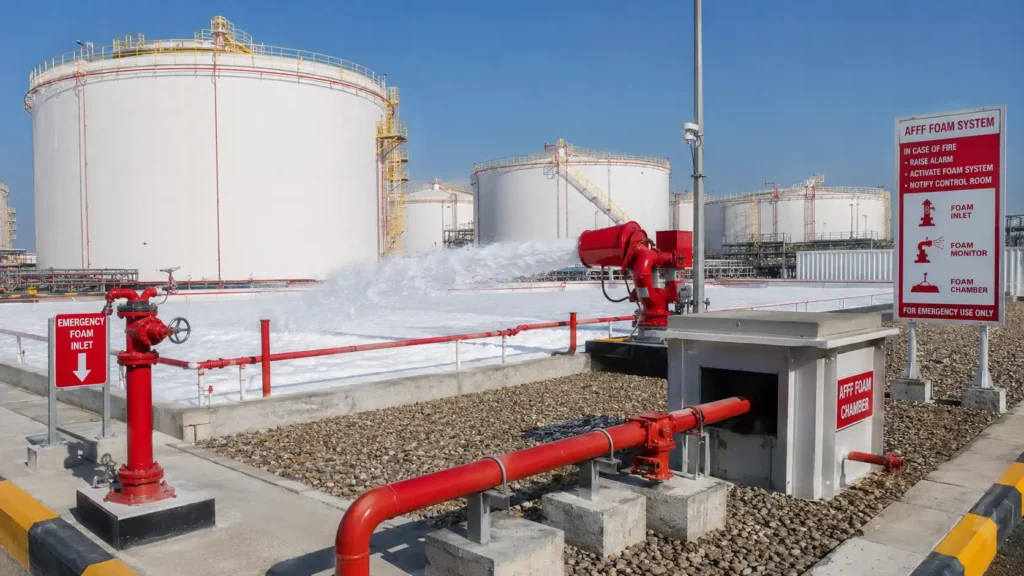
AFFF foam is a type of foam concentrate designed to help extinguish liquid fuel fires, especially Class B fires involving hydrocarbon fuels such as gasoline, diesel, aviation fuel, crude oil, and certain petroleum products. Therefore, this extinguishing media is widely used in oil & gas facilities, tank farms, refineries, petrochemical plants, fuel terminals, jetties, loading bays, power plants, and high-risk industrial areas.
In addition, liquid fuel fires have different characteristics compared with fires involving solid materials. This is because the liquid surface can continuously generate flammable vapor, so the fire may reignite if the suppression process does not effectively cover the fuel surface.
With the foam blanket formed on the fuel surface, oxygen supply can be reduced, flammable vapor can be suppressed, and fire spread can be controlled. Therefore, foam concentrate selection must be based on fuel type, protected area size, application method, and applicable technical standards.
For high-risk industrial needs, PT Adiwarna Anugerah Abadi provides Foam System solutions that can be integrated with fire pumps, hydrant systems, deluge systems, foam monitors, fire alarms, and other fire protection systems.
Why Is AFFF Foam Important in Fire Protection?
AFFF foam is important because flammable liquid fires are often difficult to control with water alone. In addition, water can spread certain fuels if it is applied improperly.
In hydrocarbon fires, foam works by forming an aqueous film over the fuel surface. As a result, contact between fuel vapor and oxygen can be reduced.
Besides separating fuel from oxygen, foam also helps cool the surface. Therefore, the risk of reignition can be reduced.
In industrial facilities, fast response is critical because a small fire can develop into a major incident. Therefore, the foam system must be designed with suitable water capacity, foam concentration, application rate, and discharge devices.
How AFFF Foam Works
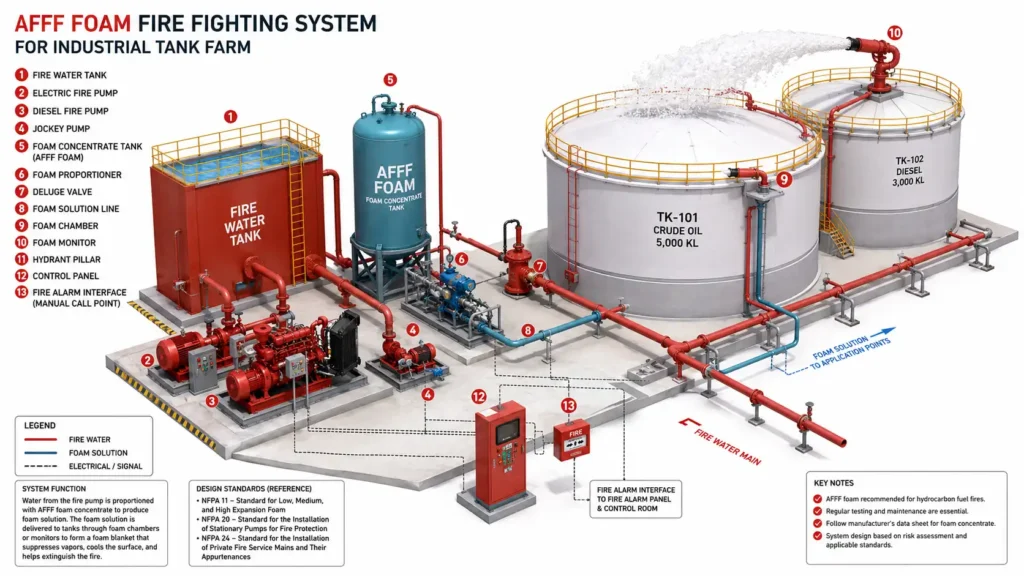
In general, foam concentrate is mixed with water through a proportioning system. Then, the mixture flows to discharge devices such as foam monitors, foam chambers, foam nozzles, or deluge nozzles.
After leaving the discharge device, the water and foam mixture combines with air to form finished foam. Then, the foam spreads across the fuel surface.
In AFFF applications, the aqueous film helps cover the hydrocarbon fuel surface. Therefore, flammable vapor can be suppressed faster than when using water alone.
However, suppression performance depends heavily on mixture concentration, concentrate quality, fuel type, and application method. If proportioning is not accurate, the foam can lose effectiveness during use.
System Components That Use AFFF Foam
Foam concentrate requires a properly designed mechanical system. Therefore, foam equipment should not be installed without hydraulic calculations and fire scenario analysis.
Common main components include:
- Fire water tank.
- Electric fire pump.
- Diesel fire pump.
- Jockey pump.
- Foam concentrate tank.
- Foam bladder tank.
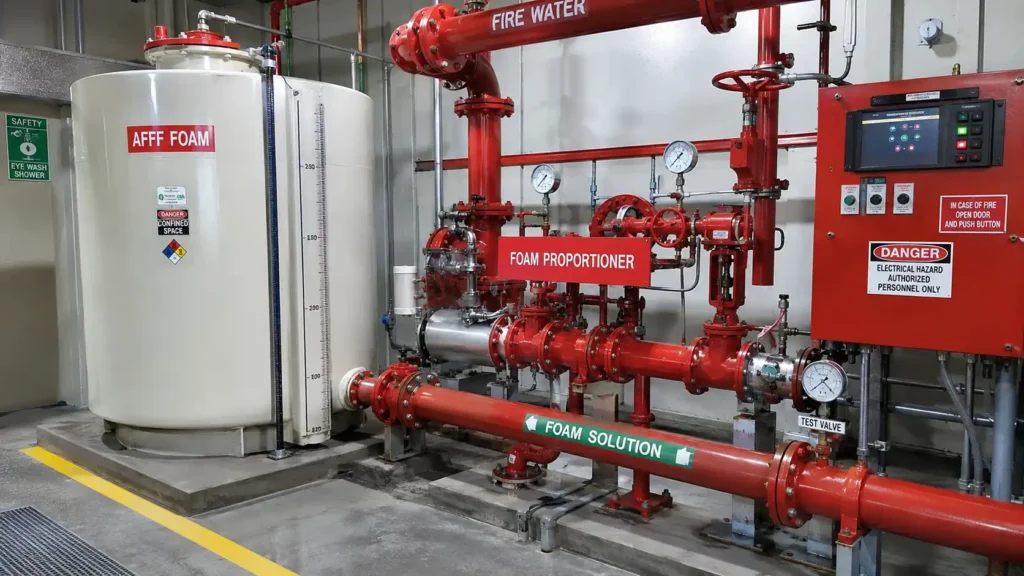
- Foam proportioner.
- Foam pump.
- Foam monitor.
- Foam chamber.
- Foam pourer.
- Foam nozzle.
- Deluge valve.
- Isolation valve.
- Control valve.
- Flow meter.
- Pressure gauge.
- Fire water piping.
- Foam solution piping.
- Fire alarm interface.
- Control panel.
In addition, the system requires technical documents such as hydraulic calculations, foam demand calculations, piping layouts, cause-and-effect matrices, testing procedures, and commissioning reports. With these documents, system performance can be verified more clearly.
AFFF Foam for Tank Farms and Oil & Gas
AFFF foam is highly relevant for tank farms and oil & gas facilities because these areas store or process large quantities of liquid fuel. Therefore, fire risks may involve large liquid surfaces, pressurized equipment, loading operations, pipe racks, and bund areas.
In tank farms, foam can be applied through foam chambers on storage tanks, fixed foam monitors, mobile foam equipment, or hydrant support. In addition, cooling systems using water spray or hydrant networks can help prevent heat from spreading to nearby tanks.
Meanwhile, in oil & gas facilities, the foam system can work together with flame detectors, gas detectors, fire alarm panels, deluge valves, hydrant pillars, and emergency response procedures. With this integration, detection, alarm, and suppression can operate in a more controlled way.
For oil and gas facilities, Adiwarna provides Oil and Gas Fire Protection System solutions so detection, alarm, suppression, hydrant, foam, and emergency response can be designed as one integrated system.
AFFF Foam in an Integrated Foam Fire Fighting System
AFFF foam is usually used as part of an integrated foam fire fighting system. Therefore, this extinguishing media must be supported by fire water supply, proportioning equipment, piping networks, discharge devices, and control systems.
First, the fire pump delivers water from the fire water tank into the piping network. Then, foam concentrate is mixed into the water flow at a specific ratio.
After that, foam solution flows toward the protected area. Next, foam monitors, foam chambers, or nozzles apply foam onto the fuel surface.
With proper design, the system can deliver the required application rate based on the fire scenario. In addition, operators can monitor system status through a control room, fire alarm panel, or BMS.
Common AFFF Foam Concentrations
Foam concentrate is available in several concentration types. Therefore, concentration selection must follow manufacturer recommendations and system requirements.
Common concentrations include:
- 1% concentrate.
- 3% concentrate.
- 6% concentrate.
For example, in a 3% concentration system, 3 parts foam concentrate are mixed with 97 parts water. However, this is only a general example, so the actual design must follow product specifications and project requirements.
In addition, foam tank capacity must be calculated based on demand area, application rate, operating duration, and safety margin. With accurate calculation, the system will not run out of concentrate during suppression.
AFFF Foam and AR-AFFF
Standard AFFF is generally used for hydrocarbon fuels. However, certain liquids such as alcohol, ketone, solvent, and polar solvent can break down a standard foam layer.
Therefore, AR-AFFF, or alcohol-resistant aqueous film forming foam, is used for certain polar liquids. This type has a polymer layer that helps prevent the foam blanket from breaking down when it contacts solvents.
The selection between standard AFFF and AR-AFFF must be based on the stored or processed material. If the wrong type is selected, foam may discharge from the nozzle but fail to form an effective suppression blanket.
Because of this, engineers need to review material safety data sheets, fuel characteristics, and foam compatibility from the design stage. With this approach, the system can truly match the fuel risk.
AFFF Foam Applications in Industrial Areas
Foam concentrate can be used in many high-risk areas. Therefore, each application requires a different design approach.
Common areas that require foam systems include:
- Tank farms.
- Fuel storage areas.
- Refineries.
- Petrochemical plants.
- Oil depots.
- Loading terminals.
- Jetties.
- Aircraft hangars.
- Power plants.
- Chemical warehouses.
- Pump stations.
- Generator fuel storage.
- Bund areas.
- Fuel transfer areas.
Besides these locations, facilities that store flammable liquids also need to perform risk assessment. With this analysis, the owner can determine whether a foam system is required as primary protection or supporting protection.
Foam Monitor for Outdoor Applications

A foam monitor is used to discharge foam solution from a certain distance. Therefore, this device is often installed in tank farms, loading terminals, jetties, and outdoor areas that are difficult to access directly.
In addition, monitors can be fixed, portable, manual, or remote-controlled. The selection must consider operator access, wind direction, throw range, and fire scenario.
In high-risk areas, a remote-controlled monitor can help operators suppress fire from a safer location. However, this system requires better control integration.
With proper design, a foam monitor can provide effective protection in open areas. Conversely, a poorly positioned monitor may fail to reach the risk point.
Foam Chamber for Storage Tanks
A foam chamber is used to apply foam into a storage tank. Usually, this device is installed on the upper shell of the tank so foam can flow onto the fuel surface.
Because storage tanks have different diameters and capacities, the number of foam chambers must be calculated based on liquid surface area and application rate. In addition, piping, valves, and proportioning systems must support the required flow.
Foam chambers also require periodic inspection. This is because blockage, corrosion, or seal damage can interfere with foam application.
With proper maintenance, this device can help protect storage tanks from fire escalation. Therefore, inspection schedules must become part of the facility’s HSE program.
Integration with Fire Pump and Hydrant System
A foam system requires a stable water supply. Therefore, fire pumps and hydrant networks must be designed to support the required flow and pressure.
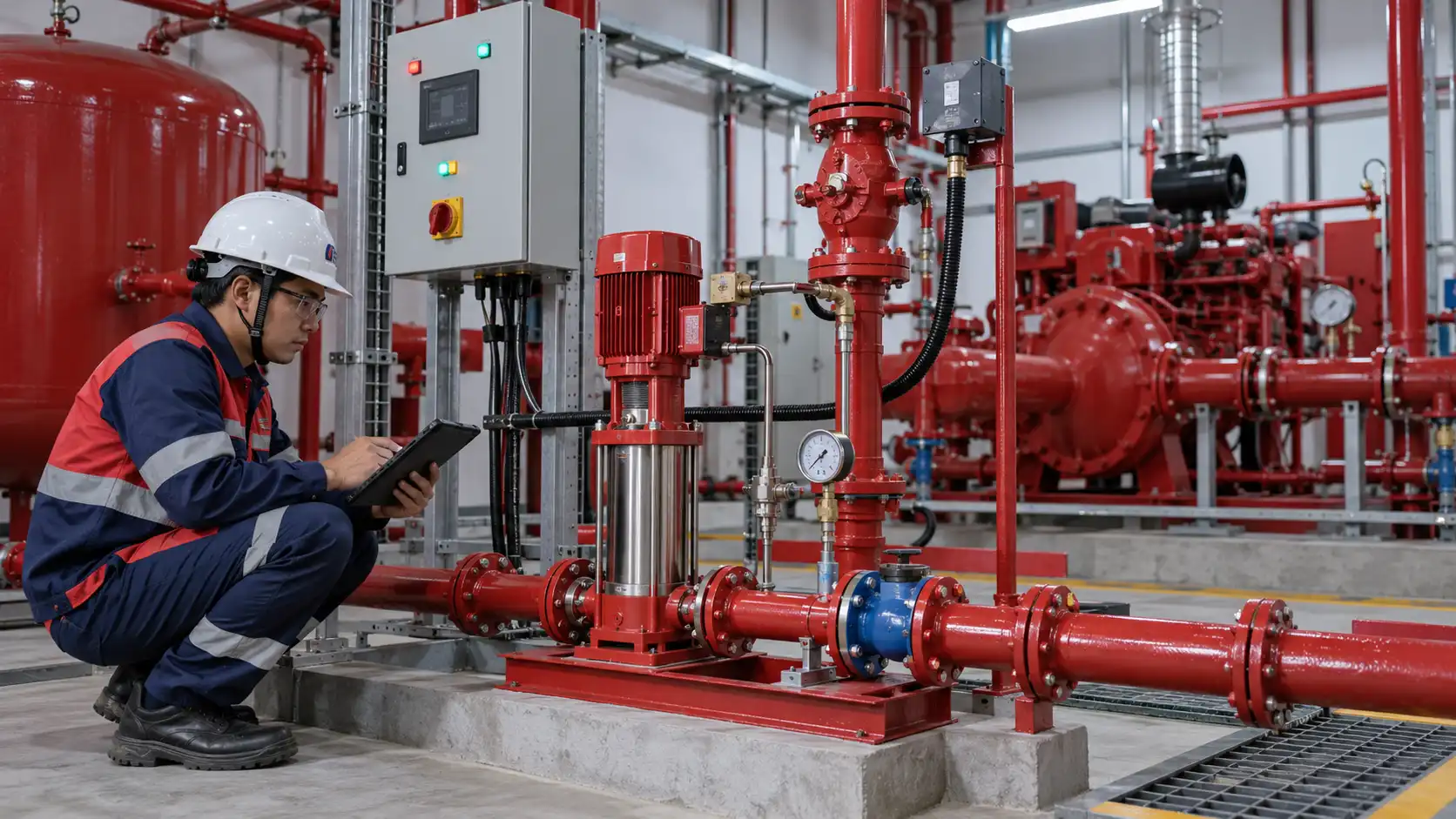
Fire pumps usually consist of electric fire pumps, diesel fire pumps, and jockey pumps. In addition, the fire water tank must have enough capacity for the designed suppression duration.
In industrial facilities, foam systems are often connected to hydrant systems. With this integration, operators can use hydrant pillars, fire hoses, foam monitors, or mobile equipment to support suppression.
For water-based protection needs, Adiwarna provides Industrial Fire Fighting System services that can support fire pump, hydrant, sprinkler, piping, valve, and fire water network design.
Integration with Fire Alarm and Detection System
Foam systems can be integrated with detectors and alarms so fire response becomes faster. For example, flame detectors, heat detectors, gas detectors, or manual call points can send early signals to the panel.
Then, the fire alarm or fire and gas controller can process the signal based on a cause-and-effect matrix. After that, alarm devices, sirens, beacons, pump start signals, deluge valves, or foam release can activate according to the logic.
However, automatic activation must be designed carefully. Therefore, some facilities use manual confirmation, interlocks, or voting logic to reduce false activation risks.
For detection and alarm systems, Adiwarna provides Fire Alarm System services so monitoring, alarms, and fire protection integration can operate in a more coordinated way.
Technical Standards to Consider
Foam system design must follow relevant technical standards. Therefore, foam concentrate selection, application rate, and discharge devices should not be chosen randomly.
In general, NFPA 11 is often used as a reference for low, medium, and high expansion foam. In addition, NFPA 20 can be used for fire pump installation, while NFPA 24 relates to private fire service mains.
Besides these standards, projects also need to consider local regulations, insurance requirements, company standards, environmental requirements, and manufacturer recommendations. Thus, the system can meet both technical and operational needs.
Important items that are usually reviewed include foam type, fuel type, application rate, discharge duration, proportioning accuracy, water demand, pipe calculation, valve arrangement, test method, and commissioning documentation.
Environmental Issues and Foam Selection
In recent years, the use of foam based on fluorinated compounds has received increasing attention due to environmental concerns. Therefore, many facilities have started evaluating the type of foam they use, including fluorine-free foam options for certain applications.
Even so, extinguishing media selection must still consider effectiveness against actual fire risks. Therefore, the decision should not be based only on trends, but also on engineering review, regulatory review, and compatibility testing.
If a facility switches to fluorine-free foam, the existing system must be evaluated. This is because viscosity, proportioning, application rate, discharge devices, and suppression performance may differ.
With proper evaluation, companies can balance safety needs, environmental compliance, and fire protection effectiveness. Therefore, technical consultation is very important before changing foam concentrate.
Important Factors in AFFF Foam System Design
System design must begin with risk identification. Therefore, engineers need to understand the fuel, storage area, potential ignition sources, facility layout, and firefighting access.
Important factors include:
- Fuel type.
- Liquid surface area.
- Flash point.
- Polar or non-polar fuel.
- Storage tank capacity.
- Bund area.
- Application rate.
- Discharge duration.
- Foam concentration.
- Water supply.
- Fire pump capacity.
- Proportioning method.
- Discharge device.
- Wind direction.
- Drainage.
- Environmental requirement.
- Manual or automatic activation.
- Maintenance access.
In addition, coordination with HSE, operations, engineering, and insurance surveyor teams is very important. With this coordination, the design can meet both safety and operational needs.
Testing and Commissioning
Testing and commissioning are required to ensure the foam system works according to design. Therefore, testing must cover mechanical, hydraulic, control, alarm, and foam quality aspects.
Important activities usually include:
- Visual inspection.
- Pipe flushing.
- Hydrostatic test.
- Flow test.
- Foam proportioning test.
- Foam quality test.
- Foam sample verification.
- Valve function test.
- Deluge valve trip test.
- Foam monitor test.
- Foam chamber inspection.
- Pump performance test.
- Alarm integration test.
- Manual release test.
- Cause-and-effect test.
- Documentation review.
In addition, test results must be recorded in an official report. With this documentation, owners, contractors, consultants, HSE teams, and insurance-related parties can assess system readiness.
If proportioning results are not correct, the system must be adjusted. This is because improper foam concentration can reduce suppression effectiveness.
AFFF Foam System Maintenance
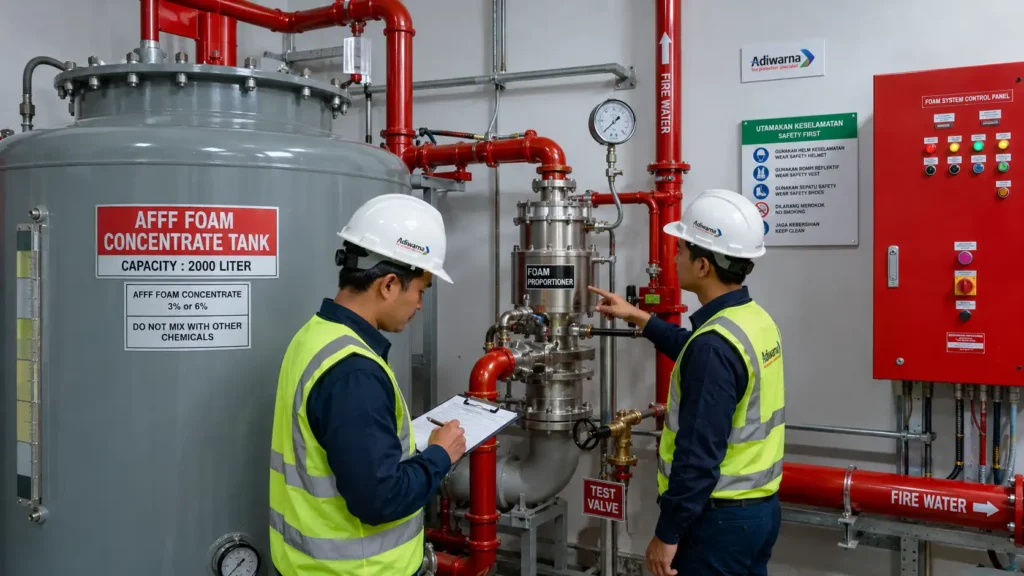
AFFF foam and all supporting systems require periodic maintenance so they remain ready for emergencies. Therefore, inspections should not only focus on pipes and valves.
Common checks include foam tank condition, concentrate level, concentrate quality, valve position, pressure gauge, proportioner, foam pump, fire pump, nozzle, monitor, chamber, piping, and control panel. In addition, alarm systems and interlocks also need to be tested.
Foam concentrate can change in quality if it is stored too long or kept in unsuitable environmental conditions. Therefore, foam sampling and testing should be performed based on manufacturer recommendations.
With proper maintenance, the system can produce foam solution as required. Conversely, a system that is rarely tested can fail even when all components appear complete.
Common Mistakes in Using AFFF Foam
Many problems occur because foam concentrate is selected without complete risk analysis. Therefore, design must begin with fuel characteristics and fire scenarios.
Common mistakes to avoid include:
- Choosing the wrong foam type.
- Using standard AFFF for polar solvents.
- Not calculating application rate.
- Insufficient foam concentrate quantity.
- Inadequate water supply.
- Unsuitable proportioner selection.
- Foam monitor cannot reach the risk area.
- Foam chamber does not match tank size.
- Unclear valve arrangement.
- Alarm logic is not tested.
- Foam concentrate is never tested.
- Maintenance access is unavailable.
- Commissioning documentation is incomplete.
- Foam change is not followed by system evaluation.
By avoiding these mistakes, the system can provide better suppression performance. In addition, facilities can reduce the risk of failure during emergencies.
Benefits of AFFF Foam for Companies
Foam concentrate provides major benefits for companies with liquid fuel risks. First, this media helps control hydrocarbon fires that are difficult to extinguish with water alone.
In addition, foam helps suppress flammable vapor so reignition risk can be reduced. Thus, the suppression process becomes more stable.
Furthermore, a properly designed foam system can protect high-value assets such as storage tanks, loading facilities, pump stations, fuel transfer areas, and process equipment. Therefore, this media is very important for high-risk industries.
Finally, design, testing, and maintenance documentation can support HSE audits, insurance reviews, and compliance inspections. Therefore, investment in foam systems provides both safety value and business value.
Why Choose PT Adiwarna Anugerah Abadi?
PT Adiwarna Anugerah Abadi can help companies design foam systems as part of integrated industrial fire protection. In addition, Adiwarna understands the needs of high-risk facilities such as oil & gas, tank farms, refineries, petrochemical plants, chemical plants, warehouses, fuel terminals, and power plants.
With the right engineering approach, every component can be selected based on risk, standards, fuel type, water capacity, application rate, and operational needs. Therefore, the system is not only installed but also tested, maintained, and ready for operation.
For projects that require a complete scope, EPC Fire Protection Adiwarna can support engineering, procurement, construction, testing, commissioning, service, and maintenance.
If your company needs consultation, design, installation, testing, commissioning, service, or maintenance for a foam fire fighting system, contact PT Adiwarna Anugerah Abadi through the Adiwarna Contact Page.
Conclusion
AFFF foam is an important extinguishing media for liquid fuel fires, especially in areas with hydrocarbon fuel risks. Therefore, its use is highly relevant for tank farms, oil & gas facilities, refineries, petrochemical plants, fuel terminals, loading bays, jetties, and high-risk industrial areas.
However, foam effectiveness is not determined only by the concentrate used. Instead, performance depends heavily on system design, proportioning accuracy, application rate, water supply, discharge devices, testing, commissioning, and maintenance.
With proper planning, foam systems can help protect people, assets, production processes, and company reputation. Therefore, PT Adiwarna Anugerah Abadi is ready to help deliver professional, integrated, and risk-based fire protection solutions.