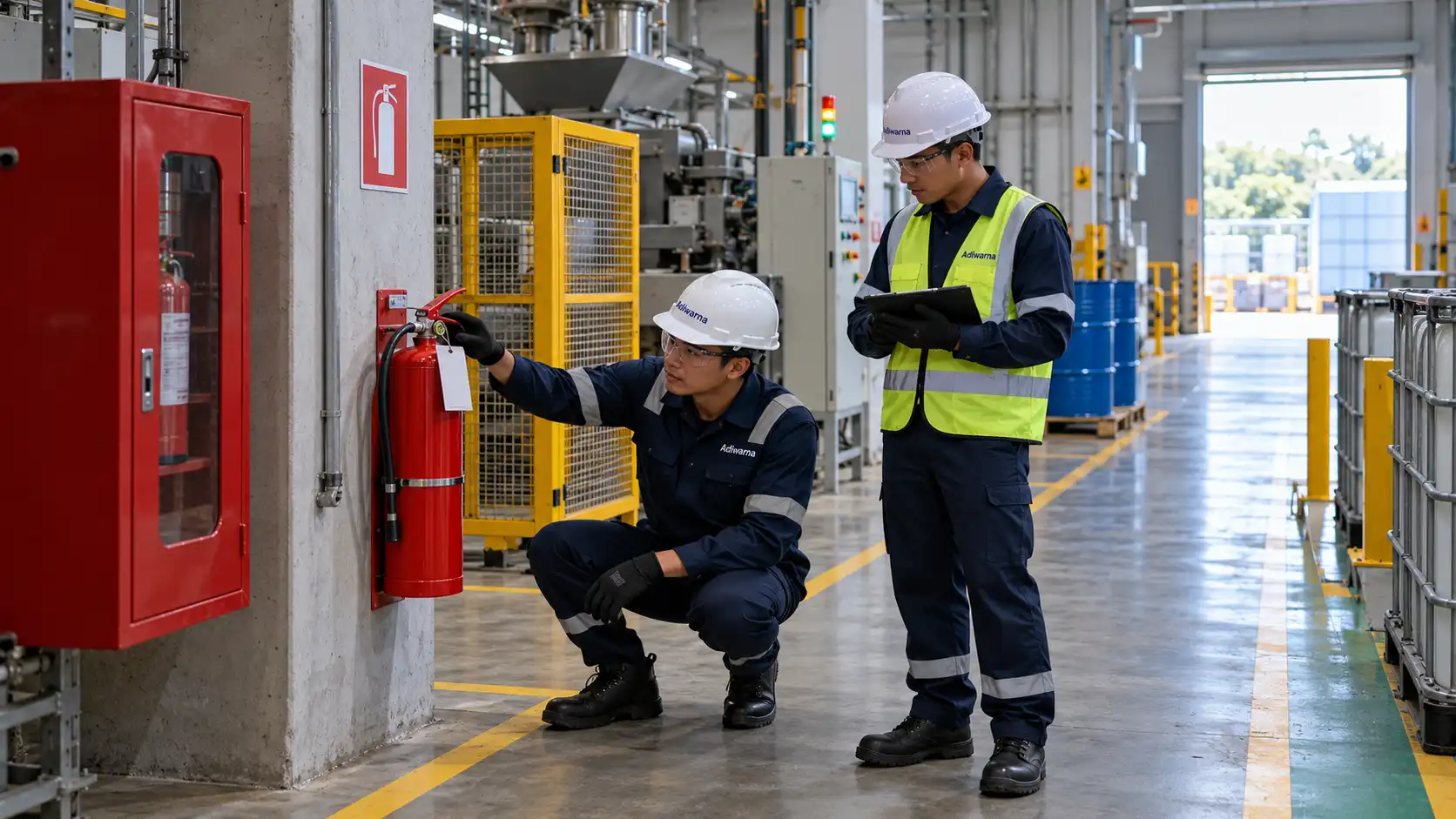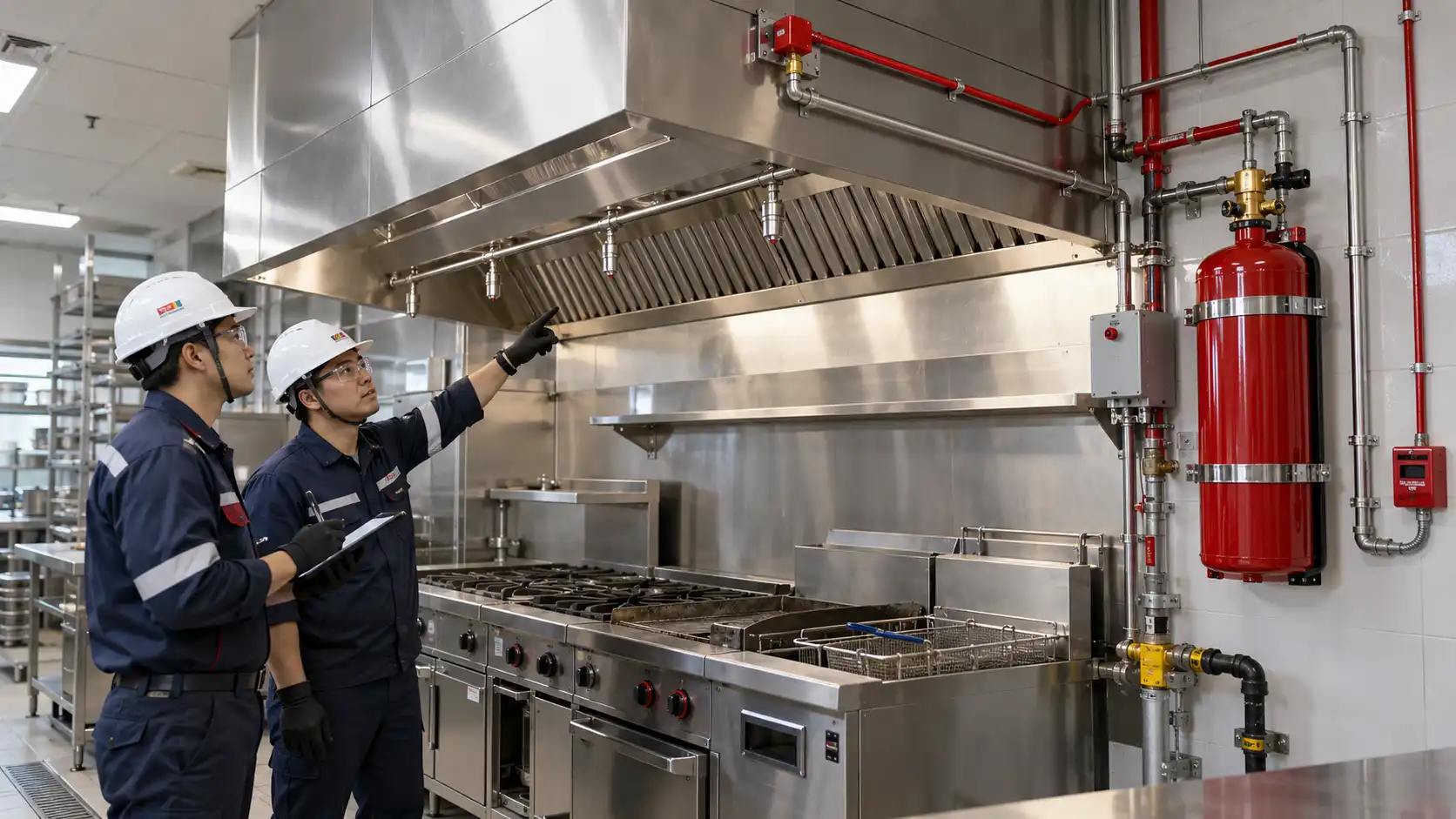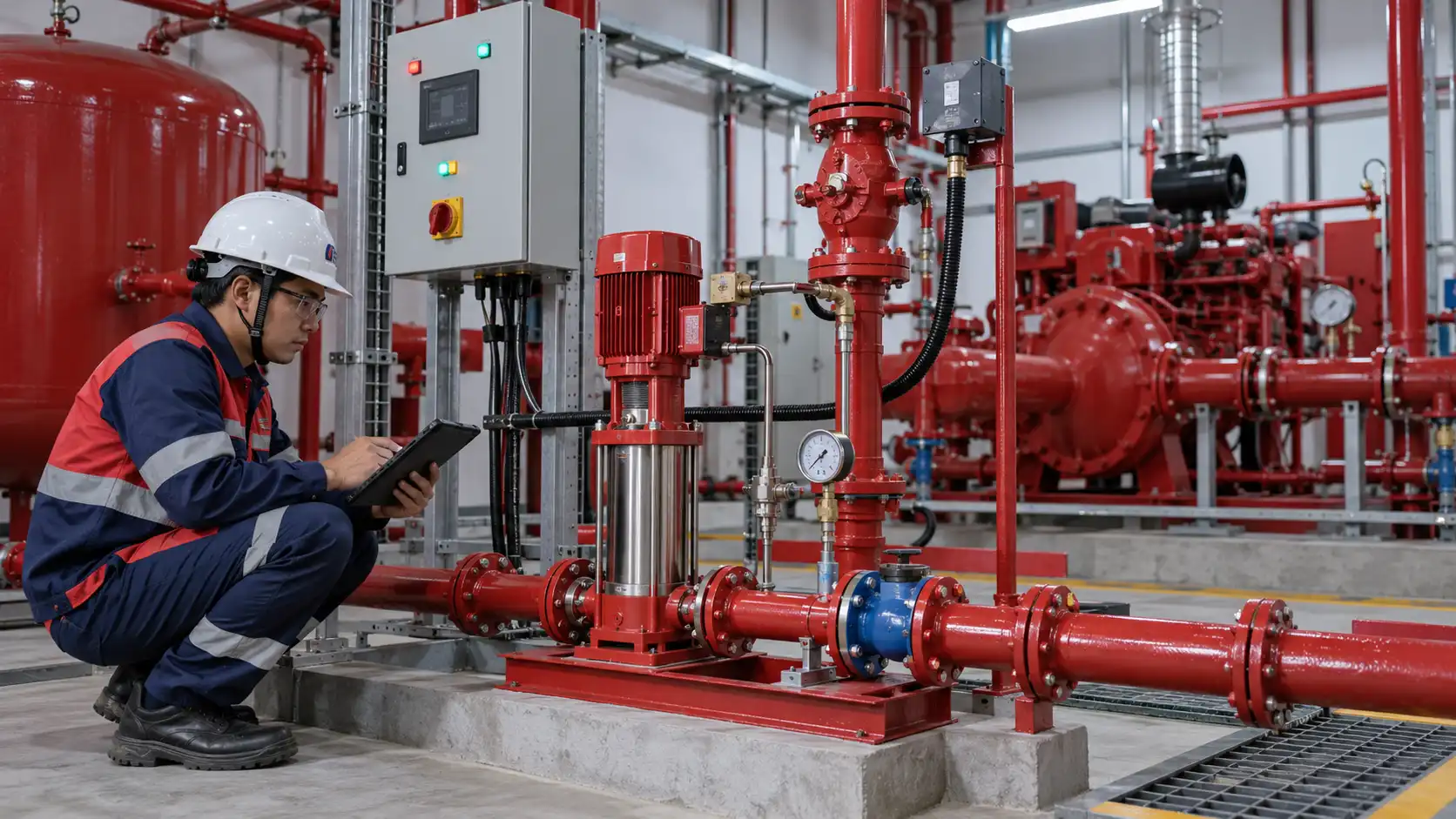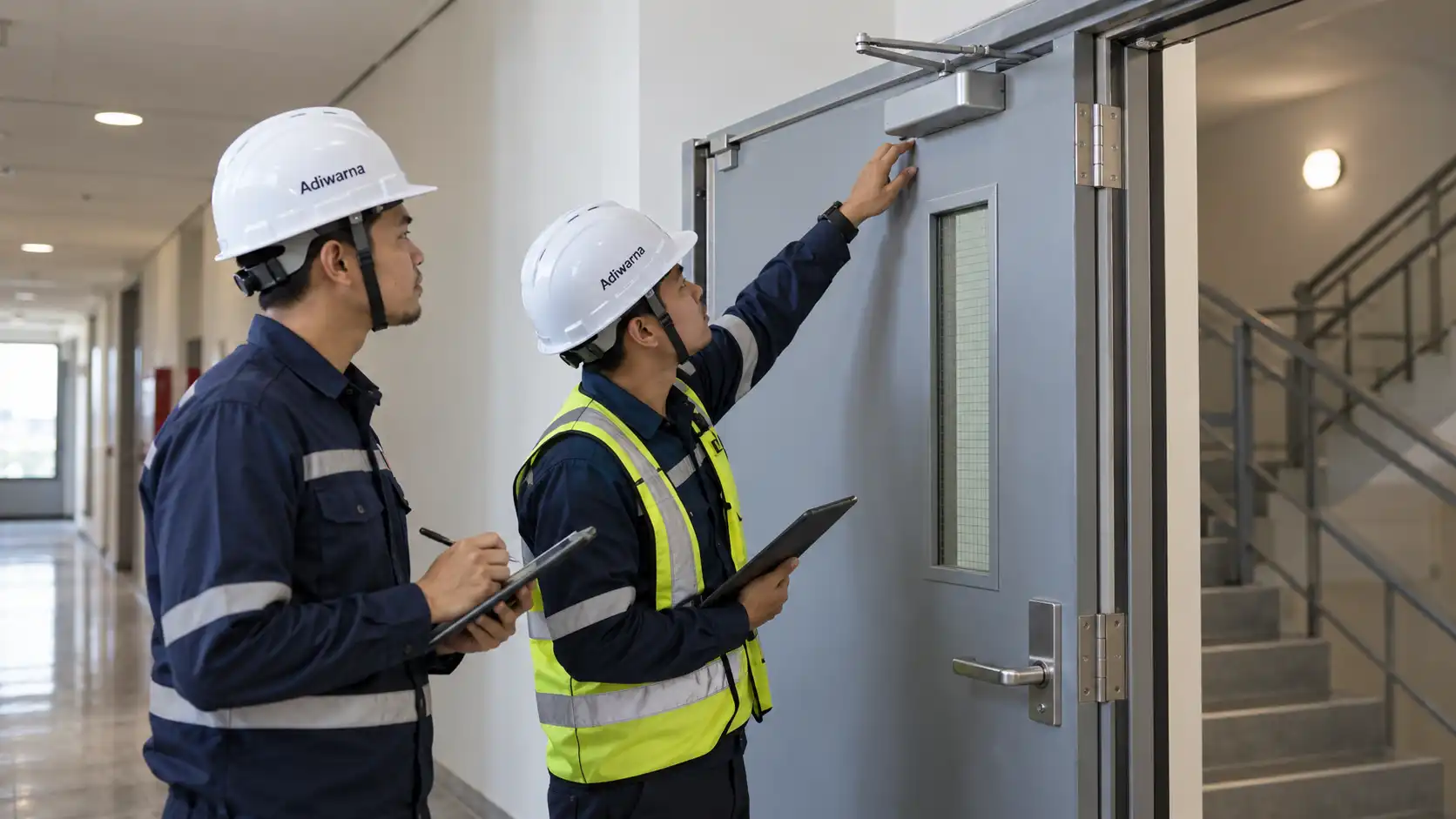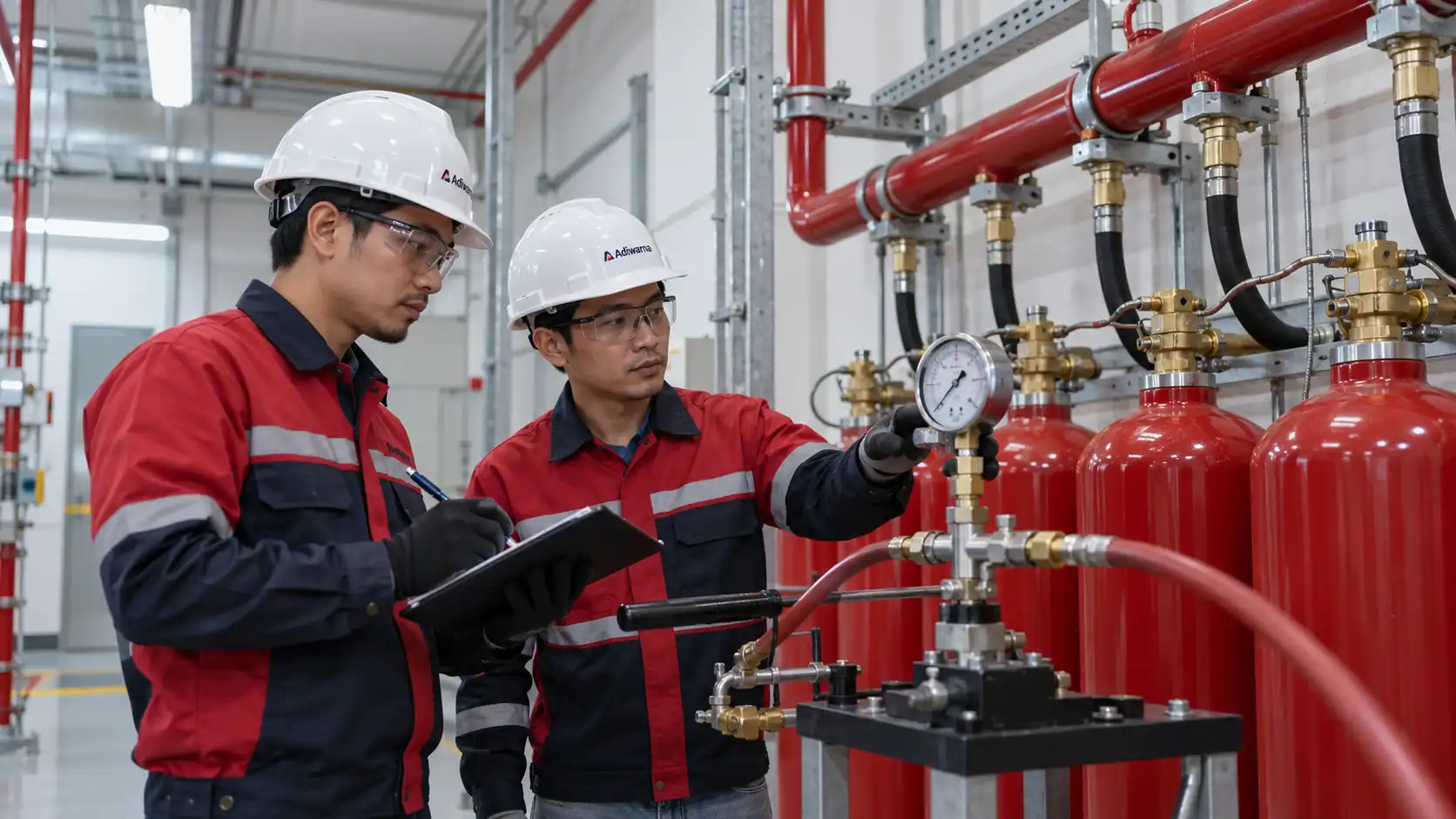

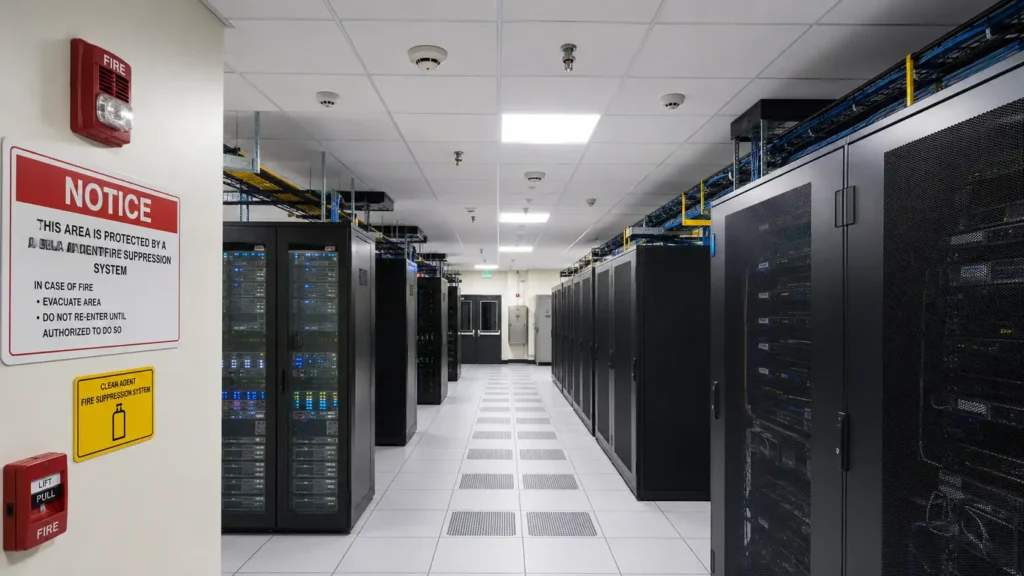
Data center fire suppression system is a specialized fire extinguishing system designed to protect server rooms, IT equipment, network devices, storage systems, UPS units, control panels, and digital infrastructure without causing major damage to electronic assets. Therefore, this system is essential for data centers, server rooms, network rooms, telecommunication rooms, colocation facilities, disaster recovery centers, and business facilities that depend on information technology.
In addition, data centers have different fire risks compared with ordinary building areas. This is because these rooms contain active electrical equipment, power cables, data cables, raised floors, battery systems, cooling systems, and high-value equipment that must remain operational with minimal downtime.
With the right suppression system, fire can be detected and controlled faster before it damages critical equipment. Therefore, data center fire protection design must combine early detection, alarms, suppression agents, control panels, discharge nozzles, room integrity, and emergency response procedures.
For critical asset protection, PT Adiwarna Anugerah Abadi provides Fire Suppression System solutions that can be designed for data centers, server rooms, electrical rooms, control rooms, and other technology facilities.
Why Is a Data Center Fire Suppression System Important?
Data center fire suppression system is important because even a small fire can cause major operational disruption. In addition, damage to servers, switches, storage devices, UPS units, or network equipment can affect digital services, business transactions, data security, and customer trust.
In many facilities, data centers must operate 24 hours a day. Therefore, the protection system must not only extinguish fire but also help maintain business continuity.
If the extinguishing media is not suitable, secondary damage can increase. For example, water from a standard sprinkler system may affect electronic equipment if it is not properly designed for sensitive areas.
Because of this, clean agent and inert gas systems are often selected for server rooms. With these media, fire can be controlled without leaving residue and without wetting the equipment.
How Fire Suppression Systems Work in Data Centers
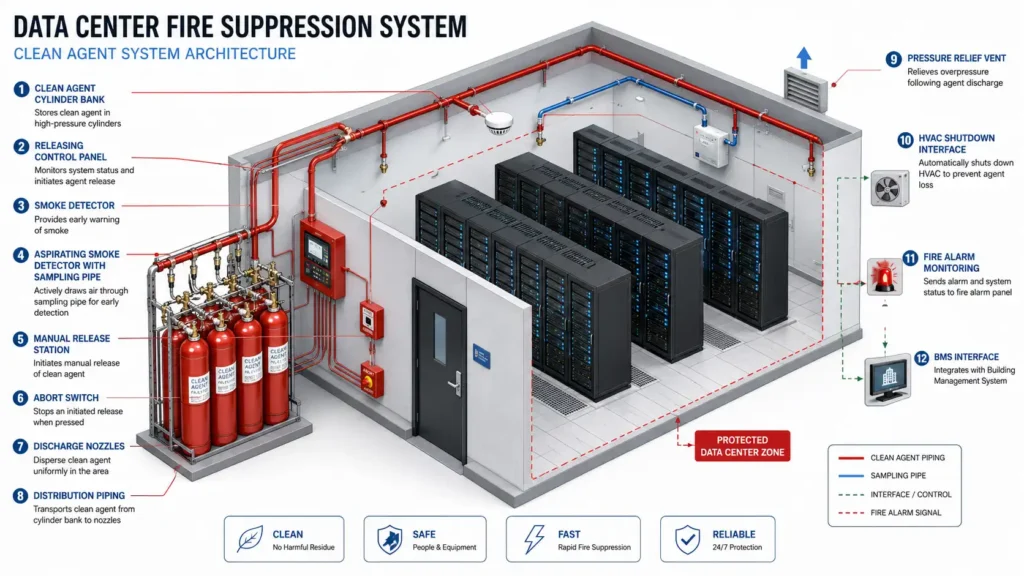
In general, a suppression system works by detecting fire indications, processing signals through a panel, and then releasing extinguishing media into the protected room. First, detectors identify smoke, heat, or early fire signs.
Then, the signal is sent to a releasing panel or fire alarm control panel. After that, the panel runs the approved logic through cross-zone detection, time delay, alarm notification, manual release, and abort switch configuration.
Next, the agent is released from the cylinder into the piping network and discharge nozzles. As a result, the extinguishing media spreads throughout the room according to the concentration design.
To work effectively, the room must be tight enough to retain the agent concentration for a certain period. Therefore, a room integrity test becomes an important part of a clean agent system project.
Main Components of a Data Center Fire Suppression System
An automatic suppression system for data centers consists of several interconnected components. Therefore, every component must be selected based on design requirements, standards, and room conditions.
Common main components include:
- Clean agent cylinder.
- Inert gas cylinder.
- Releasing control panel.
- Smoke detector.
- Aspirating smoke detector.
- Heat detector for certain applications.
- Manual release station.
- Abort switch.
- Alarm bell.
- Sounder.
- Strobe light.
- Pre-discharge alarm.
- Discharge nozzle.
- Distribution piping.
- Flexible hose.
- Pressure switch.
- Pressure gauge.
- Agent release valve.
- Warning signage.
- Room integrity test equipment.
- Fire alarm interface.
- BMS or control room interface.
In addition, the system also requires a cause and effect matrix, battery backup, cable schedule, as-built drawings, calculation reports, and commissioning documents. With this documentation, the owner can clearly understand how the system operates.
Data Center Fire Suppression System for Server Rooms and IT Rooms

Data center fire suppression system is highly relevant for server rooms and IT rooms because these areas contain sensitive electronic equipment. In addition, these rooms usually require high uptime.
In small server rooms, the system may use clean agent cylinders with a simple piping network. Meanwhile, larger data centers require a more detailed design because they may include multiple zones, cold aisles, hot aisles, raised floors, ceiling voids, and UPS areas.
In addition, integration with early detection systems is very important. With faster detection, the system can give an alarm before fire develops into a larger incident.
For integrated alarm needs, Adiwarna provides Fire Alarm System services so detectors, alarm devices, releasing panels, monitoring systems, and control rooms can work in coordination.
Data Center Fire Suppression System in a Layered Protection Strategy
Data center fire suppression system should be part of a layered protection strategy. With this approach, the facility does not rely on only one device to control fire risk.
First, early warning detection helps identify smoke at an early stage. Then, the fire alarm system provides warnings to operators, security teams, and facility teams.
After that, the suppression system can activate according to the approved logic. In addition, supporting systems such as emergency power off, HVAC shutdown, damper control, and BMS monitoring can be integrated according to project requirements.
With a layered strategy, fire response becomes more controlled. Therefore, the design must consider life safety, asset protection, business continuity, and compliance.
Clean Agent Fire Suppression for Data Centers
Clean agent fire suppression is widely used in data centers because the extinguishing media leaves no residue. In addition, this agent can suppress fire without directly damaging electronic equipment.
Clean agents work by absorbing heat or interrupting the chemical reaction of fire, depending on the agent type. Therefore, agent selection must consider room size, ventilation, occupancy, electrical risk, and safety requirements.
In data centers, clean agent systems are usually combined with detectors, releasing panels, pre-discharge alarms, abort switches, and manual release stations. Thus, agent release can be controlled through a safe procedure.
For one extinguishing media option, Adiwarna provides FM 200 Fire Suppression System solutions for server rooms, control rooms, and selected critical areas.
Inert Gas Fire Suppression for Critical Facilities
Inert gas suppression is also frequently used for areas that require high-value asset protection. Unlike some chemical clean agents, inert gas works by reducing oxygen concentration in the room until fire can no longer sustain combustion.
However, inert gas design must consider human safety. Therefore, design concentration, discharge time, pressure relief vents, signage, alarms, and evacuation procedures must be calculated properly.
In large data centers, inert gas can be an attractive solution because the agent is available from natural gases such as nitrogen, argon, or inert gas blends. In addition, this system can be used for facilities requiring long-term protection.
For this application, Adiwarna provides Inert Gas Fire Protection and Inergen Fire Suppression System solutions for critical facilities that require professional suppression design.
Difference Between Clean Agent, Inert Gas, CO₂, and Sprinkler
Every extinguishing media has different characteristics. Therefore, system selection should not be based only on price or previous project habits.
Clean agent is suitable for electronic rooms because it leaves no residue and works quickly. Meanwhile, inert gas is suitable for areas requiring equipment-friendly suppression and can be applied to large rooms with proper design.
CO₂ has strong extinguishing capability, but its use in occupied areas requires serious attention because it can endanger people. Therefore, CO₂ is more commonly used in areas that are not normally occupied.
Sprinklers remain important for general building protection. However, for water-sensitive server rooms, sprinkler systems can use a preaction concept so accidental discharge risk is better controlled.
Integration with Fire Alarm and Releasing Panel
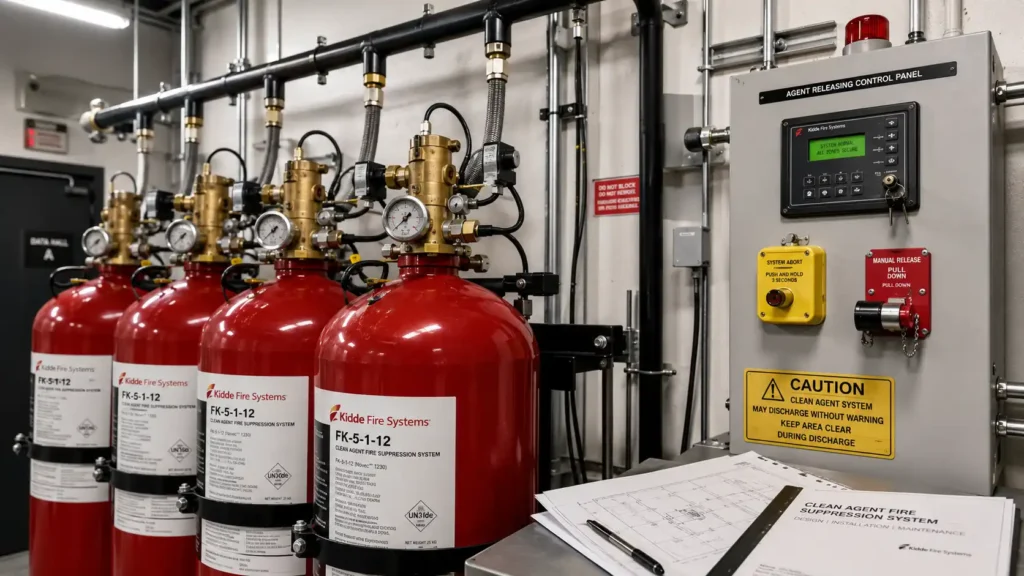
A data center suppression system must be integrated with fire alarm and releasing panels. With this integration, alarm, time delay, discharge, abort, manual release, trouble, and supervisory signals can be monitored clearly.
Usually, the system uses at least two detectors to reduce false discharge risk. Then, the panel processes the signal through cross-zone logic before the agent is released.
In addition, visual and audio alarms must activate before discharge. As a result, personnel inside the room have time to leave according to safety procedures.
As a technical reference, NFPA 72 is often used for fire alarm and signaling systems. Therefore, alarm and releasing logic must be designed carefully.
Integration with HVAC, Dampers, and Room Sealing
Gas-based extinguishing media requires a room that can retain agent concentration. Therefore, integration with HVAC and dampers is very important.
When the system activates, HVAC can be shut down or dampers can be closed so the agent does not escape too quickly. In addition, gaps in walls, doors, raised floors, cable penetrations, and ceiling voids must be reviewed.
If the room has major leakage, agent concentration can drop before the fire is fully controlled. As a result, a system that looks complete may fail to operate effectively.
Because of this, room sealing and integrity testing must be performed during commissioning. With this test, engineers can determine whether the room can retain the agent according to design requirements.
Room Integrity Test for Data Centers
A room integrity test evaluates the ability of a room to retain gaseous extinguishing concentration. Therefore, this test is very important for clean agent and inert gas systems.
The test process usually uses a blower door fan to calculate room leakage. Then, the result is used to estimate agent retention time.
If the test result does not meet requirements, sealing improvements must be completed. After that, the test can be repeated to confirm that the room is suitable.
Without this test, the owner cannot be sure that the agent will stay long enough after discharge. Therefore, room integrity is an important part of data center protection quality.
Technical Standards to Consider
Data center suppression system design should refer to relevant technical standards. Therefore, specifications should not be based only on room area or the number of cylinders.
In general, NFPA 2001 is often used as a reference for clean agent fire extinguishing systems. In addition, ISO 14520 is also widely used as a reference for gaseous fire-extinguishing systems.
For data centers, NFPA 75 can be used as a reference for fire protection of information technology equipment. In addition, projects may also consider insurance requirements, company standards, local regulations, and manufacturer guidelines.
Important items that are usually reviewed include hazard volume, agent concentration, discharge time, nozzle layout, pipe calculation, detector placement, alarm logic, room integrity, pressure relief, and documentation packages.
Important Factors in System Design
The design of a suppression system for data centers must start with room requirement analysis. Therefore, engineers need to understand server layout, airflow, cable penetrations, raised floors, ceiling voids, and cooling systems.
Important factors include:
- Room volume.
- Type of protected asset.
- Room occupancy.
- Raised floor.
- Ceiling void.
- Airflow and HVAC.
- Cable penetration.
- Door sealing.
- Agent concentration.
- Discharge time.
- Retention time.
- Nozzle placement.
- Cylinder location.
- Pressure relief vent.
- Detector type.
- Alarm logic.
- Maintenance access.
- BMS integration.
- Redundancy requirements.
In addition, coordination with the IT team is very important. This is because rack layout changes, cable routes, cooling systems, and new penetrations can affect system performance.
Testing and Commissioning
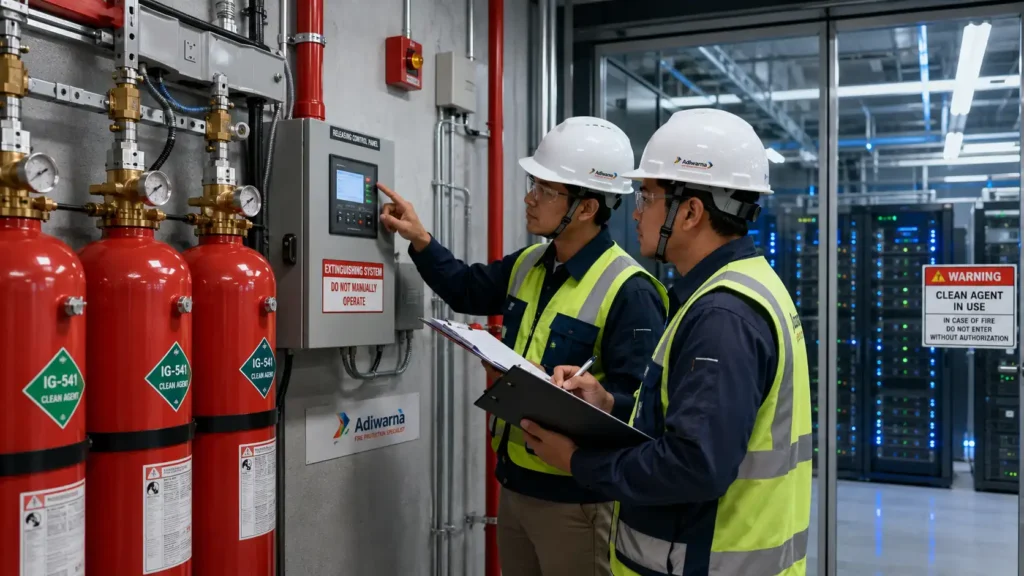
Testing and commissioning are required so the system works according to design. Therefore, this process must cover detection, alarm, control, mechanical, electrical, and integration aspects.
Important activities usually include:
- Visual inspection.
- Detector test.
- Loop test.
- Releasing panel test.
- Manual release test.
- Abort switch test.
- Pre-discharge alarm test.
- Sounder and strobe test.
- Solenoid test.
- Pressure switch test.
- Cylinder pressure check.
- Nozzle inspection.
- Pipe network inspection.
- Cause and effect test.
- HVAC shutdown test.
- BMS signal test.
- Room integrity test.
- Documentation review.
In addition, test results must be recorded in an official report. With this documentation, owners, consultants, contractors, IT teams, and HSE teams can confirm that the system is ready for use.
If issues are found in detectors, valves, cylinders, wiring, or room sealing, corrections must be completed before handover. Therefore, commissioning becomes an important stage in project quality.
Data Center Fire Suppression System Maintenance
Data center fire suppression system requires periodic maintenance so it remains ready to operate. Therefore, inspection should not only focus on cylinders but also on detectors, panels, alarms, piping, nozzles, and room conditions.
Common checks include cylinder pressure, panel status, battery, detector, wiring, manual release, abort switch, sounder, strobe, pressure switch, signage, and physical condition. In addition, the room must be inspected to ensure there are no new penetrations that create leakage.
In an active data center, small changes can have a major impact. For example, new cable installation, rack additions, or door changes can affect room integrity.
With consistent maintenance, the system can provide more reliable protection. Conversely, a system that is rarely tested can create a false sense of safety.
Common Mistakes in Data Center Fire Suppression Projects
Many problems occur because design is carried out without enough coordination with IT, MEP, and facility management teams. Therefore, every project needs to begin with a detailed survey.
Common mistakes to avoid include:
- Not calculating room volume correctly.
- Ignoring raised floors and ceiling voids.
- Ignoring cable penetrations.
- Not performing a room integrity test.
- Choosing the wrong agent.
- Nozzle coverage is not suitable.
- Cylinders are placed in difficult-access locations.
- Alarm logic is unclear.
- Abort switch is positioned incorrectly.
- HVAC shutdown is not tested.
- Pressure relief vent is ignored.
- Maintenance access is unavailable.
- Commissioning documentation is incomplete.
- The system is not re-evaluated after renovation.
By avoiding these mistakes, the system can work more effectively. In addition, the risk of discharge failure or loss of agent concentration can be reduced.
Benefits of Suppression Systems for Data Centers
A suppression system provides many benefits for data centers and server rooms. First, the system helps control fire quickly before it spreads to other equipment.
In addition, the right extinguishing media can reduce additional damage to servers and electronic devices. Thus, companies can protect digital assets while maintaining service continuity.
Furthermore, a well-documented system can support HSE audits, facility audits, insurance reviews, and compliance inspections. Therefore, design, testing, commissioning, and maintenance must be managed professionally.
Finally, a reliable protection system can improve business confidence. Because of this, investment in data center fire suppression provides both safety value and operational value.
Why Choose PT Adiwarna Anugerah Abadi?
PT Adiwarna Anugerah Abadi can help companies design data center suppression systems as part of integrated fire protection. In addition, Adiwarna understands the needs of critical facilities such as data centers, server rooms, network rooms, telecommunication rooms, control rooms, and electrical rooms.
With the right engineering approach, every system can be selected based on risk, standards, room size, agent type, alarm logic, room integrity, and operational needs. Therefore, the solution focuses not only on installation but also on emergency readiness.
For projects that require a complete scope, EPC Fire Protection Adiwarna can support engineering, procurement, construction, testing, commissioning, service, and maintenance.
If your company needs consultation, design, installation, testing, commissioning, service, or maintenance for data center suppression systems, contact PT Adiwarna Anugerah Abadi through the Adiwarna Contact Page.
Conclusion
Data center fire suppression system is an important solution for protecting servers, IT equipment, networks, UPS units, storage systems, and digital infrastructure from fire risk. Therefore, this system is highly relevant for data centers, server rooms, network rooms, telecommunication rooms, disaster recovery centers, and other critical facilities.
However, system reliability is not determined only by the type of agent used. Instead, performance depends heavily on engineering design, early detection, alarm logic, pipe calculation, nozzle layout, room integrity, testing, commissioning, and maintenance.
With proper planning, a suppression system can help protect people, digital assets, operations, and company reputation. Therefore, PT Adiwarna Anugerah Abadi is ready to become a professional partner in delivering integrated, reliable, and facility-specific data center fire protection solutions.