

Inert gas is a gaseous fire-extinguishing medium used to protect enclosed rooms and sensitive assets without water and without leaving residue after discharge. It is commonly applied in data centers, server rooms, electrical rooms, telecommunications facilities, control rooms, museums, archives, laboratories, and other critical environments where secondary damage from water or dry chemical powder must be avoided.
Within a fire suppression system, inert gas works primarily by reducing the oxygen concentration inside the protected enclosure until combustion can no longer be sustained. The required oxygen reduction must be calculated according to the protected hazard, room volume, occupancy conditions, personnel safety requirements, and applicable design standards.
Unlike halocarbon clean agents such as FK-5-1-12 or HFC-227ea, inert gas agents are composed of gases naturally present in the atmosphere, including nitrogen and argon. Certain formulations also contain a small percentage of carbon dioxide.
PT Adiwarna Anugerah Abadi provides inert gas fire suppression solutions for critical asset protection, including engineering, equipment supply, installation, testing, commissioning, room integrity testing, and preventive maintenance.
What Is Inert Gas?
Inert gas is a general term for gaseous extinguishing agents that do not support combustion and are used in fixed fire-extinguishing systems.
The agent is stored in high-pressure cylinders. When the system activates, gas travels through cylinder valves, flexible discharge hoses, a manifold, distribution piping, and engineered nozzles before entering the protected enclosure.
Most installations are designed as total-flooding systems. This means the agent quantity is calculated for the complete protected volume, which may include:
- The main occupied room.
- Raised-floor voids.
- Ceiling voids.
- Cable trenches.
- Connected concealed spaces.
- Enclosed equipment areas included in the hazard.
The ISO 14520-1 standard establishes general requirements for the design, installation, testing, maintenance, and safety of gaseous fire-extinguishing systems. Separate parts of the ISO 14520 series address specific extinguishing agents.
How Does Inert Gas Extinguish Fire?

Fire requires fuel, heat, oxygen, and a continuing chemical reaction. An inert gas system controls combustion mainly by reducing the oxygen concentration within the enclosure.
Once the calculated agent concentration is reached, the atmosphere can no longer sustain the protected fire hazard. Because no liquid or powder is discharged, the system does not wet equipment or leave deposits on electronic components.
A typical operating sequence includes:
- A smoke detector or aspirating smoke detection system identifies an early fire condition.
- The signal is transmitted to the releasing control panel.
- A first-stage alarm activates.
- A second detector confirms the condition through cross-zone logic.
- Pre-discharge sounders and strobes warn personnel.
- HVAC equipment and dampers respond according to the cause-and-effect matrix.
- A solenoid or pneumatic actuator opens the cylinder valve.
- Gas flows through the manifold and distribution piping.
- Discharge nozzles distribute the agent throughout the enclosure.
- A pressure switch confirms agent release.
- The fire alarm panel and BMS receive the system status.
Reliable operation requires integration with a suitable fire alarm system so detection, alarm notification, shutdown, discharge delay, manual release, abort functions, and remote monitoring operate in the correct sequence.
Types of Inert Gas Fire Suppression Agents
Inert gas agents are generally classified according to their composition.
1. IG-01
IG-01 uses argon as the extinguishing agent. Argon is an atmospheric inert gas suitable for total-flooding applications protecting critical assets.
ISO 14520-12 provides specific requirements for gaseous fire-extinguishing systems using IG-01.
For this application, Adiwarna provides the GEMTEX GEM01 IG-01 argon-based system.
2. IG-55
IG-55 consists of a mixture of nitrogen and argon. The agent is used in residue-free fire suppression systems where halocarbon-free protection is preferred.
Adiwarna supplies the GEMTEX GEM55 IG-55 system for data centers, server rooms, control rooms, and other facilities containing sensitive electronic equipment.
3. IG-100
IG-100 uses nitrogen as the extinguishing agent. Nitrogen occurs naturally in the atmosphere and can reduce oxygen concentration within a protected enclosure.
For critical facilities, the GEMTEX GEM100 nitrogen-based system is available as an IG-100 fire suppression solution.
4. IG-541 or Inergen
IG-541 is widely associated with the Inergen brand. Its formulation contains nitrogen, argon, and carbon dioxide.
Adiwarna describes Inergen as a mixture of approximately 52% nitrogen, 40% argon, and 8% carbon dioxide.
ISO 14520-15 provides specific requirements for systems using IG-541. Adiwarna also provides Inergen fire suppression systems for facilities requiring clean, residue-free protection.
Differences Between IG-01, IG-55, IG-100, and IG-541
| Agent | Typical Composition | Main Characteristic |
|---|---|---|
| IG-01 | Argon | Argon-based inert gas agent |
| IG-55 | Nitrogen and argon | Mixture of two atmospheric gases |
| IG-100 | Nitrogen | Nitrogen-based inert gas agent |
| IG-541 | Nitrogen, argon, and carbon dioxide | Widely associated with Inergen |
These agents should not be treated as directly interchangeable. Each system has different requirements for agent quantity, storage pressure, flow calculations, nozzles, design concentration, hardware approvals, and manufacturer-specific components.
Changing the extinguishing agent in an existing system may require:
- Cylinder evaluation.
- Valve compatibility checks.
- New flow calculations.
- Nozzle modification.
- Manifold verification.
- Pipe-pressure assessment.
- Design-concentration recalculation.
- Updated system approval.
- Complete recommissioning.
Inert Gas for Data Centers and Server Rooms
Data centers contain server racks, network switches, storage systems, UPS equipment, cable infrastructure, and cooling systems that can suffer severe secondary damage from water or dry chemical powder.
Inert gas is well suited to these environments because it leaves no residue and is electrically non-conductive. Nevertheless, reliable protection depends heavily on enclosure integrity and coordinated system engineering.
Important design considerations include:
- Server-room volume.
- Raised-floor space.
- Ceiling voids.
- Hot-aisle and cold-aisle arrangements.
- Cooling airflow.
- Cable penetrations.
- Door openings.
- HVAC shutdown.
- Pressure relief.
- Agent retention time.
- Detection sensitivity.
- Releasing logic.
- BMS monitoring.
- Cylinder storage space.
Protection can form part of a complete data center fire protection strategy integrating aspirating smoke detection, alarms, gaseous suppression, enclosure integrity testing, and emergency procedures.
Inert Gas for Electrical Rooms and Control Rooms
Electrical rooms and control rooms may be exposed to hazards such as:
- Short circuits.
- Loose electrical connections.
- Overloading.
- Overheating.
- Cable-insulation failure.
- Aging equipment.
- Battery faults.
- Ventilation failure.
Using water in these environments may increase damage to energized panels and process-control equipment. A properly designed inert gas system can suppress fire without leaving residue, provided that the enclosure retains the required agent concentration.
Main Components of an Inert Gas Fire Suppression System
A complete installation combines mechanical, electrical, detection, alarm, and control equipment.
Cylinder Bank
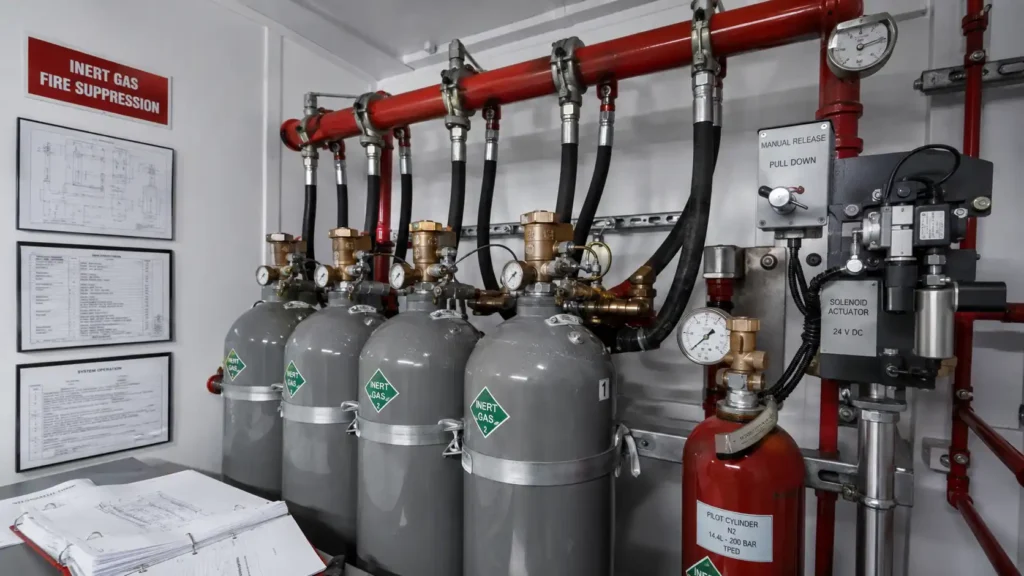
High-pressure cylinders store the extinguishing agent. Their quantity is determined by enclosure volume, design concentration, minimum ambient temperature, site altitude, and individual cylinder capacity.
Cylinder Valves
Each valve controls agent release from its cylinder. Activation may use an electric, pneumatic, or manufacturer-approved mechanical actuator.
Discharge Manifold
The manifold combines the flow from multiple cylinders before directing the gas into the distribution network. Multi-cylinder installations require coordinated valves, hoses, check valves, and release arrangements.
Flexible Discharge Hoses
Flexible hoses connect cylinder valves to the manifold. Their pressure rating and compatibility must match the approved system.
Distribution Piping
The pipe network transfers the agent from the storage area to the protected enclosure. Pipe diameter, length, fittings, and routing must follow an approved flow calculation.
Discharge Nozzles
Engineered nozzles distribute the gas throughout the enclosure. Each nozzle orifice is selected according to the manufacturer’s hydraulic or flow calculation.
Releasing Control Panel
The releasing panel processes detector signals and executes the approved cause-and-effect logic, including:
- First-stage alarm.
- Confirmed fire.
- Discharge delay.
- Pre-discharge warning.
- HVAC shutdown.
- Agent release.
- Pressure-switch monitoring.
- Trouble and supervisory indications.
Manual Release Station
A manual release station allows authorized personnel to activate the suppression system directly when required.
Abort Switch
Depending on the system philosophy, an abort switch can delay discharge while it is continuously operated.
Sounders and Strobes
Audible and visual alarms warn personnel before agent discharge and support evacuation from the protected enclosure.
Pressure Relief Vent
Rapid gas discharge can create a significant pressure change inside the room. A pressure relief vent helps protect doors, walls, ceilings, and other structural elements.
Inert Gas and Room Integrity Testing
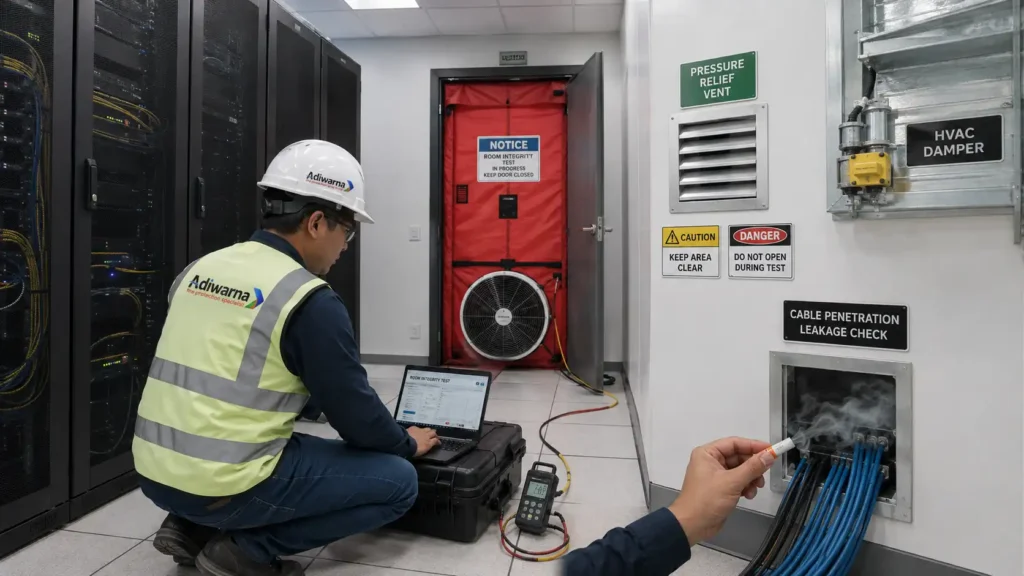
An inert gas system can only perform as designed when the enclosure retains the required concentration for the specified period.
A room integrity test uses a blower door fan to measure enclosure leakage. The resulting data is used to estimate the agent retention time and identify uncontrolled openings.
Common leakage paths include:
- Door gaps.
- Cable penetrations.
- Raised-floor openings.
- Ceiling voids.
- HVAC ducts.
- Dampers.
- Pipe penetrations.
- Wall openings.
- Access panels.
- Drains.
- Window frames.
Testing should be completed during commissioning and repeated after significant room modifications.
Changes that may affect enclosure integrity include:
- Additional cable penetrations.
- Door replacement.
- Wall renovation.
- Raised-floor alterations.
- New ductwork.
- HVAC modifications.
- Installation of new equipment.
Adiwarna can integrate room integrity testing into inert gas system testing, commissioning, and lifecycle maintenance.
Inert Gas Compared with Halocarbon Clean Agents
Both inert gas and halocarbon agents are used in gaseous fire suppression, but their characteristics differ.
| Aspect | Inert Gas | Halocarbon Clean Agent |
|---|---|---|
| Primary mechanism | Reduces oxygen concentration | Generally absorbs heat and interferes with combustion |
| Storage form | High-pressure compressed gas | Usually stored as a liquefied gas |
| Cylinder requirement | May require more cylinders | Often more compact |
| Residue | None | None |
| Pressure relief | Particularly important | Must still be evaluated |
| Typical applications | Data centers, archives, control rooms | Data centers, archives, control rooms |
| Agent composition | Atmospheric gases | Depends on the selected halocarbon |
Selection should consider:
- Available cylinder space.
- Distance between cylinders and the enclosure.
- Distribution-pipe pressure.
- Occupancy.
- Agent availability.
- Refill support.
- Pressure-relief requirements.
- Design concentration.
- Lifecycle cost.
- Required approvals.
Inert Gas Compared with Carbon Dioxide Systems
Inert gas and carbon dioxide systems should not be considered identical.
Carbon dioxide suppresses fire through oxygen reduction and cooling effects, but it presents different and more severe personnel-safety considerations. CO₂ systems are generally used for specific industrial applications and require strict safety procedures.
An inert gas system protecting an occupied enclosure must still be designed around concentration limits, evacuation time, alarm sequences, discharge delays, and applicable safety requirements.
System selection should evaluate:
- Occupancy.
- Hazard type.
- Enclosure volume.
- Safety assessment.
- Authority requirements.
- Emergency procedures.
- Ventilation.
- Applicable system standards.
Integration with the Fire Alarm System
Inert gas suppression requires dependable detection and releasing controls.
Cross-zone detection is commonly applied. Under this arrangement, the first detector initiates an early alarm, while a second detector confirms the release condition.
A cause-and-effect matrix may include:
- First-detector alarm.
- Second-detector confirmation.
- Pre-discharge alarm.
- Discharge time delay.
- HVAC shutdown.
- Damper closure.
- Equipment shutdown.
- Door release.
- Agent discharge.
- Pressure-switch confirmation.
- Fire alarm panel indication.
- BMS notification.
- Remote control-room monitoring.
Every programmed function should be verified through integrated system testing.
Pressure Relief for Inert Gas Systems
High-pressure gas discharge can increase pressure inside the protected enclosure. Without adequate relief, doors, walls, ceilings, or building panels may be damaged.
Pressure-relief vent sizing should consider:
- Agent discharge flow.
- Enclosure volume.
- Maximum allowable room pressure.
- Vent performance.
- Airflow direction.
- Wall construction.
- Number of cylinders.
- Discharge duration.
The relief path must lead to a safe area and should not discharge toward evacuation routes or occupied hazard zones.
Inert Gas Fire Suppression Standards
Design and installation should comply with applicable standards, product listings, manufacturer instructions, local regulations, and project specifications.
Common references include:
- NFPA 2001 for clean agent fire-extinguishing systems.
- ISO 14520-1:2023 for general gaseous fire-extinguishing system requirements.
- ISO 14520-12 for IG-01.
- ISO 14520-15 for IG-541.
- NFPA 72 for fire alarm and signaling systems.
- Manufacturer design manuals.
- Applicable UL or FM approvals.
- Pressure-vessel requirements.
- Local fire regulations.
- Insurance requirements.
- Project technical specifications.
Adiwarna’s inert gas fire protection services are developed with reference to recognized standards such as NFPA 2001 and ISO 14520.
Important Inert Gas Design Factors
System design cannot be based only on floor area. Engineers must calculate the complete enclosure volume and analyze the operating environment.
Important factors include:
- Hazard classification.
- Main room volume.
- Raised-floor volume.
- Ceiling-void volume.
- Minimum ambient temperature.
- Site altitude.
- Design concentration.
- Required agent quantity.
- Cylinder pressure.
- Cylinder location.
- Distribution-pipe distance.
- Number of nozzles.
- Required discharge time.
- Pressure-relief capacity.
- Occupancy.
- Evacuation time.
- HVAC shutdown.
- Door openings.
- Enclosure leakage.
- Detection logic.
- Future room modifications.
- Refill availability.
Even a small error in volume or leakage assumptions can affect both agent concentration and retention time.
Testing and Commissioning
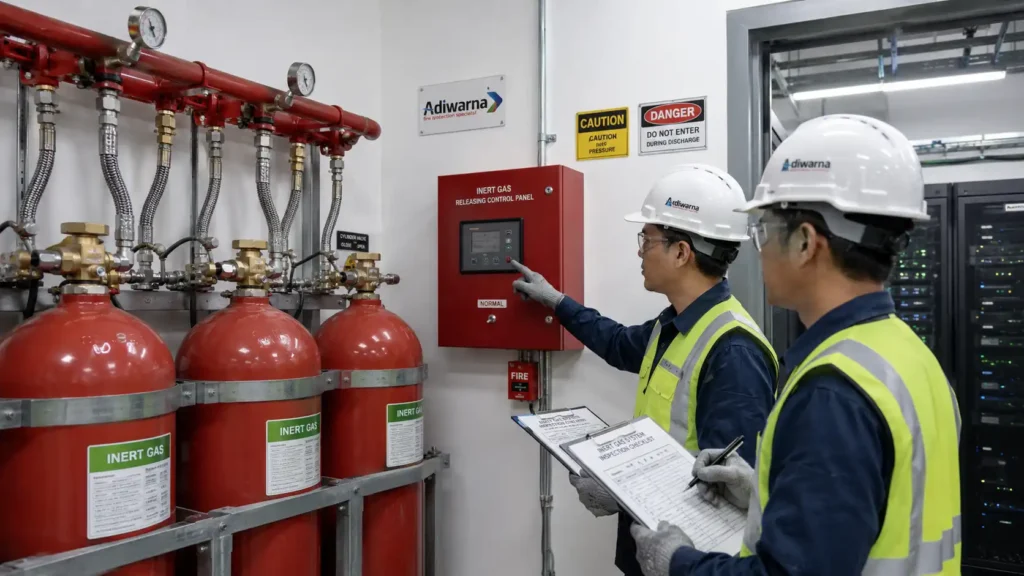
Testing and commissioning must demonstrate that every system component functions according to the approved design.
Typical activities include:
- Visual inspection.
- Cylinder-pressure verification.
- Agent quantity or cylinder-weight verification.
- Cylinder-valve inspection.
- Flexible-hose inspection.
- Manifold inspection.
- Piping pressure testing.
- Pipe-obstruction testing.
- Nozzle-orifice verification.
- Detector testing.
- Releasing-panel testing.
- Manual-release testing.
- Abort-switch testing.
- Sounder and strobe testing.
- Discharge-delay verification.
- Solenoid-circuit testing.
- Pressure-switch testing.
- HVAC shutdown testing.
- BMS interface testing.
- Cause-and-effect testing.
- Room integrity testing.
- Pressure-relief verification.
- Documentation review.
Commissioning records should include:
- Cylinder data.
- Agent quantity.
- Detector addresses.
- Nozzle information.
- Pipe calculations.
- Cause-and-effect matrix.
- Room integrity results.
- Interface test results.
- Alarm test records.
- As-built drawings.
Inert Gas System Maintenance
Periodic inspection is required to keep the system ready for emergency operation.
Maintenance activities may include:
- Cylinder-pressure checks.
- Cylinder-condition inspections.
- Valve and actuator checks.
- Flexible-hose inspections.
- Manifold inspections.
- Distribution-pipe inspections.
- Nozzle-obstruction checks.
- Releasing-panel tests.
- Backup-battery checks.
- Smoke-detector testing.
- Aspirating-detector maintenance.
- Manual-release testing.
- Abort-switch testing.
- Alarm-device testing.
- Pressure-switch verification.
- Warning-sign inspection.
- Enclosure-sealing review.
- HVAC interface testing.
- Pressure-relief vent inspection.
- Event-history review.
- Maintenance-record updates.
Any modification to the protected enclosure should trigger a technical review because it may change both room volume and leakage characteristics.
Common Inert Gas Project Mistakes
Frequent errors include:
- Calculating an incomplete room volume.
- Excluding raised floors or ceiling voids.
- Omitting a pressure relief vent.
- Skipping room integrity testing.
- Providing insufficient cylinder-room space.
- Using incorrect pipe calculations.
- Allowing equipment to obstruct nozzles.
- Failing to test HVAC shutdown.
- Preparing an incomplete cause-and-effect matrix.
- Providing inadequate pre-discharge alarm coverage.
- Installing manual release or abort controls in unsuitable locations.
- Ignoring occupancy conditions.
- Failing to verify pipe-pressure ratings.
- Providing no refill strategy.
- Modifying the room without reviewing the system.
- Skipping integrated system testing.
- Maintaining incomplete commissioning documents.
A large number of cylinders does not automatically indicate a reliable system. Performance depends on engineering calculations, detection, enclosure integrity, pressure management, commissioning, and maintenance.
Benefits of Inert Gas for Critical Facilities
A properly engineered system provides several advantages:
- No residue after discharge.
- Electrically non-conductive protection.
- No water application.
- Suitability for electronic assets.
- Use of gases naturally present in the atmosphere.
- Support for business continuity.
- Minimal post-discharge cleanup.
- Integration with fire alarm and BMS platforms.
- Suitability for total-flooding applications.
- Continuous automatic protection.
These advantages depend on correct enclosure integrity, flow calculations, alarms, releasing logic, pressure relief, and preventive maintenance.
Why Choose PT Adiwarna Anugerah Abadi?
PT Adiwarna Anugerah Abadi can help facility owners select an inert gas system according to the protected hazard, enclosure volume, occupancy, room conditions, pressure-relief requirements, and project standards.
The service scope may include:
- Site surveys.
- Fire risk assessments.
- Agent selection.
- Design-concentration calculations.
- Cylinder sizing.
- Flow calculations.
- Pipe and nozzle design.
- Pressure-relief calculations.
- Fire alarm integration.
- Equipment procurement.
- Installation.
- Testing and commissioning.
- Room integrity testing.
- Operator training.
- Preventive maintenance.
- Refilling and system restoration.
- Existing-system assessments.
- Retrofit and system upgrades.
Available solutions may include GEMTEX GEM01 IG-01, GEMTEX GEM55 IG-55, GEMTEX GEM100 IG-100, and Inergen IG-541.
For integrated project delivery, Adiwarna EPC Fire Protection can coordinate engineering, procurement, construction, detection, suppression, testing, commissioning, and maintenance.
Organizations requiring technical consultation can contact PT Adiwarna Anugerah Abadi through the Adiwarna website.
Conclusion
Inert gas provides gaseous fire suppression for data centers, server rooms, electrical rooms, control rooms, museums, archives, laboratories, and other critical facilities without applying water or leaving residue.
Common agent types include IG-01, IG-55, IG-100, and IG-541. Each agent has different composition, cylinder requirements, flow calculations, nozzle arrangements, and approval conditions.
Reliable protection depends on more than the extinguishing agent. Enclosure integrity, pressure relief, detection, releasing controls, alarms, cylinder banks, piping, commissioning, and preventive maintenance must function as one integrated system.
With correct engineering, inert gas suppression can provide automatic fire control, reduce secondary damage, and support operational continuity in critical facilities.
PT Adiwarna Anugerah Abadi is ready to support agent selection, system design, installation, testing, room integrity testing, maintenance, and inert gas system upgrades.