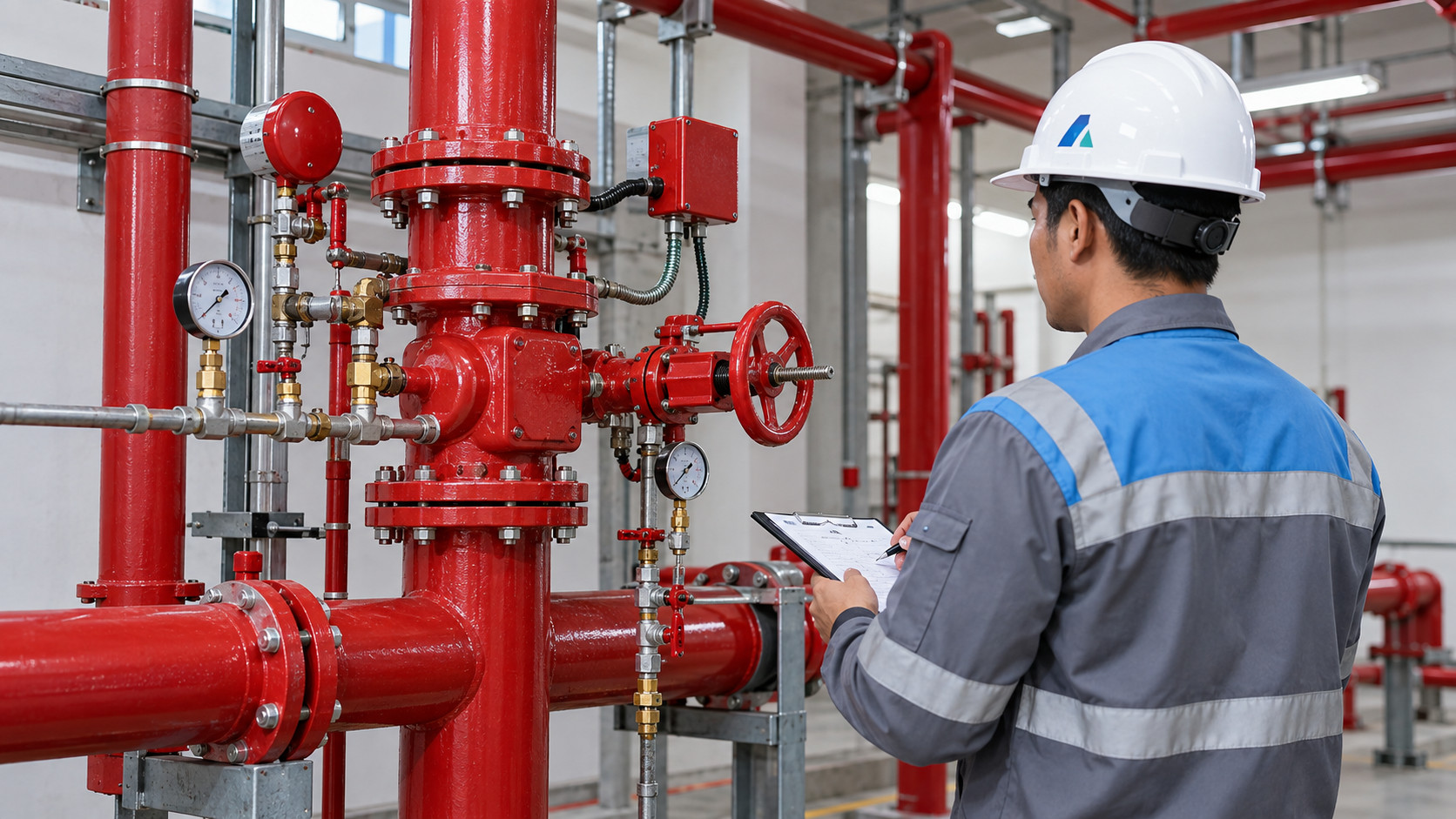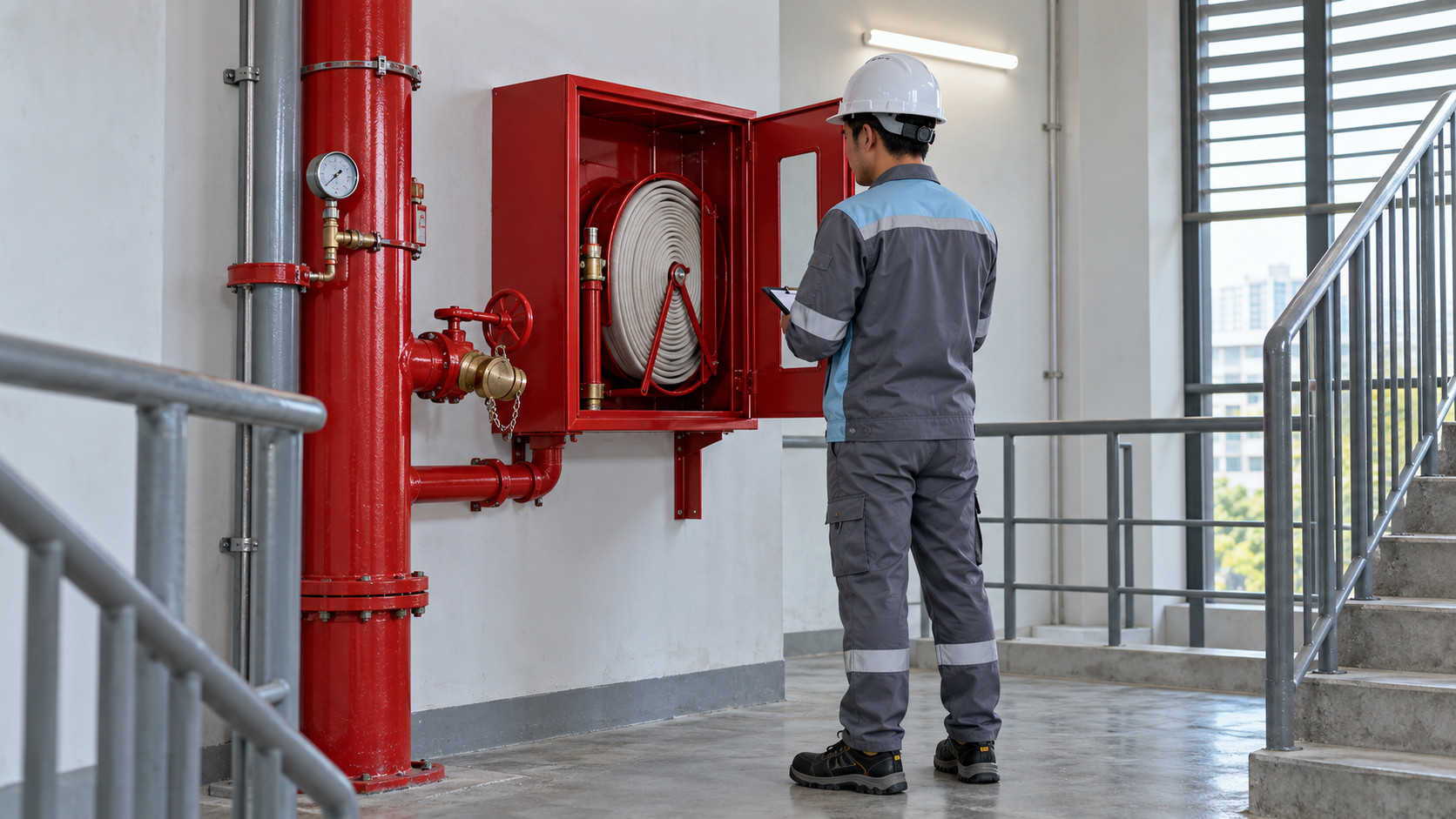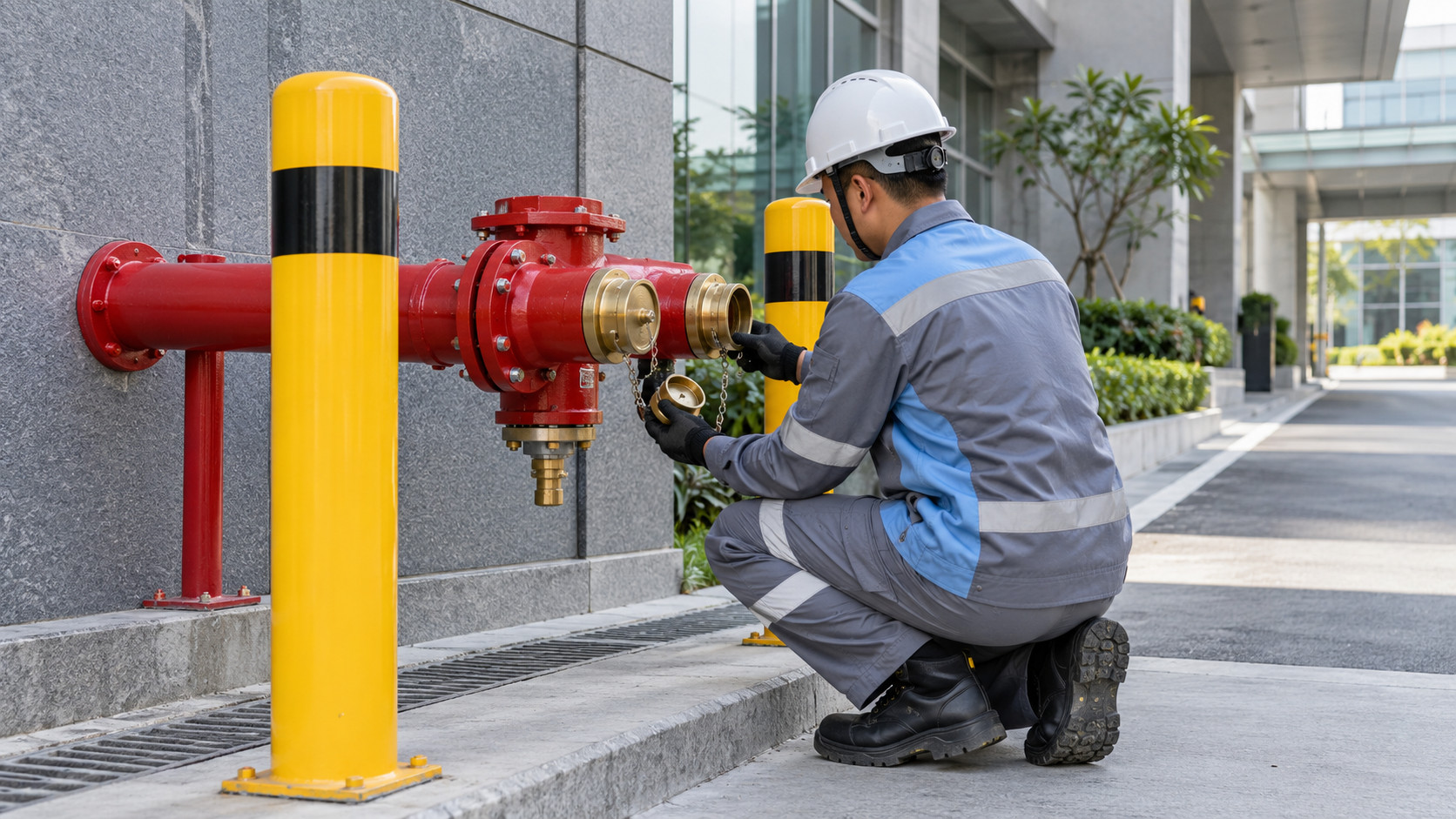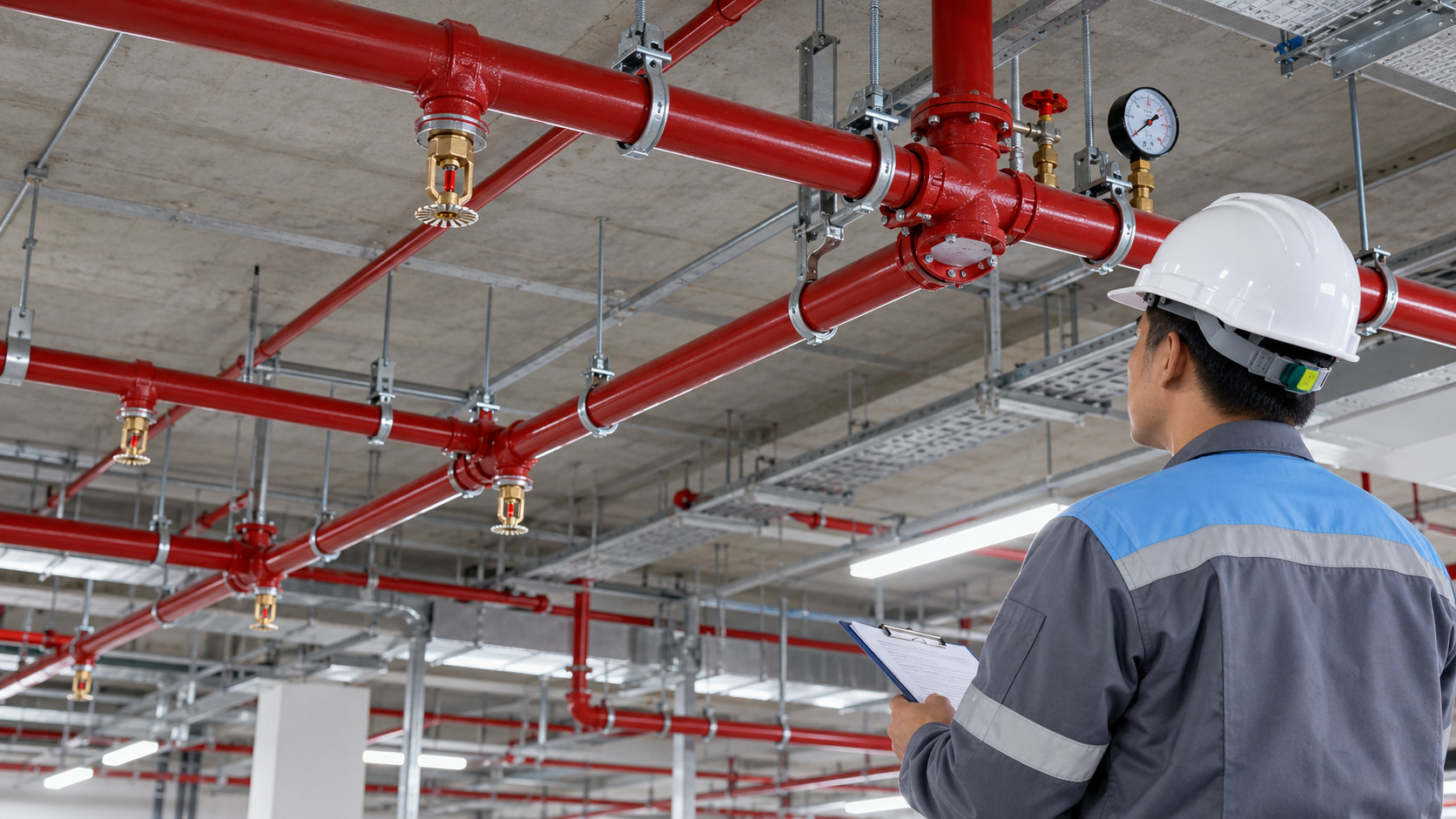

A fire suppression system is a fire protection solution designed to control or extinguish a fire using an extinguishing medium selected according to the protected hazard. In many applications, the system operates automatically after detection devices identify a fire condition and the releasing control panel executes a programmed activation sequence.
Unlike a fire alarm system that primarily warns occupants and operators, suppression equipment acts directly on the fire. Depending on the application, the extinguishing medium may include a clean agent, inert gas, carbon dioxide, foam, water mist, dry chemical, wet chemical, or water discharged through a specialized arrangement.
Selecting the correct technology requires an assessment of the combustible materials, occupancy conditions, protected area, room volume, ventilation, business-continuity requirements, and potential secondary damage. Consequently, one suppression method should not be applied uniformly to every building or industrial facility.
PT Adiwarna Anugerah Abadi provides modern fire suppression system solutions covering technologies such as FM200, Inergen, water mist, and other systems selected according to the facility risk and project requirements.
What Is a Fire Suppression System?
A fire suppression system is an integrated arrangement combining fire detection, control equipment, extinguishing-agent storage, distribution piping, and discharge devices.
Its functions may include:
- Detecting smoke, heat, flame, gas, or another fire indicator.
- Warning occupants and facility operators.
- Shutting down HVAC equipment.
- Closing dampers or isolation valves.
- Activating the extinguishing medium.
- Sending status signals to the fire alarm panel.
- Transmitting information to the BMS or control room.
- Restricting fire growth before manual response teams arrive.
Within industrial facilities, suppression equipment is frequently integrated with fire alarms, fire and gas detection, emergency shutdown systems, ventilation controls, and centralized monitoring. Such coordination allows detection, warning, shutdown, discharge, and supervision to operate as one protection strategy rather than as separate devices.
Adiwarna also provides various fire suppression system products for gaseous and special-hazard applications protecting critical rooms and industrial equipment.
Why Is a Fire Suppression System Necessary?
Fires inside data centers, electrical rooms, turbine enclosures, chemical-storage areas, and process facilities may develop faster than personnel can respond manually.
Beyond damaging equipment, a fire can cause production shutdowns, data loss, product damage, service interruption, and prolonged business downtime. An automatic system provides an opportunity to control the incident during its early development before flames spread into adjacent areas.
Water is not always an appropriate extinguishing medium. Electronic equipment may suffer additional damage from water, while an incorrectly applied water stream can spread burning flammable liquids.
For that reason, extinguishing media must match the fire class and the characteristics of the protected assets. Adiwarna’s industrial fire fighting system services cover clean agents, foam, water-based systems, and other protection methods for facilities with different hazard profiles.
How a Fire Suppression System Works
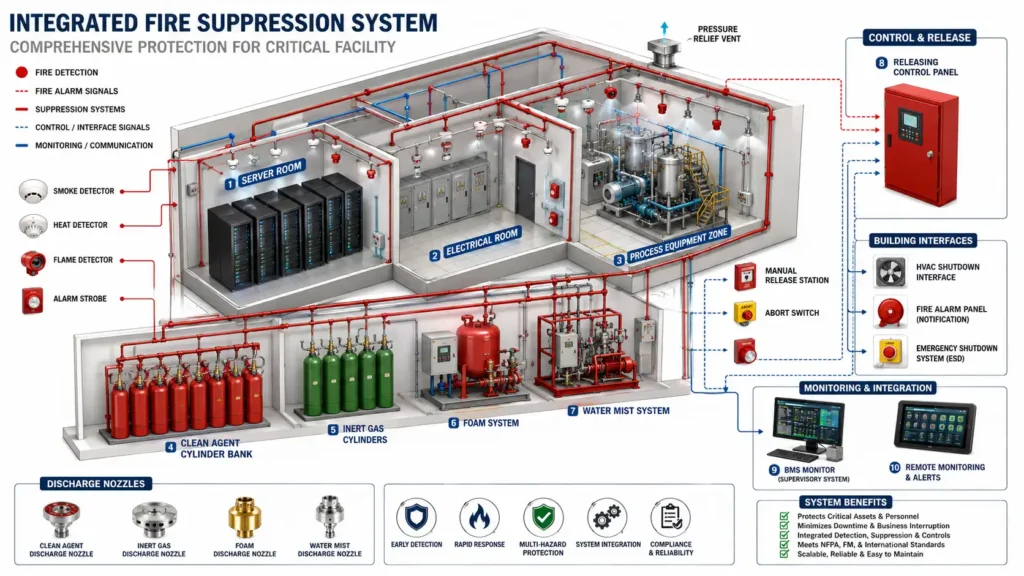
The operating sequence depends on the system type. Nevertheless, most automatic systems follow a progression involving detection, confirmation, warning, interlock operation, and extinguishing-agent release.
A total-flooding gaseous system may operate through the following sequence:
- The first detector identifies smoke, heat, or another fire indication.
- The releasing panel activates the first-stage alarm.
- A second detector confirms the condition through cross-zone logic.
- Sounders and strobes issue a pre-discharge warning.
- A time delay allows personnel to evacuate.
- HVAC equipment and dampers receive shutdown or closure commands.
- The cylinder valve or system control valve activates.
- Extinguishing agent flows through the pipe network to the nozzles.
- A pressure switch confirms system discharge.
- The fire alarm panel and BMS receive the release status.
Foam and deluge systems use a different sequence. Their operation may involve starting fire pumps, opening a deluge valve, activating a foam proportioner, and releasing foam solution or water through monitors, chambers, sprinklers, or open nozzles.
Every relationship between an initiating condition and its output action should be recorded in a cause-and-effect matrix. Integrated testing must then confirm that alarms, interlocks, shutdowns, and discharge commands work according to the approved design.
Types of Fire Suppression Systems
1. Clean Agent Fire Suppression System
Clean agent systems use electrically non-conductive extinguishing media that leave no residue after discharge. These characteristics make them suitable for data centers, server rooms, telecommunications rooms, control rooms, museums, archives, laboratories, and facilities containing sensitive electronic equipment.
Common gaseous agents include:
- HFC-227ea or FM200.
- FK-5-1-12.
- IG-01.
- IG-55.
- IG-100.
- IG-541 or Inergen.
NFPA 2001 is widely referenced for clean agent fire-extinguishing systems, while ISO 14520-1 establishes general requirements for gaseous fire-extinguishing systems.
FM200 Fire Suppression System
FM200 uses HFC-227ea as its extinguishing agent. Stored as a liquefied compressed gas, the agent is released through engineered piping and discharge nozzles.
Fast discharge and residue-free operation make this technology suitable for spaces where post-fire cleanup and operational downtime must be minimized.
Typical applications include:
- Data centers.
- Server rooms.
- Electrical rooms.
- Control rooms.
- Telecommunication rooms.
- Archive storage.
- Laboratories.
- Medical-equipment rooms.
Cylinder quantity, nozzle size, agent concentration, enclosure volume, and distribution piping must follow an approved system calculation.
Inert Gas Fire Suppression System
Inert gas systems suppress fire primarily by reducing the oxygen concentration inside an enclosure until combustion can no longer continue.
The extinguishing medium may use argon, nitrogen, a nitrogen-argon mixture, or IG-541. Each formulation requires its own design concentration, cylinder arrangement, nozzle configuration, and flow calculation.
Key advantages include:
- No residue after discharge.
- Electrical non-conductivity.
- Use of naturally occurring atmospheric gases.
- Suitability for sensitive electronic assets.
- Compatibility with total-flooding applications.
- Support for operational continuity.
Compared with certain halocarbon systems, inert gas installations may require more cylinders and a larger storage area. Additional information is available through Adiwarna’s inert gas fire protection solutions.
2. Carbon Dioxide Fire Suppression System
A carbon dioxide system controls fire by reducing oxygen concentration and providing a cooling effect.
This technology is commonly applied to specialized industrial hazards such as:
- Generator enclosures.
- Turbine enclosures.
- Printing machines.
- Dip tanks.
- Process machinery.
- Electrical equipment enclosures.
- Marine engine rooms.
Personnel safety is a critical design consideration. Extinguishing concentrations of carbon dioxide can be dangerous to occupants, so the installation may require strict controls involving pre-discharge alarms, time delays, lockout arrangements, ventilation, warning signs, and emergency procedures.
A CO₂ system should only be selected after occupancy, evacuation, ventilation, and operational risks have been thoroughly evaluated.
3. Water Mist Fire Suppression System
Water mist uses very small water droplets to absorb heat, reduce radiant energy, and influence oxygen availability around the flame.
Certain applications can achieve effective fire control with less water than conventional sprinkler systems. Actual performance, however, depends on the protected hazard, nozzle arrangement, operating pressure, droplet characteristics, and system test data.
Possible applications include:
- Turbine enclosures.
- Machinery spaces.
- Cable tunnels.
- Marine facilities.
- Heritage buildings.
- Selected commercial kitchens.
- Areas requiring reduced water application.
Water mist should be treated as an engineered system. Nozzle type, pump pressure, spacing, and system limitations must match the tested configuration.
4. Foam Fire Suppression System
Foam systems are primarily used for areas exposed to flammable-liquid fires.
After foam concentrate mixes with water and air, the resulting finished foam forms a blanket over the fuel surface. This layer suppresses flammable vapors, separates the fuel from oxygen, reduces heat transfer, and limits the potential for reignition.
Common applications include:
- Tank farms.
- Refineries.
- Fuel terminals.
- Loading racks.
- Aircraft hangars.
- Petrochemical plants.
- Marine terminals.
- Chemical facilities.
- Spill-containment zones.
A complete foam installation may include:
- Foam concentrate storage.
- A bladder tank or foam pump.
- Foam proportioning equipment.
- A deluge valve.
- Foam monitors.
- Foam chambers.
- Foam-water sprinklers.
- Fire pumps.
- Detection and control equipment.
Adiwarna’s foam fire fighting system for high-risk areas can integrate these components into a coordinated protection network.
5. Dry Chemical Suppression System
Dry chemical systems use extinguishing powder that rapidly interrupts the combustion reaction.
This technology may be suitable for hazards involving:
- Flammable gases.
- Fuel dispensing.
- Industrial processes.
- Paint booths.
- Chemical handling.
- Loading areas.
- Selected cooking equipment.
Fire knockdown can be very rapid, but discharged powder leaves residue. Cleaning requirements and potential contamination make dry chemical suppression unsuitable for many data centers and sensitive electronics rooms.
Selection should account for agent compatibility, equipment contamination, visibility during discharge, and post-release restoration.
6. Wet Chemical Suppression System
Wet chemical systems are widely used for commercial kitchen hazards involving hot cooking oil and grease.
The agent reacts with the heated oil to form a protective layer that supports cooling and helps prevent reignition.
Protected equipment may include:
- Deep-fat fryers.
- Cooking ranges.
- Hoods.
- Exhaust ducts.
- Filters.
- Plenums.
- Associated cooking appliances.
System operation should be coordinated with fuel shutoff, electrical isolation, manual release, and the building fire alarm system.
7. Deluge and Water Spray Systems
A deluge system uses open nozzles connected to piping that remains empty or unpressurized at the discharge points until the deluge valve opens.
Once activated, water flows through all open nozzles in the protected zone. This configuration is appropriate where rapid, simultaneous application is required.
Typical hazards include:
- Electrical transformers.
- Process vessels.
- Conveyors.
- Storage-tank exposures.
- Cable areas.
- Loading racks.
- High-risk industrial equipment.
Activation can originate from heat detectors, flame detectors, linear heat detection, pneumatic detection, or manual release stations.
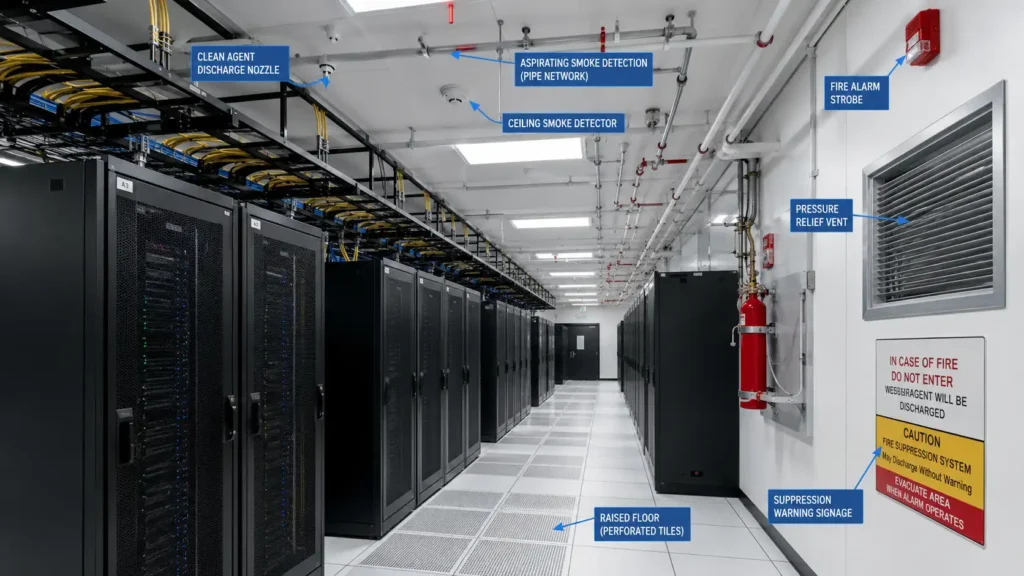
Fire Suppression Systems for Data Centers
A data center requires fire protection capable of controlling a fire without damaging servers, storage systems, network infrastructure, and electrical equipment.
A suitable design may combine:
- Aspirating smoke detection.
- Addressable fire alarms.
- Cross-zone detection logic.
- Clean agent or inert gas suppression.
- Manual release stations.
- Abort switches.
- HVAC shutdown controls.
- Pressure relief vents.
- BMS integration.
- Room integrity testing.
Raised floors, suspended ceilings, cable penetrations, hot aisles, cold aisles, and high airflow can influence agent distribution and retention. All connected volumes must therefore be included in the engineering assessment.
Adiwarna provides an integrated data center fire protection strategy combining early detection, alarm, suppression, enclosure testing, and operational response.
Protecting Raised Floors and Ceiling Voids
Hidden spaces can contain power cables, communication wiring, and airflow paths capable of spreading smoke and fire.
Excluding these areas from the calculation may result in insufficient agent quantity. Detector placement and nozzle coverage should also account for concealed volumes where fire may develop before becoming visible in the occupied room.
During the site survey, engineers should identify all connected spaces and determine whether each volume forms part of the protected enclosure.
Fire Suppression Systems for Industrial Facilities
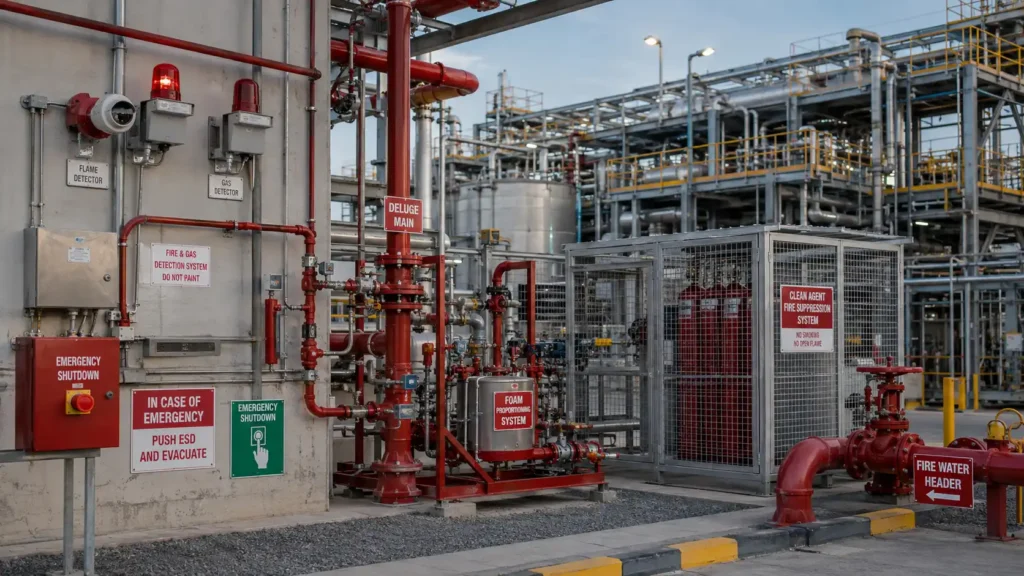
Industrial fire hazards may involve fuels, gases, electrical equipment, hot machinery, chemicals, process liquids, and high operating temperatures.
Areas that may require specialized suppression include:
- Oil and gas plants.
- Petrochemical facilities.
- Power stations.
- Manufacturing plants.
- Warehouses.
- Tank farms.
- Generator rooms.
- Turbine enclosures.
- Chemical-storage rooms.
- Paint booths.
- Battery rooms.
- Control rooms.
In these environments, suppression equipment often becomes part of a wider industrial fire fighting system incorporating hydrants, fire pumps, sprinklers, fire alarms, foam systems, and emergency-response equipment.
Process Equipment Protection
Machinery and process skids may require local application rather than total-room flooding.
A local application system directs extinguishing agent toward a particular hazard, such as an engine, turbine, machine enclosure, or fuel-handling unit. This approach can reduce the required agent quantity but demands careful nozzle positioning and hazard coverage.
Openings, airflow, machinery movement, maintenance access, and possible fuel release points must be considered during design.
Fire Suppression System and Fire Alarm Integration
A fire alarm system detects and communicates a fire condition. The suppression system, by contrast, releases an extinguishing medium to control the incident.
Although their primary functions differ, both systems must operate together. The releasing control panel depends on reliable detector input before it begins the discharge sequence.
Equipment involved in the integrated logic may include:
- Smoke detectors.
- Heat detectors.
- Flame detectors.
- Gas detectors.
- Aspirating smoke detectors.
- Manual release stations.
- Abort switches.
- Alarm bells.
- Sounders.
- Strobes.
- Pressure switches.
- Releasing modules.
- A master fire alarm panel.
Adiwarna’s fire alarm systems can be integrated with gaseous, foam, deluge, and other suppression technologies.
Fire Suppression System and BMS Integration
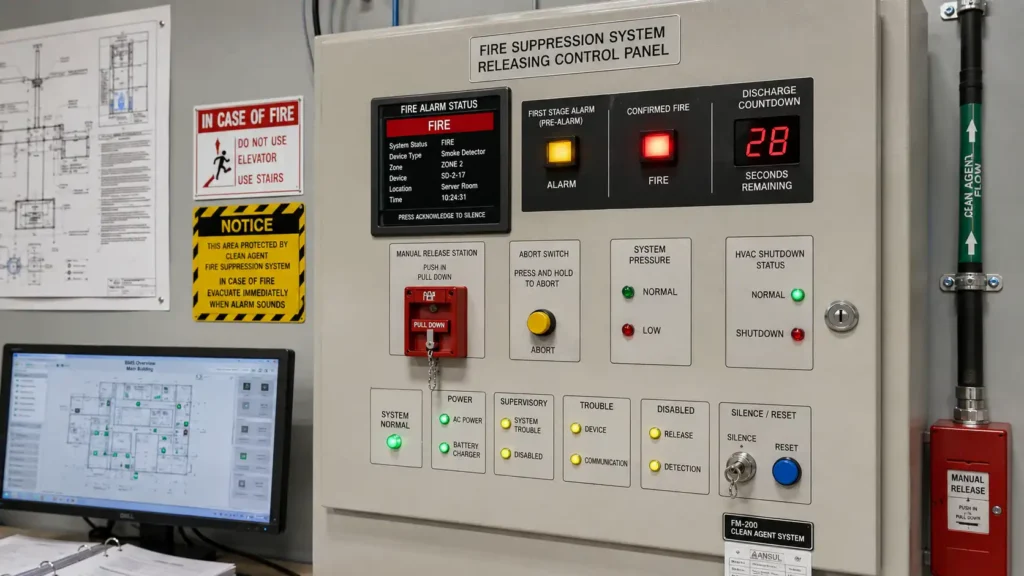
A building management system can receive suppression-system status for centralized supervision.
Information displayed may include:
- System normal.
- Fire alarm.
- Pre-discharge condition.
- Agent released.
- Low cylinder pressure.
- Panel trouble.
- Detector fault.
- Manual release activated.
- Abort function active.
- HVAC shutdown.
- Door release.
- Common alarm.
Primary suppression logic should remain under the control of the dedicated releasing panel. BMS communication should provide monitoring rather than becoming a single point of failure for extinguishing-system activation.
Signal descriptions, point names, alarm priorities, and system status should be verified during integrated commissioning.
Main Components of a Fire Suppression System
The exact configuration varies according to the extinguishing technology, but common components may include:
- Extinguishing agent.
- Cylinders or storage tanks.
- Cylinder valves.
- Discharge manifolds.
- Flexible hoses.
- Distribution piping.
- Discharge nozzles.
- Foam proportioners.
- Deluge valves.
- Pressure gauges.
- Pressure switches.
- Detection devices.
- Releasing control panels.
- Manual release stations.
- Abort switches.
- Sounders and strobes.
- HVAC interfaces.
- Fire alarm interfaces.
- BMS interfaces.
- Pressure relief vents.
- Warning signs.
- Test connections.
Components should be compatible as an approved system arrangement. Mixing cylinders, valves, nozzles, or control equipment from unrelated configurations can invalidate the design calculation or system approval.
The Role of Room Integrity Testing
Room integrity testing is essential for total-flooding gaseous systems because the extinguishing concentration must remain inside the enclosure for the required period.
A blower door fan measures leakage and allows the engineer to estimate agent retention time without releasing the extinguishing gas.
Frequent leakage locations include:
- Door gaps.
- Cable penetrations.
- Raised-floor openings.
- Ceiling openings.
- HVAC ducts.
- Pipe penetrations.
- Wall joints.
- Access panels.
- Drains.
- Window frames.
Excessive leakage may allow the agent to escape before the fire is fully controlled. Sealing improvements should therefore be completed and verified before final system acceptance.
Future room alterations can invalidate earlier test results. Additional cable penetrations, modified doors, new ducting, or equipment changes should trigger another integrity assessment.
Pressure Relief Vent Requirements
A gaseous fire suppression system can create a rapid pressure change during agent discharge.
Pressure relief vents limit positive or negative pressure inside the protected room, helping prevent damage to doors, walls, ceilings, panels, and structural elements.
Vent calculations consider:
- Agent type.
- Agent discharge rate.
- Room volume.
- Allowable room pressure.
- Structural strength.
- Vent location.
- Airflow direction.
- Number of cylinders.
- Required discharge duration.
The vent should discharge toward a safe location. Its operation must not create a hazard along evacuation routes, in occupied areas, or near other sensitive equipment.
Fire Suppression System Standards
The applicable standard depends on the extinguishing technology.
Common references include:
- NFPA 2001 for clean agent fire-extinguishing systems.
- ISO 14520 for gaseous fire-extinguishing systems.
- NFPA 12 for carbon dioxide systems.
- NFPA 11 for foam systems.
- NFPA 15 for fixed water spray systems.
- Relevant foam-water sprinkler and spray requirements.
- NFPA 17 for dry chemical systems.
- NFPA 17A for wet chemical systems.
- NFPA 72 for fire alarm and signaling systems.
- Manufacturer design manuals.
- Applicable UL or FM approvals.
- Indonesian standards and local fire regulations.
- Insurance requirements.
- Project technical specifications.
The selected edition and its applicability should be verified against the project specification, authority requirements, and product approval.
Fire Suppression System Engineering Stages
Engineering should begin with hazard identification rather than immediate product selection.
A typical project may involve:
- Conducting a site survey.
- Identifying hazards.
- Completing a fire risk assessment.
- Defining the design fire scenario.
- Selecting the suppression technology.
- Calculating the agent or water demand.
- Determining cylinder or tank capacity.
- Completing flow or hydraulic calculations.
- Designing the piping and nozzle arrangement.
- Preparing the detector layout.
- Developing the cause-and-effect matrix.
- Designing HVAC and shutdown interfaces.
- Calculating pressure relief.
- Preparing shop drawings.
- Procuring approved equipment.
- Installing the system.
- Completing testing and commissioning.
- Training operators.
- Preparing handover and maintenance plans.
Choosing an extinguishing agent before the hazard assessment is completed can produce an unsuitable system. Protected materials, occupancy, enclosure characteristics, environmental requirements, and restoration needs should guide the selection.
Testing and Commissioning
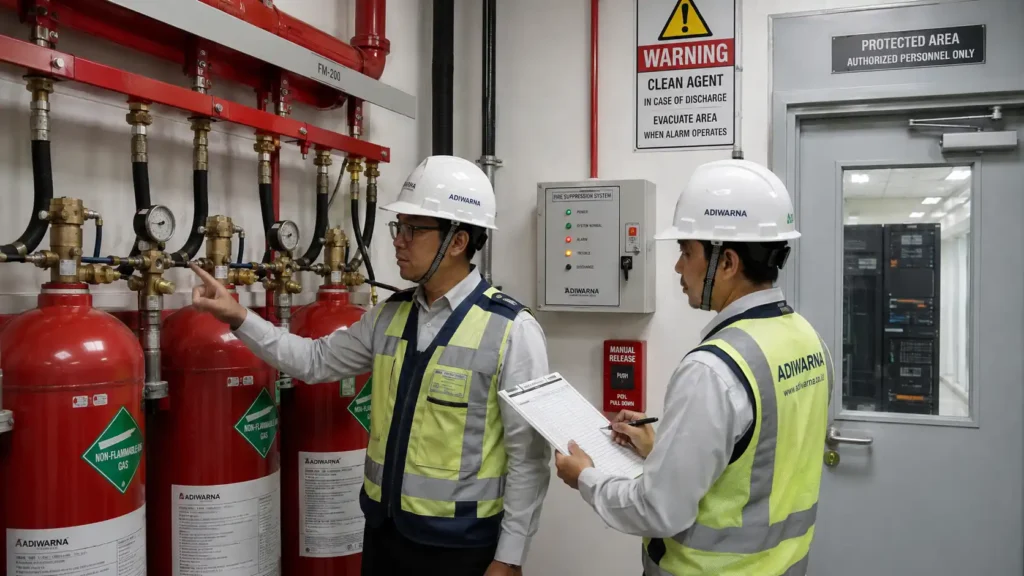
Commissioning must demonstrate that every component works in accordance with the approved design.
Testing activities may include:
- Visual inspection.
- Cylinder-pressure checks.
- Agent-quantity verification.
- Storage-tank level checks.
- Piping pressure tests.
- Pipe-obstruction tests.
- Nozzle inspections.
- Detector functional tests.
- Releasing-panel tests.
- Cross-zone logic tests.
- Manual-release tests.
- Abort-switch tests.
- Sounder and strobe tests.
- Discharge-delay verification.
- HVAC shutdown testing.
- Pressure-switch testing.
- BMS interface testing.
- Cause-and-effect testing.
- Room integrity testing.
- Pressure-relief verification.
- Final system restoration.
Test records should document measurements, alarm responses, deficiencies, corrective actions, and the final system condition.
A successful panel simulation alone does not confirm complete system reliability. Mechanical, electrical, detection, control, interface, and enclosure functions must all be verified.
Fire Suppression System Maintenance
Periodic maintenance is required even when the system has never discharged.
A maintenance program may cover:
- Cylinder pressure.
- Agent quantity.
- Storage-tank level.
- Cylinder-valve condition.
- Flexible hoses and manifolds.
- Distribution piping.
- Discharge nozzles.
- Detection devices.
- Control panels and backup batteries.
- Manual release stations.
- Abort switches.
- Alarm devices.
- Pressure switches.
- HVAC interfaces.
- Warning signs.
- Enclosure sealing.
- Event history.
- Maintenance documentation.
Room-layout changes, additional cables, HVAC modifications, and construction work should trigger a system review.
After maintenance, technicians must ensure that the system has returned to normal operating status. Disabled releasing circuits, closed valves, disconnected actuators, or unresolved trouble signals can leave the protected area without effective suppression.
Common Fire Suppression System Project Mistakes
Frequent mistakes include:
- Selecting an agent without a fire risk assessment.
- Ignoring room occupancy.
- Calculating an incomplete enclosure volume.
- Excluding raised floors or ceiling voids.
- Omitting pressure relief.
- Skipping room integrity testing.
- Installing nozzles that do not match the calculation.
- Failing to test HVAC shutdown.
- Placing manual release controls incorrectly.
- Providing inadequate pre-discharge warning.
- Using piping with an unsuitable pressure rating.
- Failing to establish an agent-refill strategy.
- Ignoring environmental restrictions.
- Skipping integrated testing.
- Failing to prepare as-built drawings.
- Leaving the system disabled after maintenance.
High-quality equipment cannot compensate for poor engineering, installation, or commissioning. Reliable protection depends on the complete system rather than on one branded component.
Tips for Choosing a Fire Suppression System
Before selecting a technology, the owner and engineer should answer several questions:
- Which materials could burn?
- Is the protected room occupied?
- Is the equipment sensitive to water?
- What is the complete enclosure volume?
- Can the room retain a gaseous agent?
- How much downtime can the facility tolerate?
- Is sufficient cylinder space available?
- How does the HVAC system operate?
- Is pressure relief required?
- Can the agent be refilled locally?
- Which technical standards apply?
- Are UL or FM approvals required?
- How will the system integrate with the fire alarm and BMS?
- Who will perform maintenance and emergency restoration?
The answers help determine whether the application requires clean agent, inert gas, carbon dioxide, foam, water mist, dry chemical, wet chemical, or a deluge system.
Lifecycle considerations should also be included. Initial equipment cost is only one factor; refill availability, inspections, spare parts, room modifications, training, and future environmental restrictions can influence the total cost of ownership.
Why Choose PT Adiwarna Anugerah Abadi?
PT Adiwarna Anugerah Abadi provides fire protection solutions for specialized facilities, including industrial plants, data centers, power stations, oil and gas facilities, petrochemical operations, and commercial buildings.
The service scope may include:
- Site surveys.
- Fire risk assessments.
- Agent selection.
- Engineering design.
- Hydraulic or flow calculations.
- Cylinder and tank sizing.
- Piping and nozzle design.
- Detection and releasing logic.
- Equipment procurement.
- Installation.
- Testing and commissioning.
- Room integrity testing.
- Operator training.
- Preventive maintenance.
- Agent refilling.
- Retrofitting and system upgrades.
For projects requiring coordinated delivery, Adiwarna EPC Fire Protection can manage engineering, procurement, construction, installation, testing, commissioning, and maintenance within one integrated scope.
Organizations can also review Adiwarna’s experience through its fire protection project portfolio, which includes gaseous and industrial fire protection applications.
Technical consultation can be requested through the PT Adiwarna Anugerah Abadi website.
Conclusion
A fire suppression system is an integrated fire protection solution that may use a clean agent, inert gas, carbon dioxide, foam, water mist, dry chemical, wet chemical, deluge water, or water spray according to the protected hazard.
The selected technology must control fire without creating an unacceptable new risk to personnel, equipment, the building, or the environment.
Reliable performance involves more than choosing an extinguishing medium. Detection, releasing controls, piping, nozzles, pressure relief, HVAC interfaces, cause-and-effect logic, commissioning, and preventive maintenance must function as one coordinated system.
With proper engineering, suppression equipment can control a fire during its early development, limit damage, reduce downtime, and support operational continuity.
PT Adiwarna Anugerah Abadi is ready to support the design, supply, installation, testing, commissioning, maintenance, and upgrading of fire suppression systems for commercial and industrial facilities.