
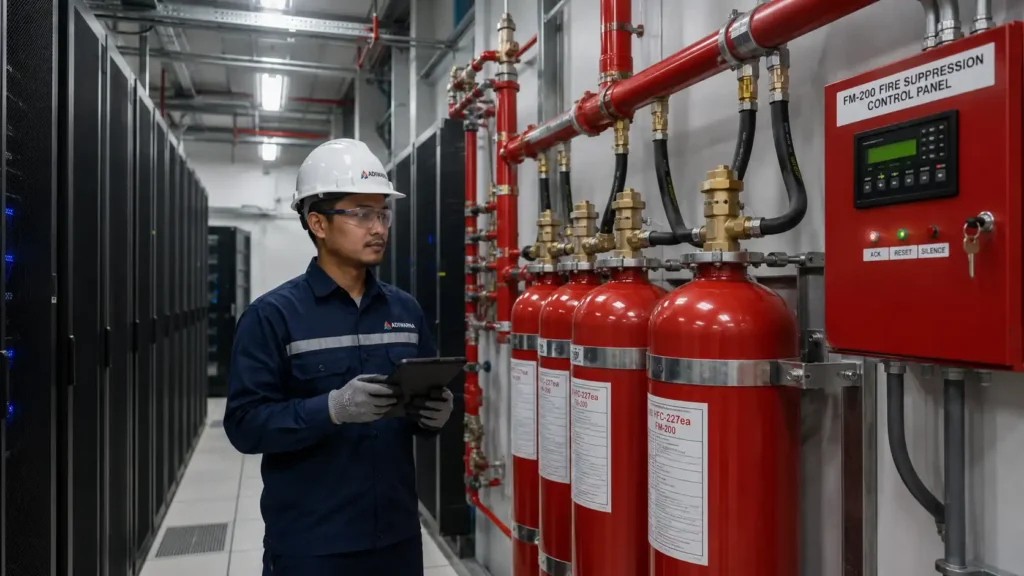
An FM 200 fire suppression system is a clean agent fire extinguishing system that uses HFC-227ea to protect spaces containing sensitive assets without leaving residue after discharge. It is commonly used in data centers, server rooms, electrical rooms, control rooms, telecommunications rooms, and industrial facilities where rapid fire suppression and minimal secondary damage are important.
However, system performance is not determined by the extinguishing agent alone. Protected room volume, design concentration, temperature, piping, nozzle distribution, fire detection, enclosure leakage, HVAC interfaces, and commissioning all form part of one engineered system.
HFC-227ea, commonly marketed as FM-200, remains listed as an acceptable total flooding agent under the US EPA SNAP program. EPA identifies HFC-227ea as having zero ozone depletion potential and a global warming potential of 3,220. These are US regulatory references and should not be treated as Indonesian regulations.
Quick Answer
An FM 200 fire suppression system is an engineered clean agent system based on HFC-227ea that suppresses fire primarily by absorbing heat from the combustion process. The system integrates detectors, a control panel, cylinders, piping, nozzles, alarms, and interlocks. Proper design should consider room volume, agent concentration, room integrity, NFPA 2001, commissioning, and maintenance requirements.
What Is an FM 200 Fire Suppression System?
An FM 200 fire suppression system uses HFC-227ea stored in pressurized cylinders and discharges the agent into a protected enclosure through piping and discharge nozzles when the fire detection system satisfies the programmed release logic.
Clean agent systems are commonly selected for critical areas because they:
- leave no powder or liquid residue;
- are electrically nonconductive;
- are suitable for total flooding;
- can integrate with automatic fire detection;
- reduce cleanup requirements after discharge;
- are suitable for many electronic-equipment environments.
Adiwarna also has a dedicated page covering FM 200 for critical spaces such as data centers, server rooms, electrical panels, and control rooms.
Read Adiwarna’s FM 200 Fire Suppression System guide
How Does an FM 200 Fire Suppression System Work?
The operation of an FM 200 fire suppression system starts with detection, not with the cylinder itself.
A typical sequence may include:
- Smoke detection or another approved detection system identifies a potential fire.
- The suppression control panel receives the signal.
- An initial alarm activates.
- Confirmation or cross-zone logic operates when used.
- Pre-discharge audible and visual alarms activate.
- A programmed time delay begins.
- HVAC, dampers, or selected equipment respond through interlocks.
- The release circuit activates the actuator.
- The cylinder valve opens.
- HFC-227ea flows into the distribution piping and nozzles.
- The agent is distributed throughout the protected volume.
- The control panel indicates system discharge status.
The actual cause-and-effect sequence should always match the hazard, occupancy, control panel listing, and project specifications.
How Does FM 200 Suppress Fire?
FM 200 suppresses fire mainly through heat absorption, reducing the thermal energy required to sustain combustion.
Its mechanism differs from inert gas systems.
Inert gases such as IG-100 and IG-541 primarily suppress fire by reducing oxygen concentration within the protected enclosure, while HFC-227ea relies more heavily on heat absorption.
Because their operating principles differ, FM 200 and inert gas systems should not be compared based on cylinder price alone.
Main Components of an FM 200 Fire Suppression System
An FM 200 fire suppression system includes mechanical and electrical components that must operate as one compatible and properly engineered system.
| Component | Main Function |
|---|---|
| HFC-227ea cylinder | Stores the extinguishing agent |
| Cylinder valve | Controls agent release |
| Electric or pneumatic actuator | Activates the cylinder |
| Pressure gauge or switch | Monitors agent condition |
| Discharge hose | Connects the cylinder to the piping network |
| Manifold | Combines multiple cylinders |
| Distribution piping | Carries the agent |
| Discharge nozzle | Distributes the agent into the room |
| Smoke detector | Provides early fire detection |
| Suppression control panel | Executes the release sequence |
| Sounder and strobe | Provides pre-discharge warning |
| Manual release | Allows manual activation |
| Abort switch | Provides abort function where approved |
| HVAC interface | Controls airflow during suppression |
For a broader discussion of gaseous suppression components, see Adiwarna’s guide to Fire Suppression System Equipment for Critical Assets.
FM 200 Fire Suppression System Design Should Not Be Based on Floor Area Alone
One of the most common mistakes is selecting cylinder quantity only from room floor area.
FM 200 is a total flooding system. Therefore, protected volume is more important than floor area alone.
Engineers should review:
- room length;
- room width;
- clear height;
- suspended ceilings;
- raised floors;
- void spaces;
- temperature;
- altitude where relevant;
- hazard classification;
- openings;
- HVAC;
- nozzle quantity;
- piping arrangement.
Two rooms with the same floor area may require different quantities of agent if their ceiling heights or protected void volumes differ.
FM 200 Fire Suppression System Design Calculation
Every FM 200 fire suppression system should be calculated using the approved design methodology and software associated with the listed system.
Engineering calculations can include several areas.
Agent Quantity
Agent quantity may depend on:
- net protected volume;
- required design concentration;
- temperature;
- fire hazard;
- applicable safety factors.
Hydraulic Flow
Hydraulic or flow calculations verify that the required quantity of agent reaches each nozzle within the required discharge performance.
Input parameters can include:
- pipe diameter;
- pipe length;
- fittings;
- elevation;
- nozzle configuration;
- flow splits;
- cylinder arrangement.
Nozzle Distribution
Nozzles should not be positioned solely for visual symmetry.
Coverage and orifice selection should follow the calculation results.
Therefore, moving a nozzle after installation may require recalculation.
Why Is Room Integrity Important for an FM 200 Fire Suppression System?
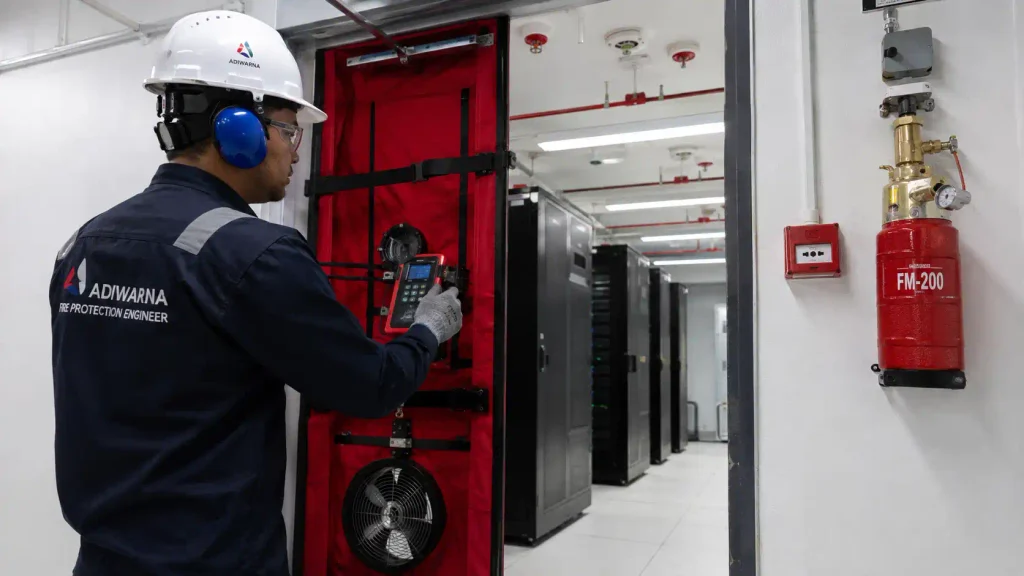
An FM 200 fire suppression system requires an enclosure capable of retaining the required design concentration.
The agent may escape through:
- door gaps;
- cable penetrations;
- ductwork;
- raised floor openings;
- ceiling voids;
- pipe penetrations;
- wall penetrations;
- other openings.
If leakage is excessive, the concentration can decrease faster than intended.
As a result, a fire that has not been fully controlled may be able to redevelop.
What Is a Room Integrity Test?
A room integrity test, often called a door fan test, is used to estimate enclosure leakage without performing an actual FM 200 discharge.
The test helps verify whether the room can retain the required concentration according to the system design.
If the result is inadequate, engineers may recommend sealing cable penetrations, wall openings, doors, or other leakage points before final acceptance.
FM 200 Fire Suppression System for Data Centers
Data centers are one of the most common applications for an FM 200 fire suppression system because these facilities contain high-value assets and require high operational continuity.
Protected equipment may include:
- server racks;
- storage systems;
- network switches;
- routers;
- UPS systems;
- network infrastructure;
- control panels;
- cabling.
However, clean agent suppression should be only one part of a layered fire protection strategy.
The system may integrate:
- aspirating smoke detection;
- conventional smoke detectors;
- fire alarm systems;
- FM 200 suppression;
- HVAC shutdown;
- damper control;
- BMS interfaces;
- emergency power interfaces;
- remote alarm monitoring.
For more detail, see Adiwarna’s Data Center Fire Suppression System for Server Rooms.
FM 200 Fire Suppression System for Electrical and Control Rooms
An FM 200 fire suppression system is also commonly considered for electrical rooms and control rooms because the agent does not leave conductive residue.
Typical equipment may include:
- MCCs;
- switchgear;
- control panels;
- UPS systems;
- PLCs;
- DCS;
- SCADA systems;
- instrumentation;
- communication systems.
Even so, engineering teams should still perform a hazard assessment.
Not every electrical room automatically requires a total flooding system. Room size, ventilation, equipment layout, occupancy, criticality, and available alternatives remain important factors.
Standards for FM 200 Fire Suppression Systems
One of the primary references for clean agent systems is NFPA 2001 — Standard on Clean Agent Fire Extinguishing Systems.
As of 2026, the latest edition is NFPA 2001:2025. The standard addresses topics such as design, agent quantity, detection, controls, discharge, safety, testing, inspection, and maintenance.
View NFPA 2001 standard information
For projects in Indonesia, implementation should also be coordinated with:
- project specifications;
- relevant SNI requirements;
- consultant requirements;
- equipment listings;
- insurer requirements;
- authority requirements;
- manufacturer design manuals.
A standard does not replace engineering calculations.
Is an FM 200 Fire Suppression System Safe for Electronics?
Yes. One of the main reasons FM 200 is used is that HFC-227ea is electrically nonconductive and leaves no significant residue after discharge.
For this reason, it is often considered for facilities containing:
- servers;
- electrical panels;
- telecommunications equipment;
- control systems;
- sensitive instrumentation.
However, equipment may still be damaged by heat, smoke, soot, or electrical faults before suppression takes place.
In other words, clean agent suppression does not eliminate the need for early fire detection.
Is an FM 200 Fire Suppression System Safe for People?
Use of an FM 200 fire suppression system in normally occupied spaces should follow approved design concentrations, exposure limits, alarms, pre-discharge warnings, and evacuation requirements.
It is not appropriate to state that the agent is safe at every concentration.
Engineers should review:
- normal design concentration;
- maximum expected concentration;
- room volume;
- occupancy;
- potential exposure duration;
- egress time;
- alarm sequence.
Personnel should still follow the facility’s evacuation procedure when the pre-discharge alarm activates.
FM 200 Fire Suppression System vs Inert Gas
Facility owners often compare FM 200 with inert gas systems.
| Parameter | FM 200 | Inert Gas |
| Agent | HFC-227ea | Nitrogen, argon, or mixtures |
| Primary mechanism | Heat absorption | Oxygen reduction |
| Residue | None | None |
| Electrical conductivity | Nonconductive | Nonconductive |
| Cylinder footprint | Usually more compact | Can require more space |
| Storage | Liquefied compressed gas | High-pressure compressed gas |
| Pressure relief | Must be evaluated | Particularly important |
| Climate profile | HFC with higher GWP | Generally very low climate impact |
| Typical use | Data centers, server rooms, control rooms | Similar critical spaces |
EPA lists HFC-227ea with zero ODP and a GWP of 3,220. As a result, environmental lifecycle considerations are becoming increasingly relevant when selecting new clean agent systems.
Review EPA total flooding agent information
For comparison with another gaseous system, see Adiwarna’s Inergen Fire Suppression System.
Can FM 200 Still Be Used in 2026?
Technically, FM 200 continues to be used in many existing and new installations in several markets.
In the United States, EPA SNAP still lists HFC-227ea as an acceptable total flooding agent when used according to applicable safety requirements.
However, HFCs are being phased down and managed more strictly in several jurisdictions.
For example, US rules beginning on January 1, 2026 introduce requirements intended to minimize HFC emissions during installation, servicing, repair, and disposal of fire suppression equipment. From January 1, 2030, new fire suppression equipment installations containing HFCs in the US must use recycled HFCs. These requirements are specific to the United States.
For Indonesian projects, this international development is still relevant to lifecycle planning because it may affect:
- global agent supply;
- manufacturer strategy;
- refill availability;
- corporate sustainability targets;
- international project specifications.
What Determines the Cost of an FM 200 Fire Suppression System?
There is no single fixed price for an FM 200 fire suppression system.
Project cost depends on:
- Protected volume.
- Required agent quantity.
- Number of cylinders.
- Cylinder capacity.
- Piping length.
- Number of nozzles.
- Number of detectors.
- Suppression control panel.
- Sounders and strobes.
- Manual release and abort switches.
- HVAC or BMS integration.
- Room integrity requirements.
- Testing and commissioning.
- Project location.
- Required listing and project specification.
For this reason, a quotation based only on room floor area is usually not sufficient for final engineering pricing.
Information Required Before Requesting a Quotation
To obtain a more accurate proposal, prepare:
- room layout;
- length × width × height;
- raised floor height;
- ceiling void information;
- room function;
- equipment list;
- HVAC information;
- cable penetrations;
- existing fire alarm system;
- project specifications;
- required standards;
- occupancy information.
These details help reduce assumptions during preliminary design.
Testing and Commissioning an FM 200 Fire Suppression System
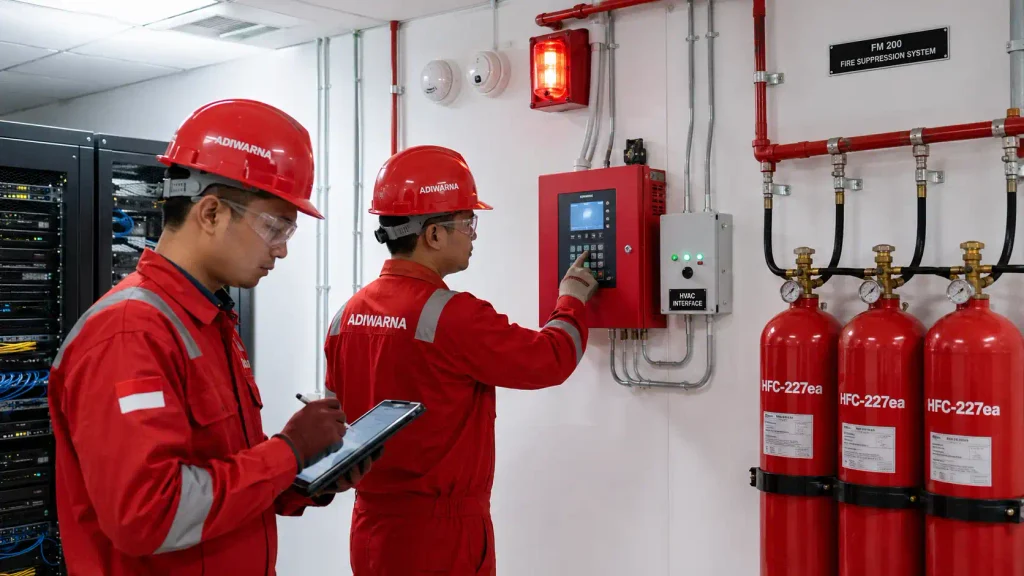
Commissioning an FM 200 fire suppression system should verify the system as one complete sequence.
Testing may include:
- detector functional tests;
- cross-zone logic;
- audible alarms;
- strobes;
- pre-discharge warnings;
- time delays;
- manual release;
- abort function where used;
- control panel trouble conditions;
- pressure monitoring;
- actuator circuits;
- HVAC shutdown;
- damper interfaces;
- discharge simulation;
- piping inspection;
- nozzle positioning;
- room integrity testing.
Integrated testing is important because each detector can work correctly on its own while an interlock or control sequence still fails.
FM 200 Fire Suppression System Handover Documentation
After commissioning, the owner should receive complete system documentation.
This may include:
- approved drawings;
- calculation reports;
- product datasheets;
- cylinder information;
- piping layout;
- nozzle details;
- fire alarm logic;
- cause-and-effect matrix;
- testing reports;
- room integrity reports;
- as-built drawings;
- operating manuals;
- maintenance schedules.
Good documentation simplifies future inspection, modification, troubleshooting, and maintenance.
FM 200 Fire Suppression System Maintenance
An FM 200 fire suppression system requires periodic inspection and maintenance to remain ready for operation.
A basic checklist may include:
- Inspect cylinder condition
- Check pressure monitoring
- Inspect cylinder mounting
- Inspect actuators
- Inspect valves
- Inspect piping
- Confirm nozzles are unobstructed
- Test fire detectors
- Test the suppression panel
- Test sounders and strobes
- Test manual release
- Inspect abort switches
- Test HVAC interlocks
- Inspect room penetrations
- Verify cause-and-effect logic
- Update maintenance records
Room modifications should be reviewed immediately.
Adding partitions, cable trays, HVAC ducts, or new openings may affect protected volume and enclosure integrity.
Common FM 200 Fire Suppression System Mistakes
Calculating from Floor Area Instead of Volume
Total flooding systems require protected-volume calculations.
Ignoring Raised Floors
Raised floors included within the protected enclosure can add significant volume.
Ignoring Ceiling Voids
Certain ceiling voids may also need to be protected or included in the calculation.
Failing to Check Room Leakage
The agent may escape before the required retention condition is achieved.
Modifying Piping After Calculation
Piping changes can affect hydraulic performance.
Moving Nozzles
Nozzle distribution should not be changed without engineering review.
Skipping Integrated Testing
Detection, alarms, HVAC interfaces, and suppression must be tested together.
Assuming FM 200 Fits Every Hazard
FM 200 is not a universal fire suppression agent.
Some hazards may be better protected with inert gas, CO₂, water mist, sprinklers, foam, or other technologies.
FM 200 Fire Suppression System for Battery Rooms
Using an FM 200 fire suppression system in battery rooms requires additional caution, especially where lithium-ion batteries are involved.
FM 200 can suppress certain flame scenarios, but lithium-ion thermal runaway is an internal battery reaction that can continue producing heat.
Therefore, battery-room design may also need to consider:
- battery chemistry;
- thermal runaway;
- cooling requirements;
- propagation;
- off-gas generation;
- explosion hazards;
- ventilation;
- gas detection;
- emergency response.
FM 200 should not automatically be treated as a complete solution for lithium-ion thermal runaway.
How to Choose an FM 200 Fire Suppression System Contractor
An FM 200 fire suppression system contractor should provide engineering capability, not only cylinders and installation labor.
Evaluate whether the contractor can:
- Conduct a site survey.
- Calculate protected volume.
- Perform agent calculations.
- Perform hydraulic calculations.
- Select cylinders.
- Select nozzles.
- Prepare piping layouts.
- Design fire detection.
- Develop a cause-and-effect matrix.
- Integrate HVAC or BMS.
- Evaluate room integrity.
- Perform testing and commissioning.
- Provide as-built drawings.
- Provide maintenance support.
Adiwarna provides fire suppression services covering design, installation, testing, commissioning, and maintenance.
Learn more about Adiwarna Fire Suppression System Equipment
Adiwarna’s project portfolio also includes an FM200 fire suppression implementation at the KCIC Padalarang High-Speed Train Station.
View Adiwarna’s project portfolio
FAQ About FM 200 Fire Suppression Systems
What Is an FM 200 Fire Suppression System?
An FM 200 fire suppression system is a clean agent total flooding system using HFC-227ea to control fire within enclosed spaces without leaving significant residue.
The system includes fire detection, a control panel, cylinders, piping, nozzles, alarms, and safety interlocks.
What Is the Function of an FM 200 Fire Suppression System?
Its primary purpose is to suppress fire rapidly in areas containing sensitive assets.
FM 200 is commonly considered for data centers, server rooms, control rooms, electrical rooms, and areas containing high-value electronic equipment.
Does FM 200 Damage Electronics?
FM 200 is electrically nonconductive and does not leave significant residue after normal discharge.
However, equipment can still be damaged by fire, heat, smoke, soot, or electrical faults before the suppression system operates.
Is FM 200 Still Legal to Use?
Its status depends on the country and applicable regulations.
In the United States, EPA still lists HFC-227ea as an acceptable total flooding agent, although HFC management is becoming stricter under emissions-reduction and phasedown rules.
For Indonesian projects, applicable national regulations, project specifications, and authority requirements should be followed.
What Is the Difference Between FM 200 and Inert Gas?
FM 200 uses HFC-227ea and suppresses fire primarily through heat absorption.
Inert gas systems use nitrogen, argon, or mixtures of these gases and primarily suppress combustion by reducing oxygen concentration.
Both leave no residue, but their storage pressure, space requirements, environmental profile, and system design differ.
Does FM 200 Require a Room Integrity Test?
For total flooding systems, enclosure integrity is very important.
A room integrity test helps estimate leakage and determine whether the required concentration can be maintained for the required period.
How Much Does an FM 200 Fire Suppression System Cost?
Cost cannot be determined from room floor area alone.
Protected volume, agent quantity, cylinders, piping, nozzles, detectors, control panels, system integration, testing, room integrity, and project specifications all affect the final price.
Is FM 200 Suitable for Data Centers?
FM 200 can be one clean agent option for data centers because it is nonconductive and leaves no significant residue.
However, the final design should also integrate early detection, fire alarms, HVAC control, enclosure integrity, and emergency procedures.
Consult Adiwarna for an FM 200 Fire Suppression System
Planning an FM 200 fire suppression system should begin with the hazard and protected enclosure, not with cylinder quantity.
Engineers need to understand room volume, equipment, HVAC, occupancy, detection, fire scenarios, room leakage, project standards, and operational requirements before preparing the final design.
PT Adiwarna Anugerah Abadi Tbk provides fire suppression solutions for critical facilities, including FM200 and inert gas systems.
Explore Adiwarna Fire Suppression Systems
For projects requiring site surveys and engineering, the Adiwarna team can evaluate requirements based on room layout, protected volume, hazard, and project specifications.
Conclusion
An FM 200 fire suppression system is an HFC-227ea-based clean agent system that remains relevant for many data centers, server rooms, electrical rooms, control rooms, and critical facilities.
However, system performance depends on much more than the agent itself. Engineering calculations, fire detection, piping, nozzle distribution, room integrity, HVAC interfaces, commissioning, and maintenance all influence protection performance.
For new projects, facility owners should also consider the lifecycle of HFC-227ea, environmental policies, future agent availability, and alternative clean agents. With this broader evaluation, an FM 200 fire suppression system can be selected based on technical and business requirements rather than simply because the technology is widely known.