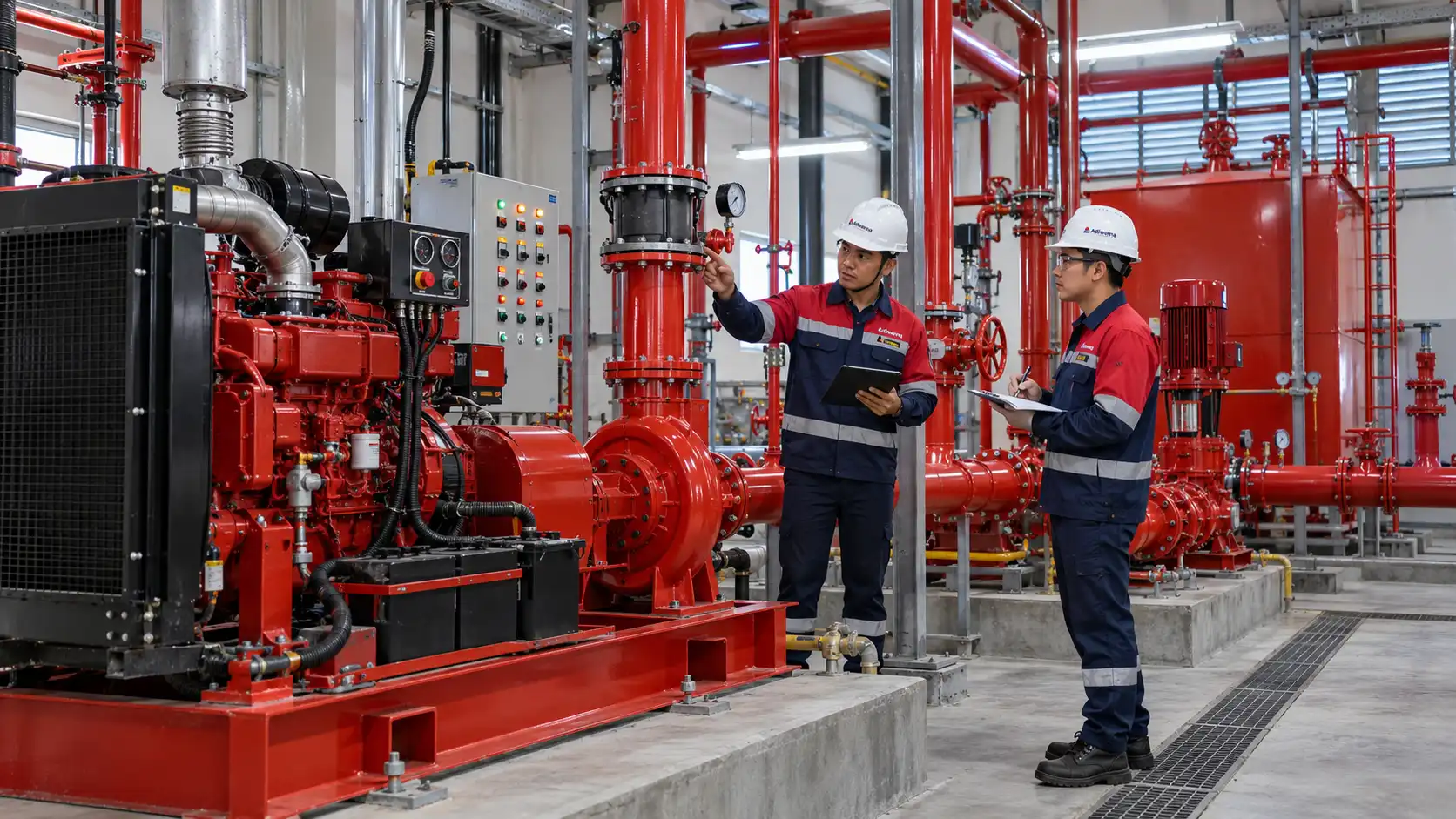

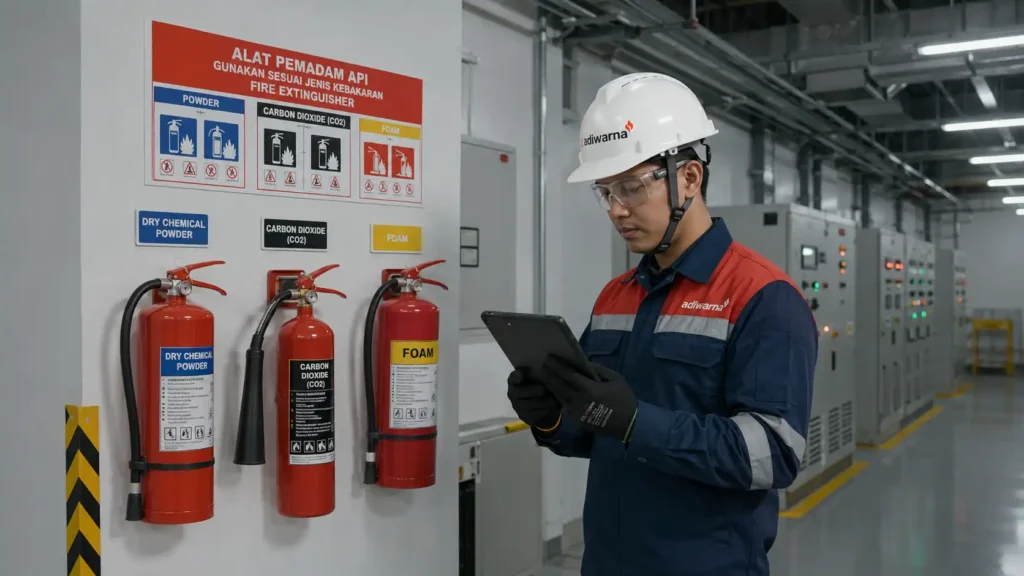
A fire extinguisher is a portable fire protection device designed to help control a fire during its early stage before it develops into a larger incident.
Portable extinguishers are important in office buildings, warehouses, factories, hospitals, hotels, shopping centers, data centers, workshops, restaurants, and industrial facilities. However, simply installing extinguishers is not enough. The extinguishing agent must match the hazard, the unit must be accessible, and its condition should be inspected regularly.
In Indonesia, portable extinguisher installation and maintenance continue to be referenced under Minister of Manpower Regulation PER.04/MEN/1980 concerning requirements for the installation and maintenance of portable fire extinguishers.
For international reference, the current edition of NFPA 10 — Standard for Portable Fire Extinguishers is the 2026 edition.
Quick Answer
A fire extinguisher is a portable device used to control a small fire during its incipient stage. Selection should be based on the fire class and the materials that may burn. Common extinguishing media include water, foam, dry chemical powder, CO₂, wet chemical, and clean agents. Proper placement, inspection, maintenance, and user training are also essential for reliable performance.
What Is a Fire Extinguisher?
A fire extinguisher is a manually operated portable fire suppression device intended for controlling fire during its early stage.
In Indonesia, the equivalent term is APAR — Alat Pemadam Api Ringan, or Portable Fire Extinguisher.
A typical extinguisher may include:
- cylinder;
- extinguishing agent;
- propellant or pressure source;
- valve;
- operating lever;
- safety pin;
- discharge hose;
- nozzle;
- pressure gauge on certain types;
- operating instructions;
- fire rating label.
When activated, the extinguishing agent is directed toward the fire to remove or disrupt one or more elements required to sustain combustion.
Why Is a Fire Extinguisher Important?
Many fires begin as relatively small incidents.
Examples include:
- electrical short circuits;
- overheated cables;
- burning cooking oil;
- solvent ignition;
- burning paper or waste;
- overheated motors;
- sparks from hot work.
During the early stage, a fire extinguisher can help control the incident before the fire becomes too large to handle safely.
Portable extinguishers should nevertheless be considered only one layer of protection.
They do not replace:
- fire alarm systems;
- automatic sprinklers;
- fire hydrants;
- automatic fire suppression;
- evacuation systems;
- emergency response teams.
The overall goal is layered fire protection rather than dependence on a single device.
Fire Extinguisher and Fire Classes
Selecting a fire extinguisher starts with identifying the fire class.
Under Indonesian regulations, fires are traditionally classified into A, B, C, and D.
| Fire Class | Typical Hazard |
|---|---|
| A | Ordinary combustible solids |
| B | Flammable liquids or gases |
| C | Energized electrical installations |
| D | Combustible metals |
Class A Fires
Class A fires involve ordinary combustible solids such as:
- wood;
- paper;
- textiles;
- cardboard;
- selected plastics;
- rubber.
Depending on the specific product rating, suitable media may include water, foam, or multipurpose dry chemical.
Class B Fires
Class B fires involve flammable liquids or gases such as:
- gasoline;
- diesel;
- solvents;
- thinner;
- certain paints;
- alcohol;
- LPG or other flammable gases.
The extinguishing method must avoid spreading burning liquid.
Class C Fires
In the Indonesian classification, Class C refers to energized electrical installations.
Suitable extinguishing media should be appropriate for energized electrical hazards, such as CO₂ or dry chemical extinguishers with the required rating.
Class D Fires
Class D fires involve combustible metals.
Examples may include:
- magnesium;
- sodium;
- potassium;
- titanium under certain conditions.
These fires require specialized extinguishing agents.
A standard ABC extinguisher should not automatically be used on combustible metal fires.
What About Class K?
Under NFPA and OSHA classifications, Class K covers cooking oils and fats used in commercial cooking equipment.
Wet chemical extinguishers are commonly used for these hazards.
Class K should be distinguished from the Indonesian A–D classification system.
Types of Fire Extinguisher by Extinguishing Agent
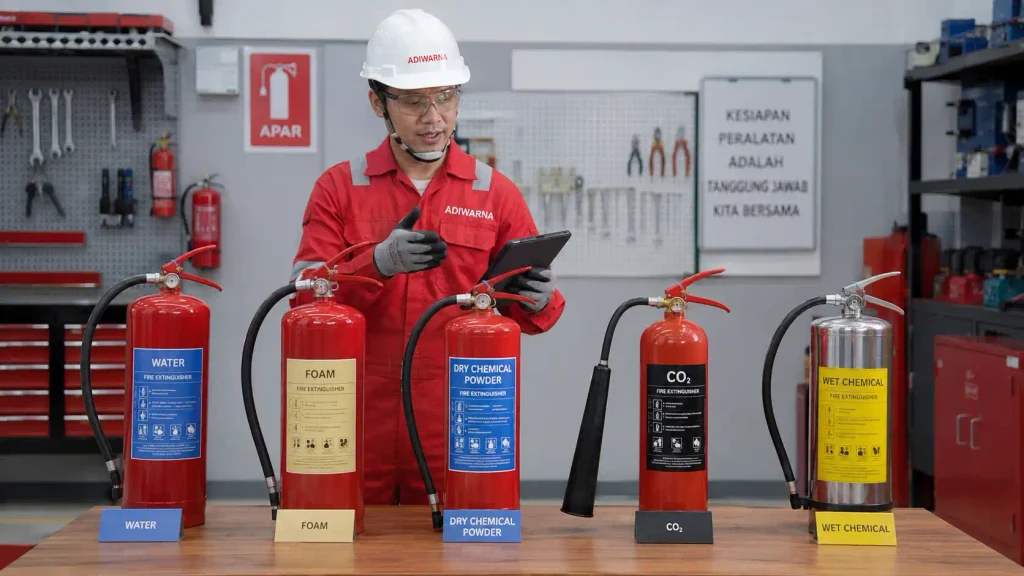
Not every fire extinguisher contains the same extinguishing medium.
Common types include:
| Type | Typical Application | Main Characteristic |
| Water | Class A | Cooling |
| Foam | Class A and selected Class B | Cooling and surface coverage |
| Dry Chemical Powder | ABC or BC depending on rating | Multipurpose |
| CO₂ | Electrical and selected Class B | Residue-free |
| Wet Chemical | Cooking oils and fats | Kitchen fire protection |
| Clean Agent | Sensitive equipment | Minimal or no residue |
| Class D Powder | Combustible metals | Specialized metal fire protection |
Final selection should always follow the extinguisher rating, manufacturer instructions, hazard assessment, and applicable standards.
Water Fire Extinguisher
A water extinguisher works primarily through cooling.
It is effective for many Class A materials, including:
- wood;
- paper;
- fabric;
- selected ordinary combustibles.
However, water should not be used indiscriminately.
Water extinguishers should not be used on energized electrical equipment because of electrical shock risk. They can also be unsuitable for certain flammable-liquid fires because the water may spread burning liquid.
Foam Fire Extinguisher
A foam extinguisher can provide both cooling and surface coverage over certain liquid fuels.
Applications may include:
- warehouses;
- workshops;
- storage areas;
- selected flammable-liquid hazards;
- commercial buildings.
However, foam formulations and product ratings differ.
Always check the extinguisher label and listed fire rating before use.
Dry Chemical Fire Extinguisher
Dry chemical is one of the most common fire extinguisher types used in commercial and industrial facilities.
Multipurpose dry chemical extinguishers may be rated for multiple fire classes.
Advantages can include:
- broad application range;
- easy operation;
- availability in various capacities;
- suitability for general hazards;
- availability in portable and wheeled units.
However, dry chemical leaves residue.
In areas containing sensitive electronics, the powder may increase cleanup requirements and potentially affect equipment.
Therefore, an extinguisher suitable for a workshop may not be the best choice for a server room.
CO2 Fire Extinguisher
A CO₂ fire extinguisher is often used around electrical equipment because carbon dioxide does not leave dry chemical residue.
Typical applications include:
- electrical panels;
- control equipment;
- laboratory equipment;
- machinery;
- selected flammable-liquid hazards.
However, CO₂ has limitations.
The gas can disperse quickly in open areas and does not provide the same deep cooling effect as water on many Class A materials.
Use in confined areas should also consider personnel safety.
Wet Chemical Fire Extinguisher
Wet chemical extinguishers are commonly associated with commercial kitchens.
The extinguishing agent is designed for cooking oils and fats used in equipment such as deep fryers.
Under NFPA and OSHA terminology, these extinguishers typically carry a Class K rating.
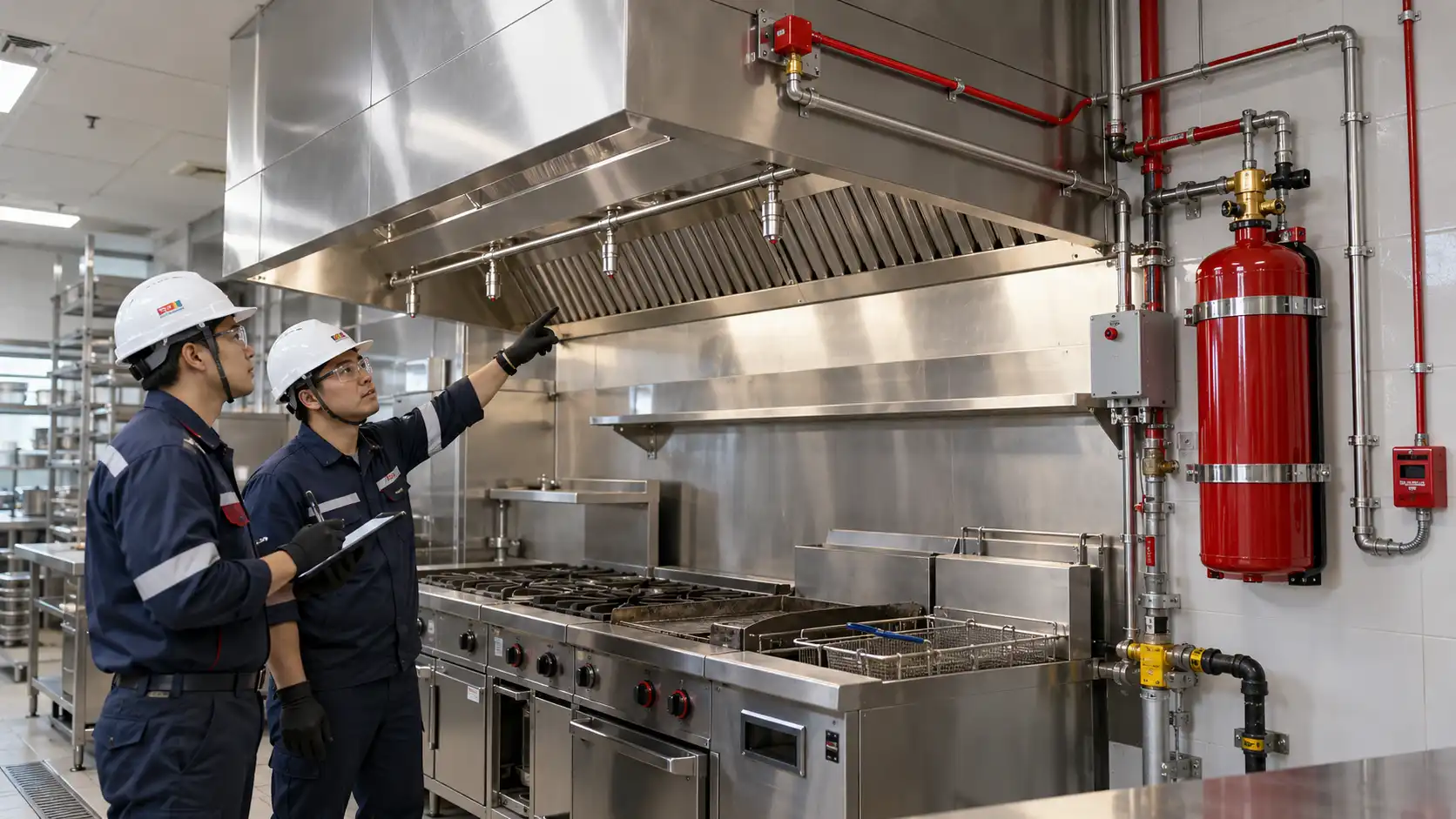
Commercial kitchens may also use fixed hood suppression systems, with portable wet chemical extinguishers acting as an additional protection layer.
Clean Agent Fire Extinguisher
A clean agent portable extinguisher may be considered where secondary damage from water or dry chemical powder is a concern.
Examples include:
- server rooms;
- telecommunications rooms;
- control rooms;
- laboratories;
- mission-critical electronic equipment.
Product listing, fire rating, environmental profile, and compatibility with the hazard should still be reviewed before selection.
Which Fire Extinguisher Is Suitable for Electrical Fires?
For energized electrical equipment, use a fire extinguisher with a rating suitable for electrical hazards.
Common options can include:
- CO₂;
- dry chemical with the appropriate rating;
- selected clean agents.
Do not choose an extinguisher based only on cylinder color.
Always check the label and rating.
Once electrical power has been isolated, the remaining fire class may change according to the material still burning.
Fire Extinguisher for Offices and Commercial Buildings
Office buildings typically contain several different hazards, including:
- paper and documents;
- furniture;
- electrical equipment;
- pantry areas;
- network equipment;
- parking areas.
For this reason, fire extinguisher selection should be performed by zone.
One extinguisher type does not need to be forced across the entire building.
For example:
- general office → multipurpose extinguisher appropriate to the hazard;
- electrical room → suitable electrical-hazard extinguisher;
- commercial kitchen → wet chemical where required;
- server room → extinguishing media compatible with sensitive electronics;
- parking area → selection based on vehicle and fuel hazards.
Learn more through Adiwarna’s Fire Fighting System for High-Risk Industries.
Fire Extinguisher for Factories and Warehouses
Industrial facilities may have more complex fire hazards.
Areas that should be assessed include:
- raw material storage;
- production lines;
- chemical storage;
- electrical rooms;
- workshops;
- welding areas;
- loading bays;
- warehouses;
- laboratories;
- utility areas.
Before selecting a fire extinguisher, conduct a fire risk assessment.
Important questions include:
- What materials may burn?
- Are flammable liquids present?
- Are combustible metals present?
- Is energized electrical equipment present?
- How quickly could a fire develop?
- Are employees trained to use extinguishers?
- Could access to the extinguisher become blocked?
Selection and distribution should match the anticipated fire class and hazard level.
Fire Extinguisher for Data Centers and Server Rooms
Server rooms need special consideration because dry chemical powder can leave residue on electronic equipment.
Potential options may include:
- clean agent portable extinguishers;
- CO₂ for selected hazards;
- listed water mist extinguishers for appropriate applications.
However, portable units should form only one part of layered protection.
A data center may also require:
- aspirating smoke detection;
- fire alarm systems;
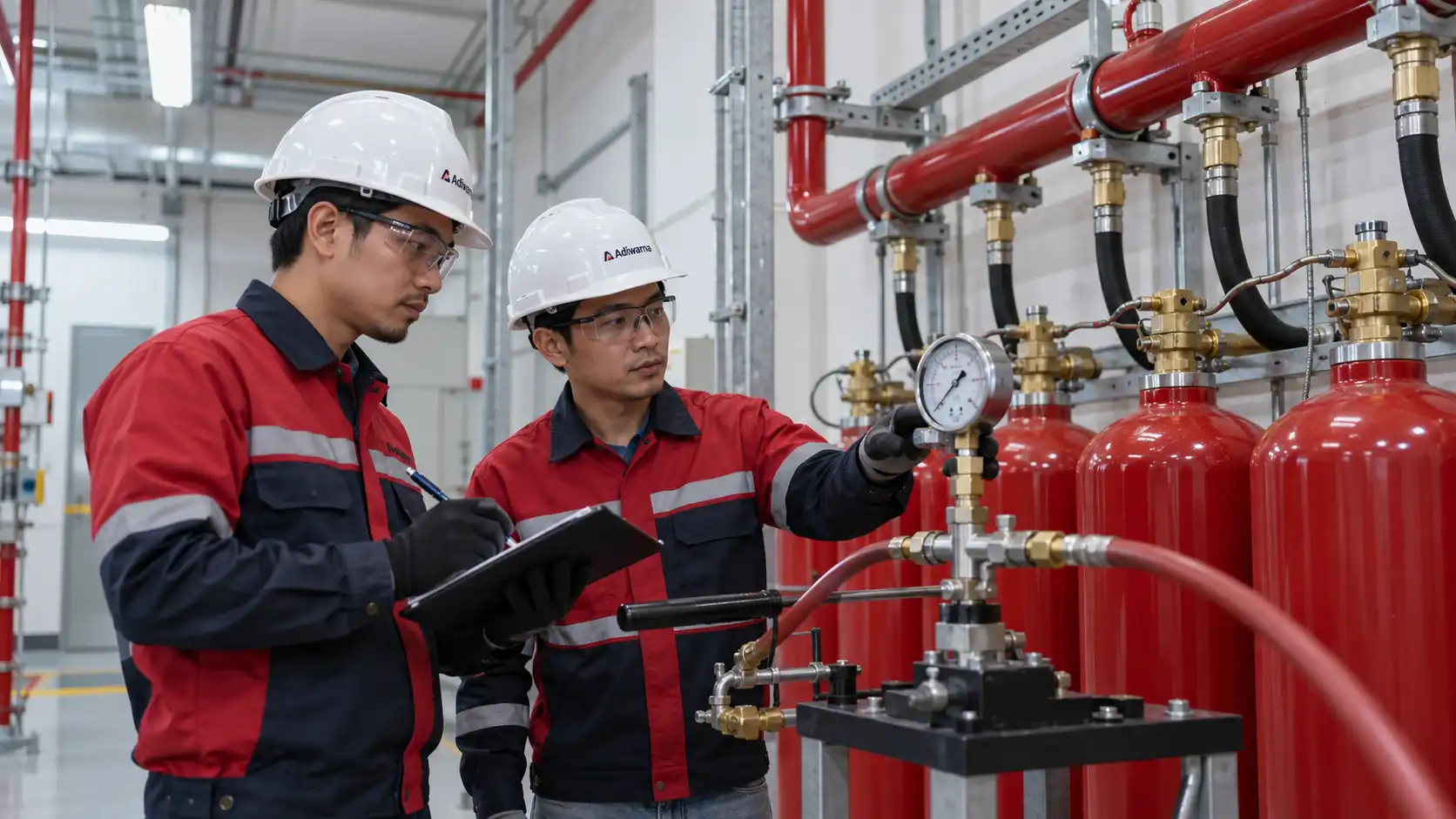
- gaseous fire suppression;
- sprinklers where applicable;
- monitoring;
- emergency procedures.
For critical facilities, see Adiwarna Fire Suppression System Equipment.
Fire Extinguisher Standards in Indonesia
In Indonesia, one important regulatory reference is PER.04/MEN/1980 concerning Requirements for the Installation and Maintenance of Portable Fire Extinguishers.
The regulation addresses areas such as:
- fire classification;
- extinguisher types;
- installation;
- placement;
- inspection;
- maintenance.
It also requires extinguishers to be positioned where they are clearly visible, accessible, and easy to retrieve.
For further reading, see Adiwarna’s Guide to Portable Fire Extinguisher Placement.
NFPA 10:2026 and Fire Extinguishers
For international reference, NFPA 10 — Standard for Portable Fire Extinguishers is one of the major standards for portable extinguishers.
The current edition available in 2026 is NFPA 10:2026.
NFPA 10 covers areas such as:
- selection;
- installation;
- inspection;
- maintenance;
- recharging;
- testing;
- fire classifications;
- special hazards.
However, NFPA 10 should not automatically be considered a replacement for Indonesian regulations.
For projects in Indonesia, the design team should evaluate:
- national regulations;
- applicable SNI standards;
- project specifications;
- insurer requirements;
- manufacturer requirements;
- NFPA requirements where specified;
- local authority requirements.
How to Determine the Number of Fire Extinguishers
The number of fire extinguisher units should not be determined only from one simple floor-area formula.
The fire safety team should consider:
- hazard classification;
- floor area;
- travel distance;
- room arrangement;
- fire compartments;
- obstacles;
- operational activities;
- stored materials;
- occupancy;
- exit locations;
- regulatory requirements.
Requirements should be checked against the regulations applicable to the specific facility.
Where Should a Fire Extinguisher Be Located?
A fire extinguisher should be:
- visible;
- accessible;
- easy to retrieve;
- clearly identifiable.
Avoid placing extinguishers:
- behind cabinets;
- inside inaccessible locked rooms;
- behind stored materials;
- behind doors where they are difficult to see;
- so close to a hazard that users must pass through the fire to reach them.
Common locations may include:
- circulation routes;
- near exits;
- strategic locations before entering hazardous rooms;
- corridors;
- workshop entrances;
- production areas;
- electrical areas based on risk assessment.
Placement should consider how a user would retrieve the extinguisher if smoke and heat are already developing.
How to Use a Fire Extinguisher
A common training method is the PASS technique:
P — Pull
Pull the safety pin.
A — Aim
Aim the nozzle at the base of the fire.
S — Squeeze
Squeeze the operating handle.
S — Sweep
Sweep the nozzle across the base of the fire in a controlled motion.
However, a fire extinguisher should only be used when conditions remain safe.
Before attempting suppression:
- activate the alarm;
- make sure an exit route remains available;
- never allow the fire to block your escape route;
- do not fight a rapidly growing fire;
- avoid heavy smoke;
- use the correct extinguisher.
Personnel expected to use extinguishers should receive appropriate training.
When Should You Not Use a Fire Extinguisher?
Do not attempt to fight a fire when:
- the fire has already spread significantly;
- smoke is extremely dense;
- temperatures are increasing rapidly;
- the exit route is not safe;
- the correct extinguishing agent is not available;
- there is an explosion hazard;
- hazardous chemicals are involved;
- the extinguisher is empty or almost empty;
- the user is not trained.
Life safety remains the priority.
Portable extinguishers are intended for incipient-stage fires, not large developed fires.
Fire Extinguisher Inspection
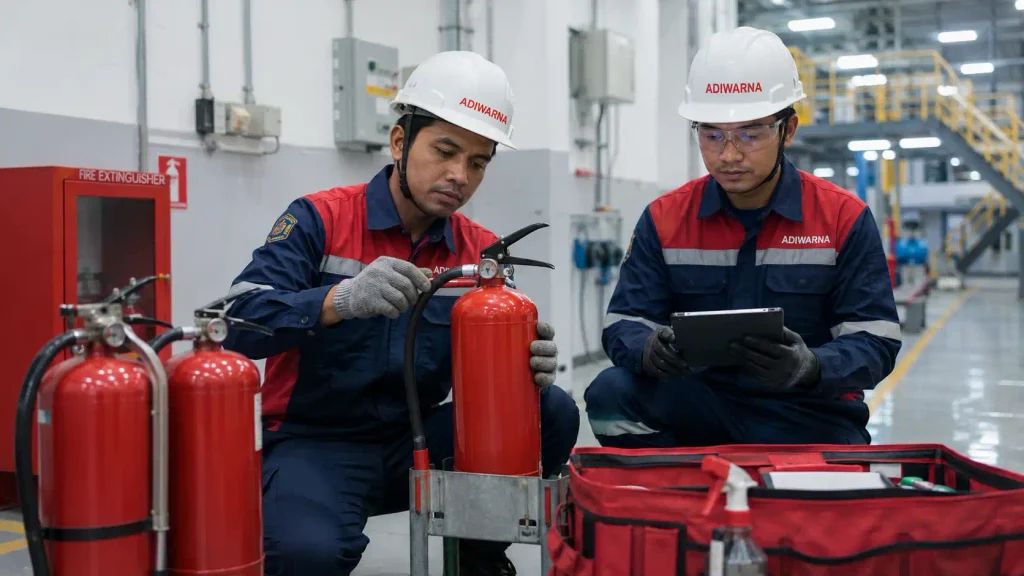
A fire extinguisher may look normal but still be unfit for service.
Visual inspection should confirm that:
- the unit is in the correct location;
- access is unobstructed;
- the safety pin is present;
- the tamper seal is intact;
- the hose or nozzle is not damaged;
- the pressure indicator is acceptable where provided;
- there is no serious corrosion;
- the cylinder has no visible physical damage;
- operating instructions are readable;
- the extinguisher has not been used.
Inspection frequency should follow applicable regulations, manufacturer instructions, and project standards.
Fire Extinguisher Maintenance
Maintenance of a fire extinguisher is more comprehensive than a routine visual check.
Activities may include:
- cylinder inspection;
- pressure verification;
- weighing where applicable;
- hose inspection;
- valve inspection;
- extinguishing-agent condition checks;
- recharging;
- seal replacement;
- internal examination when required;
- hydrostatic testing;
- maintenance records.
Maintenance should be performed by competent personnel using appropriate equipment.
A new inspection sticker alone does not prove that the extinguisher has been properly maintained.
When Should a Fire Extinguisher Be Recharged?
Recharge may be necessary after:
- the extinguisher has been used;
- some agent has been discharged;
- pressure is no longer within the acceptable range;
- maintenance requires the cylinder to be opened;
- testing or inspection identifies the need for recharge.
Even a short discharge can reduce the available extinguishing capacity.
Used extinguishers should therefore be removed from normal service and inspected promptly.
What Is a Fire Extinguisher Hydrostatic Test?
A hydrostatic test evaluates the structural integrity of a pressurized cylinder.
The purpose is to verify that the extinguisher body can safely withstand pressure.
Cylinder integrity may be affected by:
- corrosion;
- impact;
- handling damage;
- age;
- environmental exposure.
Hydrostatic testing intervals vary depending on:
- extinguisher type;
- cylinder construction;
- extinguishing agent;
- manufacturer;
- applicable standards.
One testing interval should not be applied to every extinguisher type.
How to Choose the Right Fire Extinguisher
Follow these steps before buying a fire extinguisher.
1. Identify the Combustible Material
Determine whether the hazard involves:
- ordinary solids;
- flammable liquids;
- gas;
- electricity;
- combustible metals;
- cooking oil.
2. Determine the Fire Class
Select an extinguisher with the appropriate rating.
3. Consider Secondary Damage
For servers or electronic systems, dry powder residue may be an important concern.
4. Select the Appropriate Capacity and Rating
An extinguisher that is too small may not provide sufficient suppression capability.
A unit that is too large may also be difficult for users to handle.
5. Evaluate Placement
Check whether the number and location of units provide suitable coverage and travel distance.
6. Check Certification and Listing
Use products with certification, approval, or listing appropriate to project requirements.
7. Consider Maintenance Support
Ensure that recharge services, spare parts, inspections, and technical support are available.
Common Mistakes When Buying a Fire Extinguisher
Using ABC Extinguishers Everywhere
ABC extinguishers are versatile, but they are not automatically the best choice for every hazard.
Choosing the Cheapest Product
Cylinder price alone does not indicate reliability, rating, certification, or after-sales support.
Ignoring Sensitive Equipment
Dry powder can leave significant residue.
Failing to Map Fire Hazards
Selecting extinguishing media without identifying the fuel can lead to ineffective protection.
Ignoring Maintenance
An extinguisher with limited recharge or service support can become a long-term problem.
Ignoring User Training
Even the correct extinguisher may be ineffective if users do not know when or how to operate it.
Fire Extinguisher Checklist for Buildings and Industrial Facilities
Use the following checklist:
- Fire hazards have been identified
- Fire classes have been determined
- Extinguishing agent matches the hazard
- Fire rating has been checked
- Capacity is appropriate
- Units are clearly visible
- Units are easily accessible
- Access routes are unobstructed
- Signage is available
- Safety pins and seals are intact
- Pressure has been checked
- Cylinders are free from severe corrosion or damage
- Inspection records are available
- Maintenance schedules are established
- Recharge support is available
- User training has been conducted
- Emergency response procedures are available
Choosing a Fire Extinguisher Supplier and Maintenance Provider
A fire extinguisher supplier should provide more than cylinders.
Evaluate whether the provider can:
- Conduct site surveys.
- Identify fire classes.
- Recommend extinguishing media.
- Determine appropriate capacity and rating.
- Support extinguisher placement.
- Perform inspections.
- Perform recharging.
- Perform maintenance.
- Supply spare parts.
- Provide documentation.
- Support user training.
- Integrate portable extinguishers with the wider fire protection strategy.
PT Adiwarna Anugerah Abadi Tbk provides fire protection solutions for buildings and industrial facilities, with portable extinguishers forming one layer of the overall protection strategy.
Learn more through Adiwarna Fire Protection Services.
FAQ About Fire Extinguishers
What Is a Fire Extinguisher?
A fire extinguisher is a portable fire protection device intended to control a fire during its early stage.
In Indonesia, it is commonly known as APAR or Alat Pemadam Api Ringan.
What Is the Difference Between APAR and Fire Extinguisher?
They generally refer to the same type of equipment.
Fire extinguisher is the English term, while APAR is the Indonesian abbreviation for Alat Pemadam Api Ringan.
What Are the Most Common Types of Fire Extinguisher?
Common types include:
- water;
- foam;
- dry chemical powder;
- CO₂;
- wet chemical;
- clean agent;
- special powder for combustible metals.
There is no single extinguisher that is ideal for every hazard.
Which Fire Extinguisher Is Suitable for Electrical Fires?
CO₂, appropriately rated dry chemical, or selected clean agent extinguishers may be considered.
Selection should follow the extinguisher rating and the actual electrical hazard.
Can a Water Fire Extinguisher Be Used on Electrical Equipment?
Not on energized electrical equipment.
Water can create an electrical shock hazard.
Do Fire Extinguishers Need Inspection?
Yes.
Portable extinguishers require inspection and maintenance to remain ready for use.
Applicable Indonesian regulations and manufacturer requirements should be followed.
What Standard Applies to Fire Extinguishers?
In Indonesia, PER.04/MEN/1980 remains one important regulatory reference.
For international reference, NFPA 10:2026 — Standard for Portable Fire Extinguishers is widely used.
How Far Apart Should Fire Extinguishers Be Installed?
Required spacing depends on the applicable regulation and the hazard.
Placement should be determined according to local regulations, project requirements, hazard classification, and travel distance.
How Much Does a Fire Extinguisher Cost?
Cost depends on:
- extinguishing agent;
- capacity;
- fire rating;
- cylinder construction;
- valve quality;
- certification;
- brand;
- refillability;
- accessories;
- maintenance support.
Price should therefore be evaluated together with technical specifications and lifecycle cost.
Consult Adiwarna for Fire Extinguisher Requirements
Choosing a fire extinguisher should begin with fire hazards, not cylinder color or the lowest price.
Combustible materials, electrical equipment, flammable liquids, cooking oils, sensitive assets, facility layout, and personnel capability should be evaluated first.
PT Adiwarna Anugerah Abadi Tbk can support fire protection requirements ranging from equipment supply and engineering to installation, testing, commissioning, service, and maintenance.
For portable extinguishers or wider fire protection requirements, contact the Adiwarna team.
Conclusion
A fire extinguisher is one of the most important early-response devices in a fire protection system.
However, its effectiveness depends on more than simply having a cylinder on the wall. Fire class, extinguishing agent, rating, capacity, placement, accessibility, inspection, maintenance, and user training all determine whether the extinguisher will perform when required.
In Indonesia, PER.04/MEN/1980 remains an important reference for portable extinguisher installation and maintenance, while NFPA 10:2026 provides an international reference for portable fire extinguishers.
By conducting a fire hazard assessment and selecting the correct fire extinguisher for each area, facilities can improve early-response readiness and reduce the likelihood that a small fire develops into a major incident.