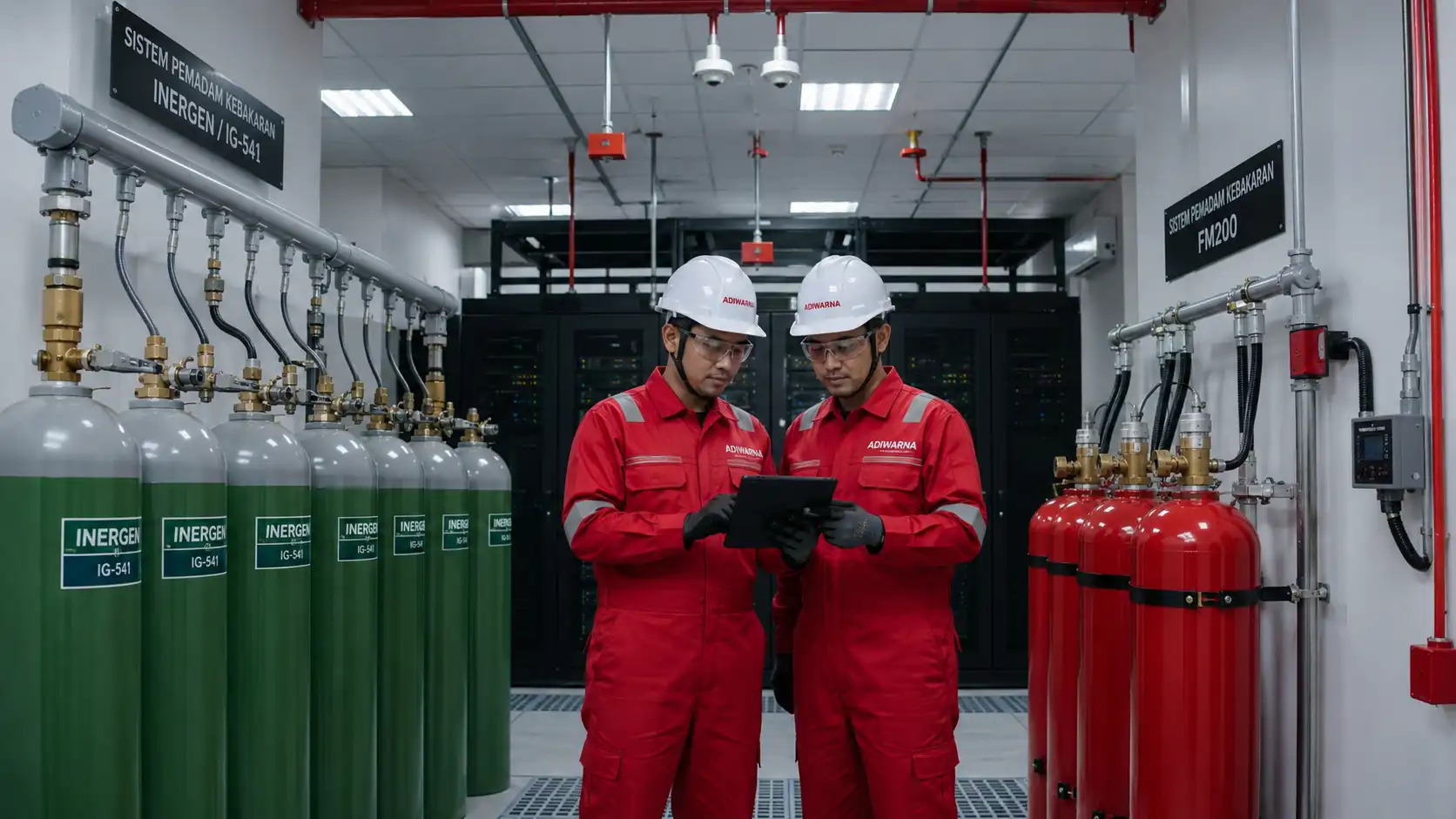

Fire suppression system equipment is a set of automatic suppression devices designed to protect critical areas from fire. This system is highly important for data centers, control rooms, oil and gas facilities, factories, panel rooms, and facilities with high-value assets. Therefore, equipment selection must be technical and precise.
In critical areas, water is not always the best extinguishing medium. Servers, electrical panels, archive rooms, and control devices need fast, clean, and low-impact suppression systems.
In addition, a small fire can trigger major downtime. Damage to electronic devices, production disruption, and data loss can create serious losses.
PT Adiwarna Anugerah Abadi helps businesses design, install, test, and maintain fire suppression systems. The Adiwarna team adjusts each solution to facility risks, technical standards, and operational needs.
Fire suppression system service by PT Adiwarna Anugerah Abadi
Why Fire Suppression System Equipment Is Important
Fire suppression system equipment helps suppress fire automatically in areas that require special protection. The system works quickly after receiving a signal from the fire alarm system. As a result, fire can be controlled before damaging critical assets.
First, the system can operate without manual intervention. Second, it can protect sensitive devices. In addition, it can reduce recovery time after an incident.
However, the selected equipment must match the room characteristics. Room volume, asset type, ventilation, room leakage, and human activity must be analyzed first.
NFPA 2001 Standard on Clean Agent Fire Extinguishing Systems
Main Functions of Fire Suppression System Equipment
Fire suppression system equipment does not only work as extinguishing equipment. It also becomes part of a wider fire protection strategy.
Its main functions include:
- Detecting fire conditions.
- Providing a pre-discharge alarm.
- Activating extinguishing agent release.
- Delivering the agent through piping.
- Distributing the agent through nozzles.
- Maintaining suppression concentration.
- Sending signals to the monitoring panel.
- Supporting testing and audit documentation.
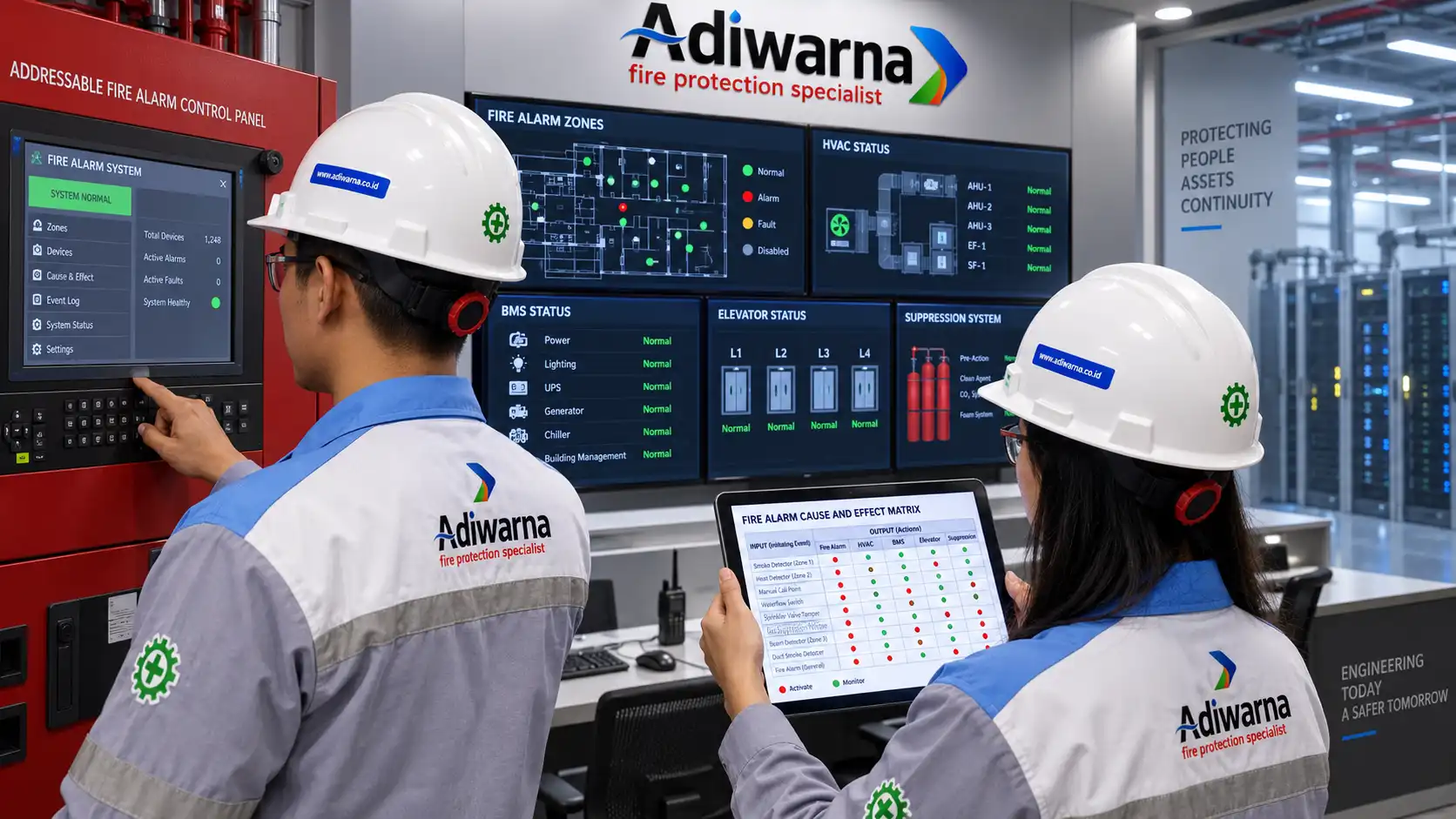
In addition, the system must connect with the fire alarm control panel. Proper integration makes the suppression scenario safer and more measurable.
Main Components in Fire Suppression System Equipment
Each system has a different configuration. However, several main components always play an important role in the design.
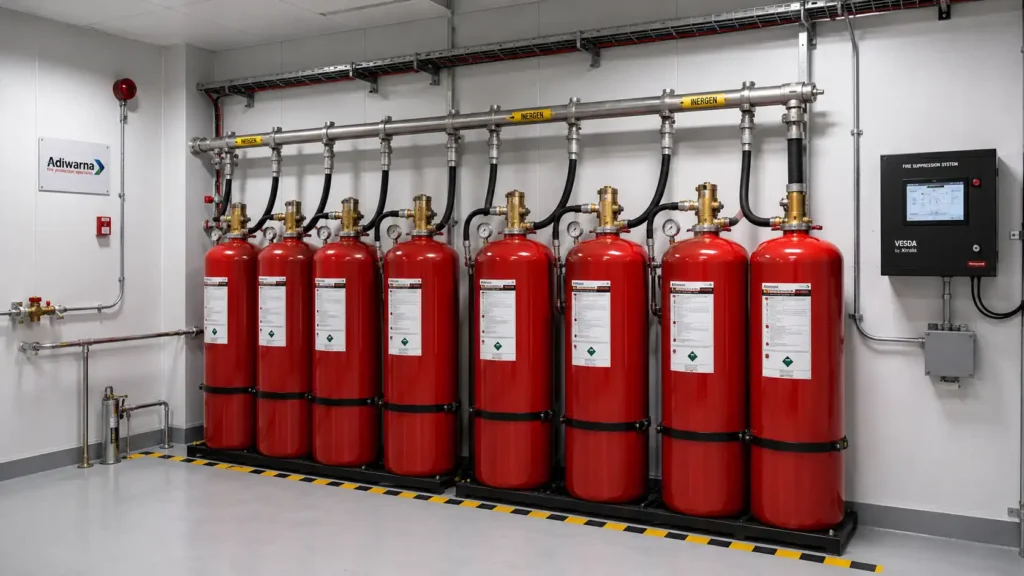
Common components include:
- Cylinder or extinguishing agent tank.
- Cylinder valve.
- Discharge hose.
- Manifold.
- Pressure gauge.
- Pressure switch.
- Discharge pipe.
- Discharge nozzle.
- Fire alarm control panel.
- Smoke detector.
- Heat detector.
- Manual release station.
- Abort switch.
- Sounder strobe.
- Warning sign.
- Control module.
- Room integrity test equipment.
In addition, every component must meet specifications. Equipment that does not match the requirements can reduce system performance during emergencies.
Fire Suppression System Equipment for Data Centers

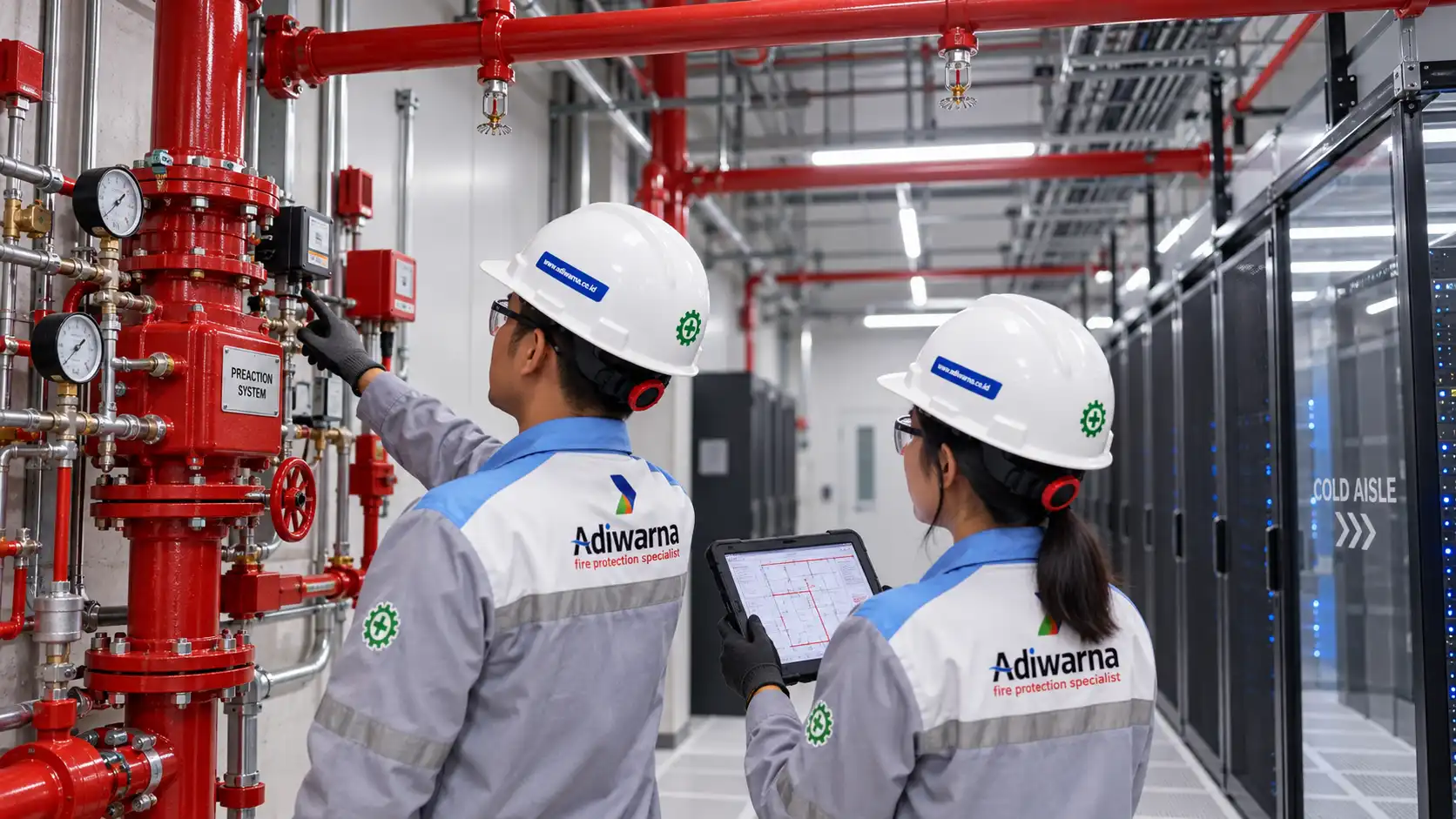
Data centers require highly precise fire protection. These areas contain servers, UPS units, batteries, network cables, electrical panels, and cooling systems.
Therefore, fire suppression system equipment for data centers usually uses clean agent or inert gas. These agents leave no residue and do not conduct electricity.
In addition, the system must connect with early detection devices. Aspirating smoke detectors, smoke detectors, alarm strobes, and pre-discharge warnings are essential in this area.
Fire suppression solutions for data centers
Fire Suppression System Equipment for Oil & Gas Facilities
Oil and gas facilities have more complex risks. Some areas contain flammable materials, hazardous gas, high temperature, and explosion potential.
Therefore, fire suppression system equipment for oil and gas must follow area classification. Control rooms, electrical rooms, and instrument rooms often require gas suppression systems.
However, open areas or specific process areas may require different solutions. Foam systems, deluge systems, gas detectors, and flame detectors can become part of the protection system.
Fire protection systems for oil and gas facilities
Fire Suppression System Equipment for Factories
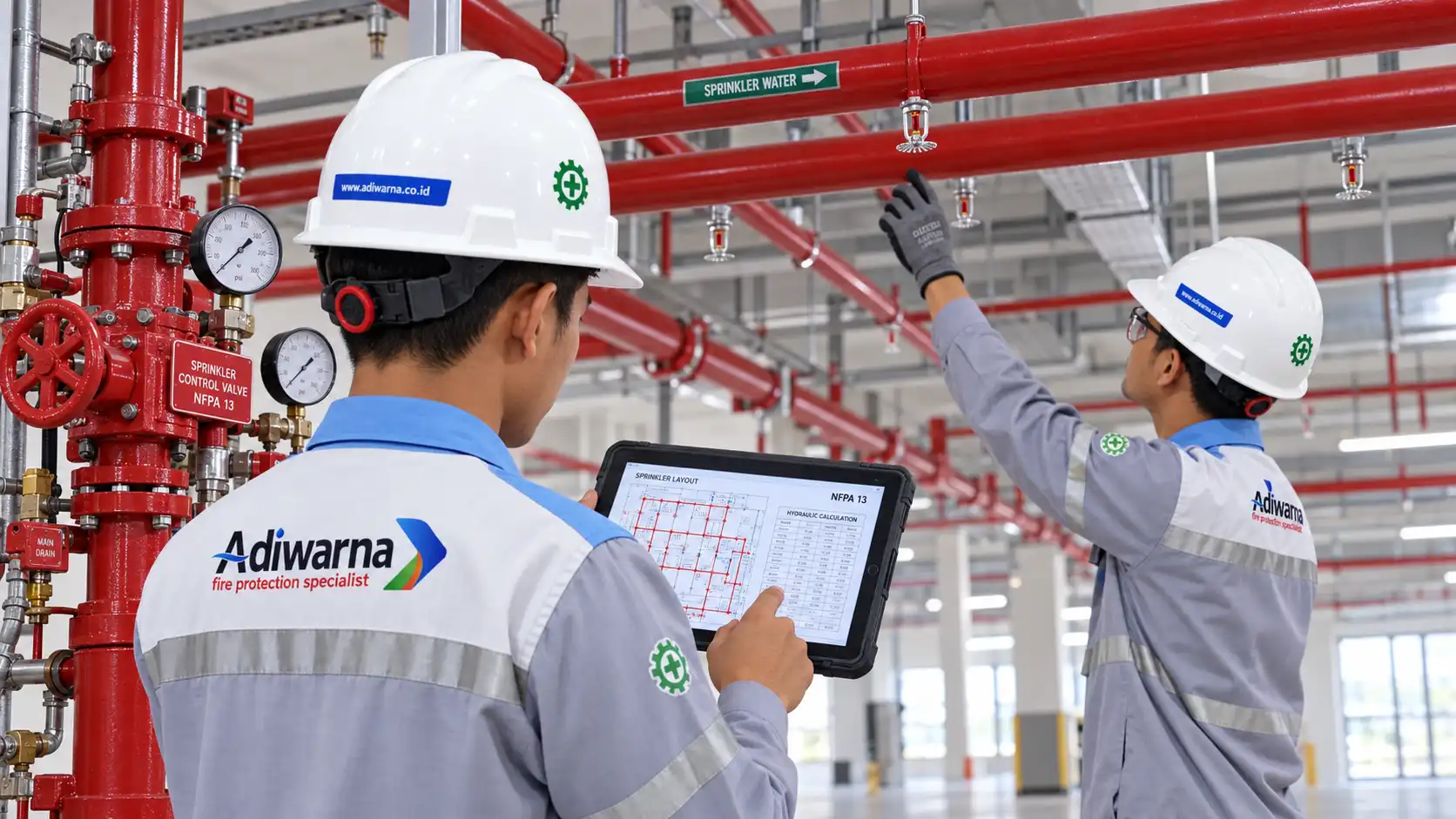
Factories face risks from machines, electrical panels, MCC rooms, local server rooms, and production processes. Each area has different fire characteristics.
Therefore, equipment must be selected based on room function. Panel rooms may need clean agent systems. Meanwhile, certain production areas may need sprinklers, hydrants, or other special systems.
In addition, fire suppression system equipment must be easy to inspect. Facility teams need safe access to cylinders, panels, valves, and pressure indicators.
Fire protection solutions for factories
Types of Agents in Fire Suppression Systems
Extinguishing agent selection strongly affects the final result. The agent must suppress fire without causing major secondary damage.
Clean Agent
Clean agent is suitable for electronic rooms, data centers, control rooms, and archive rooms. This agent leaves no residue and supports faster recovery.
In addition, clean agent does not damage electronic devices when the system is designed correctly. However, concentration design and room volume calculation must remain accurate.
Inert Gas
Inert gas works by reducing the oxygen level in the protected room. Fire will not have enough oxygen to continue burning.
However, the system must maintain human safety limits. Therefore, design calculations and pre-discharge alarms are very important.
CO2 System
CO2 has strong suppression capability for certain areas. However, CO2 can be dangerous for people if used in occupied spaces.
Therefore, its use must be highly selective. This system requires strict safety procedures, signage, alarms, and access control.
Water Mist
Water mist uses very fine water droplets. This system helps reduce heat and minimize water consumption.
However, engineers still need to evaluate asset types. Not every electronic device area is suitable for water-based agents.
Important Standards for Fire Suppression System Equipment
Fire suppression system equipment must refer to relevant technical standards. Standards help ensure the system is safe, effective, and testable.
Common references include:
- NFPA 2001 for clean agent fire extinguishing systems.
- ISO 14520 for gaseous fire-extinguishing systems.
- NFPA 12 for carbon dioxide extinguishing systems.
- NFPA 750 for water mist fire protection systems.
- NFPA 72 for fire alarm and signaling.
- Relevant SNI fire protection standards.
- Company HSE requirements.
- Insurance and safety audit requirements.
However, standards must be applied according to field conditions. Engineers must assess room volume, hazard class, ventilation, occupancy, and operational needs.
ISO 14520 gaseous fire-extinguishing systems
Fire Suppression System Equipment Must Be Integrated
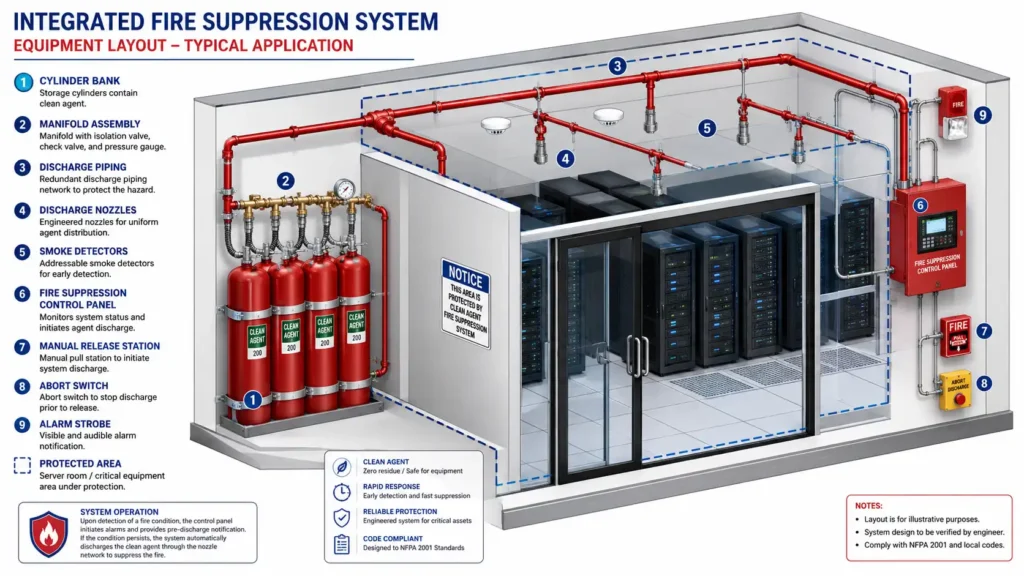
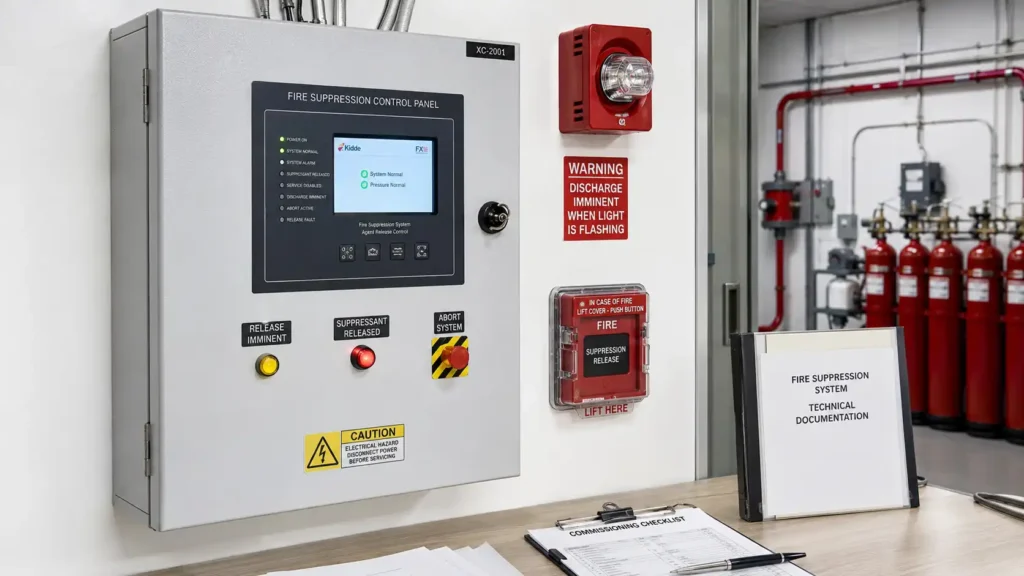
Fire suppression system equipment must work together with detection and alarm systems. Without integration, the system may fail to execute a safe suppression scenario.
For example, a smoke detector detects smoke. Then, the panel activates the initial alarm, delay time, warning strobe, and release sequence.
In addition, the abort switch allows operators to stop discharge when conditions are not appropriate. Manual release also helps operators activate the system when needed.
Planning Stages for Fire Suppression System Equipment
Planning must be completed in clear stages. These stages help ensure the system matches room risks and conditions.
1. Room Survey
First, the team surveys the protected room. They check area, height, volume, ceiling, raised floor, doors, and cable routes.
In addition, the team reviews HVAC conditions. Airflow can affect agent distribution during discharge.
2. Risk Analysis
Next, engineers identify risk sources. Electrical panels, batteries, servers, cables, and control devices have different fire behavior.
Therefore, each area needs a different protection approach. A server room is not the same as an archive room or MCC room.
3. Design Calculation
After that, engineers calculate the required agent quantity. The calculation covers room volume, design concentration, safety factor, and holding time.
If the calculation is wrong, the system will not work optimally. Therefore, this stage must be handled professionally.
4. Pipe and Nozzle Design
Then, engineers determine pipe routes and nozzle locations. Agent distribution must be even across the protected room.
In addition, obstacles such as racks, ducting, and cable trays must be considered. Nozzles must not be placed randomly.
5. Installation and Commissioning

After the final design, the team installs cylinders, pipes, nozzles, panels, and alarm devices. Installation must be neat, safe, and aligned with specifications.
Next, the team performs testing. Testing includes alarm sequence, manual release, abort switch, pressure switch, and room integrity test.
Common Mistakes in Fire Suppression System Equipment
Many systems do not perform optimally because of early-stage mistakes. Problems often come from poor design, installation, and maintenance.
Common mistakes to avoid include:
- Not calculating room volume correctly.
- Not performing a room integrity test.
- Choosing the wrong extinguishing agent.
- Selecting the wrong number of cylinders.
- Placing nozzles poorly.
- Not integrating the fire alarm.
- Not installing a pre-discharge alarm.
- Not providing an abort switch.
- Not preparing as-built drawings.
- Not performing routine maintenance.
In addition, layout changes are often ignored. Yet, changes to partitions, ceilings, or racks can change system requirements.
Benefits of Proper Fire Suppression System Equipment
Choosing the right fire suppression system equipment provides many benefits. These benefits are essential for facilities with critical assets.
Main benefits include:
- Faster suppression.
- Better protection for electronic assets.
- Residue can be avoided.
- Downtime can be reduced.
- Secondary damage risk decreases.
- The system becomes more audit-ready.
- Maintenance becomes easier.
- Personnel safety becomes more controlled.
In addition, a good system helps maintain business continuity. Companies can reduce potential losses caused by operational disruption.
Why Choose PT Adiwarna Anugerah Abadi?
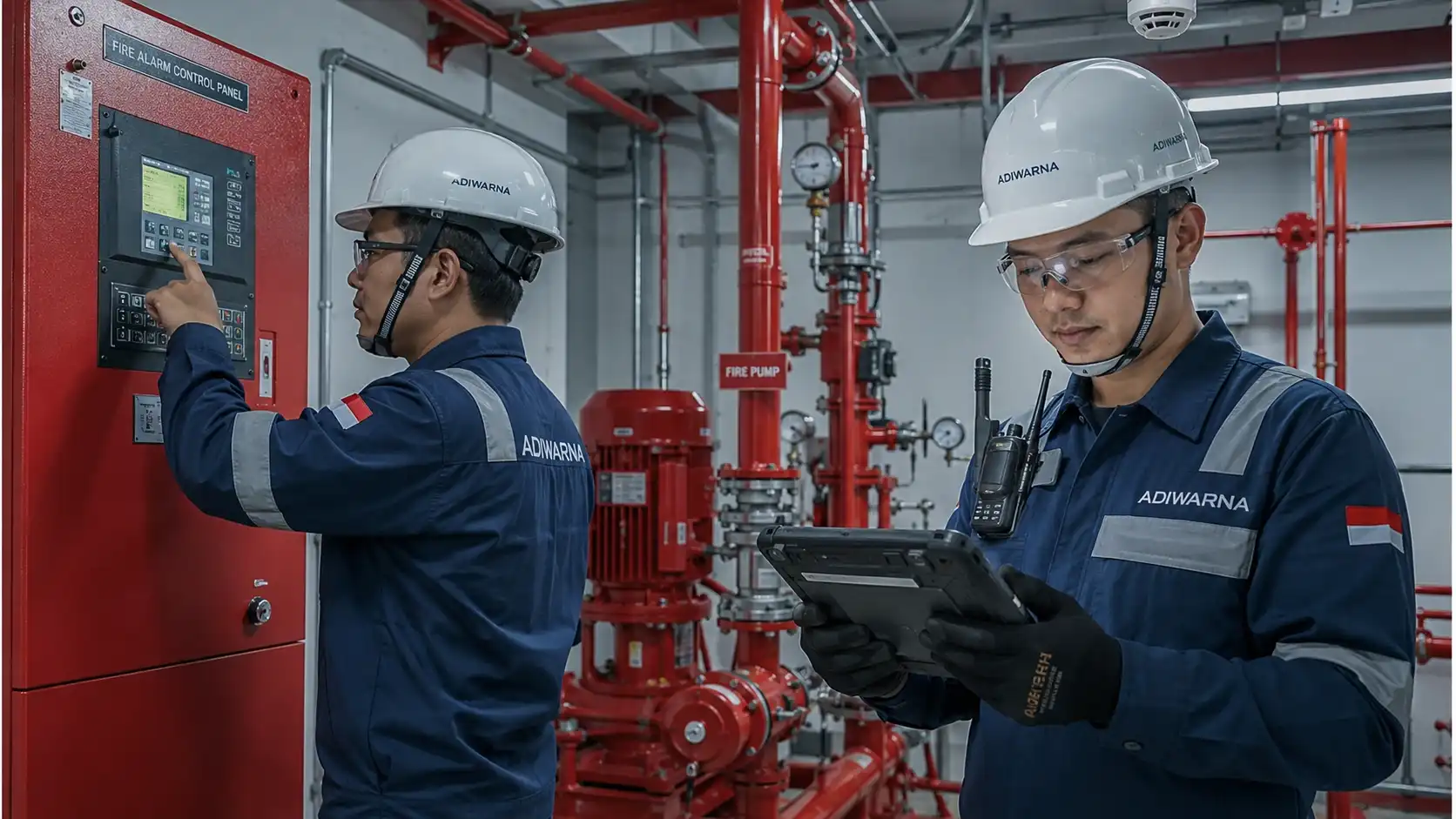
PT Adiwarna Anugerah Abadi helps clients select and implement fire suppression system equipment that matches their needs. The Adiwarna team understands the requirements of data centers, oil and gas facilities, factories, control rooms, and panel rooms.
In addition, Adiwarna can support projects from consultation to maintenance. This approach helps clients get a safer and more integrated system.
Adiwarna’s key advantages include:
- Experienced technical team.
- Facility risk analysis.
- Proper agent selection.
- Room volume calculation.
- Pipe and nozzle design.
- Fire alarm integration.
- Measurable testing and commissioning.
- Complete project documentation.
- Inspection and maintenance support.
With this approach, facilities become more prepared for emergencies. In addition, the system becomes easier for internal teams to manage.
Fire suppression system equipment consultation with Adiwarna
Tips Before Choosing Fire Suppression System Equipment
Before choosing the system, prepare technical room data. This data helps engineers create a more accurate design.
Prepare the following information:
- Latest room layout.
- Room volume.
- Room function.
- Type of protected assets.
- HVAC condition.
- Raised floor or additional ceiling.
- Cable routes and cable trays.
- Existing fire alarm system.
- Number of personnel in the area.
- Target standard or audit requirement.
In addition, involve HSE, facility, IT, and operations teams from the beginning. They understand daily needs and technical limitations in the field.
Conclusion: Fire Suppression System Equipment Determines Critical Asset Protection
Fire suppression system equipment determines how fast and safely a critical area can be protected from fire. A good system must be designed, installed, tested, and maintained professionally.
However, every room has different risks. Therefore, the solution must be based on surveys, technical standards, calculations, and operational needs.
In conclusion, PT Adiwarna Anugerah Abadi is ready to help your business choose the right fire suppression system. Consult your needs for clean agent, inert gas, CO2, water mist, fire alarm integration, and maintenance with Adiwarna’s specialist team.
Contact PT Adiwarna Anugerah Abadi for fire suppression system consultation