
Inert gas is a gas-based fire suppression solution designed to protect critical areas without leaving residue. This system is highly relevant for data centers, control rooms, panel rooms, oil and gas facilities, factories, and facilities with high-value electronic assets. Therefore, its design must be highly precise.
In critical areas, water and powder are not always the best choices. These agents can create secondary impact on servers, electrical panels, documents, control devices, and electronic systems.
In addition, a small fire can cause major downtime. Even a few minutes of disruption can affect operations, data, production, and business reputation.
PT Adiwarna Anugerah Abadi helps companies design, install, test, and maintain gas-based fire suppression systems. The Adiwarna team adjusts each solution to room risks, technical standards, and operational needs.
Adiwarna inert gas fire suppression service
Why Inert Gas Is Important for Modern Fire Protection
Inert gas is important because it suppresses fire without using water. The system works by reducing oxygen levels in the protected area until fire can no longer sustain combustion.
First, the system leaves no residue. Second, it does not conduct electricity. In addition, it suits areas with sensitive assets.
However, the system must be designed correctly. Engineers must calculate room volume, gas concentration, ventilation, openings, and human safety limits.
ISO 14520-1 gaseous fire-extinguishing systems
How Inert Gas Works in a Fire Suppression System
Inert gas works through an oxygen reduction principle. Fire needs oxygen to keep burning. When the system activates, gas is released into the protected room to lower the oxygen level.
As a result, fire loses the condition needed to continue burning. This process happens without wetting the room and without leaving powder residue.
In addition, the system usually works automatically. A smoke detector or aspirating detector sends a signal to the fire alarm control panel. After that, the panel activates the alarm and discharge sequence.
However, the system still needs safety features. Pre-discharge alarm, abort switch, manual release, warning strobe, and signage must be available based on design requirements.
Areas Suitable for Inert Gas
Not every area needs a gas suppression system. Therefore, system selection must be based on risk and asset value.
Common areas using inert gas include:
- Data centers.
- Server rooms.
- Electrical rooms.
- Control rooms.
- Instrument rooms.
- MCC rooms.
- UPS rooms.
- Telecommunication rooms.
- Archive rooms.
- Industrial monitoring rooms.
- Critical panel rooms.
- High-value electronic areas.
In addition, this system is often selected for facilities that require fast recovery after an incident. The more sensitive the asset, the more important clean suppression becomes.
Adiwarna fire suppression system service
Main Components in an Inert Gas System
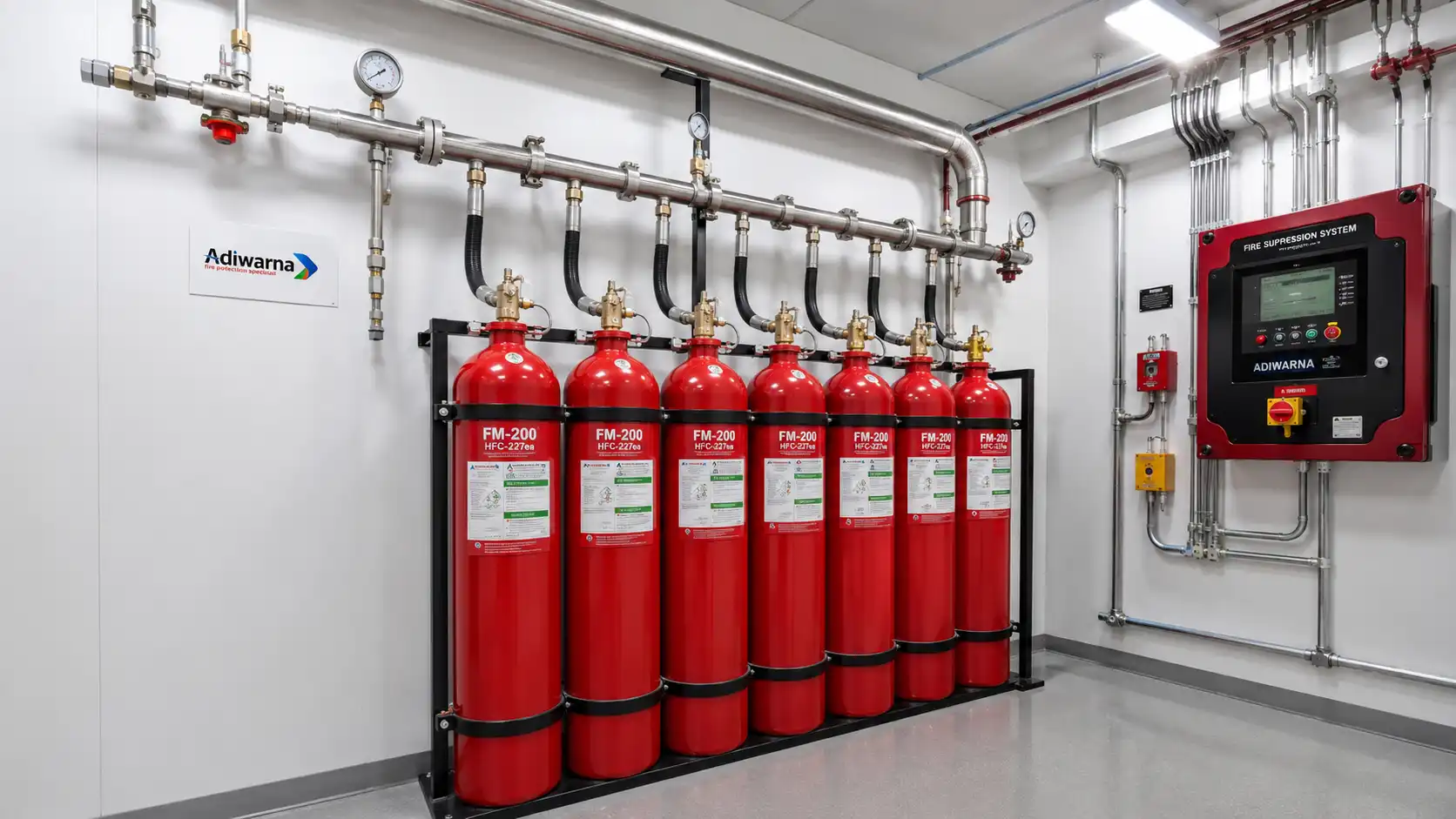
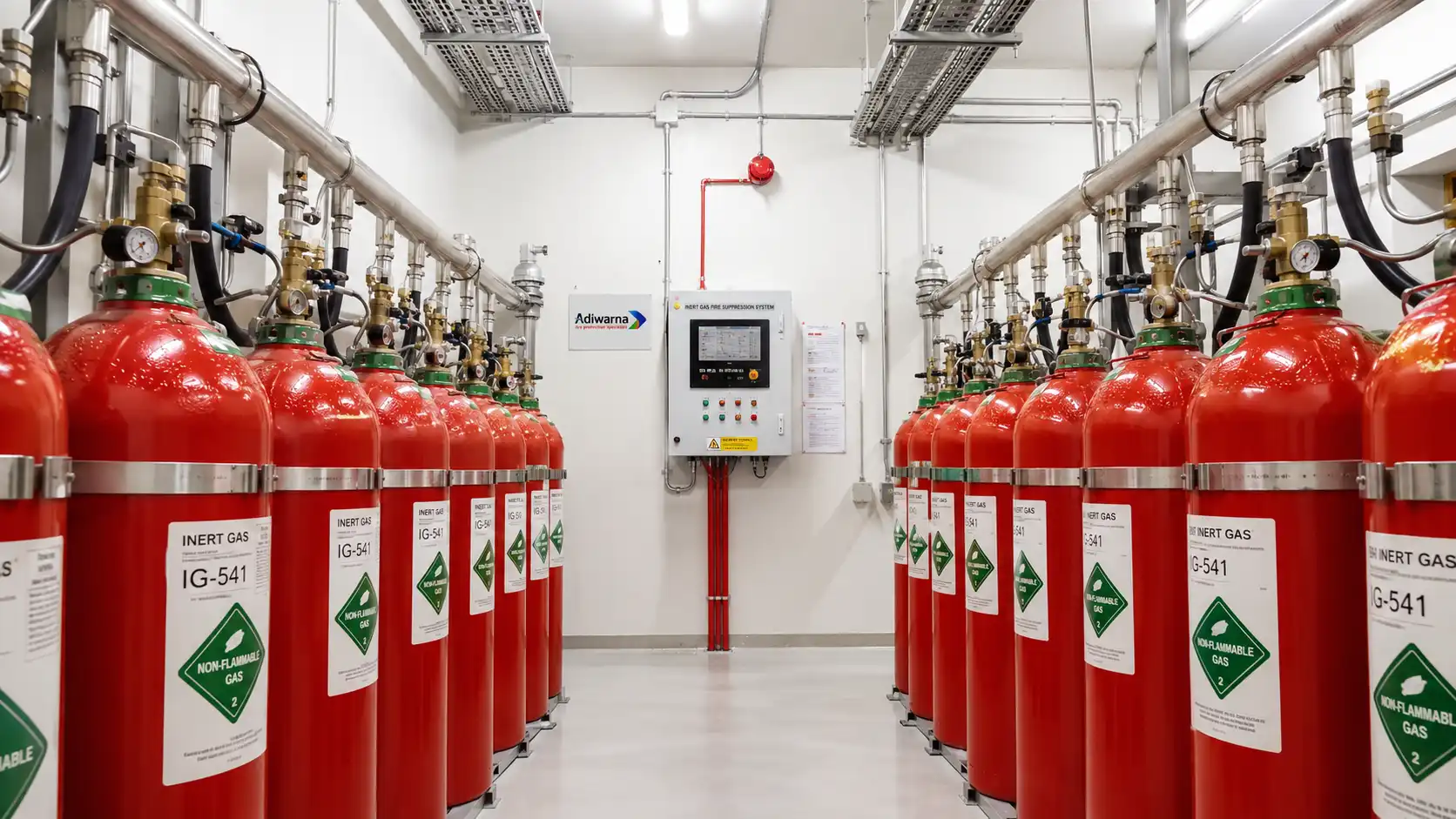
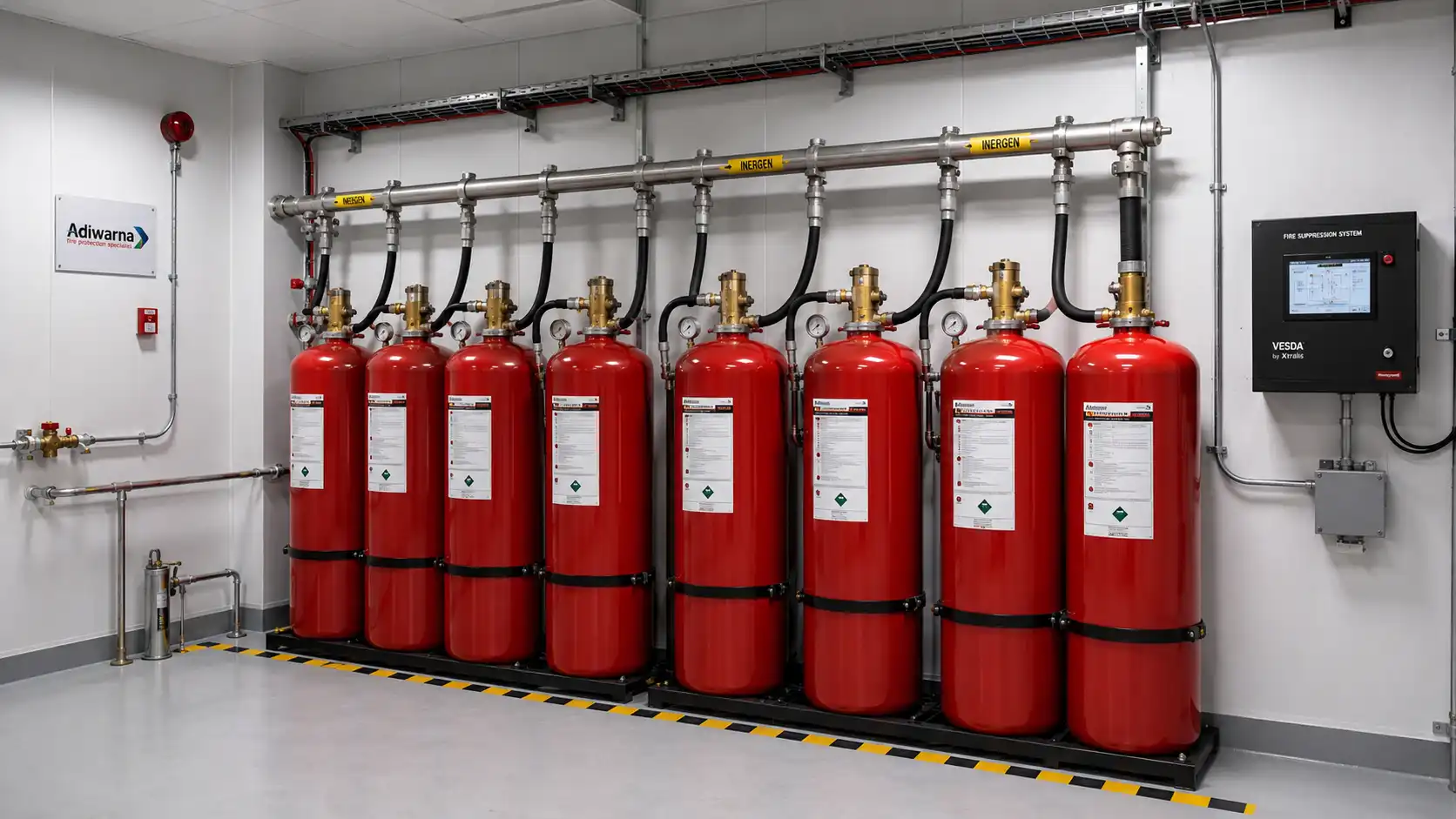
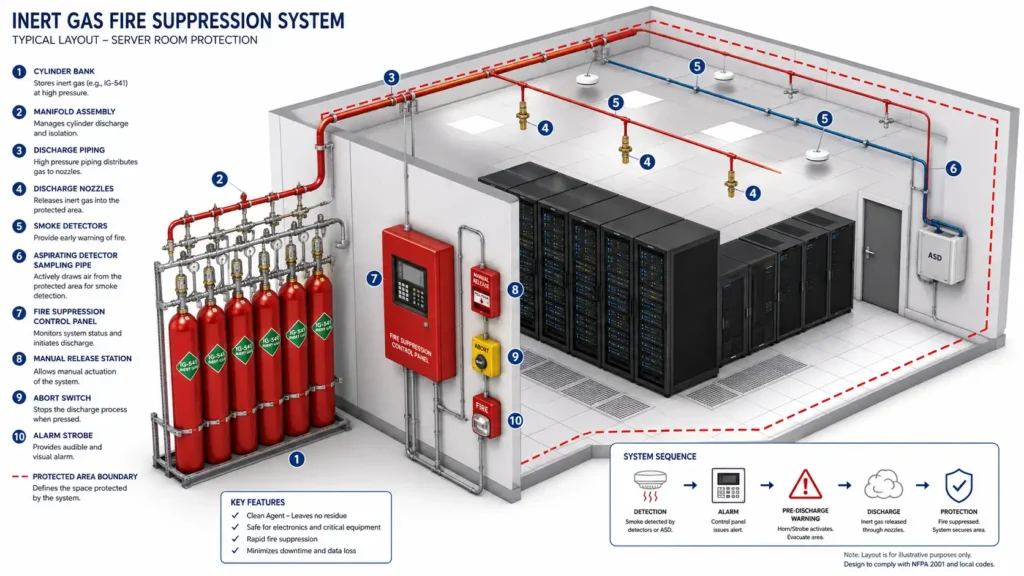
An inert gas system consists of several technical components. Each component must work according to the suppression scenario.
Common main components include:
- Cylinder bank.
- Cylinder valve.
- Manifold.
- Discharge hose.
- Pressure gauge.
- Pressure switch.
- Discharge piping.
- Discharge nozzle.
- Fire suppression control panel.
- Smoke detector.
- Aspirating smoke detector.
- Manual release station.
- Abort switch.
- Sounder strobe.
- Warning signage.
- Room integrity test equipment.
In addition, the system needs technical drawings and commissioning documents. These documents support inspection, audits, maintenance, and room modification reviews.
Inert Gas for Data Centers and Server Rooms
Inert gas is highly suitable for data centers because it leaves no residue. Servers, switches, routers, storage units, and UPS systems need fast and clean protection.
First, the system detects smoke at an early stage. Second, the panel processes the signal and provides warning. After that, the system releases gas based on the designed sequence.
In addition, data centers have complex airflow. Hot aisles, cold aisles, raised floors, and cooling systems can affect gas distribution.
Therefore, engineers must perform careful calculations. Room volume, leakage area, ceiling void, raised floor, and airflow must be analyzed from the beginning.
Adiwarna data center fire protection solution
Inert Gas for Control Rooms and Electrical Rooms
Inert gas is also ideal for control rooms and electrical rooms. These areas contain panels, PLC, DCS, local servers, monitoring devices, and communication systems.
However, the system must not be installed without analysis. Engineers must ensure the room is sealed enough to maintain the required gas concentration.
In addition, operators need to understand safety procedures. Initial alarms, evacuation routes, manual release, and abort switches must be understood by the facility team.
Inert Gas for the Oil and Gas Industry
Oil and gas facilities have more complex risks. Process areas, electrical rooms, control rooms, and instrument rooms require different approaches.
In enclosed electronic areas, inert gas can be an effective solution. This system protects critical equipment without water and without residue.
However, open oil and gas areas usually require other systems. Flame detectors, gas detectors, foam systems, deluge systems, hydrants, and fire monitors may still be needed.
Therefore, a gas suppression system must become part of a wider fire protection strategy. Engineers must integrate it with the fire and gas system and emergency response plan.
Adiwarna oil and gas fire protection system
Difference Between Inert Gas and Chemical Clean Agent
Many facilities compare inert gas with chemical clean agents. Both are used for critical areas. However, their working principles are different.
Inert gas reduces oxygen levels so fire cannot survive. Meanwhile, chemical clean agents work by interrupting the combustion reaction and absorbing heat.
In addition, inert gas usually uses natural gases such as nitrogen, argon, or specific gas mixtures. This system leaves no residue and does not damage the ozone layer.
However, cylinder storage needs may differ. Inert gas often requires more cylinders than some chemical clean agents. Therefore, storage space must be considered.
Technical Standards for Inert Gas Systems
An inert gas system must follow relevant technical standards. Standards help ensure the design is safe, effective, and testable.
Common references include:
- NFPA 2001 for clean agent fire extinguishing systems.
- ISO 14520 for gaseous fire-extinguishing systems.
- NFPA 72 for fire alarm and signaling.
- Relevant SNI fire protection standards.
- Company HSE requirements.
- Insurance and safety audit requirements.
- Internal facility safety procedures.
However, standards must be translated into real field conditions. Engineers must evaluate room volume, hazard class, occupancy, leakage, and operational needs.
NFPA codes and standards
Room Integrity Test in an Inert Gas System
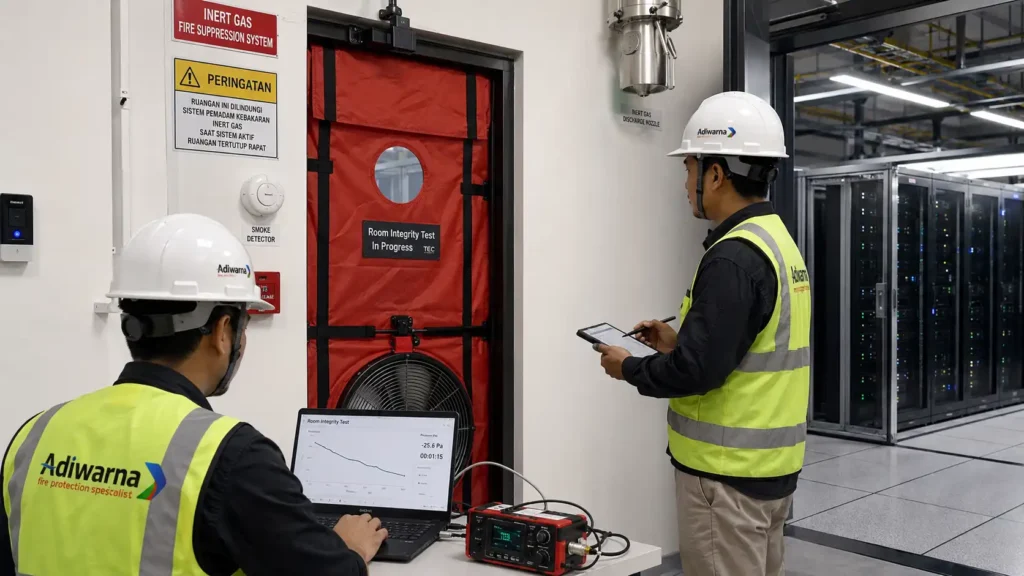
Room integrity test is an important stage in an inert gas system. This test helps confirm whether the room can maintain gas concentration.
First, the team installs a blower door fan at the room door. Second, the system measures the room leakage level. After that, engineers evaluate whether the holding time is sufficient.
If the room leaks too much, gas can escape too quickly. As a result, the suppression concentration may not last according to the design.
In addition, small changes can affect the test result. Cable holes, door gaps, raised floors, ceilings, and ducting must be checked carefully.
NFPA 2001 clean agent systems information
Planning Stages for an Inert Gas System
System planning must follow clear stages. That way, the system can work according to the emergency scenario.
1. Room Survey
First, the team surveys the protected area. They check room size, ceiling height, raised floor, openings, doors, and cable routes.
In addition, the team checks the HVAC system. Airflow can affect gas distribution when discharge occurs.
2. Risk Analysis
Next, engineers identify risk sources. Electrical panels, batteries, servers, cables, and control devices have different fire characteristics.
Therefore, each area needs a specific protection strategy. A server room cannot be treated the same as an open production area.
3. Concentration Calculation
After that, engineers calculate the required gas quantity. The calculation includes room volume, design concentration, safety factor, leakage, and holding time.
However, the calculation must consider personnel safety. The system must provide enough warning before discharge.
4. Pipe and Nozzle Design

Then, engineers determine pipe routes and nozzle positions. Gas distribution must be even across the entire protected area.
In addition, racks, ducting, cable trays, and ceilings must be considered. Nozzles must not be placed randomly.
5. Installation and Commissioning
After the final design, the team installs cylinders, pipes, nozzles, panels, and alarm devices. Installation must be neat, safe, and aligned with specifications.
Next, the team performs testing. Testing includes alarm sequence, manual release, abort switch, pressure switch, and room integrity test.
Common Mistakes in Inert Gas Projects
Many systems do not perform optimally because of early mistakes. Problems often come from poor design, installation, or maintenance.
Common mistakes to avoid include:
- Not calculating room volume accurately.
- Not performing a room integrity test.
- Not checking leakage areas.
- Choosing the wrong number of cylinders.
- Placing nozzles poorly.
- Not integrating the system with fire alarms.
- Not installing a pre-discharge alarm.
- Not providing an abort switch.
- Not updating the design after layout changes.
- Not performing routine maintenance.
In addition, room changes are often ignored. Added racks, cable trays, ducting, or partitions can change system performance.
Benefits of Inert Gas for Critical Facilities
Using inert gas provides many benefits for facilities with sensitive assets. These benefits matter from early response to operational recovery.
Key benefits include:
- Leaves no residue.
- Safe for electronics when designed correctly.
- Does not conduct electricity.
- Supports faster recovery.
- Suitable for critical areas.
- Reduces potential downtime.
- Supports audit readiness.
- Easy to integrate with fire alarms.
- Helps protect high-value assets.
In addition, a good system increases facility team confidence. They have a clear and testable protection scenario.
Why Choose PT Adiwarna Anugerah Abadi?
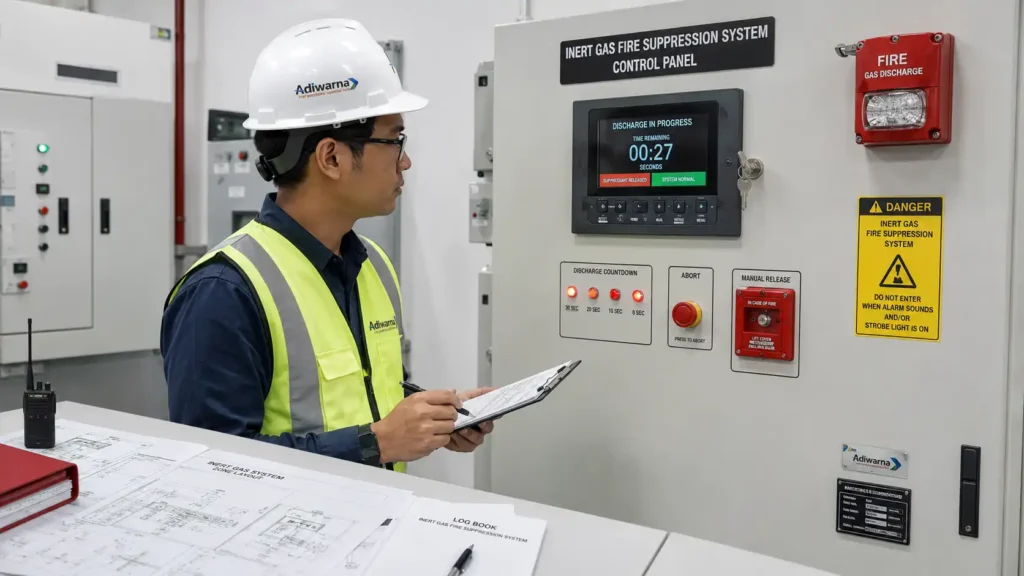
PT Adiwarna Anugerah Abadi helps clients select and implement inert gas systems based on facility needs. The Adiwarna team understands data centers, oil and gas facilities, factories, control rooms, and electrical rooms.
In addition, Adiwarna can support projects from consultation to maintenance. This approach helps clients get a safer and more integrated system.
Adiwarna’s key advantages include:
- Experienced technical team.
- Facility risk analysis.
- Proper extinguishing agent selection.
- Room volume calculation.
- Pipe and nozzle design.
- Fire alarm integration.
- Measurable testing and commissioning.
- Complete project documentation.
- Inspection and maintenance support.
With this approach, facilities become more prepared for emergencies. In addition, the system becomes easier for internal teams to manage.
About PT Adiwarna Anugerah Abadi
Tips Before Choosing an Inert Gas System
Before choosing the system, prepare technical room data. This data helps engineers create a more accurate design.
Prepare the following information:
- Latest room layout.
- Room volume.
- Room function.
- Type of protected assets.
- HVAC condition.
- Raised floor or additional ceiling.
- Cable routes and cable trays.
- Existing fire alarm system.
- Number of personnel in the area.
- Target standard or audit.
- Facility operating schedule.
In addition, involve HSE, facility, IT, and operations teams from the beginning. They understand daily needs and technical limitations in the field.
Conclusion: Inert Gas Protects Critical Assets with a Clean Approach
Inert gas is a strong choice for protecting critical areas that are sensitive to water, foam, or powder. This system suppresses fire without residue and supports faster operational recovery.
However, the system must be professionally designed. Room volume, leakage, gas concentration, nozzles, alarm sequence, and room integrity test must be calculated correctly.
In conclusion, PT Adiwarna Anugerah Abadi is ready to help your business choose the right inert gas system. Consult your fire suppression, fire alarm integration, room integrity test, installation, and maintenance needs with Adiwarna’s specialist team.
Contact Adiwarna for inert gas system consultation