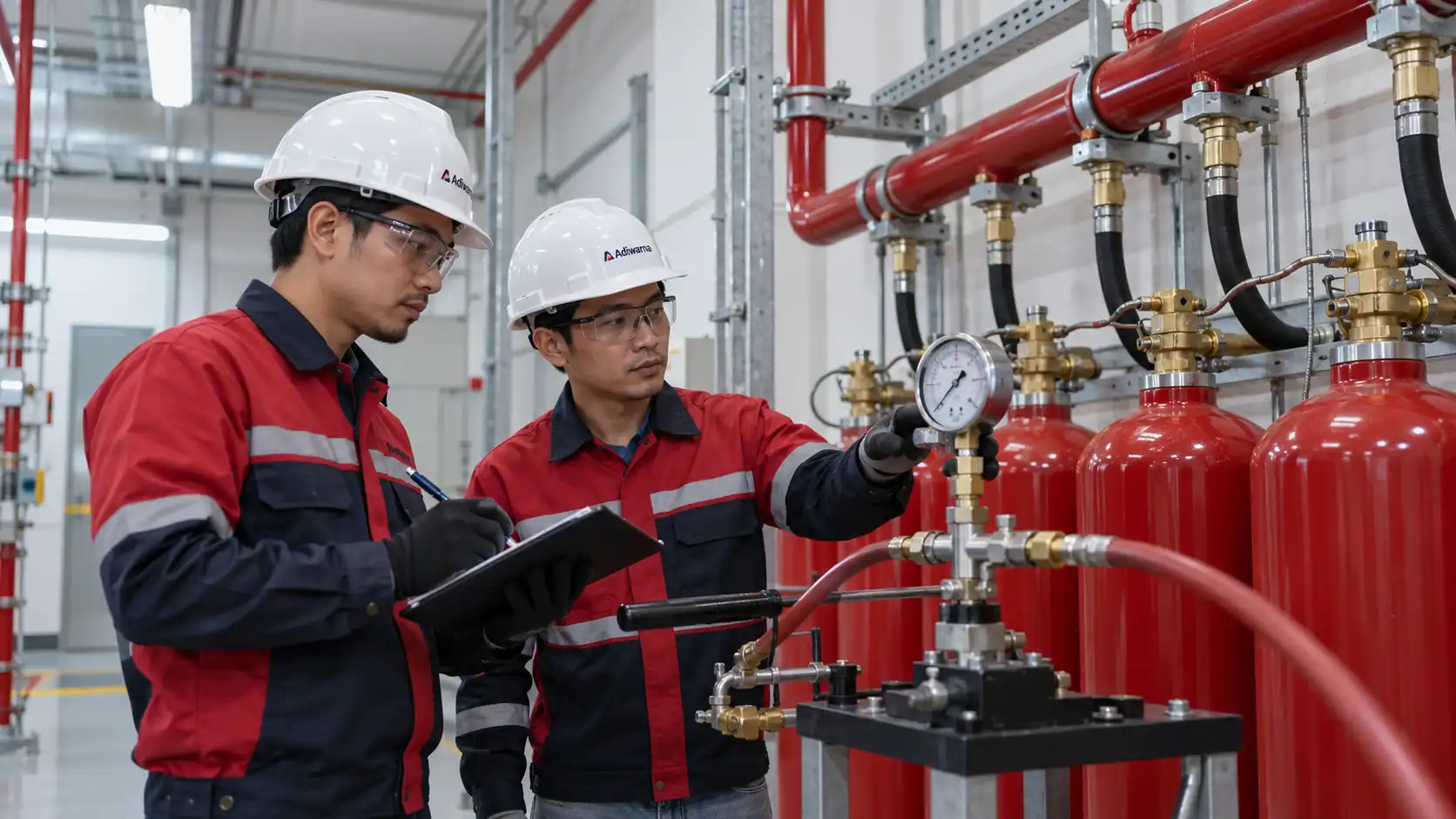


Room integrity test fire suppression is an enclosure leakage test used to determine whether a protected room can retain the required concentration of gaseous extinguishing agent according to the system design.
The test is particularly important for total flooding fire suppression systems such as FM 200, Inergen, IG-100, IG-55, IG-01, and other clean agent systems. A system may have properly functioning cylinders, piping, nozzles, detectors, and control panels, but overall fire suppression performance may still be compromised if the extinguishing agent escapes too quickly through gaps in the enclosure.
For this reason, gaseous fire suppression performance does not depend only on agent quantity. Enclosure integrity is also a fundamental part of the protection strategy.
NFPA 2001 uses enclosure integrity testing for clean agent total flooding systems, including door fan methods for evaluating room leakage.
In addition, ISO 14520-1:2023 provides requirements and recommendations covering the design, installation, testing, maintenance, and safety of gaseous fire-extinguishing systems.
Quick Answer
Room integrity test fire suppression is an enclosure test that uses a door fan or similar method to estimate room leakage and determine whether gaseous extinguishing agents such as FM 200 or inert gas can be retained according to the design requirement. The test does not normally require an actual agent discharge. If leakage is excessive, the enclosure should be improved before final acceptance.
What Is Room Integrity Test Fire Suppression?

Room integrity test fire suppression may also be referred to as:
- door fan test;
- enclosure integrity test;
- clean agent integrity test;
- room leakage test.
The principle is to measure how air moves through leaks in a protected enclosure when a controlled pressure difference is created.
The resulting data is then used to estimate how well the room can retain an extinguishing agent after system discharge.
This is different from releasing the entire FM 200 or inert gas quantity into the room.
One of the major advantages of door fan testing is that engineers can evaluate enclosure performance without performing a full extinguishing-agent discharge.
Adiwarna also discusses room integrity as part of FM 200 and inert gas engineering. On its FM 200 page, Adiwarna explains that blower door testing is used to measure enclosure leakage and estimate holding time.
Read Adiwarna’s FM 200 Fire Suppression System guide
Why Is Room Integrity Test Fire Suppression Important?
Gaseous fire suppression systems are commonly designed as total flooding systems.
This means that extinguishing agent is released throughout the protected enclosure until the required design concentration is achieved.
However, after discharge, the agent can escape through room openings.
Common leakage points include:
- door gaps;
- cable penetrations;
- wall penetrations;
- pipe penetrations;
- raised floors;
- ceiling voids;
- HVAC ducts;
- dampers;
- access panels;
- window frames;
- drains;
- unsealed service openings.
If leakage is excessive, the agent concentration may decrease faster than assumed during the design stage.
Therefore, a suppression system that appears mechanically complete may still have inadequate enclosure performance.
Adiwarna also notes that relatively small modifications such as new cable openings, ductwork changes, raised floor modifications, or ceiling work can affect the ability of the room to retain clean agent.
Leakage, Concentration, and Holding Time
To understand room integrity test fire suppression, three concepts should be separated clearly.
Leakage
Leakage refers to openings through which air or extinguishing gas can enter or leave the enclosure.
The larger the equivalent leakage area, the faster the extinguishing agent may escape.
Design Concentration
Design concentration is the extinguishing-agent concentration determined according to the selected agent, hazard, temperature, and other engineering parameters.
It should not be selected arbitrarily or based on one universal concentration for every system.
Holding Time or Retention Time
Holding time describes the ability of the protected enclosure to retain the required agent concentration for the design period.
The required retention performance should follow:
- the applicable standard;
- the approved system design;
- the selected extinguishing agent;
- the hazard;
- manufacturer requirements;
- project specifications.
Therefore, one universal holding-time value should not be applied to every gaseous suppression system.
How Is Room Integrity Test Fire Suppression Performed?
The room integrity test fire suppression process essentially simulates enclosure leakage using controlled airflow.
A typical test may include the following stages.
1. Survey the Protected Enclosure
The engineer first reviews:
- room dimensions;
- protected volume;
- raised floor;
- false ceiling;
- doors;
- cable penetrations;
- ductwork;
- dampers;
- wall openings;
- ventilation;
- adjacent spaces.
The test configuration should represent the enclosure condition expected when the suppression system is required to retain the extinguishing agent.
2. Install the Door Fan
A portable fan is installed in one doorway using a temporary test panel.
Typical equipment can include:
- calibrated fan;
- door panel;
- differential pressure gauge;
- pressure tubing;
- testing software;
- airflow measurement equipment.
3. Measure Background Pressure
Before the fan is operated, engineers should determine whether any background or bias pressure exists in the room.
Pressure differences can be influenced by:
- HVAC systems;
- building stack effect;
- exhaust fans;
- neighboring rooms;
- outdoor wind;
- building pressurization systems.
These factors can influence the final leakage calculation.
4. Pressurization and Depressurization
The fan is then operated to create controlled pressure differences.
Testing may include:
- pressurization;
- depressurization.
The airflow needed to generate the pressure difference provides information about the leakage characteristics of the enclosure.
5. Calculate Equivalent Leakage Area
Measurement data and software are used to estimate the equivalent leakage area.
The engineer then combines this information with fire suppression design parameters to evaluate retention performance.
6. Evaluate Holding Time
The final result is not simply an answer to “how much does the room leak?”
The more important question is whether that leakage still allows the gaseous agent to meet the required retention performance according to the approved system design.
Does Room Integrity Test Fire Suppression Use the Actual Extinguishing Agent?
Normally, no.
A door fan test does not require actual extinguishing-agent discharge.
This is one of its major benefits.
A simple analogy is filling a water tank. Before filling the entire tank, it is more efficient to determine whether the tank contains a large hole.
Door fan testing performs a similar function for a protected enclosure.
The test uses controlled airflow and pressure to estimate how gaseous extinguishing agent would behave after discharge.
Therefore, the enclosure can be evaluated without wasting FM 200 or inert gas simply to measure room leakage.
Room Integrity Test Fire Suppression for FM 200
Room integrity test fire suppression is highly relevant to FM 200 total flooding systems.
HFC-227ea is discharged into a protected enclosure to achieve the design concentration.
However, the agent may escape quickly if the room has excessive leakage.
Common critical points include:
- cable tray penetrations;
- underfloor openings;
- ceiling voids;
- HVAC ducts;
- door gaps;
- new network cabling;
- wall penetrations.
For this reason, enclosure integrity should not only be checked during the original installation.
Facility modifications should also be reviewed.
Learn more through Adiwarna’s FM 200 Fire Suppression System.
Room Integrity Test Fire Suppression for Inergen and Inert Gas
Enclosure integrity is equally important for inert gas systems.
Common agent categories include:
- IG-01;
- IG-55;
- IG-100;
- IG-541 / Inergen.
ISO 14520-1:2023 provides general requirements for gaseous fire-extinguishing systems, while additional sections in the ISO 14520 series address specific extinguishing agents.
In inert gas systems, another important factor is the pressure change that can occur when high-pressure gas is discharged into the enclosure.
Therefore, engineers may also need to evaluate:
- pressure relief vents;
- enclosure strength;
- HVAC shutdown;
- dampers;
- leakage;
- protected volume.
Adiwarna also explains that room integrity testing forms part of inert gas commissioning, and that modifications such as new cable installations, ductwork, doors, or HVAC changes can affect results.
Read Adiwarna’s Inert Gas Fire Suppression for Critical Assets.
Room Integrity Test for Data Centers
Data centers are among the most important applications for room integrity test fire suppression.
Server rooms can contain many potential leakage paths, including:
- raised floors;
- cable trays;
- fiber optic penetrations;
- electrical cable penetrations;
- hot aisle containment;
- cold aisle containment;
- cooling ducts;
- CRAC or CRAH openings;
- ceiling voids;
- doors;
- expansion work.
The challenge is that data centers change frequently.
Adding one server rack may also involve installing new cabling and creating additional wall or floor penetrations.
If these openings are not properly resealed, the enclosure may no longer perform as it did during initial commissioning.
Adiwarna also explains that clean agent protection in data centers depends on adequate sealing and room integrity to retain the extinguishing agent.
Read Adiwarna’s Data Center Fire Suppression System guide.
Is a Room Integrity Test the Same as a Piping Pressure Test?
No.
These tests serve different purposes.
| Test | What It Evaluates |
|---|---|
| Room integrity test | Leakage of the protected enclosure |
| Piping pressure test | Mechanical integrity of suppression piping |
| Piping obstruction test | Internal obstruction in piping |
| Detector functional test | Fire detection performance |
| Cause-and-effect test | System integration and sequence |
| Cylinder inspection | Condition of suppression cylinders |
A system can therefore pass a piping test but fail a room integrity test.
Likewise, a room may have excellent enclosure integrity while the suppression piping or releasing system is not functioning correctly.
This is why commissioning should evaluate the fire suppression system as a complete system.
Room Integrity Test Fire Suppression in Testing and Commissioning

Room integrity test fire suppression should be considered part of the broader commissioning process.
Integrated gaseous suppression commissioning may include:
- detector testing;
- cross-zone testing;
- releasing panel testing;
- manual release testing;
- abort switch testing;
- sounder testing;
- strobe testing;
- time-delay verification;
- HVAC shutdown;
- damper interfaces;
- pressure switches;
- actuator circuits;
- BMS interfaces;
- cause-and-effect testing;
- nozzle verification;
- piping inspection;
- room integrity testing.
Adiwarna also lists room integrity testing as one of the important stages in inert gas testing and commissioning.
For broader system information, see Adiwarna Fire Suppression System Equipment.
NFPA 2001 and Room Integrity Test Fire Suppression
NFPA 2001 — Standard on Clean Agent Fire Extinguishing Systems is one of the major international references for clean agent systems.
As of 2026, the current edition is NFPA 2001:2025.
NFPA technical material recognizes the use of door fan testing to verify that enclosure leakage is consistent with the assumptions used in clean agent system design.
Engineers should still use:
- the actual applicable edition;
- the approved system design manual;
- manufacturer instructions;
- project acceptance criteria;
- authority requirements.
ISO 14520 and Room Integrity Test Fire Suppression
In addition to NFPA 2001, ISO 14520-1:2023 is an important reference for gaseous fire-extinguishing systems.
The standard provides requirements and recommendations for:
- design;
- installation;
- testing;
- maintenance;
- safety.
It applies to gaseous fire-extinguishing systems used in buildings, plants, and other structures.
The standard covers total flooding systems that use electrically nonconductive gaseous extinguishing agents that leave no residue after discharge.
Learn more about ISO 14520-1:2023
For specific agents, engineers should use ISO 14520-1 together with the relevant agent-specific section.
When Should Room Integrity Test Fire Suppression Be Performed?
Testing is especially relevant in the following situations.
After a New Installation
The objective is to confirm that the actual enclosure matches the design assumptions before final system acceptance.
After Room Renovation
New partitions, doors, raised floors, or ceiling modifications can affect enclosure leakage.
After New Cable or Pipe Penetrations
Even relatively small openings can create significant leakage paths.
After HVAC Modifications
Changes to ducts, dampers, exhaust systems, or airflow configurations can affect enclosure performance.
When Enclosure Condition Is Uncertain
Testing may be appropriate if:
- door seals are damaged;
- building modifications have occurred;
- new openings are visible;
- commissioning records are missing.
Adiwarna also recommends reassessment after significant changes involving cables, doors, walls, raised floors, ducts, HVAC, or equipment.
The final testing frequency should follow the applicable standard, system documentation, insurer requirements, authority requirements, and project maintenance plan.
Why Can a Room Integrity Test Fail?
An enclosure may fail to meet the required integrity because of several common problems.
Unsealed Cable Penetrations
This is one of the most frequent issues, especially in data centers.
New cables are often installed without restoring the original fire-rated or gas-retention seal.
Door Gaps
Damaged door seals or excessive gaps beneath doors can increase leakage.
HVAC Dampers That Do Not Close
An open duct can create a major leakage path.
Raised Floor Openings
Openings used for cables or cooling may affect both the protected volume and leakage behavior.
Ceiling Voids Connected to Other Areas
A false ceiling may provide an unintended pathway into an adjacent space.
Unsealed Wall Penetrations
MEP work frequently creates new openings that are not properly sealed afterward.
Open Service Panels
Maintenance access panels that do not close correctly can become additional leakage paths.
What Should Be Done If a Room Integrity Test Fails?
Do not immediately increase the extinguishing-agent quantity.
That approach may not solve the actual problem.
A better process is:
- Identify the major leakage paths.
- Inspect cable and pipe penetrations.
- Inspect door seals.
- Evaluate HVAC and dampers.
- Inspect ceiling and raised floor areas.
- Seal unnecessary openings.
- Confirm that improvements do not interfere with pressure relief or other safety requirements.
- Perform a retest.
- Document the final enclosure condition.
The objective is not to make the room completely airtight.
The enclosure should perform according to the engineered system design.
In inert gas systems, for example, pressure relief still needs to be considered, so sealing should not be performed without understanding system pressure behavior.
How Long Does a Room Integrity Test Fire Suppression Take?
Testing duration depends on several factors:
- room size;
- number of enclosures;
- accessibility;
- quantity of leakage paths;
- HVAC configuration;
- raised floor complexity;
- ceiling voids;
- pre-test preparation;
- need for leakage troubleshooting.
A simple room can be tested much faster than a large data center with multiple penetrations and interconnected spaces.
For this reason, test duration should ideally be estimated after reviewing the room layout or completing a site survey.
Does Facility Operation Need to Stop During the Test?
Not always.
One advantage of the door fan method is that it does not require a full extinguishing-agent discharge.
However, the room may need to be configured according to the intended test condition.
For example:
- doors may need to be closed;
- HVAC may need to be adjusted;
- dampers may need to follow the suppression hold-time condition;
- access may need to be temporarily limited.
For critical facilities, testing should be coordinated with the operations team to minimize downtime and operational risk.
Room Integrity Test Fire Suppression Report
A good test report should provide more than simply PASS or FAIL.
Documentation may include:
- project information;
- room identification;
- protected volume;
- extinguishing agent;
- design parameters;
- test equipment;
- calibration information;
- test configuration;
- pressure data;
- airflow data;
- leakage results;
- holding-time or retention calculation;
- observed leakage locations;
- test conclusion;
- recommendations;
- photographs;
- engineer or technician information.
This information is useful for:
- commissioning;
- audits;
- maintenance;
- future modifications;
- insurance;
- troubleshooting.
Room Integrity Test Fire Suppression and Preventive Maintenance
Room integrity test fire suppression is also closely related to preventive maintenance.
Many facility owners inspect only:
- cylinder pressure;
- fire detectors;
- releasing panels;
- alarms;
- nozzles.
However, the enclosure itself can change over time.
For example, an IT team may install new cables several times per year.
The suppression cylinders may remain in perfect condition while cable penetrations continue increasing.
In this situation, the mechanical fire suppression equipment may look healthy even though the overall protection performance has changed.
For this reason, enclosure inspection should form part of the lifecycle management of gaseous suppression systems.
Room Integrity Test Fire Suppression vs Actual Discharge Test
The two tests have different objectives.
| Door Fan / Room Integrity Test | Actual Agent Discharge |
|---|---|
| Evaluates enclosure leakage | Tests actual suppression discharge |
| Does not consume extinguishing agent | Uses extinguishing agent |
| Estimates retention performance | Demonstrates actual discharge behavior |
| Practical for enclosure evaluation | More complex and costly |
| Less disruptive | Usually requires restoration and refill |
A full agent discharge is not automatically required simply to evaluate enclosure leakage.
The required acceptance procedure should follow:
- project specifications;
- authority requirements;
- applicable standards;
- manufacturer requirements.
Room Integrity Test Fire Suppression for Existing Systems
Existing gaseous suppression systems can also benefit from enclosure integrity evaluation.
Typical indicators include:
- room renovation;
- new racks;
- additional cabling;
- HVAC modifications;
- replaced doors;
- new partitions;
- ceiling modifications;
- raised floor work;
- missing historical integrity reports;
- incomplete commissioning records.
In these cases, an integrity test can help determine whether the current enclosure still supports the original fire suppression design philosophy.
Common Room Integrity Test Fire Suppression Mistakes
Focusing Only on PASS or FAIL
The engineering value lies in understanding the leakage condition and required improvements.
Ignoring HVAC Conditions
The test configuration should represent the enclosure condition expected when the extinguishing agent must be retained.
Ignoring Raised Floors
In data centers, raised floors can significantly affect enclosure performance.
Failing to Document Openings
Without documentation, the same leakage problems may return after future MEP work.
Excessive Sealing
Enclosure integrity does not mean sealing every opening without considering pressure relief and safety requirements.
Skipping Retesting
After leakage improvements, final performance should be verified.
Room Integrity Test Fire Suppression Checklist
Before testing, verify that:
- The protected room is construction-complete
- Doors are installed and can close correctly
- Cable penetrations are completed
- Pipe penetrations are completed
- HVAC configuration is known
- Fire dampers are functional
- Raised floor areas have been reviewed
- Ceiling voids have been reviewed
- Room volume is available
- The suppression agent is known
- Design calculations are available where needed
- Access to the room is available
- Operations personnel have been informed
- Latest drawings are available
After testing:
- Leakage issues are documented
- Recommendations are prepared
- Sealing is completed where required
- Retesting is performed if necessary
- Final report is stored with commissioning documentation
How to Choose a Room Integrity Test Fire Suppression Provider
A room integrity test fire suppression provider should understand gaseous fire suppression, not just blower fan operation.
Evaluate whether the provider can:
- Understand clean agent and inert gas systems.
- Understand total flooding design.
- Review suppression calculations.
- Identify protected volume.
- Understand raised floors and ceiling voids.
- Evaluate HVAC and dampers.
- Operate calibrated door fan equipment.
- Interpret pressure and leakage data.
- Evaluate holding time.
- Recommend leakage improvements.
- Understand NFPA 2001 and ISO 14520.
- Prepare professional test documentation.
- Integrate test results into the commissioning process.
This is important because room integrity testing is not simply a general building leakage test.
The test result should be interpreted in the context of fire suppression performance.
Adiwarna’s Experience in Room Integrity Testing
PT Adiwarna Anugerah Abadi has relevant experience in gaseous fire suppression and room integrity testing.
Adiwarna’s company profile includes a Room Integrity Test Gas Turbine — BP Indonesia, Tangguh Gas Field project.
In addition, Adiwarna’s inert gas services cover engineering, installation, testing, commissioning, room integrity testing, and preventive maintenance.
This allows the testing process to be positioned within a complete workflow:
survey → engineering review → room integrity test → leakage improvement → retest → commissioning → documentation
FAQ About Room Integrity Test Fire Suppression
What Is Room Integrity Test Fire Suppression?
Room integrity test fire suppression is an enclosure test used to estimate room leakage and determine whether the protected room can retain gaseous extinguishing agent according to the design requirement.
A door fan is typically used to create controlled pressure and measure airflow through enclosure leakage.
Is a Room Integrity Test the Same as a Door Fan Test?
In gaseous fire suppression applications, a door fan test is one of the most common methods used to perform enclosure integrity evaluation.
It measures leakage characteristics using controlled airflow and differential pressure.
Does a Room Integrity Test Require an FM 200 Discharge?
No, not for a standard door fan test.
Leakage is evaluated using airflow and pressure measurements, so FM 200 does not need to be discharged merely to assess enclosure integrity.
Does Inergen Require a Room Integrity Test?
Enclosure integrity is important for Inergen and other inert gas total flooding systems because the extinguishing concentration must be retained according to the approved design.
Pressure relief requirements should also be evaluated because inert gas systems typically use high-pressure storage.
Is a Room Integrity Test Important for Data Centers?
Yes.
Data centers often contain:
- cable penetrations;
- raised floors;
- cooling infrastructure;
- doors;
- ceiling openings;
- frequent equipment modifications.
These conditions can change enclosure leakage over time.
When Should Room Integrity Testing Be Repeated?
Retesting should be considered after significant changes such as:
- room renovation;
- new cable penetrations;
- HVAC modifications;
- door replacement;
- wall changes;
- raised floor modifications;
- equipment installations affecting the enclosure.
Formal intervals should follow the applicable standard and project maintenance requirements.
What Standards Apply to Room Integrity Test Fire Suppression?
For clean agent systems, NFPA 2001:2025 is one major reference.
For gaseous suppression more broadly, ISO 14520-1:2023 provides general requirements for design, installation, testing, maintenance, and safety.
What Happens If the Room Integrity Test Fails?
Engineers should identify major leakage paths, improve the required sealing, evaluate HVAC and pressure considerations, and perform a retest.
Increasing the extinguishing-agent quantity without correcting leakage is not automatically the best solution.
How Much Does a Room Integrity Test Cost?
Cost depends on:
- number of rooms;
- enclosure size;
- protected volume;
- project location;
- raised floors;
- ceiling voids;
- HVAC complexity;
- number of tests;
- leakage troubleshooting;
- reporting requirements;
- project or standard requirements.
An accurate quotation should be based on room information, layout, and testing scope.
Consult Adiwarna for Room Integrity Test Fire Suppression
The effectiveness of gaseous fire suppression does not depend only on cylinders, extinguishing agent, piping, and nozzles.
Room integrity test fire suppression helps verify a part of the system that is often invisible: whether the protected enclosure can actually retain the extinguishing agent according to the design.
PT Adiwarna Anugerah Abadi Tbk can support gaseous fire suppression requirements from engineering and installation through testing, commissioning, room integrity testing, and maintenance.
For project evaluation, prepare:
- room layout;
- room dimensions;
- protected volume;
- extinguishing-agent type;
- existing calculations where available;
- HVAC information;
- raised floor and ceiling information;
- latest drawings.
Then contact the Adiwarna team for Room Integrity Test and Fire Suppression consultation.
Conclusion
Room integrity test fire suppression is an important part of total flooding gaseous fire suppression performance.
Door fan testing helps evaluate enclosure leakage without requiring a full extinguishing-agent discharge. The result allows engineers to determine whether the protected room can retain the required agent concentration according to the approved design.
The test is particularly relevant for:
- FM 200;
- Inergen;
- IG-100;
- IG-55;
- IG-01;
- data centers;
- server rooms;
- control rooms;
- electrical rooms;
- other critical facilities.
NFPA 2001 and ISO 14520 are important references for clean agent and gaseous fire-extinguishing system engineering.
By including room integrity test fire suppression as part of commissioning and lifecycle maintenance, facility owners can verify that their gaseous suppression investment is supported not only by complete equipment, but also by an enclosure capable of supporting the system’s intended performance.