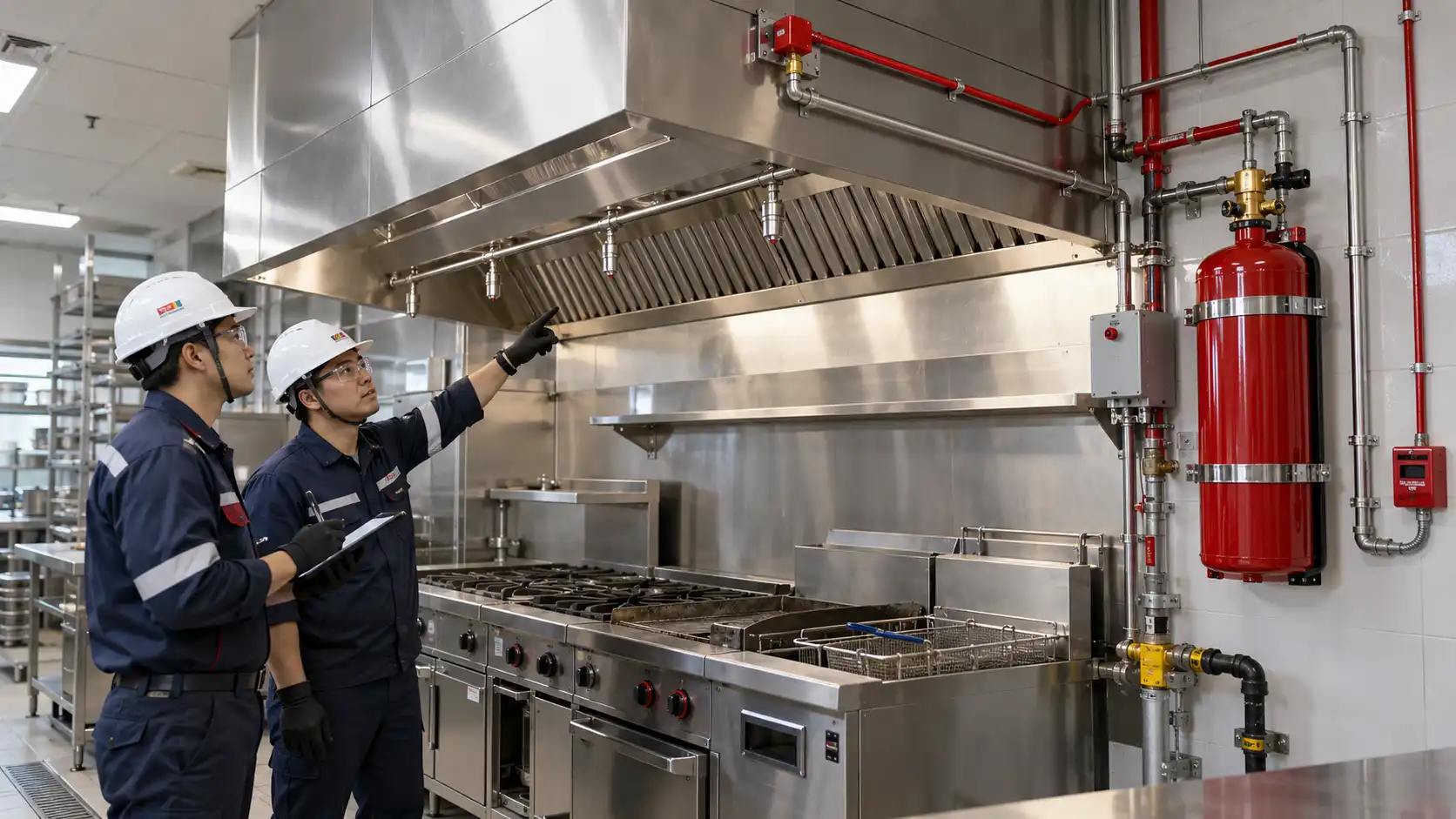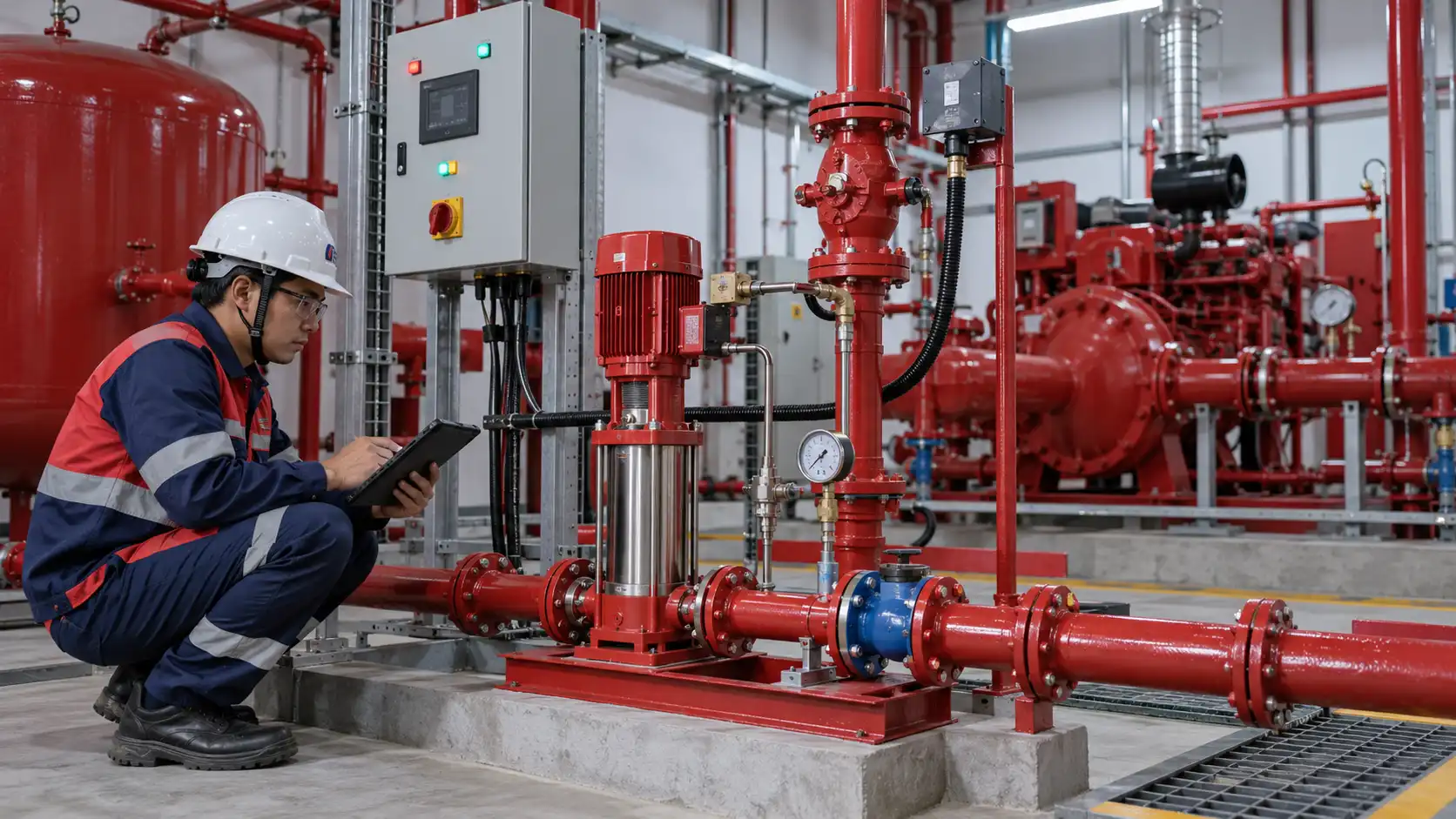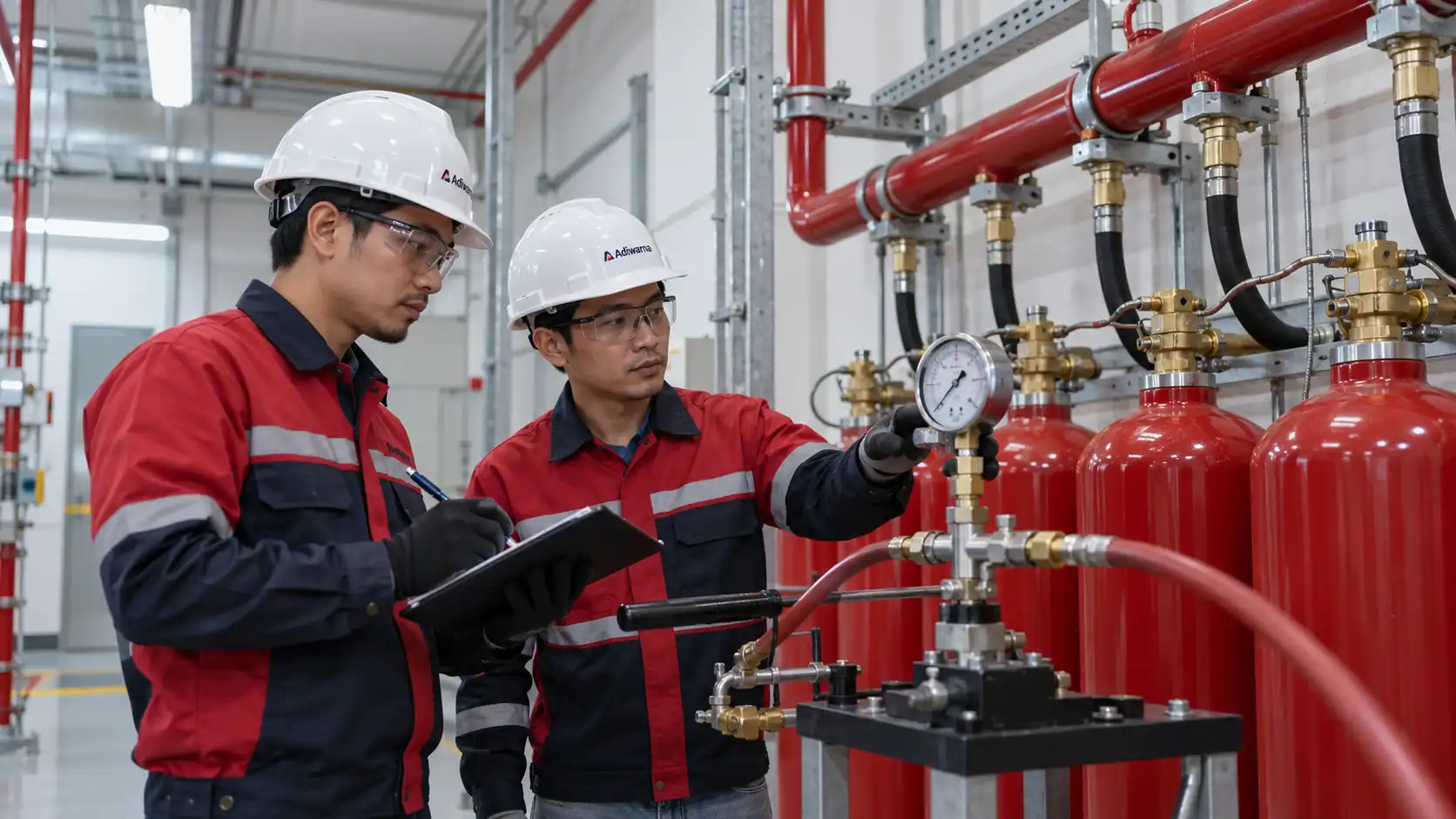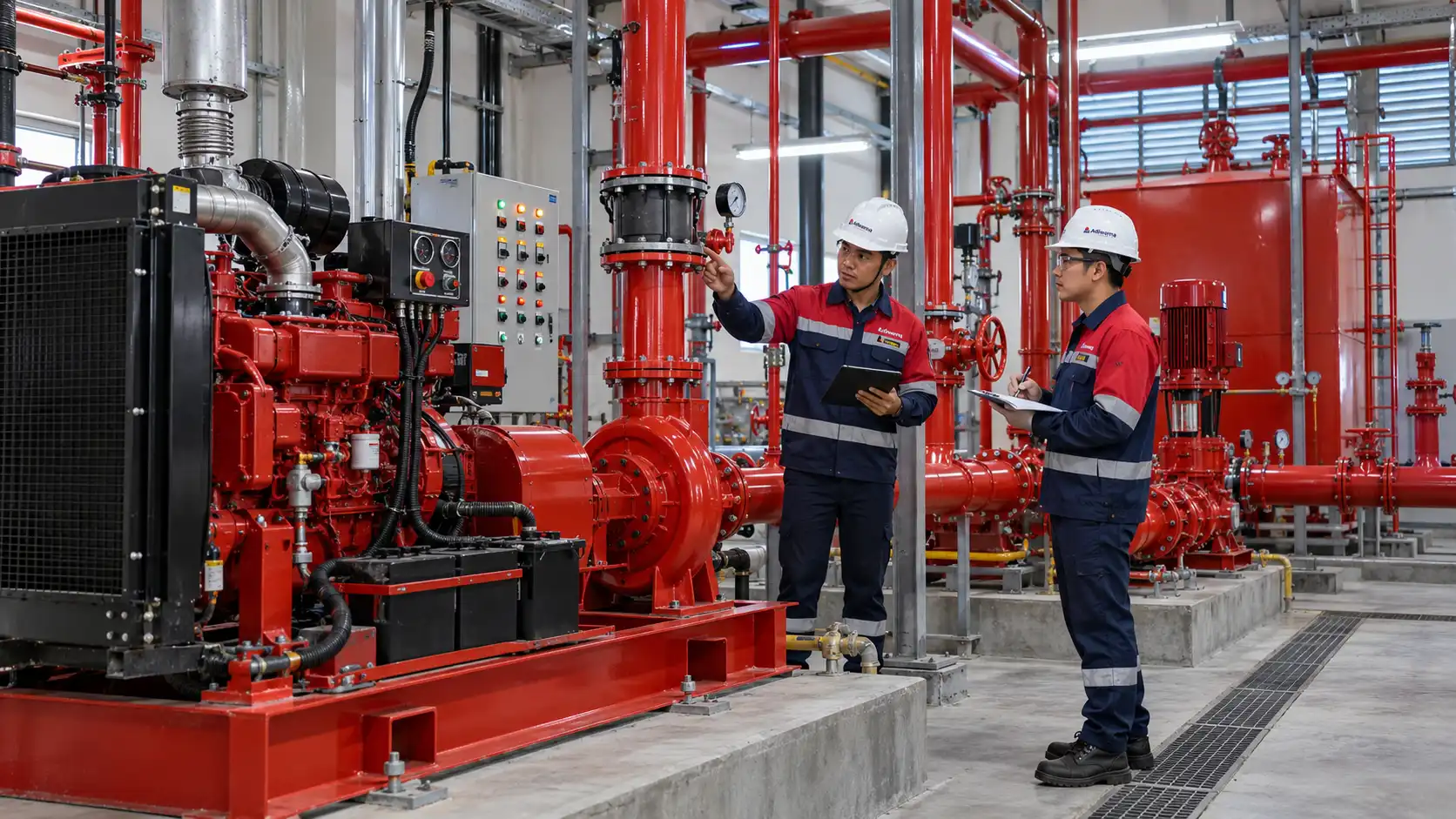

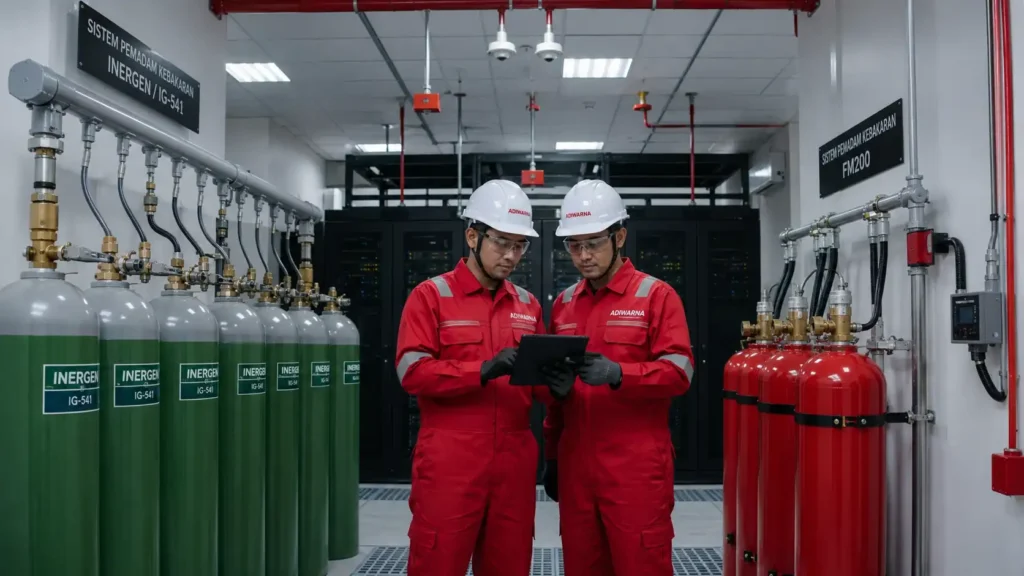
Inergen vs FM200 is one of the most common comparisons when engineers and facility owners evaluate gaseous fire suppression systems for data centers, server rooms, electrical rooms, control rooms, archives, and other critical facilities.
Both can be used as clean agent total flooding systems and do not leave residue on protected equipment. However, Inergen and FM200 differ significantly in agent type, extinguishing mechanism, storage pressure, cylinder requirements, pressure relief considerations, environmental profile, and lifecycle strategy.
Inergen is based on IG-541, a mixture of approximately 52% nitrogen, 40% argon, and 8% carbon dioxide. It works primarily by reducing the oxygen concentration inside a protected enclosure to a level where combustion can no longer be sustained.
FM200, on the other hand, uses HFC-227ea, a halocarbon clean agent that works mainly through heat absorption.
Therefore, the better question is not simply:
“Which one is better?”
The more useful question is:
Which system best matches the hazard, protected volume, occupancy, available space, environmental objectives, existing infrastructure, and lifecycle requirements of the project?
Quick Answer: Inergen vs FM200
Inergen vs FM200 does not have one universal winner.
FM200 is often attractive when a project requires a relatively compact, clean, electrically nonconductive suppression system for sensitive electronic environments. However, HFC-227ea has a higher climate impact than inert gas systems and HFC lifecycle considerations are becoming increasingly important.
Inergen uses IG-541, a mixture of nitrogen, argon, and carbon dioxide. It leaves no residue and has a simpler environmental profile because the agent is based on gases naturally present in the atmosphere. However, inert gas systems generally require high-pressure cylinders, more storage space, and careful pressure relief engineering.
The final choice should be made through engineering calculations.
What Are the Main Differences Between Inergen vs FM200?
The table below provides an initial comparison.
| Parameter | Inergen / IG-541 | FM200 / HFC-227ea |
|---|---|---|
| Agent type | Inert gas | Halocarbon |
| Composition | N₂ + Ar + CO₂ | HFC-227ea |
| Main suppression principle | Oxygen concentration reduction | Heat absorption |
| Residue | None | None |
| Electrical conductivity | Nonconductive | Nonconductive |
| Storage | High-pressure compressed gas | Liquefied clean agent, nitrogen-superpressurized |
| Cylinder requirement | Usually more cylinders | Usually more compact |
| Pressure effect during discharge | Major design consideration | Still requires evaluation |
| Environmental profile | Atmospheric gases | HFC with high GWP |
| ODP | Not halocarbon-based | 0 |
| Room integrity | Important | Important |
| Typical applications | Data centers, control rooms, electrical rooms, archives | Data centers, server rooms, electrical rooms, control rooms |
| Main standards | NFPA 2001 / ISO 14520 | NFPA 2001 / ISO 14520 |
This table is only an initial screening tool. Final design should be based on approved system data and hydraulic or pneumatic calculations.
Inergen vs FM200 by Extinguishing Agent
The most fundamental difference is the extinguishing medium itself.
Inergen / IG-541
Inergen uses a mixture of approximately:
- 52% nitrogen;
- 40% argon;
- 8% carbon dioxide.
This mixture is known as IG-541.
Because these gases are naturally present in the atmosphere, Inergen is considered an inert gas suppression technology rather than a halocarbon system.
Learn more through the Adiwarna Inergen System.
FM200 / HFC-227ea
FM200 is a widely used trade name associated with HFC-227ea or heptafluoropropane.
It is a halocarbon clean agent designed for total flooding fire suppression systems.
Learn more through the Adiwarna FM200 Fire Suppression System.
Inergen vs FM200: How Do They Work?
How Inergen Works
Inergen primarily suppresses fire by reducing oxygen concentration in the protected enclosure.
When the agent is discharged, the concentration of oxygen is lowered to a level that can no longer effectively support combustion under the intended design conditions.
Therefore, an Inergen design should consider:
- room volume;
- altitude;
- temperature;
- design concentration;
- fire hazard;
- occupancy;
- room leakage;
- discharge characteristics.
How FM200 Works
FM200 works differently.
HFC-227ea suppresses fire primarily through heat absorption, removing thermal energy from the combustion process.
The agent is discharged through engineered piping and nozzles to reach the required design concentration within the protected enclosure.
In simplified terms:
Inergen → oxygen concentration reduction
while
FM200 → primarily heat absorption
This difference in operating mechanism is one reason why the two systems cannot simply be substituted without redesign.
Inergen vs FM200 for Electronic Equipment
Both systems are attractive for environments containing sensitive electronics because neither leaves water or dry chemical residue after discharge.
Typical applications include:
- server racks;
- networking equipment;
- PLCs;
- MCCs;
- electrical panels;
- UPS systems;
- telecommunications equipment;
- instrumentation;
- control systems.
Because they are nonconductive and residue-free, both can be suitable for critical electronic environments.
However, residue-free does not mean automatically safe for every application.
The engineering design should still consider:
- actual fire hazard;
- equipment;
- room condition;
- occupancy;
- alarm sequence;
- shutdown procedure;
- evacuation requirements.
Inergen vs FM200 by Cylinder Requirement
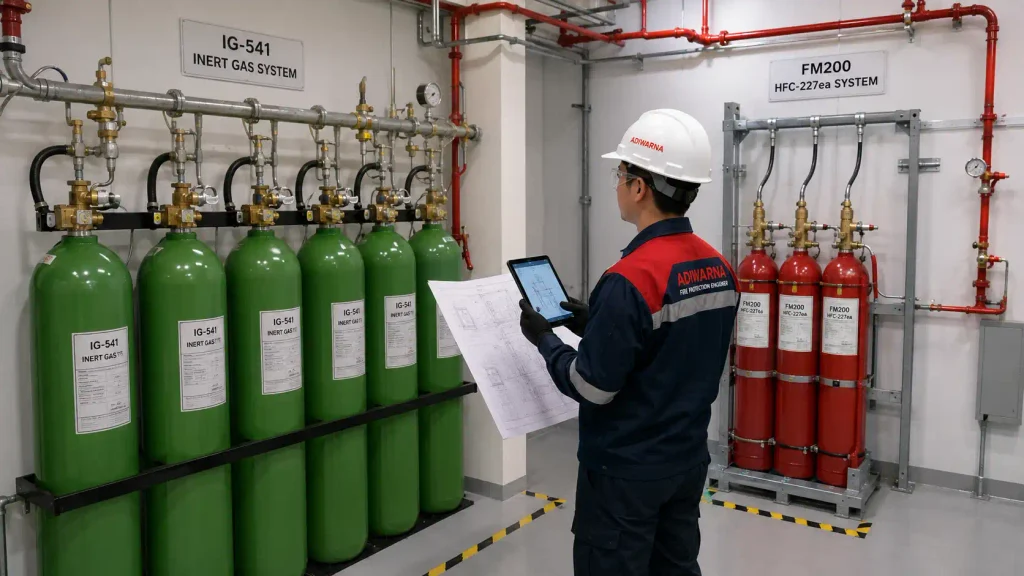
This is one of the biggest practical differences.
Inergen Cylinders
Inergen is stored as compressed gas at high pressure.
Depending on the listed system, configurations may use storage pressures such as 150 bar or 200 bar.
Because a relatively large gaseous volume is required, an Inergen system may require a larger cylinder bank.
Engineers should therefore consider:
- cylinder room size;
- floor loading;
- manifold arrangement;
- cylinder restraint;
- piping route;
- maintenance access;
- cylinder transportation;
- replacement access.
FM200 Cylinders
FM200 is stored as a liquefied agent and is typically superpressurized with nitrogen.
Because its storage density is higher than that of inert gas, the cylinder arrangement is usually more compact.
Actual storage pressure depends on the manufacturer and the listed system.
Practical Implication
For retrofit projects with very limited cylinder-room space, FM200 can offer an advantage in terms of footprint.
However, the decision should not be based on cylinder footprint alone.
Inergen vs FM200 by Space Requirement
If available floor area is a major project constraint, FM200 is often easier to accommodate because the agent can generally be stored in fewer or smaller cylinders.
An Inergen system may require:
- more cylinders;
- a larger cylinder bank;
- manifold systems;
- dedicated storage space;
- greater maintenance clearance.
However, actual space requirements depend on:
- protected volume;
- hazard;
- system pressure;
- cylinder size;
- required agent quantity;
- piping arrangement;
- manufacturer design.
For a proper comparison, engineers should develop preliminary layouts for both options.
Inergen vs FM200 and Pressure Relief
Pressure management is important for both systems, but it is particularly significant for inert gas systems.
When Inergen is discharged, a large quantity of high-pressure gas enters the protected enclosure.
The engineer may therefore need to evaluate:
- peak enclosure pressure;
- pressure relief vent sizing;
- free vent area;
- wall strength;
- door strength;
- ceiling construction;
- damper behavior;
- enclosure integrity.
FM200 can also produce pressure transients during discharge, so pressure relief may still need to be evaluated.
However, in inert gas designs, enclosure pressure is often a more prominent engineering consideration.
Therefore, engineers should not evaluate only the cylinder system.
The protected enclosure must also be able to safely manage the discharge dynamics.
Inergen vs FM200 and Room Integrity Test
Both Inergen and FM200 total flooding systems depend heavily on enclosure integrity.
If the extinguishing agent escapes too quickly through openings, the design concentration may not be retained as required.
Common leakage locations include:
- cable penetrations;
- pipe penetrations;
- door gaps;
- HVAC ducts;
- raised floors;
- ceiling voids;
- service openings.
A room integrity test or door fan test can help evaluate leakage and expected agent retention without performing a full agent discharge.
Read the Adiwarna Room Integrity Test Fire Suppression Guide.
Key Point
Inergen vs FM200 both require an enclosure that supports the intended total flooding design.
Installing a clean agent system without evaluating room integrity can result in a system that is mechanically complete but may not perform as intended.
Inergen vs FM200 Environmental Impact
This is one of the clearest differences.
Environmental Profile of Inergen
Inergen uses nitrogen, argon, and carbon dioxide.
Because these gases are already present in the atmosphere, the system avoids the HFC lifecycle issues associated with HFC-227ea.
This makes inert gas attractive for projects where long-term environmental performance is a major consideration.
Environmental Profile of FM200
FM200 uses HFC-227ea.
HFC-227ea has:
- ODP: 0
- a significantly higher GWP than inert atmospheric gases.
Therefore, an important distinction is:
ODP 0 does not mean GWP 0.
FM200 does not deplete the ozone layer, but that does not mean it has no climate impact.
For projects with ESG or long-term sustainability objectives, this difference can be significant.
Is FM200 Banned?
It is inaccurate to say that FM200 is globally banned.
HFC-227ea continues to be used in fire suppression applications in various jurisdictions.
However, HFCs are facing increasing regulatory pressure because of their climate impact.
Project owners should therefore evaluate:
- current local regulations;
- agent availability;
- future refill options;
- lifecycle planning;
- sustainability policies;
- insurer requirements;
- expected project life.
For projects in Indonesia, local regulations and project requirements should be evaluated rather than automatically applying regulations from another country.
Inergen vs FM200 for Occupied Rooms
Both Inergen and FM200 can be used in certain normally occupied spaces when designed within permitted exposure limits and applicable safety requirements.
However, avoid statements such as:
“100% safe for humans.”
Life-safety engineering should consider:
- design concentration;
- exposure limits;
- discharge duration;
- pre-discharge alarms;
- time delays;
- evacuation time;
- protected volume;
- occupancy;
- applicable standards.
NFPA 2001 provides safety requirements for clean agent total flooding systems.
NFPA 2001 for Inergen vs FM200
Both IG-541 and HFC-227ea fall within the scope of clean agent engineering referenced by NFPA 2001 — Standard on Clean Agent Fire Extinguishing Systems.
The current edition is NFPA 2001:2025.
The standard covers requirements for clean agent systems, including design, installation, operation, safety, and system performance.
Engineers should still use:
- the listed system manual;
- manufacturer data;
- approved calculations;
- project specifications;
- authority requirements.
ISO 14520 for Inergen vs FM200
The ISO 14520 series is also highly relevant.
ISO 14520-1 provides general requirements for:
- design;
- installation;
- testing;
- maintenance;
- safety;
of gaseous fire extinguishing systems.
Agent-specific parts are also available for individual extinguishing agents, including HFC-227ea and IG-541.
This means the correct design approach is not simply to compare brand names.
Each agent requires a methodology appropriate to its physical and fire suppression characteristics.
Inergen vs FM200 for Data Centers
Data centers are one of the most common applications where owners compare Inergen vs FM200.
Typical requirements include:
- no residue;
- electrically nonconductive agent;
- fast response;
- minimal secondary damage;
- integration with fire detection;
- controlled discharge;
- minimal downtime.
Read more through the Adiwarna Data Center Fire Suppression System.
When Can FM200 Be Attractive for Data Centers?
FM200 may be attractive when:
- cylinder space is limited;
- the existing facility cannot accommodate a large cylinder bank;
- compact storage is a priority;
- an existing system already uses HFC-227ea;
- the owner accepts the lifecycle considerations of the agent.
When Can Inergen Be Attractive?
Inergen may be a strong candidate when:
- environmental objectives are important;
- adequate cylinder storage space is available;
- the owner prefers inert gas technology;
- pressure relief can be properly engineered;
- long-term dependence on HFCs is a concern.
These are not universal rules.
Final selection still requires engineering evaluation.
Inergen vs FM200 for Electrical Rooms
Electrical rooms may contain:
- switchgear;
- MCCs;
- UPS systems;
- control panels;
- transformer auxiliaries;
- instrumentation.
Both FM200 and Inergen are residue-free and nonconductive, making them suitable candidates for many electrical-room applications.
Selection should still consider:
- room volume;
- ventilation;
- enclosure integrity;
- electrical hazard;
- cylinder space;
- pressure;
- occupancy;
- shutdown logic.
For smaller rooms with limited storage space, FM200 can offer a layout advantage.
For facilities prioritizing environmental lifecycle performance, Inergen may be more attractive.
Inergen vs FM200 for Control Rooms
Control rooms require high operational continuity.
Secondary damage should be minimized because these spaces may contain:
- DCS;
- SCADA;
- PLC;
- communication equipment;
- workstations;
- servers;
- control panels.
Either Inergen or FM200 may be used depending on the engineering study.
In large industrial facilities, the decision often considers more than agent price.
Important factors include:
- continuity of operation;
- system redundancy;
- cylinder location;
- architecture;
- room leakage;
- maintenance availability.
Inergen vs FM200 for Archives, Museums, and High-Value Assets
Water or dry chemical powder may cause secondary damage to certain valuable materials.
For this reason, gaseous suppression may be considered for:
- archives;
- document storage;
- museum collections;
- heritage assets;
- special library collections.
However, a hazard analysis is still required.
Material compatibility, evacuation, enclosure integrity, and fire load should be evaluated before selecting the agent.
Inergen vs FM200 from an Installation Perspective
Neither system is automatically “easier” in every project.
FM200
Potential advantages include:
- smaller cylinder footprint;
- fewer cylinders in many applications;
- suitability for retrofit projects with limited space.
However, FM200 still requires:
- piping calculations;
- nozzle calculations;
- fire detection;
- releasing systems;
- room integrity;
- HVAC integration.
Inergen
Installation may require:
- multiple high-pressure cylinders;
- a manifold;
- larger storage area;
- high-pressure piping considerations;
- pressure relief vents;
- more coordination with enclosure design.
The complexity is different rather than simply higher or lower.
Inergen vs FM200 from a Maintenance Perspective
Both systems require preventive maintenance.
Maintenance can include:
- cylinder condition;
- agent quantity or pressure;
- valves;
- actuators;
- piping;
- nozzles;
- detectors;
- releasing panels;
- manual release;
- abort switches;
- alarms;
- HVAC interfaces;
- room integrity;
- maintenance records.
The key difference lies partly in agent lifecycle.
For Inergen, supply is based on atmospheric gases.
For FM200, HFC-227ea availability, recovery, refill strategy, environmental regulation, and future lifecycle should be considered.
Inergen vs FM200 from a Refill Perspective
Inergen Refill
Inergen refill should consider:
- correct agent composition;
- filling pressure;
- cylinder condition;
- valve condition;
- manufacturer requirements;
- hydrostatic test status.
Refill should not be based only on nominal pressure without verifying the system specification.
FM200 Refill
FM200 refill should verify:
- HFC-227ea quantity;
- agent condition;
- cylinder condition;
- nitrogen superpressurization;
- valve condition;
- system specification.
Owners should also consider long-term agent availability.
Inergen vs FM200 by Cost
Asking:
“Which is cheaper, Inergen or FM200?”
cannot be answered by comparing agent price alone.
Total project cost should include:
CAPEX
- extinguishing agent;
- cylinders;
- manifolds;
- piping;
- nozzles;
- detection;
- control panel;
- pressure relief;
- room improvement;
- engineering;
- installation;
- commissioning.
OPEX / Lifecycle
- inspection;
- maintenance;
- refill;
- cylinder testing;
- agent availability;
- future regulation;
- facility modifications.
Inergen may require more cylinders and larger storage infrastructure.
FM200 may be more compact but carries HFC lifecycle considerations.
Therefore, total cost should be evaluated per project, not per kilogram of agent.
Inergen vs FM200: Which Is More Environmentally Favorable?
If environmental impact is a major decision factor, Inergen generally has a stronger position.
Reasons include:
- atmospheric-gas composition;
- no dependence on HFCs;
- no HFC lifecycle concern associated with HFC-227ea.
FM200 has ODP 0, but HFC-227ea still has significant global warming potential.
Therefore:
ODP 0 ≠ GWP 0.
This distinction is important when comparing clean agent technologies for long-term projects.
Inergen vs FM200: Which Requires Less Space?
In general:
FM200 is usually more compact.
Because HFC-227ea is stored as a liquefied agent, it can usually be stored in a smaller cylinder footprint than an inert gas system.
Inergen generally requires more cylinders.
However, actual footprint depends on:
- design concentration;
- protected volume;
- cylinder size;
- system configuration;
- pressure;
- manufacturer.
Inergen vs FM200: Which Is Better for Retrofit Projects?
For retrofit projects with very limited cylinder room space, FM200 may be easier to accommodate.
However, several additional questions should be answered:
- Can the existing piping be reused?
- Are the existing cylinders still suitable?
- Does the room meet enclosure integrity requirements?
- Is pressure relief available?
- Is the releasing panel compatible?
- What is the lifecycle strategy for the agent?
- Does the owner have sustainability targets?
Therefore, retrofit projects should begin with an engineering audit.
Inergen vs FM200 and Existing Fire Suppression Systems
Do not automatically convert an existing FM200 system to Inergen, or vice versa.
Changing the agent can affect:
- agent quantity;
- cylinders;
- piping diameter;
- nozzles;
- hydraulic or pneumatic calculations;
- discharge pressure;
- room venting;
- control logic;
- certification.
Changing the extinguishing agent should be treated as a system redesign, not merely a cylinder replacement.
Inergen vs FM200 Decision Matrix
Use the table below as an initial screening tool.
| Project Condition | Option That May Be Attractive |
|---|---|
| Very limited cylinder space | FM200 |
| Sustainability is a high priority | Inergen |
| Existing FM200 system remains serviceable | Evaluate retaining FM200 |
| Greenfield critical facility | Compare both through engineering |
| Large room with adequate storage space | Inergen may be attractive |
| Small retrofit with tight footprint | FM200 may be attractive |
| Owner wants to reduce HFC dependence | Inergen |
| Sensitive electronics | Both may be suitable |
| Enclosure has excessive leakage | Improve enclosure first |
| Pressure relief is difficult | Perform detailed engineering comparison |
| New data center | Evaluate both |
| Control or electrical room | Evaluate both |
Note: This table is not a final design recommendation.
7 Factors for Choosing Inergen vs FM200
Before selecting either system, evaluate seven major factors.
1. Hazard
What is being protected?
Servers, electrical equipment, archives, machinery, and process systems have different risk profiles.
2. Protected Volume
Larger rooms will change agent quantity and cylinder arrangements.
3. Available Space
Review cylinder storage, piping routes, and maintenance access.
4. Occupancy
Whether a room is normally occupied or unoccupied affects life-safety requirements.
5. Enclosure Integrity
Total flooding systems depend on suitable enclosure performance.
6. Environmental Policy
Owners with ESG objectives may give more weight to inert gas technologies.
7. Lifecycle Cost
Do not evaluate CAPEX alone.
Maintenance, refill, cylinder testing, and future agent availability all matter.
Common Mistakes When Comparing Inergen vs FM200
Comparing Only Cylinder Prices
Cylinder cost is only one part of total system cost.
Assuming FM200 Has No Environmental Impact
This is incorrect.
HFC-227ea has ODP 0, but it still has a high GWP.
Assuming Inergen Does Not Need Pressure Relief
Inert gas discharge requires serious consideration of enclosure pressure.
Ignoring Room Integrity
Both systems require enclosure performance that supports agent retention.
Assuming Every Data Center Needs the Same Agent
Every facility has different:
- architecture;
- fire hazard;
- available space;
- occupancy;
- redundancy;
- operational requirements.
Inergen vs FM200 Engineering Checklist

Before requesting a quotation, prepare:
- Protected room layout
- Room dimensions
- Ceiling height
- Raised floor height
- Ceiling void information
- Protected volume
- Hazard description
- Occupancy information
- HVAC information
- Cable penetration details
- Existing fire alarm information
- Existing suppression system information
- Cylinder room availability
- Available cylinder area
- Piping route
- Pressure relief information
- Project standards
- Required certification
- Sustainability requirements
- Expected project lifecycle
With this information, Inergen vs FM200 can be evaluated based on engineering rather than assumptions.
FAQ About Inergen vs FM200
What Is the Difference Between Inergen vs FM200?
Inergen vs FM200 differs mainly in extinguishing agent and suppression mechanism.
Inergen uses IG-541, a mixture of nitrogen, argon, and CO₂, and works primarily by reducing oxygen concentration.
FM200 uses HFC-227ea and works mainly through heat absorption.
Which Is Better, Inergen or FM200?
There is no universal answer.
FM200 may be attractive where cylinder footprint is limited, while Inergen may be attractive where environmental lifecycle is a major priority.
Final selection should be based on an engineering study.
Is Inergen More Environmentally Friendly Than FM200?
In general, Inergen has a stronger environmental profile because it uses atmospheric gases rather than HFC-227ea.
Is FM200 Banned?
No, not globally.
HFC-227ea continues to be used in fire suppression in various jurisdictions, although HFC regulations are becoming stricter in some markets.
Projects in Indonesia should follow applicable Indonesian regulations and project requirements.
Which Is More Compact, Inergen or FM200?
FM200 generally requires less cylinder storage space.
Inergen uses high-pressure compressed gas and may require more cylinders.
Do Inergen and FM200 Leave Residue?
No.
Both are gaseous clean agent systems and do not leave water or dry chemical residue under normal discharge conditions.
Are Inergen and FM200 Suitable for Data Centers?
Both may be suitable.
Selection should consider protected volume, cylinder area, sustainability targets, room integrity, pressure relief, occupancy, and project standards.
Do Inergen and FM200 Require a Room Integrity Test?
For total flooding applications, enclosure integrity is important for both.
A door fan test can help evaluate leakage and retention performance.
What Standards Apply to Inergen vs FM200?
Key international references include NFPA 2001:2025 and the ISO 14520 series.
How Much Do Inergen and FM200 Systems Cost?
Cost depends on:
- protected volume;
- agent quantity;
- cylinder count;
- piping;
- nozzles;
- pressure relief;
- fire detection;
- releasing panel;
- installation;
- testing;
- project standards.
A proper engineering review is required for a meaningful comparison.
Consult Adiwarna About Inergen vs FM200
Selecting Inergen vs FM200 should not be based only on agent name or cylinder price.
PT Adiwarna Anugerah Abadi Tbk can support gaseous fire suppression projects from engineering and installation through testing, commissioning, room integrity testing, and maintenance.
The engineering evaluation can include:
hazard → room volume → agent selection → cylinder sizing → piping calculation → nozzle design → pressure evaluation → fire detection integration → room integrity → testing & commissioning.
For an initial assessment, prepare:
- room layout;
- protected volume;
- facility type;
- occupancy;
- available cylinder space;
- HVAC information;
- existing fire protection systems;
- project specifications.
Then contact the Adiwarna team for fire suppression consultation.
Conclusion
The Inergen vs FM200 comparison shows that each technology has different strengths.
Inergen / IG-541 uses nitrogen, argon, and CO₂, works primarily through oxygen concentration reduction, and offers an attractive environmental profile because it is not HFC-based.
FM200 / HFC-227ea is a halocarbon clean agent that works mainly through heat absorption and usually requires a more compact cylinder footprint.
Both systems:
- leave no residue;
- can be suitable for sensitive electronic environments;
- require engineered design;
- require fire detection and releasing systems;
- depend on room integrity;
- require testing and commissioning.
Their major differences lie in agent chemistry, storage pressure, cylinder footprint, pressure behavior, environmental lifecycle, and overall system design.
Therefore, the question “Inergen vs FM200: which is better?” should always be answered based on actual facility requirements rather than general assumptions.