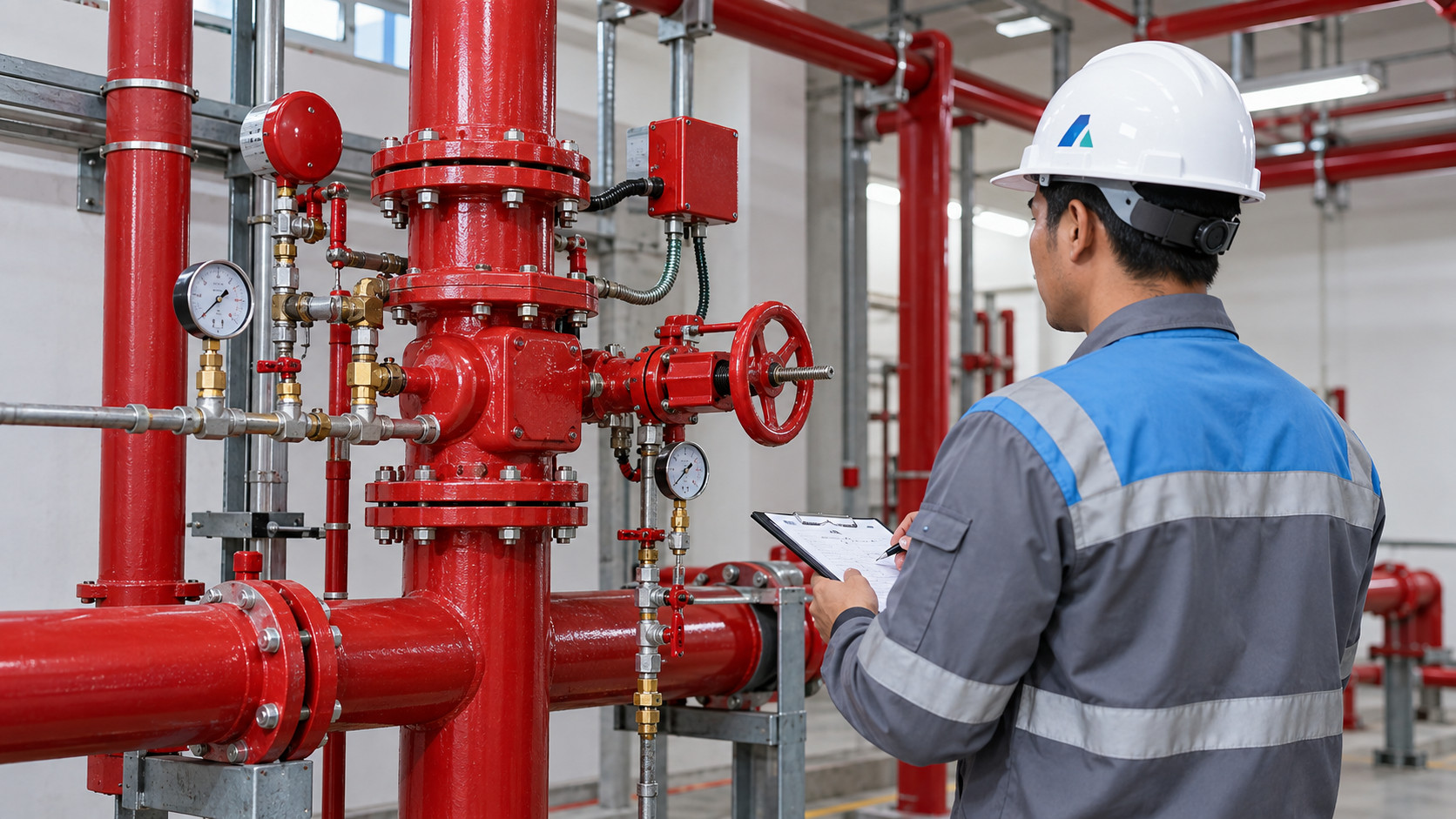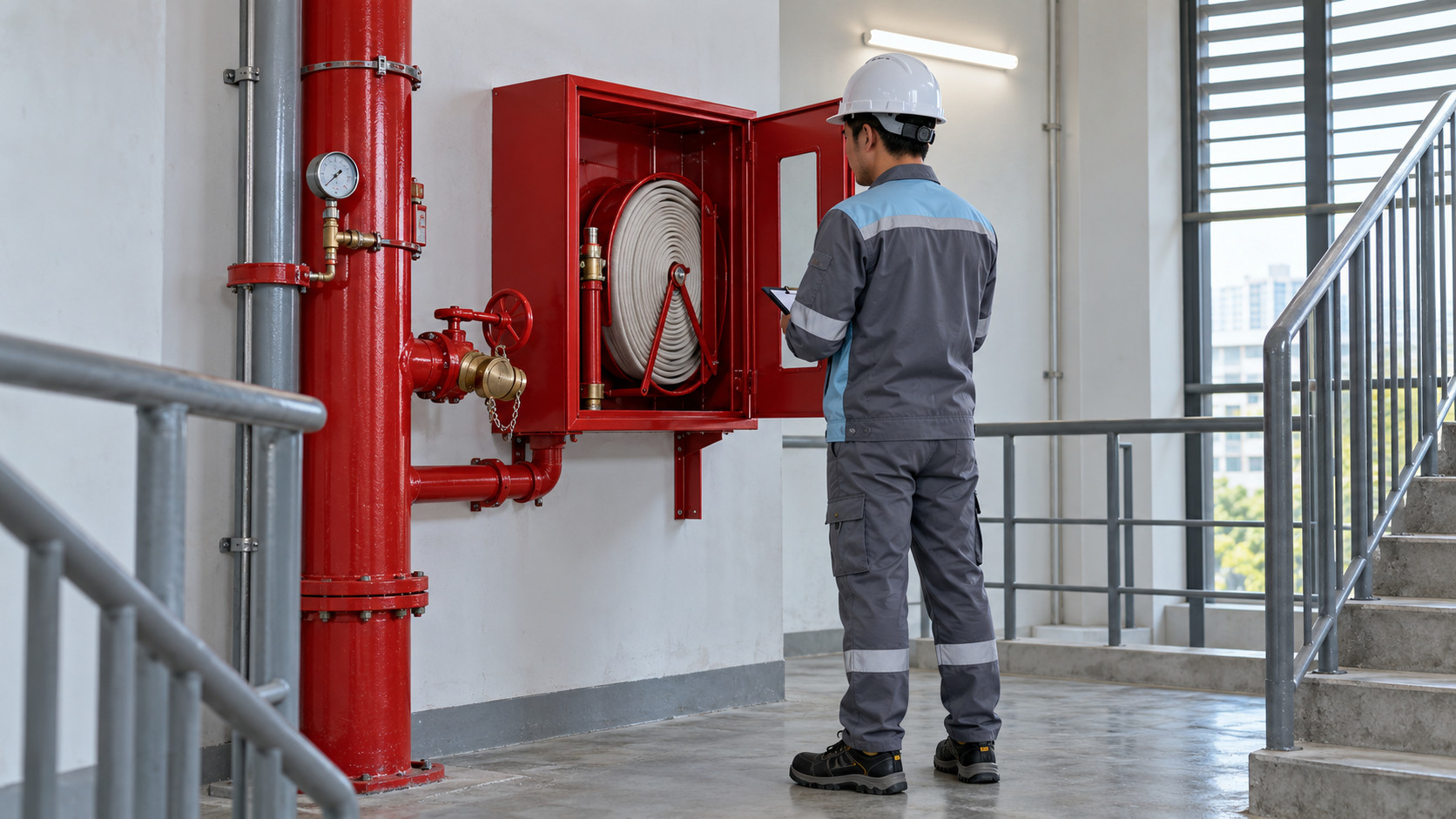


NFPA 14 hydrant system is a commonly used term in Indonesia for discussing building fire hydrant systems consisting of standpipes, hose connections or landing valves, piping networks, water supply, and other equipment used for manual firefighting.
However, one important terminology point should be clarified.
The official title of NFPA 14:2024 is Standard for the Installation of Standpipe and Hose Systems, rather than “Fire Hydrant Standard.” As of September 2026, NFPA LiNK lists the 2024 edition as the current NFPA 14 edition. The standard covers water supply, underground piping, system components, system requirements, installation, design, plans and calculations, acceptance, existing-system modifications, and inspection/testing/maintenance provisions.
Therefore, in Indonesian project terminology, NFPA 14 hydrant system is generally most accurate when referring to the indoor standpipe and hose system.
Outdoor private hydrants and private fire service mains, on the other hand, are more directly related to NFPA 24 — Standard for the Installation of Private Fire Service Mains and Their Appurtenances. NFPA LiNK lists the 2025 edition for NFPA 24.
This distinction is important because a complete fire-water network can include:
Fire Water Tank → Fire Pump → Ring Main → Outdoor Hydrant → Building Standpipe → Landing Valve / Hose Connection
while different sections of that network may fall under different technical standards.
Adiwarna provides integrated hydrant and sprinkler solutions that include hydrant valves, hydrant pillars, fire hoses, nozzles, siamese connections, and other water-based fire protection equipment.
Read Adiwarna’s Hydrant System guide
Quick Answer
An NFPA 14 hydrant system technically refers primarily to a standpipe and hose system designed to provide firefighting water through strategically located hose connections inside or around a building.
NFPA 14 recognizes Class I, Class II, and Class III arrangements with different intended hose connections and users. Class I and Class III systems support larger fire-department hose streams, while Class II systems are associated with smaller hose service for trained personnel or incipient-stage fire control.
Engineering must consider:
- standpipe class;
- system type;
- required pressure;
- required flow;
- hydraulic calculations;
- hose connection locations;
- fire department connection;
- fire pumps;
- pressure zoning;
- water supply;
- testing and commissioning.
For Indonesian projects, NFPA 14 should also be coordinated with SNI 03-1745-2000, which BSN currently lists with status Berlaku or active.
View SNI 03-1745-2000 through BSN
What Is an NFPA 14 Hydrant System?
In NFPA terminology, the system is a standpipe and hose system.
A standpipe is a piping network designed to deliver a water supply to hose connections installed at strategic locations throughout a building.
A simplified arrangement is:
Water Source
↓
Fire Pump
↓
Fire-Water Main
↓
Standpipe / Riser
↓
Hose Connection / Landing Valve
↓
Fire Hose & Nozzle
The objective is to provide firefighting personnel with accessible water outlets without requiring very long hoses to be stretched from outside the building.
Why Is It Commonly Called a Hydrant System in Indonesia?
In Indonesian construction practice, the term “hydrant system” commonly includes several components together:
- fire water tank;
- fire pump;
- hydrant piping;
- indoor hydrant box;
- landing valve;
- fire hose;
- nozzle;
- hydrant pillar;
- siamese connection;
- outdoor ring main.
Adiwarna’s English hydrant article describes the system similarly, including fire pumps, piping, hydrant outlets, hydrant boxes or pillars, hose/nozzle equipment, and siamese connections.
From an engineering perspective, however, this complete system may involve several standards.
A clearer design basis would state:
Building standpipe / hose connections → NFPA 14
Fire pumps → NFPA 20
Private fire service mains & outdoor hydrants → NFPA 24
Inspection, testing & maintenance → NFPA 25
This approach is more precise than simply writing:
“Hydrant system according to NFPA.”
NFPA 14 Hydrant System vs Outdoor Fire Hydrant
This distinction is important for design and specification.
NFPA 14
NFPA 14 primarily addresses:
- standpipes;
- building risers;
- hose stations;
- hose connections;
- landing valves;
- standpipe fire department connections;
- building pressure zones;
- standpipe hydraulic design.
NFPA 14:2024 contains dedicated chapters for water supply, system components, system requirements, installation, design, calculations, acceptance, and modifications to existing systems.
NFPA 24
NFPA 24 addresses private fire service infrastructure such as:
- private fire service mains;
- private hydrants;
- underground piping;
- valves;
- hydraulic calculations;
- building service connections.
The 2025 edition includes dedicated requirements for underground piping, hydraulic calculations, system testing, and hydrant-related infrastructure.
Therefore, when a project has outdoor hydrant pillars on a fire-water ring main, the engineer should not rely on NFPA 14 alone.
Classes in an NFPA 14 Hydrant System
One of the key concepts in an NFPA 14 hydrant system is standpipe classification.
The traditional classifications are:
- Class I;
- Class II;
- Class III.
Class I Standpipe System
Class I systems provide 2½-inch hose connections intended primarily for fire-department use and structural firefighting operations.
They are designed to support larger fire streams and professional firefighting.
In multi-story buildings, these connections are typically positioned at strategic locations to support fire-department operations.
Class II Hose / Standpipe System
Class II traditionally uses a smaller hose station, commonly associated with 1½-inch hose equipment, for trained personnel or early-stage fire control.
NFPA technical committee material has noted that Class II systems are intended for incipient-stage fire control rather than full interior structural firefighting.
Class III Standpipe System
Class III combines functions associated with Class I and Class II.
It can therefore provide:
- smaller hose service for trained personnel; and
- 2½-inch fire-department hose connections.
The required system class should not be selected based on contractor preference.
It should be determined by:
- adopted building/fire code;
- building use;
- fire strategy;
- AHJ;
- owner specification;
- project design basis.
NFPA 14 Hydrant System Class Comparison
| Parameter | Class I | Class II | Class III |
|---|---|---|---|
| Main hose connection | 2½ in. | Typically smaller hose service | Combination |
| Primary user | Fire department | Trained personnel / incipient response | Both |
| Typical purpose | Structural firefighting | Smaller fire stream | Combined capability |
| Building standpipe use | Very common | Limited / specific applications | Application-dependent |
| Hydraulic demand | Higher | Lower | Depends on required functions |
This table is an initial engineering overview only.
Final requirements must be determined from the applicable edition of NFPA 14 and the adopted building/fire code.
Types of NFPA 14 Hydrant System
Standpipe systems can also be classified based on how water is supplied to the piping.
Common configurations include:
- automatic wet;
- automatic dry;
- semiautomatic dry;
- manual wet;
- manual dry.
Automatic Wet Standpipe
An automatic wet system normally remains filled with water and has an automatically available water supply.
When a hose valve is opened:
Hose Valve Opens → Water Is Immediately Available
This configuration is highly relevant in tropical environments because freezing is generally not a concern.
Automatic Dry Standpipe
In an automatic dry system, the piping is normally filled with pressurized air rather than water.
Water enters after the system operates.
This arrangement is most relevant where freezing or other environmental conditions make wet piping unsuitable.
Semiautomatic Dry Standpipe
A semiautomatic dry system has a water supply available but requires activation of a remote-control device before water enters the piping.
Manual Wet Standpipe
The piping contains water, but full system demand may depend on fire-department pumping through the fire department connection according to the system design.
Manual Dry Standpipe
The standpipe piping remains dry and relies on fire-department apparatus through the FDC to provide the required firefighting water.
The correct system type depends on factors such as:
- building height;
- local fire-department capability;
- climate;
- system reliability requirements;
- adopted codes.
Pressure in an NFPA 14 Hydrant System
Pressure is one of the most important parameters in standpipe engineering.
For modern Class I and Class III standpipe applications, a commonly referenced NFPA 14 design criterion is 100 psi minimum residual pressure at the required remote hose outlet condition. NFSA’s standpipe guidance also summarizes 100 psi as the modern minimum hose-outlet pressure for systems designed under post-1993 NFPA 14 editions.
However, a standpipe design should never be reduced to one pressure value.
The engineer must also consider:
- elevation;
- pipe friction;
- fittings;
- pipe length;
- simultaneous flow;
- fire-pump curve;
- pressure zoning;
- pressure-regulating equipment.
Static Pressure vs Residual Pressure
Suppose a pressure gauge shows high pressure while no water is flowing.
That is static pressure.
When one or more hose outlets are flowing, pressure can decrease because of:
- friction losses;
- elevation head;
- flow through valves and fittings;
- simultaneous demand.
Therefore, actual system capability must be assessed by verifying residual pressure while the required flow is being delivered, not by checking only a static pressure gauge.
Adiwarna also explains pressure and flow as core factors in hydrant-system performance.
Flow Requirements in an NFPA 14 Hydrant System
Hydraulic flow demand depends on:
- standpipe class;
- number of standpipes;
- building configuration;
- sprinkler protection;
- adopted code and NFPA edition.
NFSA summarizes a common modern Class I/Class III standpipe design condition as 500 gpm for the most remote standpipe, with additional demand for additional standpipes according to applicable requirements.
That does not mean every building has exactly the same total demand.
Actual total flow can depend on:
- number of standpipes;
- building sprinkler protection;
- building size;
- horizontal standpipe arrangements;
- system configuration.
For this reason, the correct flow must be established through a hydraulic calculation for the actual project.
Hydraulic Calculation for an NFPA 14 Hydrant System

An NFPA 14 hydrant system should be hydraulically analyzed.
The calculation links:
Water Supply
↓
Fire Pump
↓
Main Pipe
↓
Standpipe
↓
Hydraulically Remote Hose Connection
Typical calculation inputs include:
- design flow;
- pipe size;
- pipe material;
- pipe length;
- fittings;
- elevation;
- valve losses;
- backflow devices where applicable;
- pump performance;
- FDC arrangement.
Hydraulically Remote Hose Connection
The hydraulically remote outlet is not always simply the outlet farthest away horizontally.
In high-rise buildings, elevation becomes a major part of the hydraulic calculation.
Higher outlets require additional pressure at the supply to overcome elevation head.
This is why standpipe engineering for tall buildings cannot be performed reliably using pipe-size rules alone.
NFPA 14 Hydrant System for High-Rise Buildings
High-rise buildings require careful pressure management.
As building height increases:
- elevation loss increases;
- fire-pump discharge pressure increases;
- lower-level pressure can become excessive;
- pressure zoning may become necessary.
The design may use:
- multiple pressure zones;
- separate pumps;
- intermediate tanks;
- pressure-regulating valves;
- zone-specific risers;
- multiple FDC arrangements.
NFPA 14:2024 specifically contains design and calculation requirements for standpipe systems and pressure management.
Pressure Zoning in an NFPA 14 Hydrant System
Pressure zoning is used to manage the large pressure differences that can occur in tall buildings.
A simplified arrangement might be:
Low Zone
↓
Middle Zone
↓
High Zone
Each zone may have its own:
- water supply strategy;
- fire pump;
- PRV arrangement;
- riser;
- FDC arrangement.
Without proper zoning, two opposite problems can occur:
Upper floors → insufficient residual pressure
while
Lower floors → excessive pressure
Engineering must therefore maintain suitable operating conditions throughout the building.
Fire Pumps in an NFPA 14 Hydrant System
Fire pumps provide the required pressure and flow when the available water supply cannot meet system demand on its own.
The principal installation reference for stationary fire pumps is NFPA 20, rather than NFPA 14.
A typical fire pump set may include:
- jockey pump;
- electric main fire pump;
- diesel fire pump;
- fire pump controller.
The actual arrangement depends on the approved design.
Jockey Pump Function
The jockey pump maintains normal system pressure and compensates for small pressure losses or leakage.
It is not the main firefighting pump.
Adiwarna’s English jockey pump page explains that the jockey pump is a low-capacity pressure-maintenance pump used in hydrant and sprinkler networks so minor pressure losses do not repeatedly start the main fire pump.
Learn about Adiwarna Jockey Pumps
Main Fire Pump
During a significant system demand:
System Pressure Drops
↓
Main Fire Pump Starts
↓
Required Flow and Pressure Are Delivered
Pump selection should be based on the calculated standpipe demand.
A larger pump does not automatically create a better system.
NFPA 14 Hydrant System and Fire Department Connection
A Fire Department Connection (FDC) allows the fire department to supplement or supply water to the building fire-protection system using a fire apparatus pump.
In Indonesian terminology, related equipment is often called:
- siamese connection;
- breeching inlet;
- fire brigade connection.
The terminology and actual configuration should follow the approved system design.
Adiwarna’s hydrant and sprinkler product range includes siamese connections alongside hydrant valves, fire hoses, and other fire-water equipment.
View Adiwarna Hydrant & Sprinkler Products
The FDC is especially important in manual or partially fire-department-supplied standpipe arrangements.
Hose Connection Locations in an NFPA 14 Hydrant System
Hose connections should be positioned to support actual firefighting operations.
Potential locations may include:
- exit stairs;
- stair landings;
- horizontal exits;
- building levels;
- roof areas;
- other locations required by adopted codes.
Placement depends on:
- building geometry;
- stair configuration;
- fire-department access;
- code requirements;
- AHJ requirements.
Therefore, hose-connection placement should not be based only on a simplified rule such as:
“One hydrant box every X meters.”
Accessibility is also important. NFSA notes that the 2024 edition of NFPA 14 clarified several visibility and clearance considerations around hose connections.
NFPA 14 Hydrant System and Indoor Hydrant Boxes
In Indonesian projects, indoor hydrant boxes commonly contain equipment such as:
- landing valve;
- fire hose;
- nozzle;
- hose rack or reel;
- selected accessories.
However, box contents must reflect:
- the standpipe class;
- intended users;
- local regulatory requirements;
- fire strategy.
A Class I fire-department connection is not functionally identical to a smaller Class II hose station.
Therefore, hydrant cabinets should be specified according to the actual design basis rather than simply copied from a product catalog.
NFPA 14 Hydrant System and Outdoor Hydrant Pillars
Outdoor hydrant pillars generally form part of the private fire-water distribution network.
From a standards perspective, these systems are more closely connected with NFPA 24 than with NFPA 14.
NFPA 24 covers private fire service mains and appurtenances, including hydrant-related infrastructure and hydraulic calculations.
Adiwarna’s Hydrants & Sprinklers range also includes hydrant pillars, valves, hoses, nozzles, and siamese connections for fire-water networks.
NFPA 14 Hydrant System and NFPA 24
A practical way to understand the relationship is:
NFPA 24
primarily supports:
Water Source → Yard Fire Main → Private Hydrant → Building Connection
while NFPA 14 focuses on:
Building Supply → Standpipe → Hose Connection
Large industrial facilities may therefore use both standards in the same fire-water project.
NFPA 14 Hydrant System and NFPA 20
The relationship with NFPA 20 can be represented as:
NFPA 14 establishes standpipe demand
↓
Hydraulic calculation determines required flow and pressure
↓
NFPA 20 governs fire-pump installation
This means fire pump selection should follow the system demand.
The design should not start by selecting a pump and then attempting to make the system fit that pump.
NFPA 14 Hydrant System and NFPA 13
Many buildings have both:
- automatic sprinklers; and
- standpipes.
These systems may share:
- fire-water supply;
- pumps;
- common infrastructure;
- combined risers in some configurations.
Engineering must therefore coordinate:
- NFPA 13 sprinkler demand;
- NFPA 14 standpipe demand;
- combined hydraulic conditions;
- pump capacity;
- pressure management.
The Adiwarna NFPA 13 content discusses hazard classification, hydraulic calculations, water supply, sprinkler selection, and fire-pump coordination as part of sprinkler-system engineering.
NFPA 14 Hydrant System and NFPA 25
Fire-water system readiness does not end after commissioning.
NFPA 25 — Standard for the Inspection, Testing, and Maintenance of Water-Based Fire Protection Systems addresses lifecycle inspection, testing, and maintenance for water-based fire protection systems. The current 2026 edition is documented by NFPA.
A simple distinction is:
NFPA 14 → Design & installation of standpipe/hose systems
NFPA 25 → Inspection, testing & maintenance during service life
Hydrant or standpipe systems that are installed but rarely tested can develop problems such as:
- seized valves;
- leakage;
- low pressure;
- piping obstruction;
- degraded hoses;
- fire pump problems;
- incorrect valve positions.
NFPA 14 Hydrant System and SNI 03-1745-2000
For Indonesian projects, a key national reference is:
SNI 03-1745-2000 — Procedure for planning and installing standpipe and hose systems for fire prevention in buildings.
BSN currently lists this standard with status Berlaku.
NFPA 14 or SNI?
The better question is not:
“Should we use NFPA or SNI?”
Instead:
“What is the approved regulatory and engineering design basis for this project?”
Engineers should evaluate:
- Indonesian regulations;
- SNI;
- owner specifications;
- insurer requirements;
- consultant specifications;
- AHJ requirements;
- contract requirements.
Any conflict should be resolved through a clearly documented design basis before construction begins.
NFPA 14 Hydrant System for Commercial Buildings
Typical applications include:
- office towers;
- hotels;
- shopping malls;
- hospitals;
- mixed-use developments;
- apartments;
- public buildings.
Design considerations include:
- building height;
- stair configuration;
- floor layout;
- fire-department access;
- water supply;
- hose connection locations.
A high-rise office tower will require a different engineering approach from a small commercial building.
NFPA 14 Hydrant System for Hospitals
Hospitals create additional operational challenges because they contain:
- occupants with limited mobility;
- continuous operations;
- high-dependency areas;
- complex compartmentation.
The hydrant or standpipe system should coordinate with:
- fire compartments;
- stairways;
- fire alarms;
- smoke-management systems;
- evacuation strategy.
Water-based fire protection should therefore be treated as part of the broader building fire strategy.
NFPA 14 Hydrant System for Industrial Facilities
Industrial facilities may contain:
- large floor areas;
- high fire loads;
- process hazards;
- warehouses;
- outdoor yards;
- storage tanks.
The hydrant network may integrate with:
- private fire mains;
- outdoor hydrants;
- fire monitors;
- foam systems;
- fire pumps;
- deluge systems;
- sprinklers.
Adiwarna’s English fire-protection-services page identifies fire pumps, fire-water tanks, hydrant pillars, hydrant boxes, hoses, nozzles, landing valves, pressure gauges, and fire brigade connections as important parts of hydrant infrastructure.
Explore Adiwarna Fire Protection Services
NFPA 14 Hydrant System for Warehouses
Warehouse protection often focuses heavily on sprinklers, but hydrant and standpipe infrastructure may still be an important part of manual firefighting operations.
Design review can consider:
- building area;
- building height;
- storage arrangement;
- aisles;
- rack layout;
- firefighter access;
- outdoor fire-water infrastructure.
Large warehouse complexes may also require NFPA 24-based outdoor fire-water networks.
NFPA 14 Hydrant System for High-Rise Buildings
High-rise buildings are among the most demanding standpipe applications.
Engineers must evaluate:
- highest hose outlet;
- elevation head;
- required residual pressure;
- simultaneous flow;
- pump capacity;
- pressure zones;
- FDC arrangement;
- system redundancy where required.
In high-rise systems, pressure management can be more critical than simply increasing pipe diameter.
Testing an NFPA 14 Hydrant System

After installation, the standpipe or hydrant system must be tested.
Testing can include:
- hydrostatic testing;
- flushing;
- hose-valve operation;
- flow testing;
- residual-pressure measurement;
- fire-pump integration;
- FDC verification;
- supervisory or alarm interfaces where applicable.
The purpose is not simply to obtain a “PASS” result.
Measured performance should be compared with:
- approved hydraulic calculations;
- approved drawings;
- acceptance criteria;
- applicable standards.
Commissioning an NFPA 14 Hydrant System
Commissioning evaluates whether the entire fire-water chain works correctly.
A simplified operational test may be:
Hose Valve Opens
↓
System Pressure Drops
↓
Fire Pump Responds
↓
Required Flow and Residual Pressure Become Available
↓
Pump Status / System Indication Is Verified
Testing results should then become part of the owner’s technical baseline.
Adiwarna provides testing and commissioning services for fire protection equipment including sprinklers, fire pumps, smoke detection, and related integrated systems.
Read about Adiwarna Testing & Commissioning Services
NFPA 14 Hydrant System Design Checklist
Before design approval, verify:
- Applicable NFPA 14 edition identified
- SNI/local requirements identified
- Standpipe class determined
- System type determined
- Building height confirmed
- Floor plans available
- Hose connection locations reviewed
- Fire-department access reviewed
- FDC arrangement defined
- Water-supply data available
- Hydraulic calculation completed
- Required system flow verified
- Required residual pressure verified
- Fire pump selection reviewed
- Pressure zoning reviewed
- Pipe sizing completed
- Valve arrangement completed
- NFPA 24/outdoor hydrant interface reviewed
- NFPA 13 sprinkler interface reviewed
- Testing procedure prepared
- Handover documentation planned
Existing NFPA 14 Hydrant System Checklist
For an existing facility, review:
- As-built drawings available
- Standpipe class identified
- Hose connections accessible
- Hose valves operable
- Hose and nozzle condition acceptable
- Main fire pump operational
- Jockey pump operational
- Pressure gauges serviceable
- Fire-water tank adequate
- FDC accessible
- Signage clear
- Flow testing performed
- Residual pressure measured
- Pressure-regulating equipment inspected
- Hydrant points free of obstruction
- NFPA 25 maintenance records available
- Building modifications reviewed
Common NFPA 14 Hydrant System Mistakes
Treating NFPA 14 as the Standard for Every Hydrant Component
NFPA 14 primarily addresses standpipe and hose systems.
Private outdoor hydrants and yard fire mains are more closely related to NFPA 24.
Checking Static Pressure Only
High static pressure does not prove that adequate pressure remains at the required firefighting flow.
Skipping Hydraulic Calculations
Large piping alone does not guarantee system performance.
Selecting the Fire Pump Before Calculating Demand
The pump should be selected from calculated hydraulic requirements.
Ignoring Elevation
This can create major problems in high-rise buildings.
Treating the FDC as an Afterthought
The FDC is part of the fire department’s operating strategy and should be coordinated early.
Placing Hydrant Boxes Only by Distance
Outlet location should reflect actual firefighting access and building layout.
Skipping Flow Testing
A visually complete system has not proven that it can provide the required flow and pressure.
How to Choose an NFPA 14 Hydrant System Contractor
An NFPA 14 hydrant system contractor should provide more than piping installation.
Evaluate whether the contractor can:
- Interpret NFPA 14 and applicable SNI.
- Determine standpipe class.
- Perform hydraulic calculations.
- Determine required fire-pump performance.
- Engineer pressure zoning.
- Coordinate NFPA 20 requirements.
- Coordinate NFPA 24 outdoor infrastructure.
- Coordinate sprinkler systems.
- Produce coordinated shop drawings.
- Perform flow and pressure testing.
- Perform commissioning.
- Produce as-built documentation.
- Provide maintenance recommendations.
Adiwarna provides integrated fire-protection scope covering engineering, equipment supply, installation, testing and commissioning, and maintenance. Its English website identifies Hydrants & Sprinklers as one of its main fire-protection product categories.
NFPA 14 Hydrant System by Adiwarna
PT Adiwarna Anugerah Abadi Tbk can support a hydrant and standpipe project through:
Site Survey
↓
Design Basis Review
↓
NFPA 14 / SNI Assessment
↓
Hydraulic Calculation
↓
Fire Pump Selection
↓
Shop Drawings
↓
Equipment Supply & Installation
↓
Testing & Commissioning
↓
Maintenance
Adiwarna’s product range includes fire-hydrant valves, hydrant pillars, hoses, nozzles, siamese connections, control equipment, and related water-based protection products.
View Adiwarna Hydrant & Sprinkler Products
FAQ About NFPA 14 Hydrant System
What Is an NFPA 14 Hydrant System?
An NFPA 14 hydrant system generally refers to a standpipe and hose system designed using NFPA 14 as a principal technical reference.
Its purpose is to provide firefighting water at strategically located hose connections inside or around a building.
Is NFPA 14:2024 the Current Edition?
Yes. As of September 2026, NFPA LiNK lists NFPA 14:2024 — Standard for the Installation of Standpipe and Hose Systems as the current edition.
What Is the Difference Between NFPA 14 and NFPA 24?
NFPA 14 primarily addresses standpipe and hose systems.
NFPA 24 addresses private fire service mains and appurtenances, including private hydrant infrastructure.
What Is a Class I Standpipe?
Class I provides larger hose connections, typically 2½-inch connections, for fire-department structural firefighting operations.
What Is a Class II System?
Class II is associated with smaller hose service intended for trained personnel or incipient-stage fire control rather than full structural firefighting.
What Is a Class III Standpipe?
Class III combines fire-department hose capability with smaller hose-service functions.
What Pressure Is Required for an NFPA 14 Hydrant System?
For modern Class I/Class III standpipe design conditions, 100 psi minimum hose-outlet pressure is a commonly referenced NFPA 14 criterion. Actual required pressure must still be confirmed for the specific system configuration and applicable edition.
What Is the NFPA 14 Flow Requirement?
A common Class I/Class III design basis begins with 500 gpm for the hydraulically remote standpipe, with additional flow for additional standpipes according to applicable requirements. Total system demand depends on the actual building and system configuration.
Does an Outdoor Hydrant Pillar Fall Under NFPA 14?
Not primarily.
Private outdoor hydrants are generally more closely associated with NFPA 24, while building standpipes and hose connections fall under NFPA 14.
What Indonesian Standard Applies to Building Standpipes and Hoses?
A key standard is SNI 03-1745-2000, which BSN currently lists as active.
Should an Existing Hydrant System Be Flow Tested?
Yes.
Actual flow and residual pressure are important indicators of whether the system can deliver its intended firefighting performance.
Consult Adiwarna for NFPA 14 Hydrant System Engineering
An NFPA 14 hydrant system is much more than a combination of pipes, hydrant cabinets, hoses, landing valves, and pumps.
Engineering should connect:
Building Requirement
→ Standpipe Class
→ Required Flow & Pressure
→ Hydraulic Calculation
→ Fire Pump
→ Pressure Zoning
→ FDC
→ Testing & Commissioning
PT Adiwarna Anugerah Abadi Tbk can support:
- site surveys;
- hydrant engineering;
- NFPA/SNI review;
- hydraulic calculations;
- fire-pump coordination;
- shop drawings;
- equipment supply;
- standpipe/hydrant installation;
- flow and pressure testing;
- commissioning;
- preventive maintenance.
For a preliminary engineering review, prepare:
- building layout;
- number of floors;
- building height;
- existing hydrant layout;
- fire-water tank data;
- fire-pump data;
- previous pressure/flow results;
- applicable project specifications.
Contact Adiwarna for Hydrant and Standpipe Consultation
Conclusion
An NFPA 14 hydrant system provides the main engineering framework for building standpipe and hose systems.
The current NFPA 14 edition is 2024, covering areas including water supply, system components, installation, design, plans and calculations, system acceptance, modifications to existing systems, and system inspection/testing/maintenance.
Key concepts include:
- Class I;
- Class II;
- Class III;
- standpipe system type;
- residual pressure;
- required flow;
- hydraulic calculations;
- fire department connections;
- high-rise pressure zoning;
- fire-pump coordination.
However, NFPA 14 should not be treated as the only standard governing the entire hydrant network.
NFPA 20 is relevant to stationary fire pumps, NFPA 24 to private fire service mains and outdoor hydrants, and NFPA 25 to lifecycle inspection, testing, and maintenance. NFPA’s current NFPA 25 documentation identifies the 2026 edition.
For Indonesian projects, SNI 03-1745-2000 is also directly relevant and remains listed as active by BSN.
With a clear design basis, correct hydraulic calculations, appropriate fire pumps, pressure management, testing, and commissioning, a hydrant and standpipe system can provide dependable firefighting water when it is actually needed.