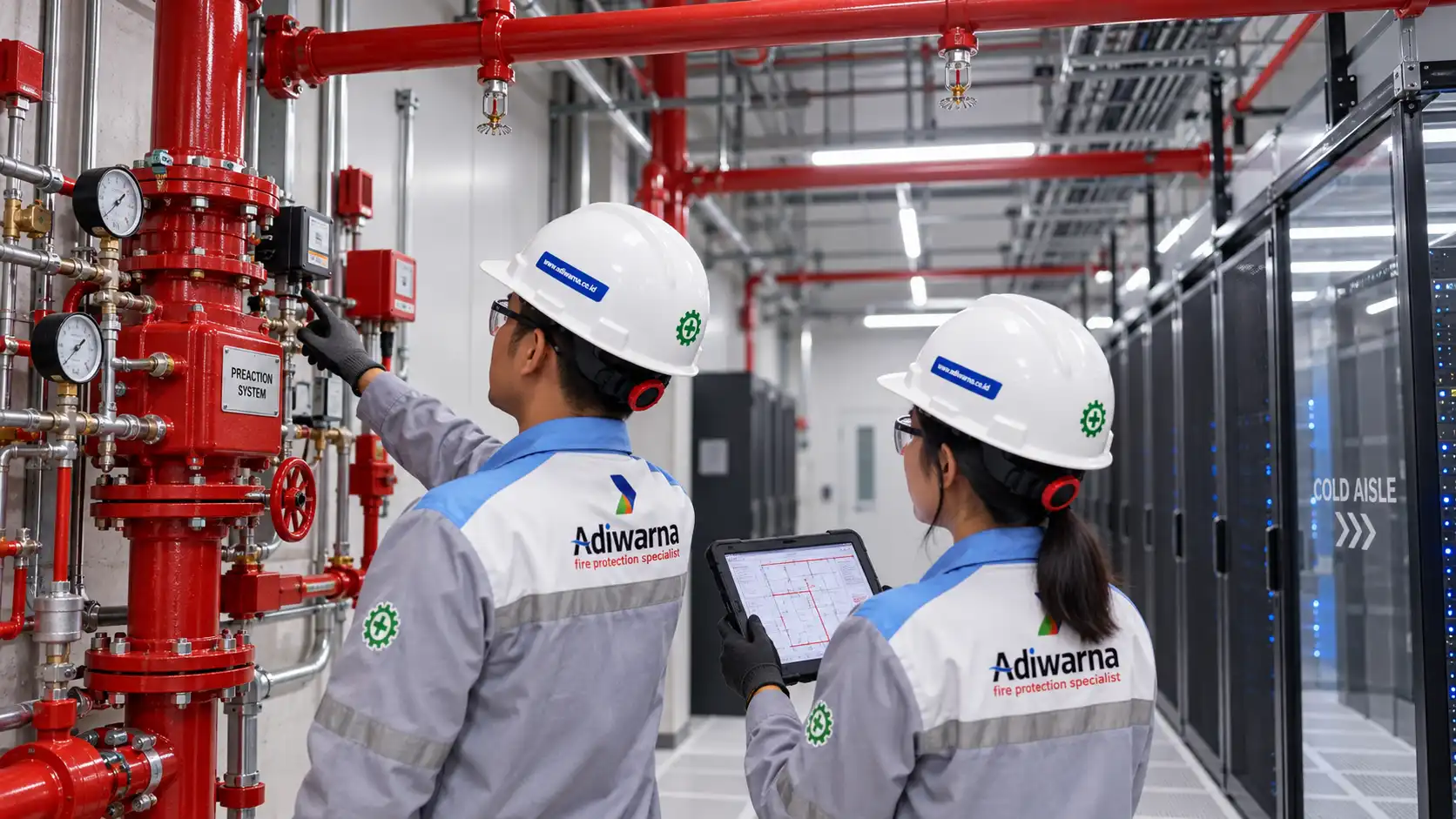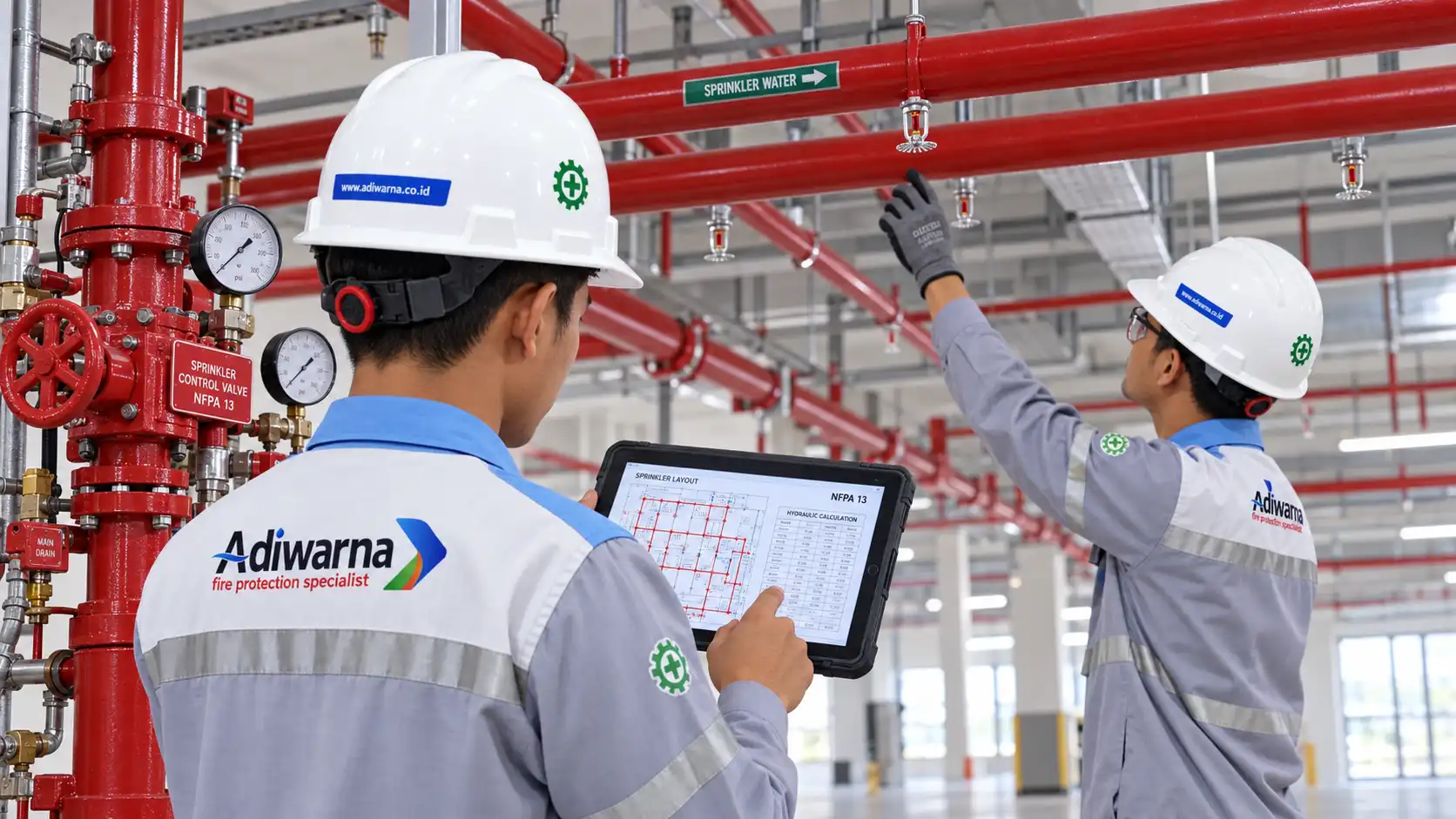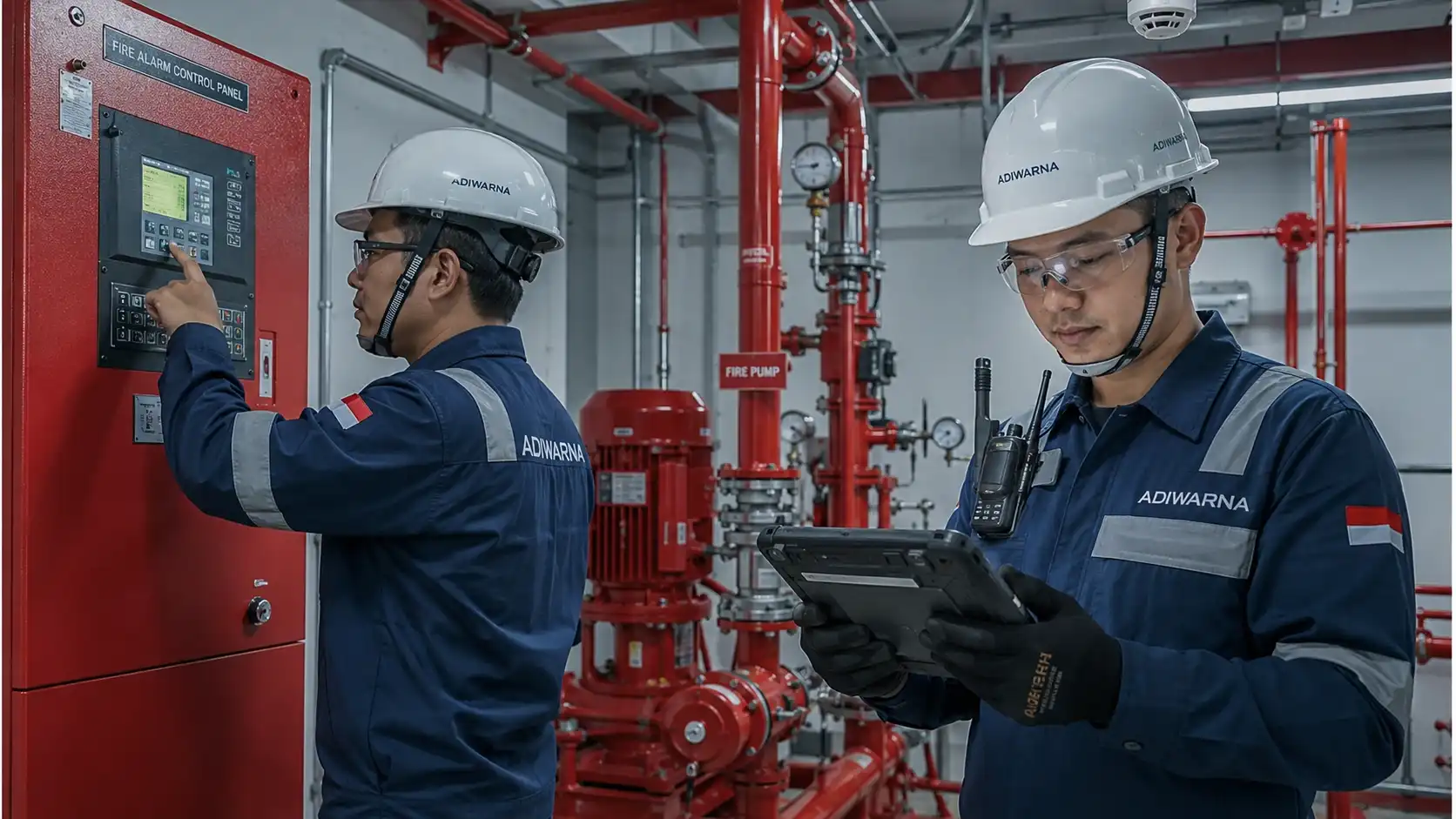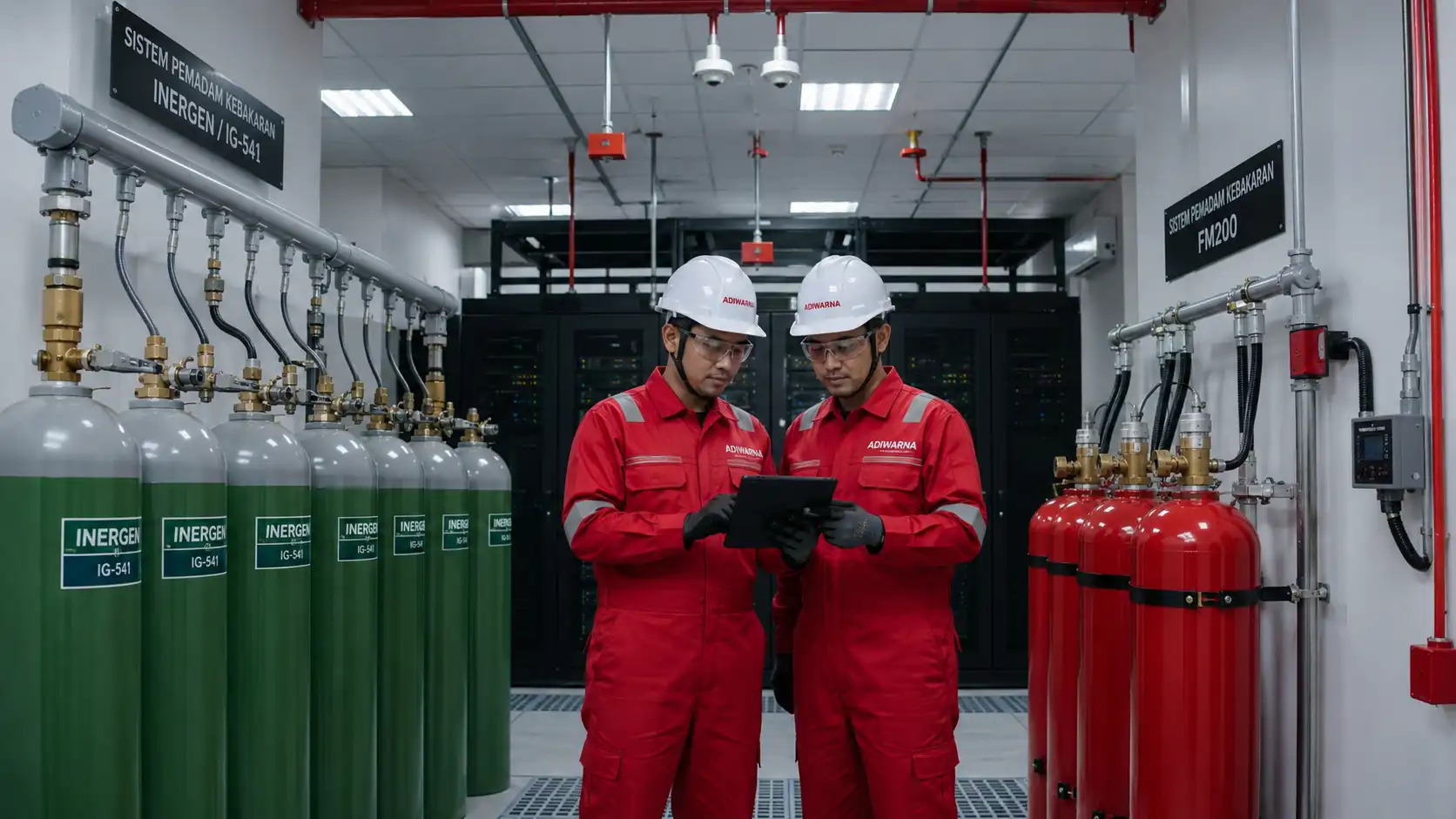

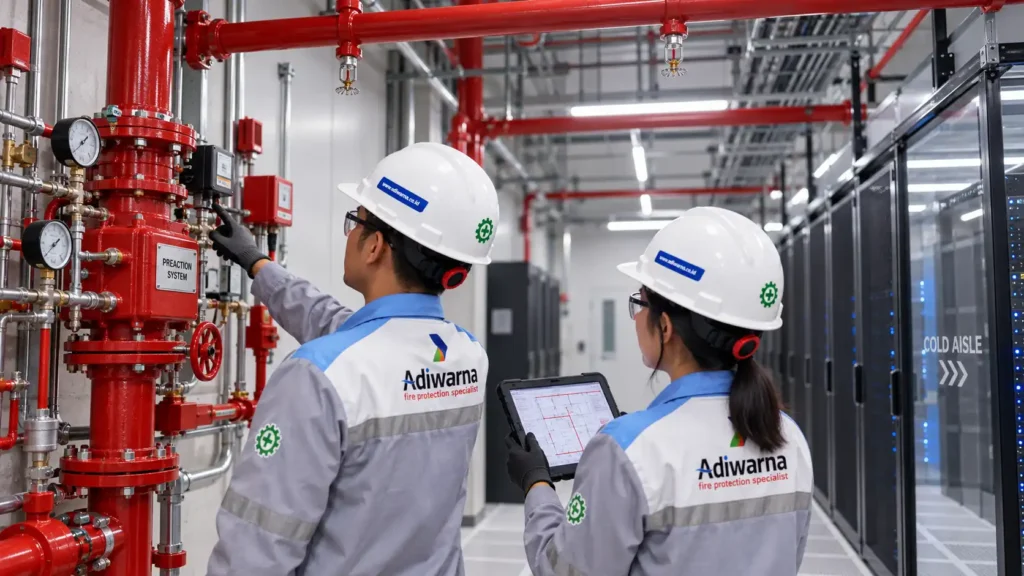
Preaction sprinkler data center systems are a water-based fire protection solution frequently considered for server rooms and mission-critical IT facilities because they provide an additional control layer before water enters the sprinkler piping.
Unlike a conventional wet pipe sprinkler system, where the downstream piping is continuously filled with water, a preaction system normally holds the water supply behind a preaction valve. Detection logic and sprinkler operation then determine when water is allowed into the piping, depending on the selected system configuration.
This concept is particularly relevant in data centers because these facilities contain:
- server equipment;
- network infrastructure;
- storage systems;
- UPS systems;
- electrical distribution;
- data cabling;
- cooling equipment;
- high-value electronic assets.
However, a preaction sprinkler data center system does not mean a data center is “water-free,” nor does it mean sprinklers can never discharge.
Preaction remains a water-based fire protection system.
Its purpose is to reduce the likelihood of unintended water entry while preserving the ability of the sprinkler system to deliver water when an actual fire condition requires it.
As of 2026, NFPA 13:2025 — Standard for the Installation of Sprinkler Systems is the current edition of NFPA 13. NFPA 75:2024 — Standard for the Fire Protection of Information Technology Equipment is also an important reference for IT equipment areas and data centers.
Adiwarna also discusses pre-action sprinkler protection as an option for data centers and other sensitive facilities.
Read Adiwarna’s NFPA 13 Sprinkler System guide
Quick Answer
A preaction sprinkler data center system is an automatic sprinkler system that uses a preaction valve and fire detection logic to control when water is allowed to enter the sprinkler piping.
In a single interlock system, operation of the detection system opens the preaction valve and allows water into the piping. Water is then discharged only if an automatic sprinkler subsequently operates.
In a double interlock system, two conditions are generally required before the preaction valve opens: operation of the detection system and a sprinkler-related pressure condition indicating sprinkler operation.
This additional control can reduce the risk of unintended water entering a data center sprinkler network. However, the design must also ensure that the additional logic does not create unacceptable delay in water delivery.
What Is a Preaction Sprinkler Data Center System?
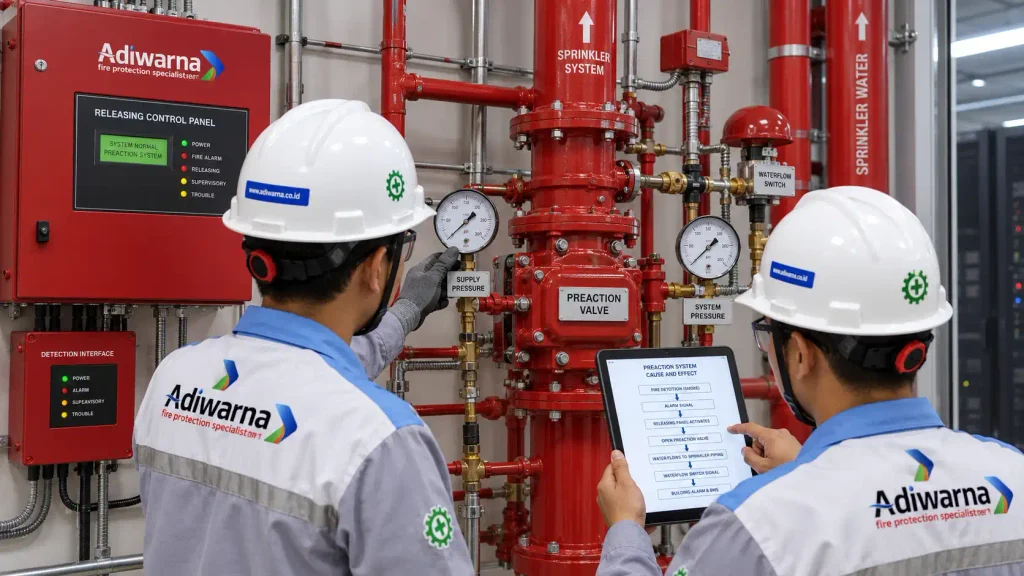
A preaction sprinkler data center system is an automatic sprinkler arrangement in which the water supply is held back by a preaction valve until defined release conditions are satisfied.
Typical components may include:
- preaction valve;
- closed automatic sprinklers;
- sprinkler piping;
- fire detection system;
- releasing control panel;
- supervisory air or nitrogen;
- pressure switches;
- waterflow switch;
- control valves;
- fire alarm interfaces;
- fire pump and water supply where required.
The major preaction configurations commonly discussed are:
- single interlock;
- non-interlock;
- double interlock.
The correct system type should be selected through engineering analysis rather than by assuming that one configuration is always superior.
Important factors include:
- fire risk;
- permissible water-delivery time;
- system reliability;
- accidental activation risk;
- system complexity;
- insurer requirements;
- AHJ requirements;
- overall fire strategy.
Why Use Preaction Sprinkler Data Center Protection?
Data centers have an unusual risk profile because water damage can create significant operational consequences.
An unwanted water event can potentially cause:
- server shutdown;
- short circuits;
- equipment damage;
- service interruption;
- IT infrastructure outages;
- business continuity impacts.
For this reason, a preaction system introduces an additional control layer between the available water supply and the protected sprinkler piping.
However, this additional control must always be balanced against the primary fire-protection objective:
Water must still reach the sprinklers quickly enough when a genuine fire occurs.
A system that becomes too complex or too slow may reduce its effectiveness during an actual fire event.
Adiwarna’s English data center fire suppression article also treats sprinkler protection as one part of a broader layered strategy that may include detection, alarms, suppression systems, HVAC control, and system integration.
Read Adiwarna’s Data Center Fire Suppression System guide
Preaction Sprinkler Data Center vs Wet Pipe Sprinkler
The major difference lies in the normal condition of the piping and the way water enters the system.
| Parameter | Wet Pipe | Preaction |
|---|---|---|
| Normal piping condition | Filled with water | Normally not filled with water |
| Separate detection system | Not required for basic sprinkler operation | Required depending on configuration |
| Water entry into piping | Water already present | Controlled by preaction valve |
| Sprinkler type | Closed | Closed |
| Water discharge | When sprinkler operates | After release logic is satisfied and sprinkler operates |
| Exposure to accidental piping leakage | Higher | Can be reduced |
| Complexity | Lower | Higher |
| Typical critical application | General buildings | Data centers and water-sensitive areas |
Wet pipe systems provide simplicity and rapid availability of water.
Preaction systems provide greater protection against unintended water entry, but they also add:
- detection;
- releasing controls;
- valve logic;
- supervision;
- additional commissioning requirements.
Therefore, preaction is not automatically “safer” in every respect. Its suitability depends on the project.
Single Interlock Preaction Sprinkler Data Center
In a single interlock preaction sprinkler data center system, the detection system is typically the event that opens the preaction valve.
A simplified sequence is:
Smoke or Fire Detection
↓
Releasing Panel
↓
Preaction Valve Opens
↓
Water Enters Sprinkler Piping
However, the room does not automatically receive sprinkler discharge.
Water discharge still requires the sprinkler’s heat-responsive element to operate:
Sprinkler Operates
↓
Water Discharges from That Sprinkler
Advantages of Single Interlock
Potential advantages include:
- faster water availability after detection;
- less water-delivery delay than double interlock;
- simpler logic than double interlock;
- reduced exposure to normal piping leakage compared with wet pipe.
Limitations of Single Interlock
If the fire detection system falsely activates, the preaction valve can open and fill the piping with water.
The sprinklers may remain closed, but once the piping becomes wet, a mechanical leak or damaged sprinkler could still result in water release.
For this reason, the quality of detection and releasing logic remains critical.
Double Interlock Preaction Sprinkler Data Center
A double interlock preaction sprinkler data center system requires two separate conditions before the preaction valve opens.
Conceptually:
Fire Detection Condition
+
Sprinkler Operation / Supervisory Pressure Loss
↓
Preaction Valve Opens
This makes double interlock attractive in water-sensitive facilities because a single false detection event generally will not fill the sprinkler piping.
Advantages of Double Interlock
Potential benefits include:
- additional protection against unwanted water entry;
- lower probability that a single false alarm will wet the piping;
- suitability for selected critical IT environments.
Typical applications may include:
- data halls;
- network rooms;
- server rooms;
- selected control rooms;
- mission-critical technology facilities.
Limitations of Double Interlock
The additional interlock can also introduce:
- longer water-delivery time;
- more control components;
- more complex troubleshooting;
- additional maintenance;
- increased commissioning scope.
For that reason, double interlock should not automatically be selected for every data center.
The engineering team must balance asset protection against sprinkler response time.
Double Interlock Is Not the Same as Two Smoke Detectors
This distinction is important.
A common misunderstanding is:
“Double interlock means two smoke detectors must operate.”
That is not the fundamental meaning of double interlock preaction.
Cross-zone detection may require two detection signals for a particular output, but double interlock relates to the combination of detection and sprinkler/system pressure conditions before the preaction valve opens.
Therefore:
Cross-Zone Detection ≠ Double Interlock Preaction
The distinction matters when preparing:
- specifications;
- shop drawings;
- panel programming;
- cause-and-effect matrices;
- commissioning procedures.
Non-Interlock Preaction System
Non-interlock is another preaction configuration.
In this arrangement, water can enter the sprinkler piping when either:
- the detection system operates; or
- sprinkler operation produces the relevant pressure condition.
Its operating characteristics therefore differ from both single and double interlock systems.
For critical IT facilities, the choice should be based on an approved engineering design rather than generic preference.
Preaction Sprinkler Data Center Is Not a Clean Agent System
Preaction sprinklers and clean agent systems are sometimes incorrectly treated as interchangeable.
They serve different roles.
Preaction Sprinkler
Uses:
Water-based fire suppression
It remains part of the automatic sprinkler protection strategy.
Clean Agent or Inert Gas
Uses gaseous extinguishing agents such as:
- inert gas;
- IG-541 / Inergen;
- other approved clean agents.
These systems can suppress fire without leaving water residue on sensitive electronic equipment.
Many data centers use a layered protection strategy, not just one technology.
For example:
Early Warning Detection
↓
Fire Alarm
↓
Clean Agent / Inert Gas Suppression
+
Preaction Sprinkler Protection
Adiwarna’s data center fire protection content also describes a layered strategy involving detection, alarm, clean agent or inert gas suppression, sprinkler protection, and integrated controls.
NFPA 13 for Preaction Sprinkler Data Center Design
NFPA 13:2025 is the current edition of NFPA 13 as of 2026.
NFPA 13 is a primary reference for topics such as:
- sprinkler-system type;
- preaction arrangements;
- sprinkler selection;
- piping;
- water supply;
- hydraulic calculations;
- supervision;
- testing;
- acceptance.
However, engineers should still use the edition required by the project, which may be based on:
- contract documents;
- adopted codes;
- AHJ requirements;
- insurer criteria;
- owner standards.
The newest published edition does not automatically replace the edition adopted by a project.
NFPA 75 for Preaction Sprinkler Data Center Applications
Data centers also have a more specialized fire-protection reference:
NFPA 75 — Standard for the Fire Protection of Information Technology Equipment.
The current edition is NFPA 75:2024.
NFPA 75 addresses broader fire protection considerations for IT equipment and IT equipment areas.
Therefore:
NFPA 13 → sprinkler system design and installation
while
NFPA 75 → broader fire protection considerations for IT environments
The two documents can complement one another when developing a data center fire strategy.
NFPA 72 and Preaction Sprinkler Data Center Integration
Detection and releasing controls are fundamental parts of many preaction systems.
NFPA 72:2025 — National Fire Alarm and Signaling Code is the current edition of NFPA 72.
Relevant fire alarm engineering may include:
- initiating devices;
- releasing control;
- signal supervision;
- alarm;
- supervisory conditions;
- trouble conditions;
- interface control;
- documentation;
- testing.
This means a preaction sprinkler project should not be treated as a piping-only project.
Detection, valve control, releasing logic, fire alarm interfaces, and supervision must all be coordinated.
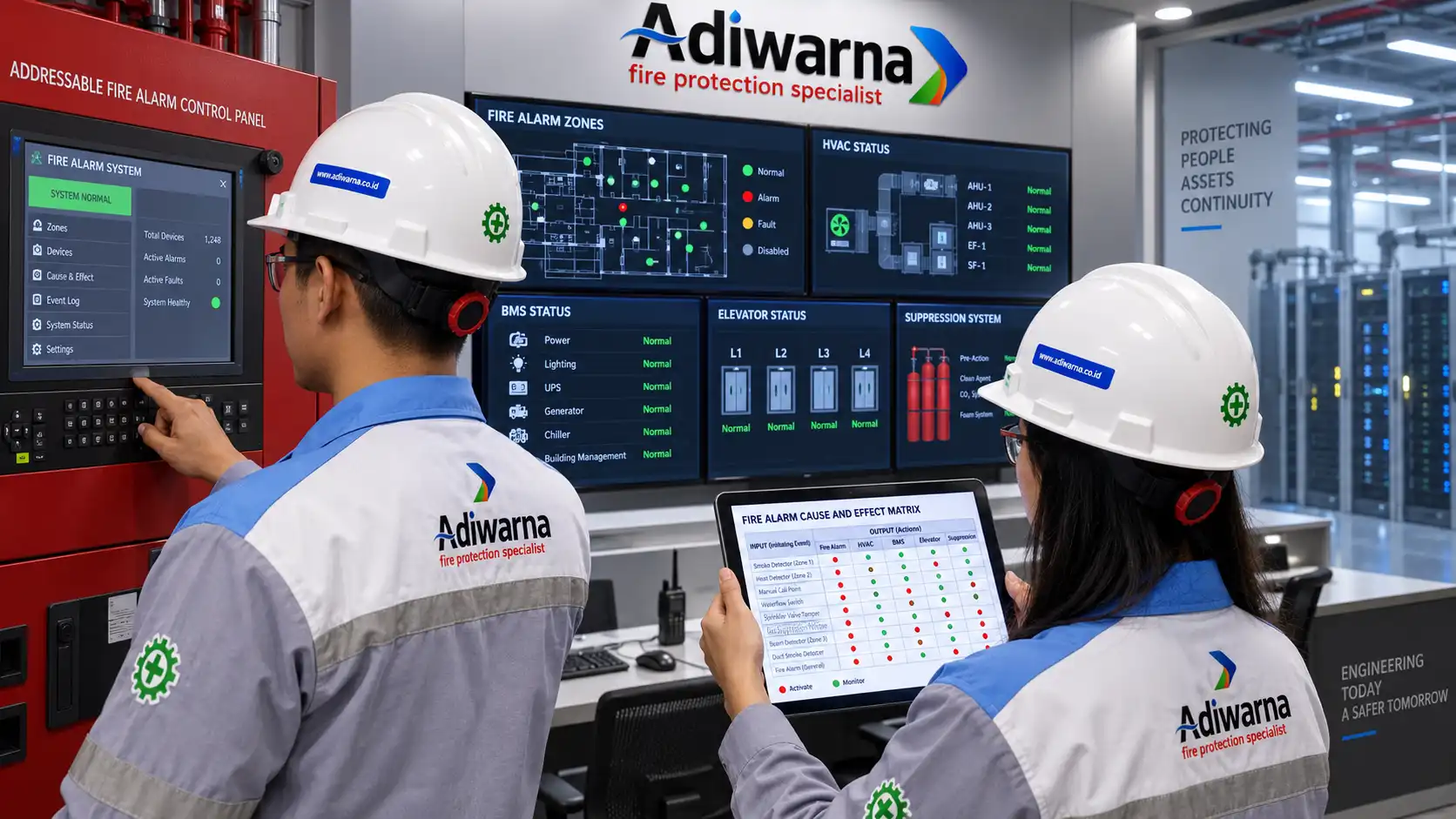
Cause and Effect for Preaction Sprinkler Data Center
Preaction sprinkler data center operation depends heavily on a correct cause-and-effect sequence.
A simplified example:
| Cause | Preaction Valve | Fire Alarm | BMS/DCIM | Waterflow |
|---|---|---|---|---|
| Smoke Detection | According to interlock type | Alarm | Signal | No |
| Low Supervisory Pressure | According to logic | Supervisory | Signal | No |
| Sprinkler Operates | According to interlock type | According to logic | Signal | After water arrives |
| Valve Opens | Open status | Status | Status | — |
| Waterflow | — | Alarm | Alarm | Active |
The actual matrix must correspond to the selected:
- single interlock configuration;
- double interlock configuration;
- detection system;
- releasing panel;
- BMS/DCIM interface;
- approved fire strategy.
Adiwarna has a dedicated English guide covering fire alarm cause-and-effect logic, including HVAC, BMS, sprinkler, and suppression interfaces.
Read Cause and Effect Fire Alarm
Detection for Preaction Sprinkler Data Center Systems
Data centers can use different levels of fire detection sensitivity.
Detection technologies may include:
- spot-type smoke detectors;
- aspirating smoke detection;
- heat detection for selected applications;
- multi-criteria detectors.
Detection design is particularly important because high airflow from data center cooling systems can change smoke movement.
Engineers should therefore consider:
- air velocity;
- return-air paths;
- hot aisles;
- cold aisles;
- containment;
- ceiling configuration;
- raised floors;
- rack layout;
- detector sensitivity.
Aspirating Detection and Preaction Sprinkler Data Center
Aspirating smoke detection is often used for very early warning.
However, an early warning signal should not automatically be treated as a preaction release signal.
An aspirating system may provide several alarm levels, for example:
Alert
↓
Action
↓
Fire 1
↓
Fire 2
The fire protection engineer must determine which level:
- alerts operations personnel;
- generates a BMS/DCIM signal;
- creates a fire alarm;
- becomes part of the preaction release sequence.
This prevents both excessive sensitivity and unnecessary delay.
Preaction Sprinkler Data Center Hydraulic Calculation
A preaction system remains an automatic sprinkler system.
Therefore, hydraulic performance remains essential.
The calculation may consider:
- water supply;
- sprinkler K-factor;
- pipe diameter;
- pipe length;
- elevation;
- design area;
- pressure loss;
- fire pump performance;
- sprinkler demand.
The preaction valve and the system configuration must also be included in the hydraulic design.
A wet-pipe hydraulic calculation should not simply be copied into a preaction system without evaluating the actual arrangement.
For additional background, Adiwarna’s English NFPA 13 article covers sprinkler hydraulic design, hazard classification, K-factor, water supply, and acceptance.
Read NFPA 13 Sprinkler System: Design, Standards & Checklist
Preaction Sprinkler Data Center and Fire Pumps
The preaction system must still have sufficient water supply.
The supply may include:
- dedicated fire water tank;
- acceptable municipal source;
- fire pump;
- approved combined arrangement.
The system can be viewed as:
Water Supply
↓
Fire Pump
↓
Preaction Valve
↓
Distribution Piping
↓
Automatic Sprinklers
A fire pump does not compensate for incorrect sprinkler design.
Water supply, pump performance, valve losses, piping, and sprinkler demand must be analyzed as one hydraulic network.
Preaction Sprinkler Data Center and Supervisory Air
Many preaction systems use compressed air or nitrogen to supervise the downstream sprinkler piping.
Depending on the system design, supervisory pressure can help:
- identify piping leakage;
- detect sprinkler operation;
- contribute to double-interlock logic;
- monitor system integrity.
The required pressure should not be selected arbitrarily.
Engineers should follow:
- listed valve-system requirements;
- manufacturer instructions;
- NFPA requirements;
- approved project design.
Preaction Sprinkler Data Center and Corrosion
A preaction piping system may experience both dry and wet conditions during its lifecycle.
Corrosion can be influenced by:
- residual water;
- oxygen;
- condensation;
- trapped moisture;
- poor drainage;
- piping slope;
- repeated testing.
Therefore, a piping system described as “dry” should not automatically be assumed to be moisture-free.
Proper drainage and installation details remain important.
Preaction Sprinkler Data Center and Raised Floors
Raised floors can contain:
- electrical cables;
- network cables;
- power distribution;
- airflow routes;
- combustible materials.
The engineering team should determine whether the underfloor space:
- forms part of the protected space;
- has meaningful combustible loading;
- requires detection;
- requires sprinkler protection;
- requires gaseous suppression.
The presence of a raised floor alone does not determine the required protection.
Actual hazard conditions should be evaluated.
Preaction Sprinkler Data Center and Ceiling Voids
The same principle applies to ceiling voids.
Important considerations include:
- cables;
- cable trays;
- electrical infrastructure;
- airflow;
- combustible materials;
- physical separation.
Protection requirements should be based on the actual void construction and contents.
Preaction Sprinkler Data Center and Hot Aisle / Cold Aisle Containment
Modern data centers frequently use:
- cold aisle containment;
- hot aisle containment;
- chimney racks;
- high-density rack arrangements.
Containment can influence:
- smoke movement;
- heat movement;
- detector response;
- sprinkler discharge patterns.
For this reason, the fire protection layout should ideally be coordinated before the IT rack and containment arrangement becomes final.
Fire protection design cannot be separated from the airflow strategy.
Obstruction in Preaction Sprinkler Data Center Design
Data centers contain large amounts of overhead infrastructure.
Potential sprinkler obstructions include:
- cable trays;
- busway;
- cooling piping;
- HVAC ducts;
- lighting;
- containment structures;
- structural members.
Sprinkler coordination should therefore involve:
- fire protection;
- mechanical;
- electrical;
- IT;
- architectural;
- structural teams.
This is especially important because rack and MEP layouts frequently change during construction.
Preaction Sprinkler Data Center and BMS / DCIM
BMS or DCIM platforms may receive statuses such as:
- fire alarm;
- preaction valve open;
- valve normal;
- low supervisory pressure;
- waterflow;
- pump running;
- system trouble.
However, BMS/DCIM should not automatically replace the dedicated fire alarm and releasing functions required by the design.
Integrated testing should verify:
- correct point mapping;
- correct location text;
- correct signal type;
- correct priority;
- correct reset behavior;
- correct status updates.
Preaction Sprinkler Data Center and Gaseous Suppression
Preaction sprinkler protection can coexist with gaseous fire suppression.
A layered approach might look like:
Very Early Smoke Detection
↓
Fire Alarm
↓
Clean Agent / Inert Gas Suppression
↓
Preaction Sprinkler Remains Available as Water-Based Backup Protection
However, the exact sequence should not be assumed to be universal.
It can vary according to:
- owner requirements;
- insurer requirements;
- applicable codes;
- data-center tier or resilience objectives;
- criticality;
- suppression design.
Adiwarna provides clean agent and inert gas fire suppression solutions for data centers in addition to water-based fire protection.
Can Preaction Sprinkler Data Center Replace Clean Agent?
Not necessarily.
The two systems provide different forms of protection.
Preaction Sprinkler
Potential strengths include:
- established water-based fire control;
- localized sprinkler activation;
- building-level fire protection;
- robust long-term protection.
Clean Agent / Inert Gas
Potential strengths include:
- no water residue;
- suitability for sensitive electronics;
- rapid room-level suppression;
- lower secondary cleanup burden after discharge.
Therefore, the engineering question is often not:
“Which one should we eliminate?”
but rather:
“Which combination of protection layers is appropriate for this facility?”
Is Double Interlock Always Better for Data Centers?
No.
Double interlock can reduce the risk of unintended water entering the piping.
However, it also introduces additional release conditions before water becomes available.
The engineering team must therefore balance:
Water-damage concern
against:
Fire-response and water-delivery time
A more complex system is not automatically a better system.
Testing a Preaction Sprinkler Data Center System
Testing should demonstrate that every major subsystem operates correctly.
The scope may include:
- detector functional testing;
- releasing panel testing;
- supervisory pressure testing;
- preaction valve trip testing;
- waterflow-switch testing;
- valve supervisory testing;
- trouble-condition testing;
- fire alarm interface testing;
- BMS/DCIM interface testing;
- fire pump integration.
Testing should not be reduced to manually operating the preaction valve.
The objective is to verify the complete system response.
Commissioning a Preaction Sprinkler Data Center System
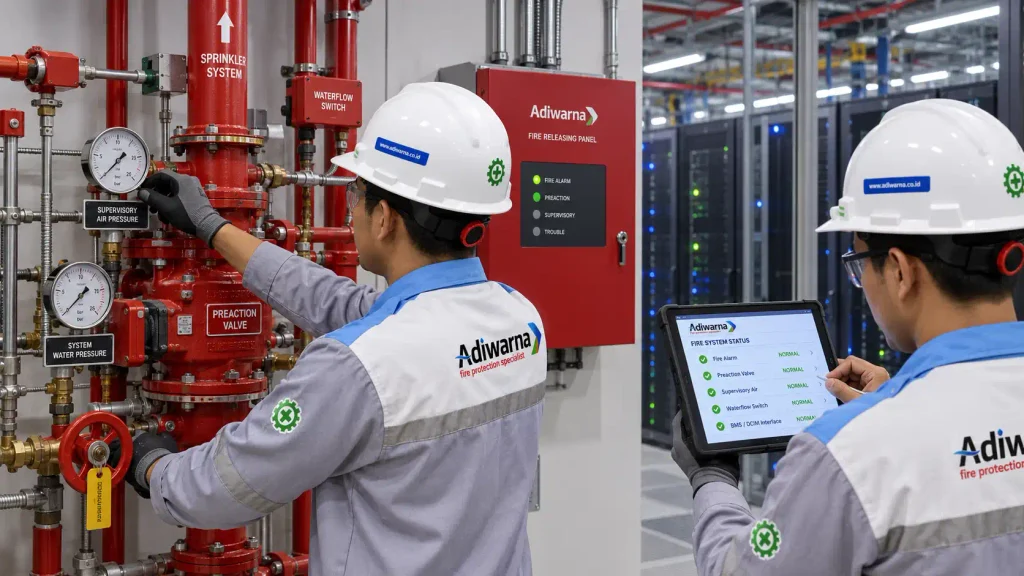
A preaction sprinkler data center requires integrated commissioning because multiple systems depend on one another.
For example:
Detector Activated
↓
Fire Alarm / Releasing Panel
↓
Preaction Logic
↓
Valve Operation
↓
Piping Condition Changes
↓
Waterflow
↓
Fire Alarm / BMS/DCIM Indication
For a double interlock system, the required sprinkler/pressure condition must also be verified.
Adiwarna’s English commissioning guide describes integrated testing involving fire alarm, sprinklers, fire pumps, BMS, HVAC, and suppression systems.
Read Testing Commissioning Fire Protection
Preaction Sprinkler Data Center Cause-and-Effect Checklist
Before final integrated testing, verify:
- Preaction system type is documented
- Single/double interlock logic is clear
- Detection inputs are defined
- Releasing panel programming is complete
- Supervisory air/nitrogen status is correct
- Preaction valve status is monitored
- Valve-release conditions are verified
- Waterflow alarm is tested
- Tamper switch is tested
- Trouble signal is verified
- Fire alarm interface is verified
- BMS/DCIM mapping is verified
- Fire pump status is verified
- Reset procedure is tested
- Deficiencies are documented
- Corrective actions are completed
- Retesting is performed
Preaction Sprinkler Data Center Design Checklist
Before design approval, review:
- Applicable NFPA 13 edition
- Applicable NFPA 75 requirements
- Local code and standards
- Data hall layout
- Rack configuration
- Raised floor
- Ceiling void
- Hot/cold aisle containment
- Cable tray obstruction
- Sprinkler type
- K-factor
- Hydraulic calculations
- Water supply
- Fire pump
- Preaction valve
- Detection technology
- Releasing logic
- Cause-and-effect matrix
- BMS/DCIM interface
- Clean agent / inert gas coordination
- Testing procedure
- Handover requirements
Common Preaction Sprinkler Data Center Mistakes
Assuming Preaction Is a Dry, Non-Water System
Preaction is still water-based fire protection.
Treating Double Interlock as Two Detectors
Double interlock is not defined simply by two smoke-detector signals.
Adding Excessive Detection Logic
Overly complicated logic can introduce unnecessary delay.
Ignoring Hydraulic Performance
The preaction valve and sprinkler network must still satisfy hydraulic demand.
Ignoring Rack and Cable Tray Obstructions
IT infrastructure can interfere with sprinkler discharge.
Treating Fire Alarm as a Separate System
Fire detection and release controls are fundamental to preaction operation.
Stopping Testing at the Relay
A relay changing state does not prove the final valve, pump, BMS, or system response actually occurred.
Existing Preaction Sprinkler Data Center Systems
An existing data center should be reviewed when major changes occur, including:
- additional racks;
- higher-density IT loads;
- hot/cold aisle changes;
- raised-floor modifications;
- cooling-system redesign;
- additional cable trays;
- fire alarm replacement;
- BMS/DCIM upgrades;
- preaction valve replacement;
- fire pump modification.
Even if sprinkler piping remains unchanged, modifications to IT infrastructure can affect the protection strategy.
Preaction Sprinkler Data Center Maintenance
Preaction systems contain more components than basic wet pipe systems.
Maintenance may need to include:
- preaction valve;
- releasing control panel;
- detectors;
- supervisory air/nitrogen supply;
- pressure switches;
- waterflow switches;
- control valves;
- sprinkler piping;
- sprinkler heads;
- fire alarm interfaces.
Therefore, preventive maintenance should evaluate the complete integrated system, not only the sprinkler heads.
NFPA 25 is an important lifecycle reference for inspection, testing, and maintenance of water-based fire protection systems, while NFPA 13 primarily addresses design and installation.
How to Choose a Preaction Sprinkler Data Center Contractor
A preaction sprinkler data center contractor should understand both water-based fire protection and detection/releasing controls.
Evaluate whether the provider can:
- Perform data-center fire-risk assessment.
- Interpret NFPA 13.
- Understand NFPA 75 requirements.
- Perform hydraulic calculations.
- Design preaction valve arrangements.
- Select appropriate interlock configuration.
- Integrate fire alarm systems.
- Develop cause-and-effect matrices.
- Integrate BMS/DCIM.
- Perform functional testing.
- Perform integrated commissioning.
- Produce as-built documentation.
- Support preventive maintenance.
A contractor that understands piping but not releasing logic can create significant coordination risk.
Preaction Sprinkler Data Center by Adiwarna
PT Adiwarna Anugerah Abadi Tbk provides integrated fire protection solutions that include sprinkler, fire alarm, fire suppression, testing, commissioning, and maintenance.
Adiwarna’s English sprinkler content specifically discusses pre-action sprinkler systems for data centers and water-sensitive facilities.
A typical workflow may be:
Site Survey
↓
Risk & Data Hall Review
↓
Design Basis
↓
Preaction Configuration Selection
↓
Hydraulic Calculation
↓
Detection & Cause-and-Effect
↓
Installation
↓
Testing
↓
Integrated Commissioning
↓
Handover
Explore Adiwarna Fire Protection Solutions
FAQ About Preaction Sprinkler Data Center
What Is a Preaction Sprinkler Data Center System?
A preaction sprinkler data center system is an automatic sprinkler arrangement that holds water behind a preaction valve until specified release conditions are satisfied.
It is commonly considered for water-sensitive and mission-critical IT facilities.
Is a Preaction Sprinkler System Water-Free?
No.
The downstream piping may normally be dry, but water remains the extinguishing medium.
What Is the Difference Between Single and Double Interlock?
Single interlock typically opens the preaction valve based on the detection system.
Double interlock generally requires both detection and a sprinkler/system pressure condition before the valve opens.
Does Double Interlock Mean Two Smoke Detectors?
No.
Two detection signals or cross-zone logic are not the same as double interlock preaction.
Is Preaction Suitable for Data Centers?
It can be highly suitable when unintended water entry is an important concern.
However, the final selection should be based on:
- risk assessment;
- code requirements;
- owner standards;
- insurer requirements;
- system response objectives.
Which Standards Apply to Preaction Sprinkler Data Center Systems?
Common references include:
- NFPA 13:2025;
- NFPA 75:2024;
- NFPA 72:2025;
- NFPA 25 for lifecycle inspection, testing, and maintenance;
- applicable local standards and regulations.
Does a Data Center Need Clean Agent if It Has Preaction Sprinklers?
It depends on the fire-protection strategy.
Preaction sprinkler and gaseous suppression can serve complementary roles rather than replacing one another.
Does Preaction Require a Fire Alarm System?
Detection and releasing controls are integral to many preaction configurations.
Therefore, the fire alarm and releasing logic must be properly engineered and supervised.
Does Preaction Require Hydraulic Calculations?
Yes.
A preaction system remains a sprinkler network and must satisfy the required hydraulic demand.
Does Preaction Need Periodic Testing?
Yes.
The valve, detection system, supervisory pressure, alarms, waterflow, fire pump interfaces, and controls should be tested and maintained according to applicable requirements.
Consult Adiwarna for Preaction Sprinkler Data Center Engineering
A preaction sprinkler data center should be designed as an integrated fire protection system, not merely as sprinkler piping connected to a valve.
The engineering process should connect:
Data Center Risk
→ Sprinkler Design
→ Hydraulic Calculation
→ Detection
→ Preaction Valve Logic
→ Fire Alarm
→ BMS/DCIM
→ Testing & Commissioning
PT Adiwarna Anugerah Abadi Tbk can support:
- data center fire-risk assessment;
- NFPA 13 sprinkler engineering;
- preaction design;
- hydraulic calculations;
- fire alarm integration;
- cause-and-effect;
- equipment supply;
- installation;
- testing;
- commissioning;
- preventive maintenance.
For a preliminary review, prepare:
- data hall layout;
- rack layout;
- raised-floor and ceiling details;
- fire alarm drawings;
- water-supply information;
- fire-pump data;
- existing fire strategy;
- project specifications.
Contact the Adiwarna team for preaction sprinkler and data center fire protection consultation
Conclusion
A preaction sprinkler data center system provides additional control compared with a conventional wet pipe sprinkler because water is not normally present throughout the downstream sprinkler piping.
However, the system should not be reduced to the idea of:
“a safer sprinkler for servers.”
Proper engineering must consider:
- single interlock;
- double interlock;
- detection logic;
- water delivery;
- hydraulic demand;
- sprinkler arrangement;
- fire alarm integration;
- BMS/DCIM;
- testing;
- commissioning.
NFPA 13:2025 provides the principal sprinkler design and installation framework, while NFPA 75:2024 addresses broader fire protection for IT equipment environments. NFPA 72:2025 is relevant to detection and releasing interfaces.
With appropriate engineering, a preaction system can become an important layer within a comprehensive data center fire protection strategy while still working alongside early detection, fire alarms, gaseous suppression, emergency response, and business-continuity planning.