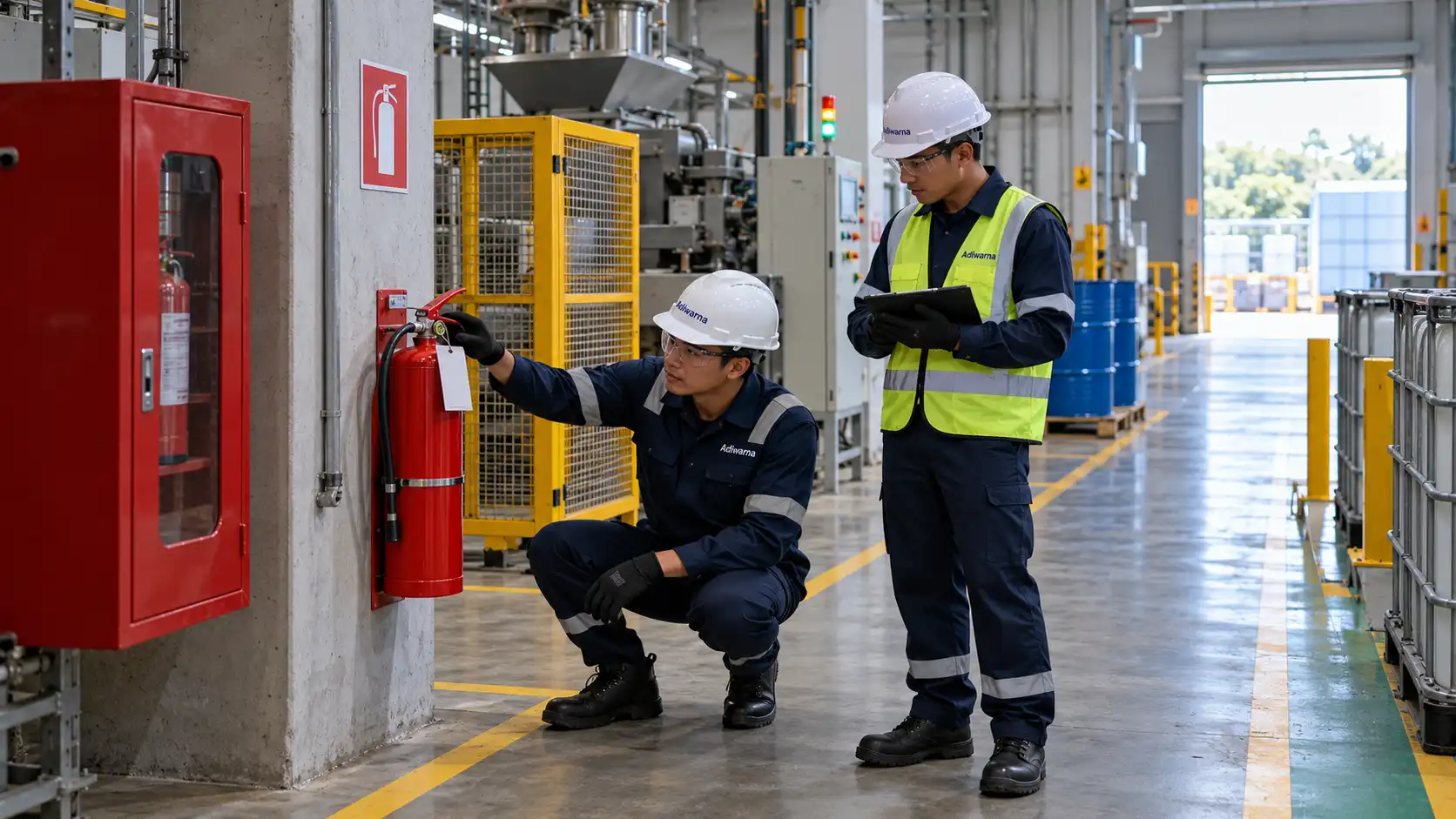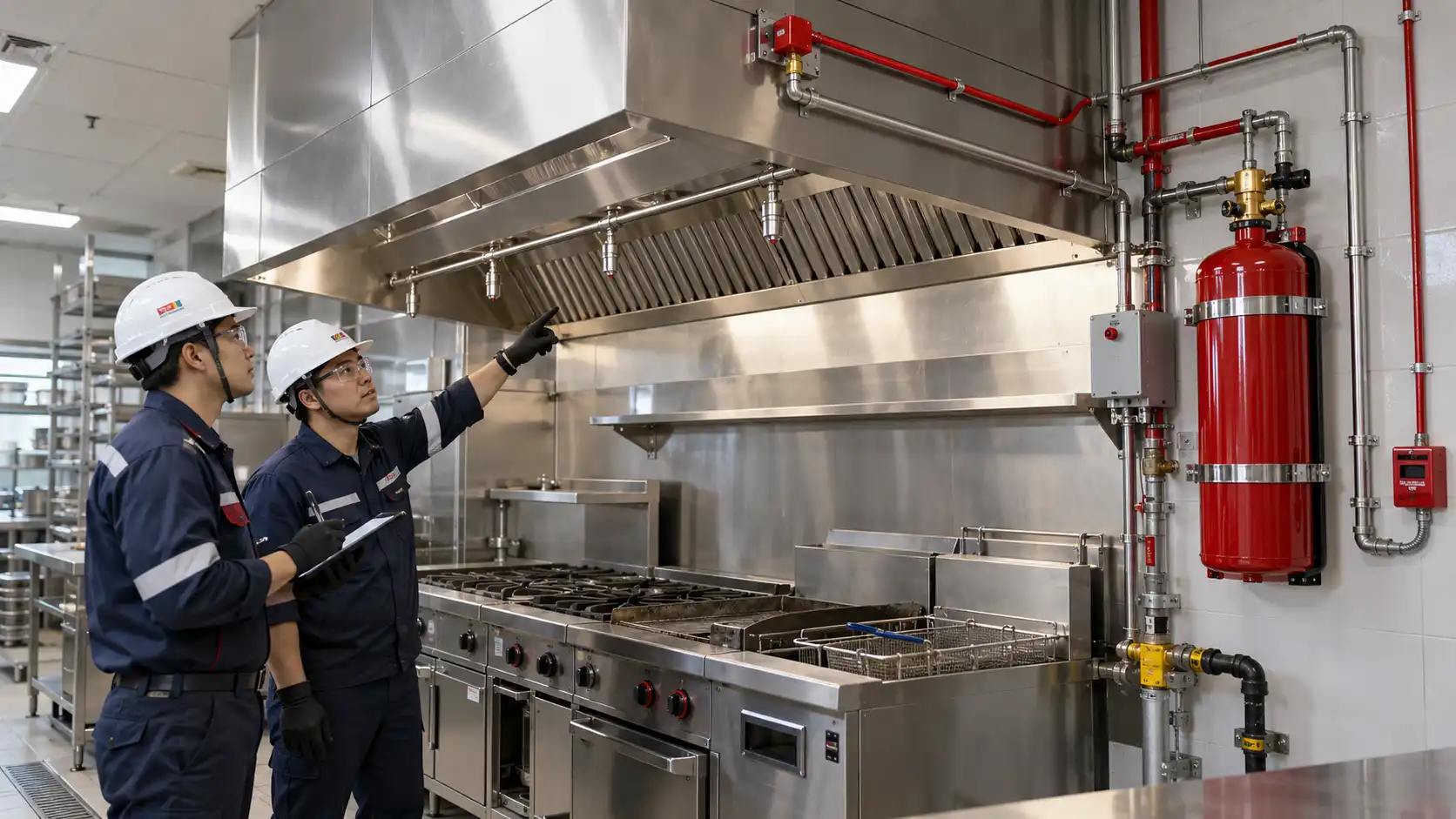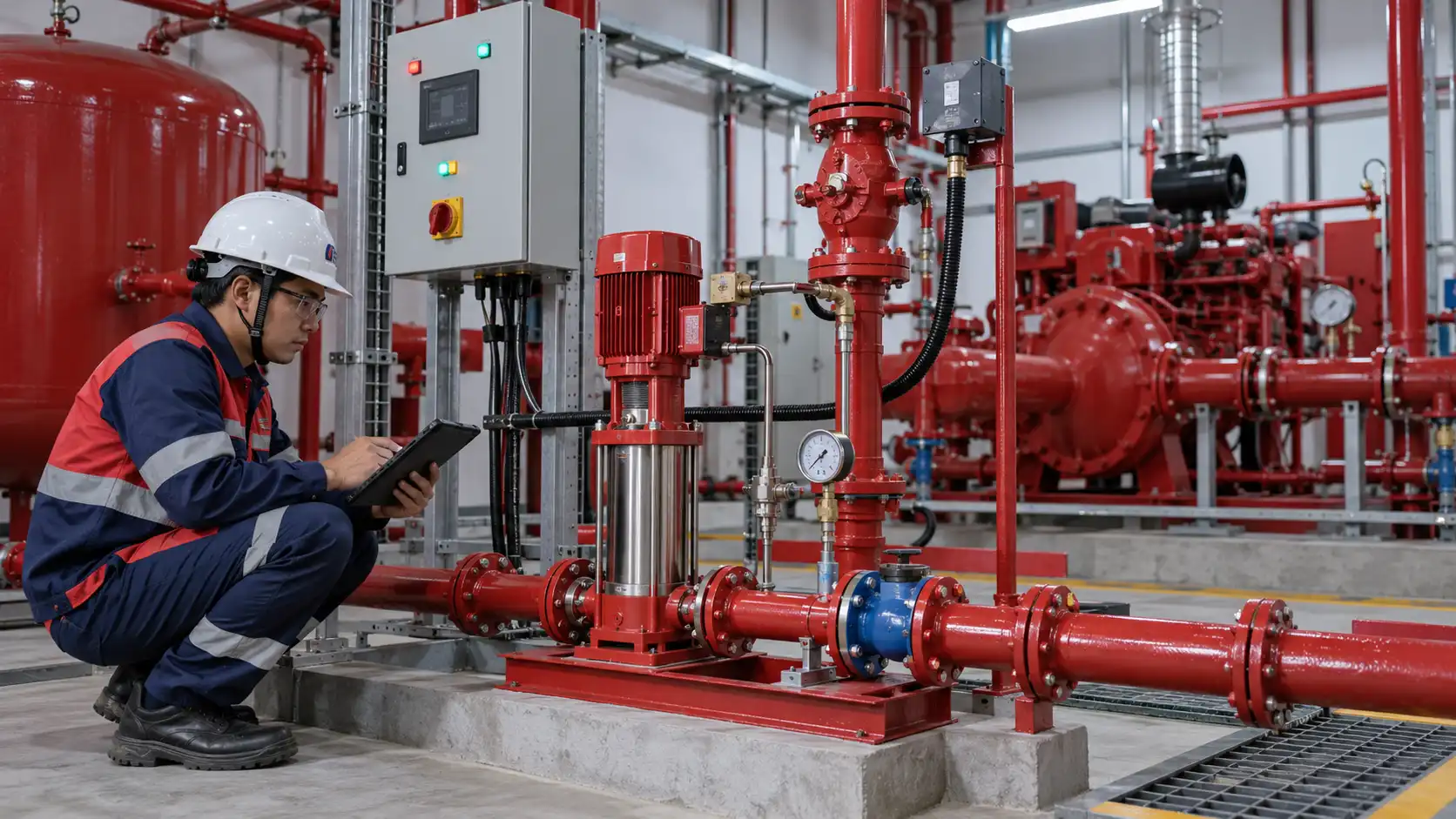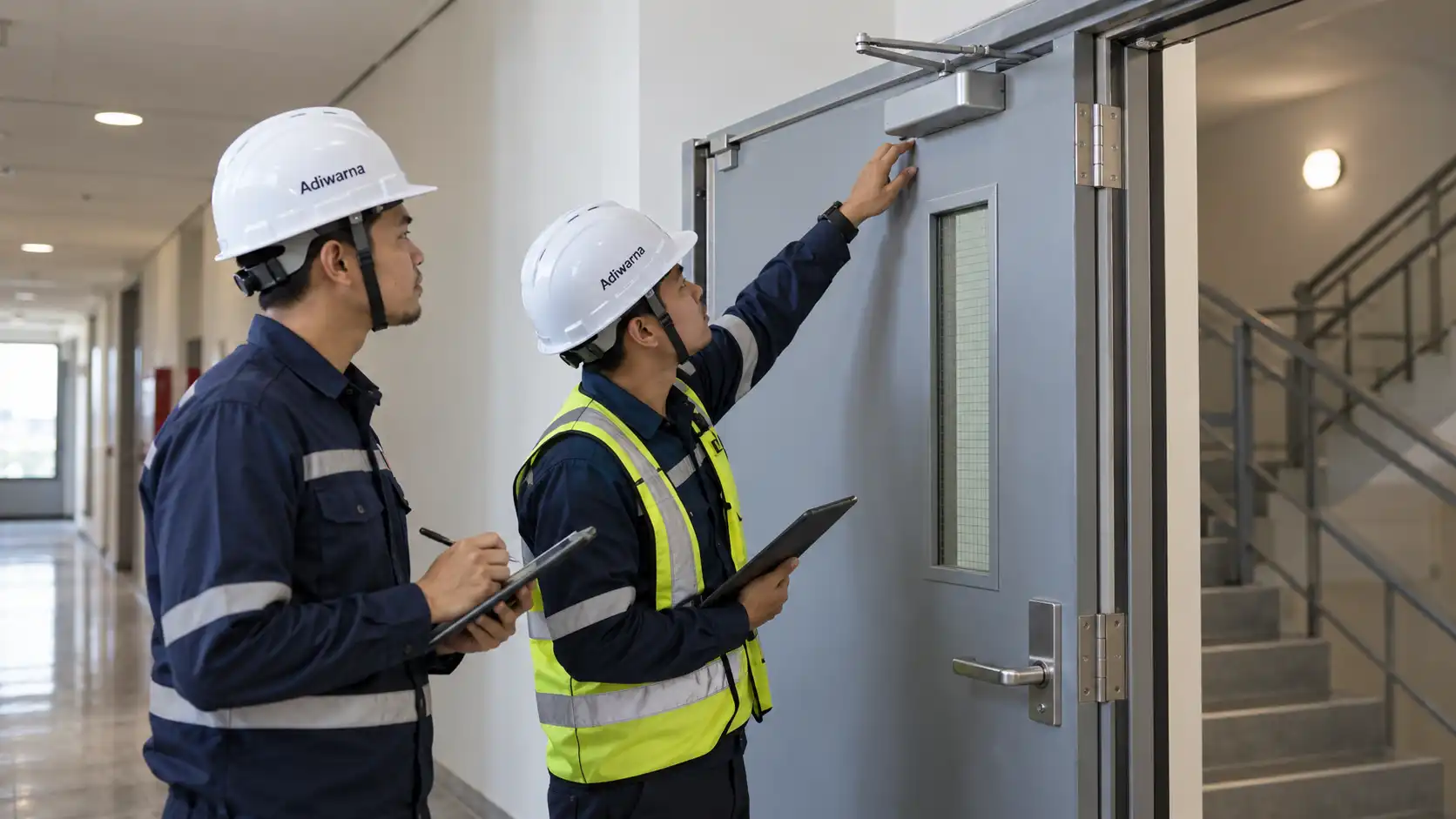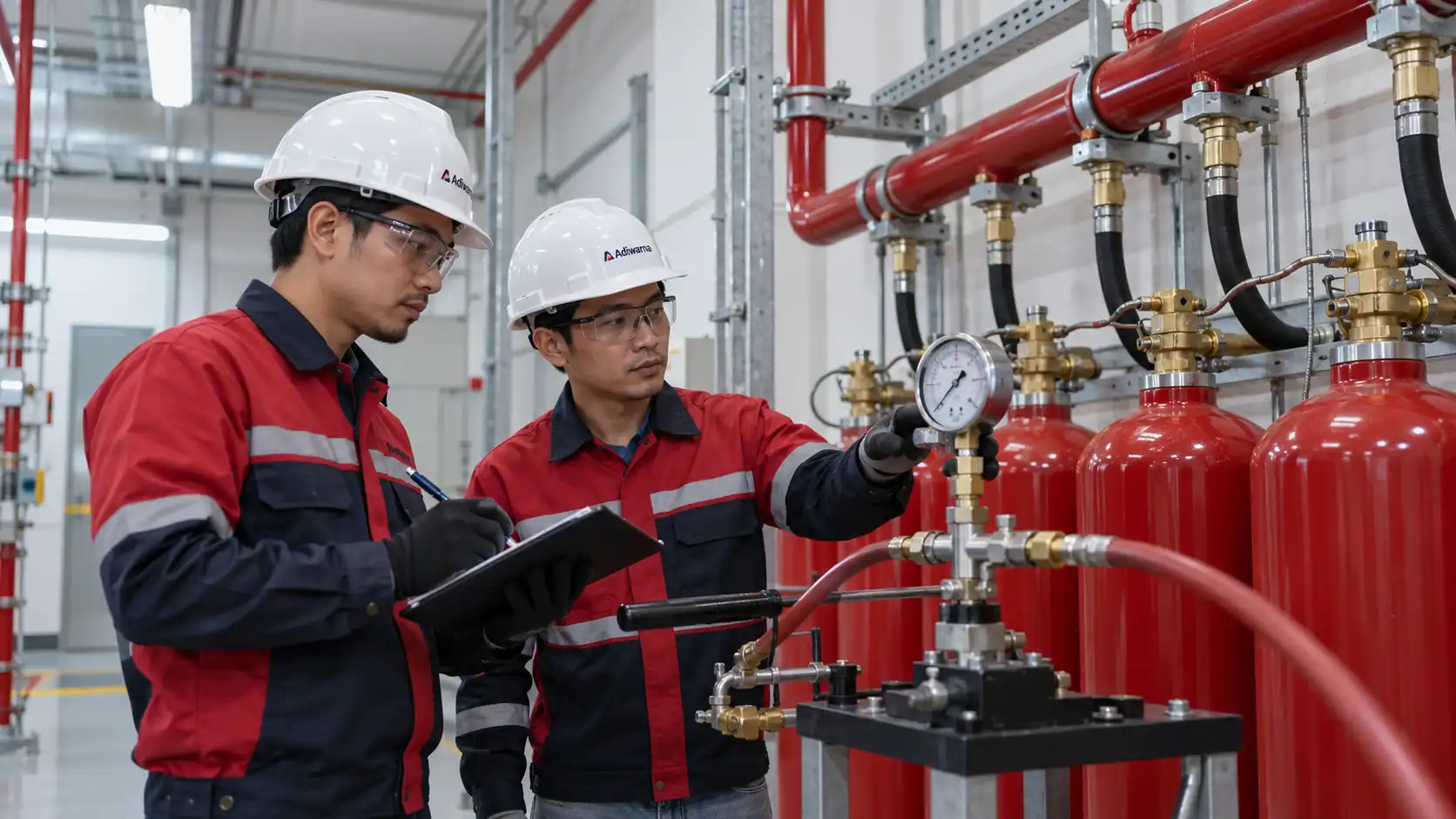

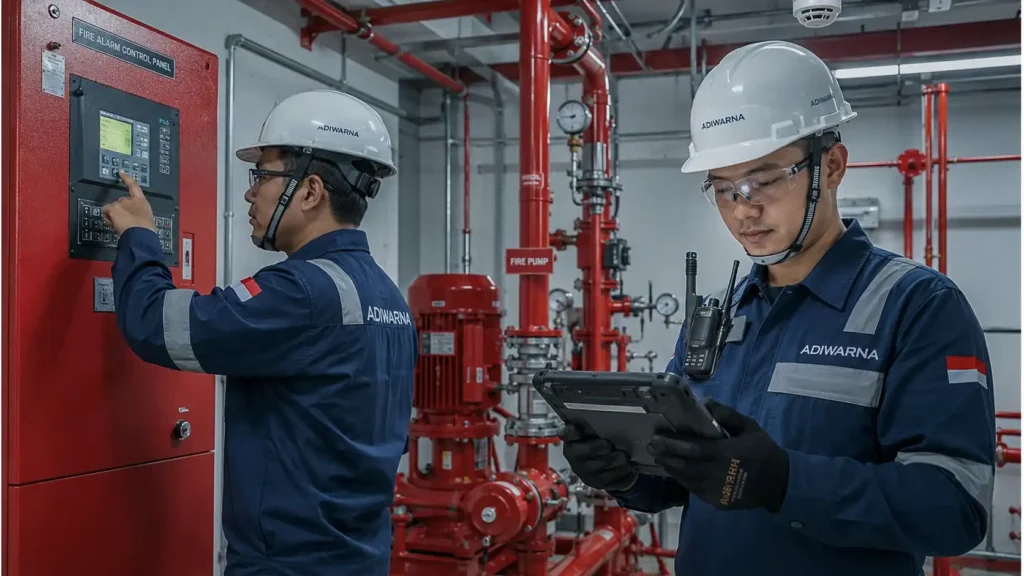
Testing commissioning fire protection is the process used to prove that a fire protection system is not only physically installed, but also performs according to the approved design, sequence of operation, project specifications, and life-safety requirements.
This stage is critical because modern fire protection systems consist of multiple interconnected subsystems. A smoke detector may function correctly on its own, a fire pump may run properly, and a suppression cylinder may have the correct pressure, but the overall system can still fail when a real fire scenario occurs.
For example, a detector may need to send an alarm to the fire alarm control panel, activate sounders and strobes, transmit signals to the BMS, initiate HVAC shutdown, close dampers, trigger selected control functions, or start a fire suppression sequence.
For this reason, commissioning should not be treated as a formality before handover.
A fire protection system should be proven through functional testing and integrated testing.
Two important standards are commonly referenced for this purpose:
- NFPA 3 — Standard for Commissioning of Fire Protection and Life Safety Systems
- NFPA 4 — Standard for Integrated Fire Protection and Life Safety System Testing
The edition used on an actual project should still follow the contract, AHJ requirements, applicable regulations, and project specifications.
Quick Answer
Testing commissioning fire protection is a process of inspection, functional testing, performance verification, and integrated testing used to confirm that a fire protection system operates according to the approved design and sequence of operation.
The process may include fire alarm, sprinkler, hydrant, fire pump, suppression, detectors, notification appliances, valves, pressure, flow, HVAC shutdown, dampers, BMS interfaces, room integrity, and cause-and-effect testing before the system is handed over to the owner.
What Is Testing Commissioning Fire Protection?
In simple terms, testing commissioning fire protection confirms three things:
First — the equipment is installed correctly.
Second — each subsystem functions correctly.
Third — all subsystems work together according to the intended sequence.
Adiwarna positions testing and commissioning as a core service together with design and engineering, supply, installation, and service and maintenance.
In complex projects, testing may involve:
- fire alarm;
- smoke detector;
- heat detector;
- flame detector;
- manual call point;
- sprinkler;
- hydrant;
- hose reel;
- fire pump;
- jockey pump;
- deluge valve;
- foam system;
- clean agent suppression;
- inert gas;
- FM200;
- BMS interface;
- HVAC;
- smoke control;
- access control;
- emergency shutdown.
Therefore, commissioning should be planned from the beginning of the project rather than only after installation is nearly complete.
Difference Between Testing and Commissioning Fire Protection
Although the terms are often used together, testing and commissioning are not exactly the same.
| Testing | Commissioning |
|---|---|
| Verifies a specific function | Confirms overall system performance |
| Can be performed per device or equipment | Involves multiple subsystems |
| Focuses on test results | Focuses on system readiness |
| Pressure test is testing | Overall hydrant-system verification is commissioning |
| Detector activation test is testing | Verifying the full alarm sequence is commissioning |
| Pump performance test is testing | Verifying pump, controller, alarm, and water system integration is commissioning |
For example:
A smoke detector may be tested with smoke and successfully trigger an alarm.
That is functional testing.
However, when the complete sequence is verified:
Detector → Fire Alarm Panel → Alarm Notification → HVAC Shutdown → Damper Close → BMS Signal → Suppression Logic
the process becomes part of integrated commissioning and testing.
Why Is Testing Commissioning Fire Protection Important?
A system can look perfectly installed but still fail functionally.
Many problems are only discovered during commissioning, including:
- incorrect detector addresses;
- reversed zone mapping;
- alarms not appearing in the control room;
- valve supervisory signals not being received;
- fire pumps not starting automatically;
- incorrect jockey pump settings;
- pressure switches not transmitting signals;
- HVAC failing to shut down;
- dampers failing to close;
- sounders not activating in certain areas;
- releasing panels not receiving cross-zone input;
- incorrect BMS point mapping;
- suppression time delays not matching the approved sequence.
This is why testing commissioning fire protection is essential for discovering system failures before the system is needed during an emergency.
Testing Commissioning Fire Protection Based on NFPA 3
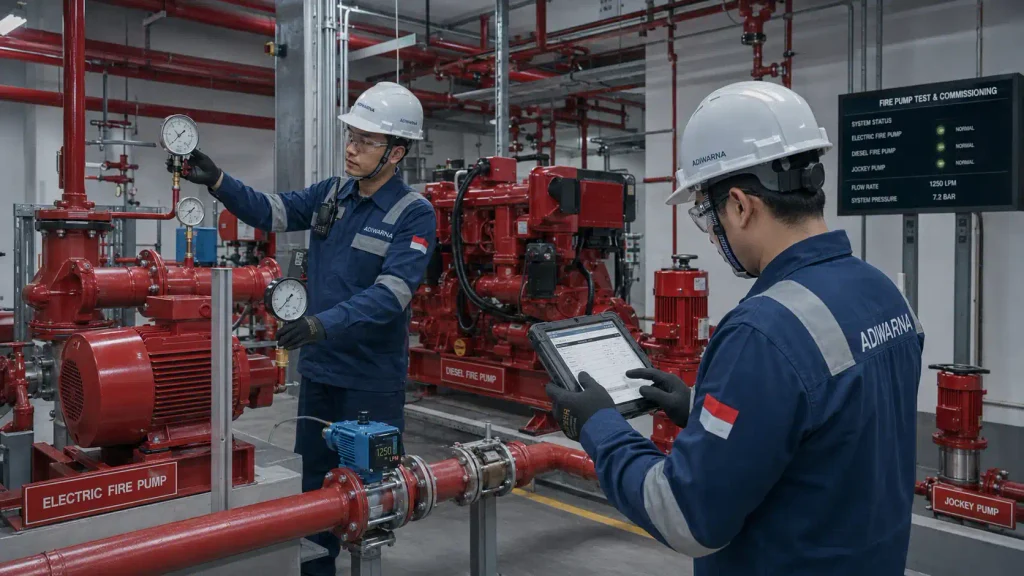
NFPA 3 — Standard for Commissioning of Fire Protection and Life Safety Systems is one of the primary references for commissioning fire protection and life-safety systems.
Commissioning is not limited to final testing.
The process can cover the entire project lifecycle:
Owner Requirements
↓
Design Review
↓
Submittal Review
↓
Installation Verification
↓
Functional Testing
↓
Integrated Testing
↓
Documentation
↓
Handover
This approach helps identify design and integration issues before they become major problems near project completion.
The actual edition used should follow the project contract, AHJ, and applicable regulatory requirements.
Testing Commissioning Fire Protection Based on NFPA 4
While NFPA 3 focuses on the commissioning process, NFPA 4 focuses on integrated fire protection and life safety system testing.
One of the most important concepts is:
End-to-End Testing
This means testing does not stop at a single device.
The complete sequence must be verified from trigger to final response.
For example:
Smoke Detector
↓
Fire Alarm Control Panel
↓
Alarm Notification
↓
BMS Signal
↓
HVAC Shutdown
↓
Damper Operation
Or for gaseous suppression:
Detector 1 + Detector 2
↓
Cross-Zone Confirmed
↓
Pre-Discharge Alarm
↓
Time Delay
↓
HVAC Shutdown
↓
Release Command
This approach confirms that system integration actually works rather than only proving that each individual component functions.
Standards Relevant to Testing Commissioning Fire Protection
Because fire protection consists of multiple subsystems, one standard is rarely enough.
Common references may include:
| System | Common Reference |
|---|---|
| Commissioning | NFPA 3 |
| Integrated testing | NFPA 4 |
| Sprinkler | NFPA 13 |
| Standpipe / hydrant | NFPA 14 |
| Fire pump | NFPA 20 |
| Water-based system ITM | NFPA 25 |
| Fire alarm | NFPA 72 |
| Clean agent suppression | NFPA 2001 |
| Foam | NFPA 11 |
| CO₂ suppression | NFPA 12 |
For projects in Indonesia, engineers should also consider:
- national regulations;
- SNI;
- fire department or AHJ requirements;
- project specifications;
- insurance requirements;
- manufacturer instructions;
- approved design documents.
The latest NFPA edition should not automatically replace the edition specified in the contract.
Stages of Testing Commissioning Fire Protection
In practice, commissioning can be divided into several stages.
1. Documentation Review
Before testing, the team should review:
- approved shop drawings;
- design drawings;
- equipment datasheets;
- hydraulic calculations;
- battery calculations;
- cause-and-effect matrix;
- panel configuration;
- device list;
- cable schedule;
- valve schedule;
- suppression calculations;
- manufacturer manuals.
If the documentation does not match the actual installation, commissioning becomes difficult to perform accurately.
2. Visual Inspection
Check the physical condition and installation of:
- equipment position;
- pipe supports;
- valve orientation;
- wiring;
- cable termination;
- detector location;
- nozzle position;
- signage;
- accessibility;
- identification.
3. Pre-Commissioning Test
Subsystems are tested before integrated testing.
Examples include:
- continuity testing;
- insulation testing;
- pipe pressure testing;
- flushing;
- detector testing;
- valve testing;
- pump rotation checks;
- control-panel checks.
4. Functional Testing
Each device is tested against its intended function.
5. Integrated Testing
Multiple subsystems are tested as one sequence.
6. Performance Testing
Actual system performance is compared with design requirements.
7. Deficiency / Punch List
All nonconformities are recorded.
8. Corrective Action and Retest
After corrections, relevant items should be retested.
9. Final Documentation
Complete commissioning records are handed over to the owner.
Testing Commissioning Fire Protection for Fire Alarm Systems
Fire alarm systems interact with many other building systems.
Testing may include:
- fire alarm control panel;
- smoke detector;
- heat detector;
- beam detector;
- flame detector;
- manual call point;
- input modules;
- output modules;
- sounders;
- alarm bells;
- strobes;
- batteries;
- power supplies;
- network;
- annunciators.
Functional testing may also verify:
- alarm condition;
- trouble condition;
- supervisory condition.
Commissioning should confirm not only that the device works, but that the system responds correctly.
Cause and Effect in Testing Commissioning Fire Protection
A cause-and-effect matrix is one of the most important documents in integrated fire protection testing.
In simple terms:
CAUSE = event or input
EFFECT = system response or output
Example:
| Cause | Effect |
|---|---|
| Smoke detector alarm | Fire alarm panel alarm |
| Waterflow switch | Alarm + signal to control room |
| Fire pump running | Running indication |
| Valve closed | Supervisory indication |
| Cross-zone detection | Suppression sequence |
| Fire alarm | AHU shutdown |
| Fire alarm | Fire damper command |
| Fire alarm | Elevator interface |
| Suppression discharge | BMS indication |
Commissioning should verify that each cause generates the correct effect.
This is why cause-and-effect testing provides much more value than simply confirming that a detector activates.
Testing Commissioning Fire Protection for Fire Pumps

A fire pump is a critical pressure source for many water-based fire protection systems.
Testing may include:
- electric fire pump;
- diesel fire pump;
- jockey pump;
- controllers;
- pressure switches;
- suction pressure;
- discharge pressure;
- flow;
- churn condition;
- rated flow;
- electrical parameters;
- diesel engine operation;
- automatic start;
- manual start;
- alarms.
An important part of commissioning is not merely confirming that the pump rotates.
The engineer should compare actual performance against the design requirement and pump performance data.
Testing Commissioning Fire Protection for Hydrant Systems
A hydrant system should be tested as a hydraulic network.
Testing may include:
- piping;
- valves;
- hydrant pillars;
- landing valves;
- fire hoses;
- hose reels;
- fire department connection;
- pressure;
- flow;
- fire pump interface.
Typical tests may include:
Hydrostatic Test
Checks piping mechanical integrity.
Flow Test
Confirms available flow.
Pressure Test
Evaluates pressure at selected points.
Valve Test
Confirms proper valve operation.
Pump Integration Test
Confirms that pressure reduction produces the correct pump response.
Hydrant commissioning is therefore much more than simply opening a valve and seeing water flow.
Testing Commissioning Fire Protection for Sprinkler Systems
Sprinkler systems also require comprehensive verification.
Inspection may cover:
- piping;
- sprinkler location;
- sprinkler orientation;
- obstructions;
- valves;
- waterflow switches;
- tamper switches;
- alarm valves;
- test connections;
- drains;
- pressure;
- water supply.
An integrated sequence may be:
Waterflow
↓
Fire Alarm
↓
Notification / BMS
↓
Control Room Indication
This demonstrates that the sprinkler system must also integrate correctly with the fire alarm system.
Testing Commissioning Fire Protection for Fire Suppression Systems
Gaseous fire suppression systems typically have more complex commissioning sequences.
Testing may include:
- cylinder condition;
- agent quantity;
- cylinder pressure;
- piping;
- nozzles;
- detection;
- releasing panel;
- solenoid;
- manual release;
- abort switch;
- sounder;
- strobe;
- pressure switch;
- pre-discharge delay;
- HVAC shutdown;
- damper interfaces;
- BMS;
- room integrity.
For clean agent total flooding systems, room integrity can be a critical part of commissioning.
Read the Adiwarna Room Integrity Test Fire Suppression guide.
Does Fire Suppression Commissioning Require Agent Discharge?
Not always.
Many commissioning activities can be performed without a full agent discharge.
Engineers may use:
- detector simulation;
- output simulation;
- solenoid isolation;
- release circuit testing;
- cause-and-effect testing;
- room integrity testing.
Actual extinguishing-agent discharge should only be performed when required by the acceptance procedure, applicable standard, manufacturer, or project specification.
This is especially important for gaseous suppression because unnecessary discharge can create significant restoration and refill requirements.
Testing Commissioning Fire Protection for Foam and Deluge Systems
High-risk facilities may also include foam or deluge systems.
Testing may include:
- deluge valves;
- solenoids;
- manual release;
- fire detection;
- foam tank;
- bladder tank;
- proportioner;
- foam pump;
- monitors;
- nozzles;
- alarms;
- pressure;
- water flow;
- interfaces.
Typical deluge commissioning may include:
- pipe flushing;
- hydrostatic testing;
- valve trip testing;
- solenoid activation;
- detector testing;
- waterflow signal verification;
- automatic fire pump start;
- nozzle flow testing;
- spray-pattern verification;
- cause-and-effect testing.
Foam systems may also require verification of proportioning performance according to the applicable system design and test method.
Testing Commissioning Fire Protection for Data Centers
Data centers require more complex integrated commissioning because many systems interact.
A typical sequence may include:
Smoke Detection
↓
Fire Alarm
↓
Pre-Alarm / Alarm
↓
HVAC / CRAH Interface
↓
Damper Operation
↓
Suppression Logic
↓
BMS / DCIM Indication
Testing may also involve:
- aspirating smoke detection;
- addressable fire alarm;
- preaction sprinkler;
- gaseous suppression;
- room integrity testing;
- UPS room protection;
- fire alarm integration;
- emergency shutdown.
Because critical facilities need to maintain uptime, the test plan should also define how functional testing can be performed without unnecessary disruption.
Testing Commissioning Fire Protection and BMS Integration
A common commissioning mistake is to treat fire alarm and BMS as completely separate systems.
In many facilities, required interfaces may include:
Fire Alarm → BMS
Fire Pump → BMS
Suppression → BMS
Valve Supervisory → BMS
Gas Detection → BMS
Integrated testing should verify:
- correct point mapping;
- correct status;
- correct text description;
- correct alarm priority;
- no incorrect signal swapping;
- correct reset behavior.
BMS indication should not replace required fire alarm control functions where the fire alarm system is the designated system of record.
Testing Commissioning Fire Protection and HVAC
HVAC can significantly affect fire protection performance.
Certain fire scenarios may require:
- AHU shutdown;
- exhaust control;
- smoke-control operation;
- fire damper closing;
- smoke damper movement;
- suppression-room isolation.
Testing should verify the actual equipment response.
It is not enough to confirm that the fire alarm relay output has changed state.
The engineer should confirm that the connected HVAC equipment actually performs the intended action.
Pre-Commissioning vs Integrated Commissioning
| Pre-Commissioning | Integrated Commissioning |
|---|---|
| Individual equipment | Multiple subsystems |
| Performed earlier | Performed after subsystems are ready |
| Pressure / continuity tests | End-to-end scenarios |
| Device testing | Cause-and-effect testing |
| Pump rotation | Pump integration |
| Panel checks | Building-system integration |
| Equipment-focused | System-response-focused |
Both stages are important.
Integrated testing should generally be performed only after the individual systems are ready for testing.
Testing Commissioning Fire Protection Documentation
Documentation is critical because the system will remain in service long after construction is complete.
The owner should typically receive:
- approved drawings;
- as-built drawings;
- equipment datasheets;
- hydraulic calculations;
- suppression calculations;
- cause-and-effect matrix;
- device list;
- panel configuration;
- testing procedures;
- testing reports;
- pump performance results;
- pressure records;
- flow records;
- room integrity reports where applicable;
- punch lists;
- corrective-action records;
- final acceptance records;
- operation manuals;
- maintenance schedules.
Commissioning without documentation creates future maintenance and troubleshooting difficulties.
What Is a Commissioning Report?
A commissioning report is the technical record showing that testing was performed and the results were evaluated.
A good report should contain more than simply:
“PASS.”
It may include:
- test item;
- test method;
- expected result;
- actual result;
- measurement;
- date;
- equipment;
- technician;
- witness;
- deficiency;
- corrective action;
- retest result;
- final status.
This gives the owner a technical baseline for the system at handover.
Common Problems Found During Testing Commissioning Fire Protection
Incorrect Device Mapping
The device address shown on the panel does not match the actual room.
Incorrect Cause and Effect
The alarm output does not generate the intended response.
Valve Not Fully Open
The system appears normal, but the hydraulic path is restricted.
Incorrect Fire Pump Settings
The automatic starting sequence does not match the required logic.
HVAC Interface Failure
The relay changes state, but the AHU does not actually shut down.
Incorrect Supervisory Signal
A closed valve may appear as an alarm instead of a supervisory condition.
Incorrect BMS Point
The displayed label does not match the actual equipment.
Incomplete Fire Suppression Sequence
Alarm, time delay, shutdown, and release command do not operate as one sequence.
Documentation Does Not Match the Actual Installation
The shop drawing still reflects an earlier installation condition.
These examples show why commissioning should be performed by a team that understands mechanical systems, electrical systems, detection, controls, and integration.
Testing Commissioning Fire Protection Checklist
Before final handover, the checklist may include:
- Approved drawings available
- As-built drawings updated
- Equipment identified
- Piping inspection completed
- Hydrostatic testing completed
- Flushing completed where required
- Fire pump testing completed
- Hydrant flow testing completed
- Sprinkler alarm testing completed
- Fire alarm detector testing completed
- Notification appliance testing completed
- Battery testing completed
- Trouble condition testing completed
- Supervisory testing completed
- BMS interface verified
- HVAC interface verified
- Cause-and-effect testing completed
- Suppression sequence verified
- Room integrity testing completed where required
- Deficiencies corrected
- Retesting completed
- Commissioning report available
- Operation manual available
- Maintenance schedule available
- Operator training completed
The checklist should always be adjusted to the actual project scope.
When Should Testing Commissioning Fire Protection Be Performed?
Commissioning is most clearly required for new systems before handover.
However, testing may also be needed after:
- system retrofit;
- major modification;
- equipment replacement;
- control panel replacement;
- control logic modification;
- additional detector installation;
- pump replacement;
- sprinkler modification;
- suppression-system modification;
- HVAC modification;
- BMS integration changes.
A change to one subsystem can affect the response of several others.
Therefore, the retest scope should be based on the systems and interconnections affected by the modification.
Testing Commissioning Fire Protection for Existing Systems
Existing buildings may also require assessment.
Typical indicators include:
- no commissioning records;
- missing as-built drawings;
- aging systems;
- multiple modifications;
- replaced control panels;
- upgraded BMS;
- replaced pumps;
- expanded sprinkler networks;
- renovated suppression rooms;
- recurring false alarms;
- interfaces that have never been fully tested.
Testing can establish a new baseline condition for the existing system.
The results can then support:
- deficiency identification;
- corrective maintenance;
- retrofit planning;
- replacement planning;
- future preventive maintenance.
Testing Commissioning Fire Protection Is Not Maintenance
Commissioning and maintenance have different objectives.
Commissioning proves that the system meets its intended performance at a specific project stage or after modification.
Maintenance preserves that performance throughout the system lifecycle.
In simple terms:
Commissioning → establishes readiness
while
Maintenance → preserves readiness
Both are necessary.
How to Choose a Testing Commissioning Fire Protection Provider
A provider performing testing commissioning fire protection should offer more than testing equipment.
Evaluate whether the provider can:
- Read approved designs.
- Understand applicable standards.
- Understand hydraulic systems.
- Understand fire alarm logic.
- Understand suppression sequences.
- Read cause-and-effect matrices.
- Perform fire pump performance testing.
- Test hydrant and sprinkler systems.
- Test fire alarm systems.
- Verify BMS and HVAC interfaces.
- Perform integrated testing.
- Perform troubleshooting.
- Produce commissioning reports.
- Update as-built documentation.
- Provide maintenance recommendations.
Ideally, the provider should understand the system from design through operation, not only one type of equipment.
Testing Commissioning Fire Protection by Adiwarna
PT Adiwarna Anugerah Abadi Tbk provides an integrated scope that includes:
Design & Engineering → Supply → Installation → Testing & Commissioning → Service & Maintenance.
This integrated approach is valuable because commissioning is more effective when the team understands:
- the design basis;
- equipment selection;
- installation;
- control logic;
- system integration;
- final acceptance criteria.
Adiwarna can support testing from individual equipment verification to integrated fire protection system commissioning.
Learn more about Adiwarna Fire Protection Services
FAQ About Testing Commissioning Fire Protection
What Is Testing Commissioning Fire Protection?
Testing commissioning fire protection is a process used to verify installation, function, performance, integration, and system sequence before handover or after significant modification.
What Is the Difference Between Testing and Commissioning?
Testing usually verifies a specific device or function.
Commissioning confirms that the complete system meets the intended design and works correctly as an integrated system.
What Standards Apply to Testing Commissioning Fire Protection?
Two key references are NFPA 3 for commissioning and NFPA 4 for integrated testing.
Individual systems may also follow specific standards such as NFPA 13, NFPA 20, NFPA 25, NFPA 72, and NFPA 2001.
What Is Integrated Fire Protection Testing?
Integrated testing verifies several interconnected systems as one sequence.
For example:
Detector → Fire Alarm → HVAC Shutdown → BMS → Suppression
The objective is to verify complete end-to-end performance.
What Is a Cause and Effect Test?
A cause-and-effect test confirms that every input or trigger produces the required output according to the approved logic.
For example, a smoke detector may trigger an alarm, fan shutdown, damper command, or suppression sequence depending on the design.
Should Fire Pumps Be Tested During Commissioning?
Yes, when fire pumps are included in the project scope.
Testing may include automatic start, pressure, flow, controllers, alarms, and performance.
Does Fire Suppression Need to Be Discharged During Commissioning?
Not always.
Many functions can be tested using simulation and functional testing. Actual agent discharge should only be performed when required by the acceptance procedure or project specification.
What Documents Should the Owner Receive?
Documents may include:
- as-built drawings;
- test reports;
- cause-and-effect matrix;
- calculations;
- equipment datasheets;
- room integrity results;
- operation manuals;
- maintenance schedules.
When Should Integrated Testing Be Performed?
Usually after the individual subsystems have successfully completed functional testing and are ready to be tested together.
How Much Does Testing Commissioning Fire Protection Cost?
Cost depends on:
- number of systems;
- number of devices;
- facility size;
- number of pumps;
- hydrant and sprinkler network size;
- suppression-system complexity;
- system integration;
- BMS and HVAC interfaces;
- required test equipment;
- reporting requirements;
- project location;
- witness requirements.
A meaningful quotation should be based on actual drawings and project scope.
Consult Adiwarna for Testing Commissioning Fire Protection
A fire protection system should not be considered fully ready simply because installation is complete.
Testing commissioning fire protection is needed to prove that fire alarm, hydrant, sprinkler, fire pump, fire suppression, HVAC, BMS, and associated interlocks respond according to the approved design.
PT Adiwarna Anugerah Abadi Tbk can support:
- inspection;
- pre-commissioning;
- functional testing;
- fire pump performance testing;
- hydrant and sprinkler testing;
- fire alarm testing;
- suppression testing;
- room integrity testing;
- cause-and-effect testing;
- integrated system testing;
- commissioning reports;
- handover documentation.
For an initial assessment, prepare:
- approved drawings;
- system scope;
- equipment list;
- cause-and-effect matrix;
- project standards;
- project location;
- target commissioning schedule.
Conclusion
Testing commissioning fire protection is a critical stage for ensuring that fire protection systems are truly ready to operate according to design.
The process may include:
visual inspection → pre-commissioning → functional testing → performance testing → cause-and-effect testing → integrated testing → corrective action → retesting → documentation → handover.
NFPA 3 provides a framework for commissioning fire protection and life-safety systems, while NFPA 4 focuses on integrated system testing.
Individual subsystems should also be tested according to relevant standards such as NFPA 13, NFPA 20, NFPA 25, NFPA 72, NFPA 2001, as well as applicable local regulations and project requirements.
With properly planned and documented testing commissioning fire protection, the owner receives more than a completed installation.
The owner receives evidence that the system is capable of delivering its intended response when it is actually needed.