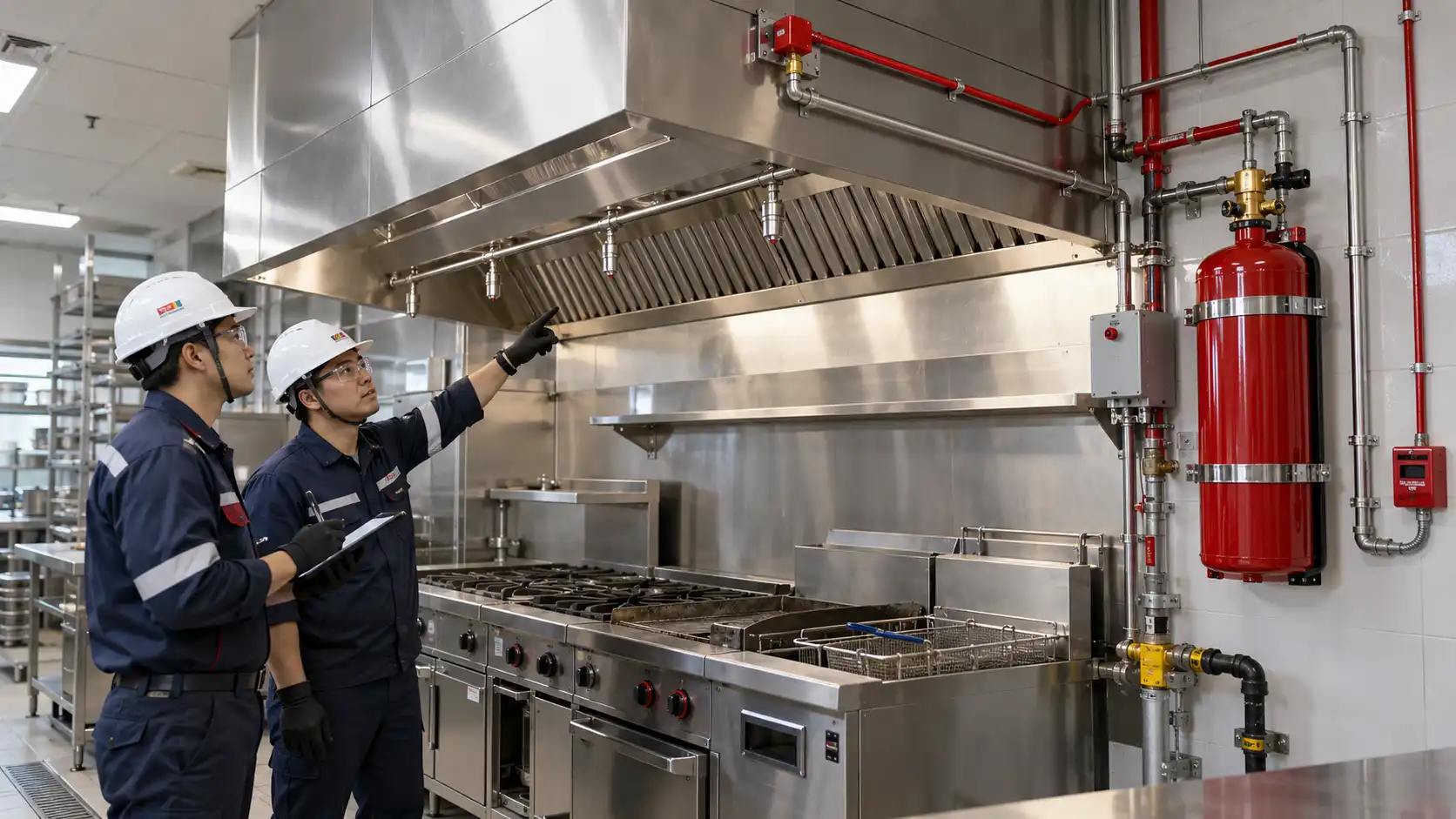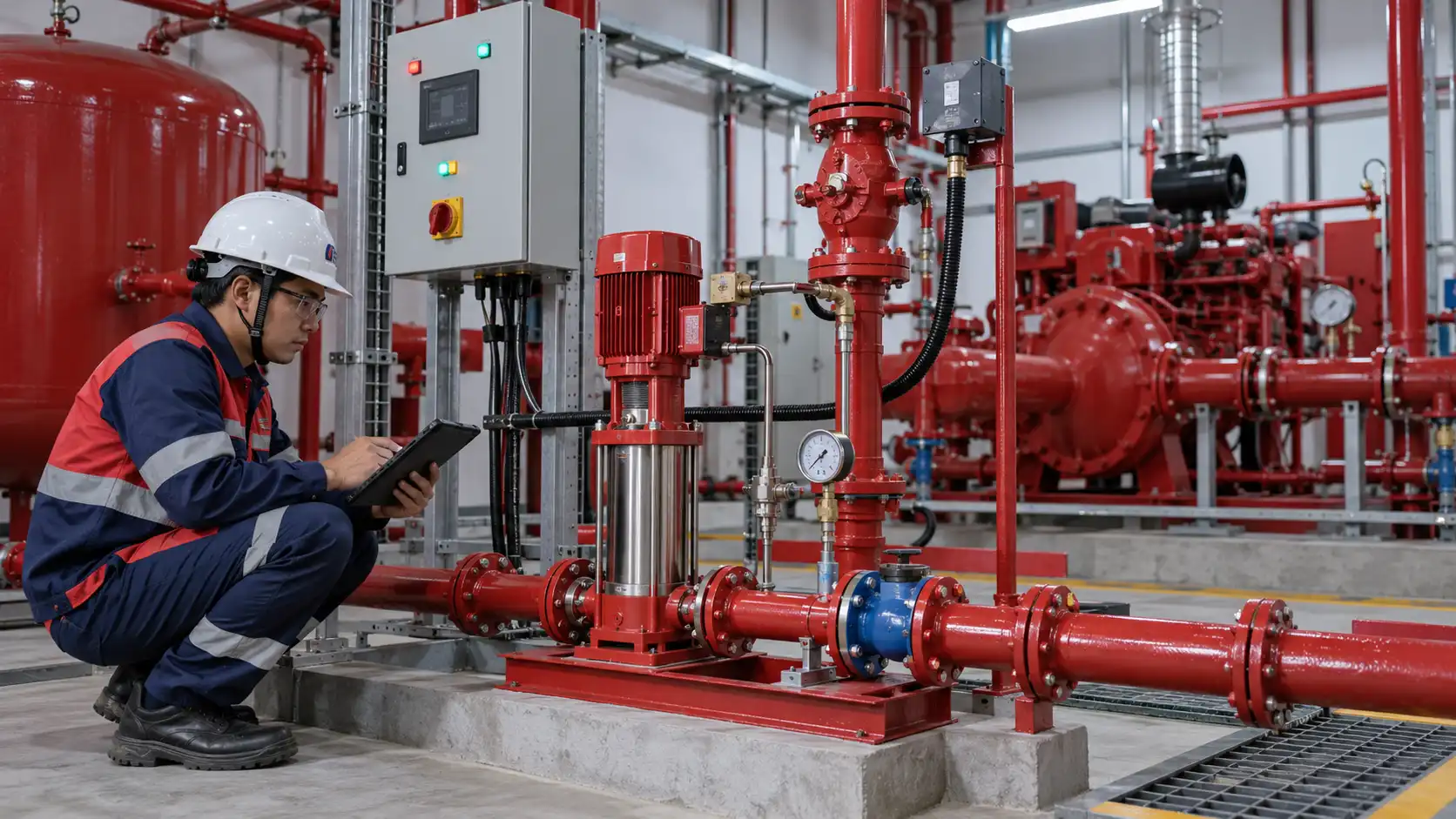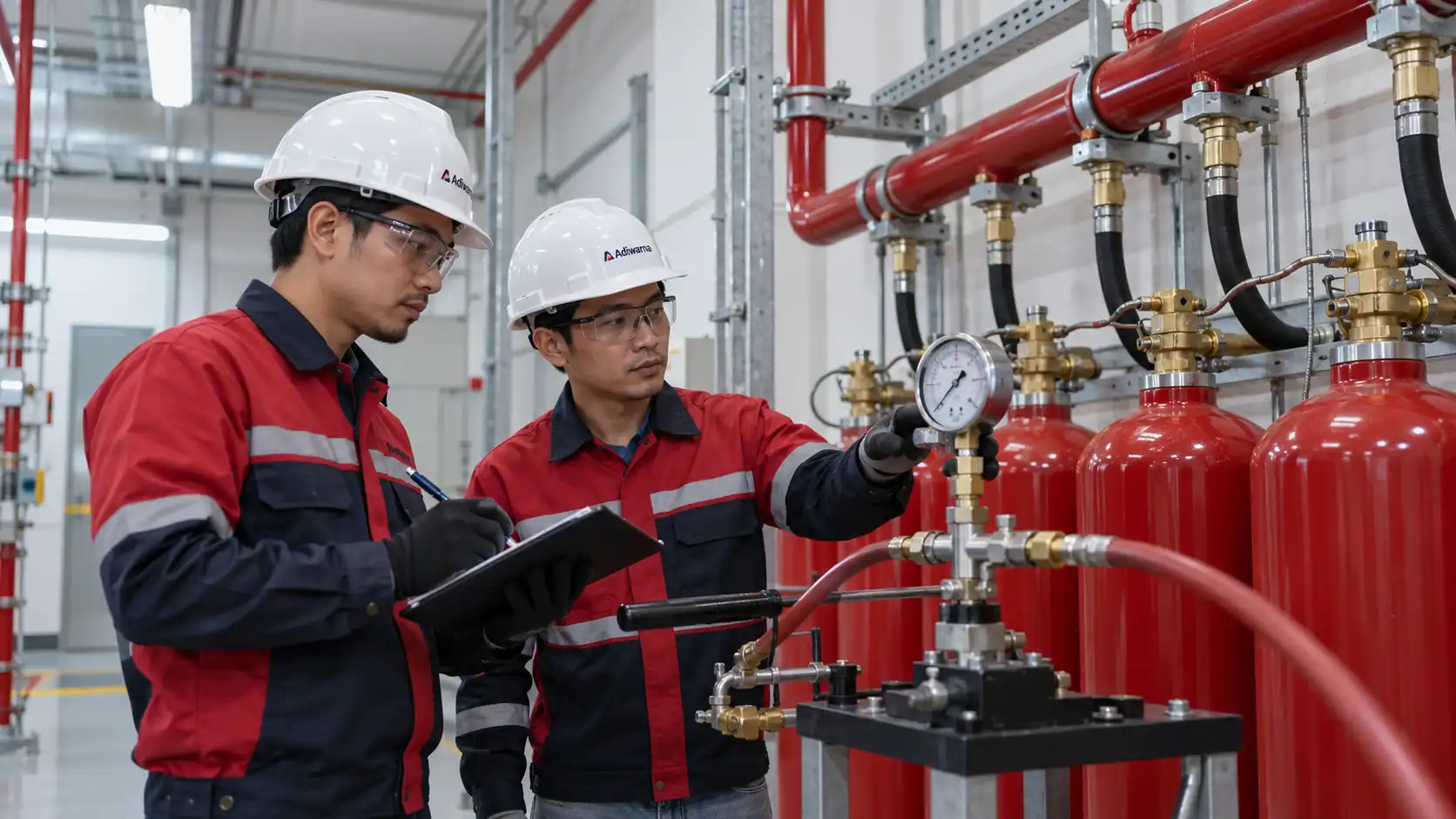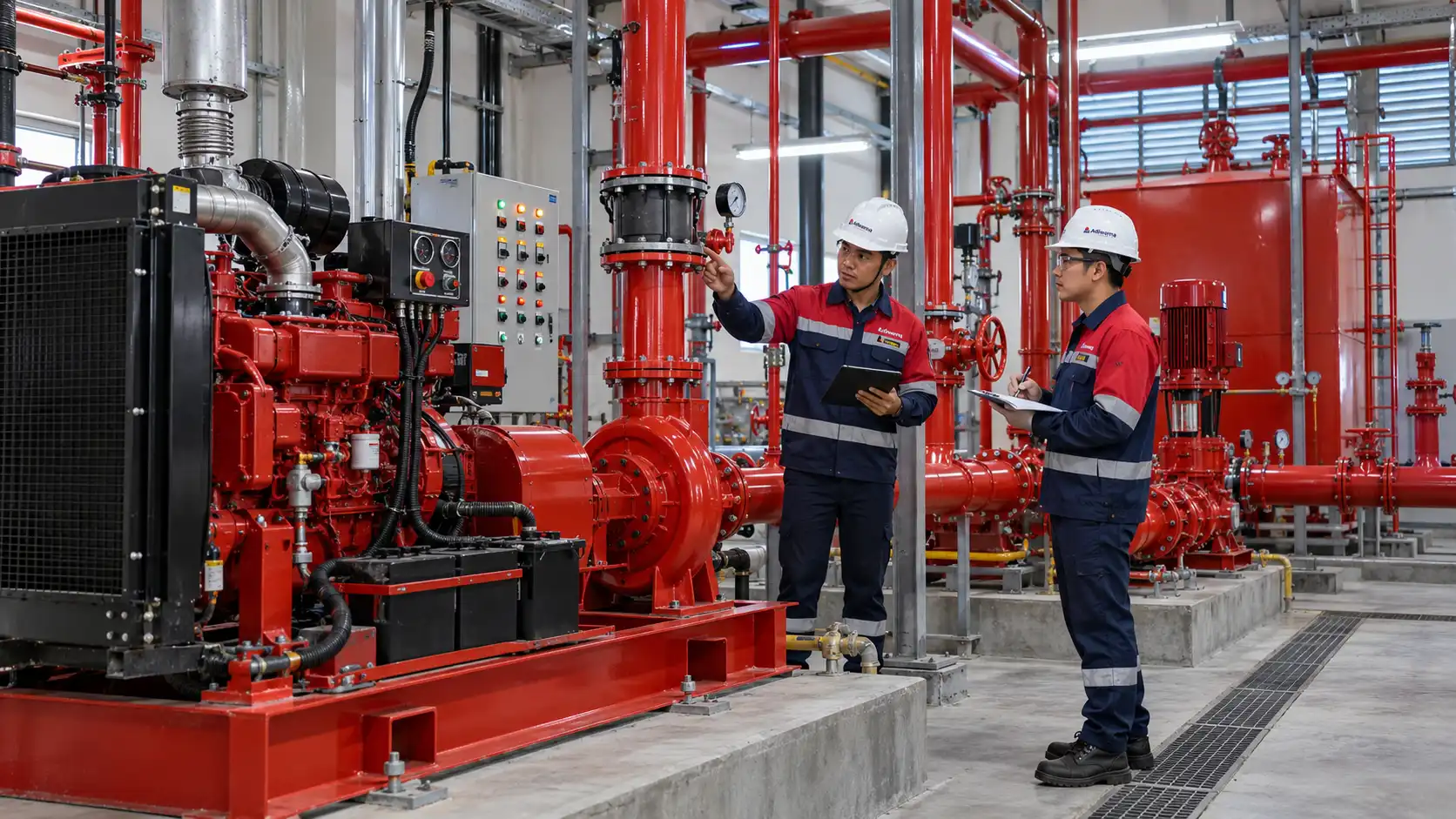

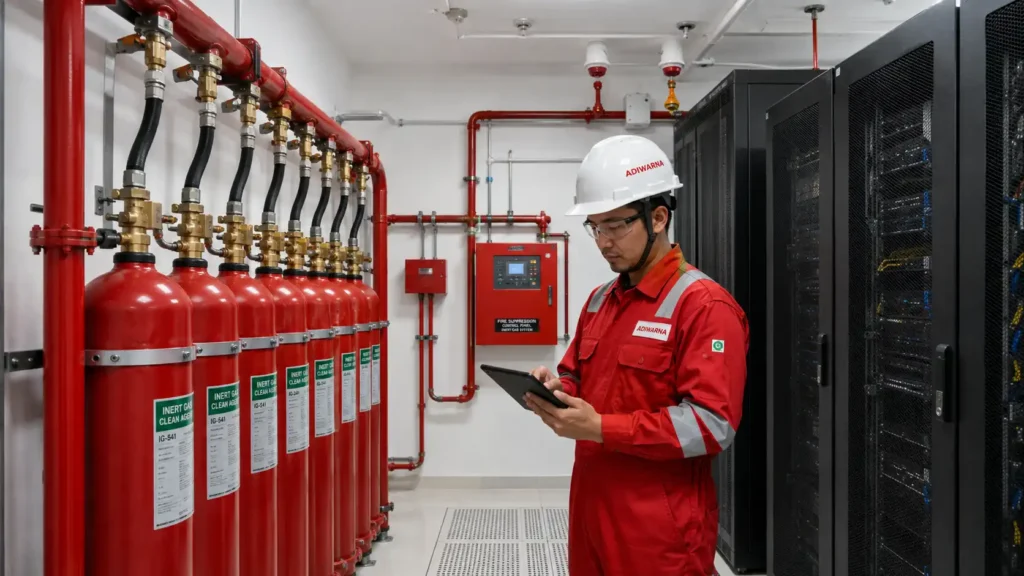
Inert gas is a type of clean agent used in fire suppression systems to protect enclosed spaces containing critical assets. The system uses naturally occurring gases or gas mixtures to reduce oxygen concentration until combustion can no longer be sustained, without leaving residue on equipment after discharge.
This technology is widely used in data centers, server rooms, electrical rooms, control rooms, telecommunications facilities, museums, archive storage, laboratories, and industrial facilities containing high-value equipment.
Unlike halocarbon clean agents such as HFC-227ea, gas inert systems use gases naturally present in the atmosphere. Common types recognized in standards and commercial systems include IG-01, IG-55, IG-100, and IG-541. IG-01 uses argon, IG-55 combines nitrogen and argon, IG-100 uses nitrogen, while IG-541 combines nitrogen, argon, and carbon dioxide.
Quick Answer
Gas inert is a clean agent fire suppression technology that uses argon, nitrogen, or mixtures of naturally occurring gases to reduce oxygen concentration until combustion can no longer be sustained. The agent leaves no residue and is electrically nonconductive, making it suitable for data centers, server rooms, control rooms, and other facilities containing sensitive electronic equipment.
What Is Inert Gas in a Fire Suppression System?
Gas inert is a gaseous extinguishing agent used in fixed fire suppression systems. The agent is stored in pressurized cylinders and delivered through piping to discharge nozzles when the control system initiates the suppression sequence.
Under normal conditions, combustion requires sufficient oxygen to sustain the fire reaction. An gas inert system changes the atmosphere inside the protected enclosure so that combustion can no longer continue.
This is achieved by introducing a calculated quantity of gas to reduce oxygen concentration according to the required design conditions.
Adiwarna also describes this technology as a residue-free fire suppression method for enclosed spaces and sensitive assets. Learn more through Inert Gas Fire Suppression for Critical Assets.
However, the required oxygen concentration should never be determined using one universal value for every project. It depends on the selected agent, hazard, design concentration, occupancy, altitude, temperature, and applicable standard.
How Does Inert Gas Work?
The operating principle of inert gas differs from that of halocarbon clean agents.
Once a fire condition has been confirmed according to the detection logic, the suppression control panel activates the cylinder bank. Gas then flows through the manifold and piping network toward the discharge nozzles in the protected enclosure.
A typical sequence may include:
- Fire detectors identify a potential fire condition.
- The suppression control panel receives the signal.
- Cross-zone or confirmation logic operates.
- Pre-discharge alarms activate.
- A time delay operates where required.
- HVAC and dampers respond according to the cause-and-effect matrix.
- The actuator opens the cylinder valve.
- Inert gas flows through the manifold and piping.
- Nozzles distribute the gas into the protected room.
- Oxygen concentration decreases until combustion can no longer be sustained.
The system should be designed as an engineered total flooding system. Cylinder quantity, pipe sizing, nozzle configuration, flow, pressure, and discharge characteristics must be determined using an approved calculation method.
Types of Inert Gas for Fire Suppression
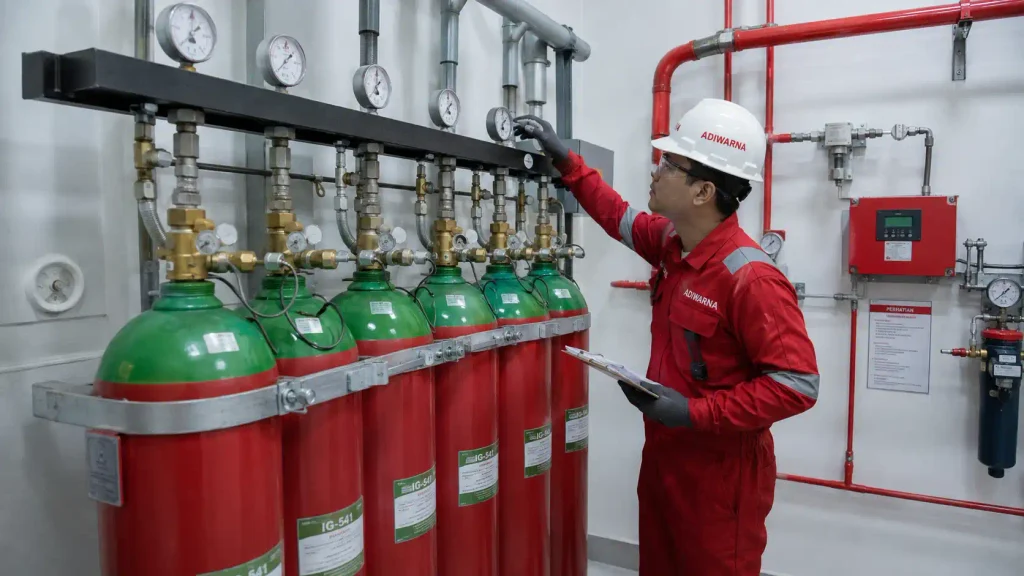
Four commonly used agent categories are IG-01, IG-55, IG-100, and IG-541. NFPA 2001:2025 recognizes these agent categories within clean agent fire suppression applications.
| Agent | Typical Composition | Main Characteristic |
|---|---|---|
| IG-01 | Argon | Single-component inert gas |
| IG-55 | Nitrogen + Argon | Two-gas mixture |
| IG-100 | Nitrogen | Single-component inert gas |
| IG-541 | Nitrogen + Argon + CO₂ | Three-gas mixture |
These compositions are also used in commercial gaseous suppression systems.
IG-01 Inert Gas
IG-01 uses argon as the extinguishing agent.
Argon is a naturally occurring gas that is electrically nonconductive and leaves no residue after discharge.
ISO 14520 includes a dedicated section addressing IG-01 gaseous extinguishing systems.
IG-55 Inert Gas
IG-55 is a mixture of nitrogen and argon.
The agent combines the properties of these naturally occurring gases to produce an atmosphere that no longer supports combustion within the protected enclosure.
ISO 14520-14 addresses the physical properties, system design, application, and safety aspects of IG-55.
IG-100 Inert Gas
IG-100 uses nitrogen as the extinguishing agent.
Nitrogen is the largest component of the Earth’s atmosphere, meaning the system does not depend on a synthetic halocarbon compound.
Adiwarna also provides an IG-100-based system using nitrogen for total flooding protection. Learn more about GEMTEX GEM100 — IG-100 Nitrogen Fire Suppression.
IG-541 Inert Gas
IG-541 is a mixture of nitrogen, argon, and carbon dioxide. Inergen is one of the best-known commercial systems using this agent composition.
Adiwarna describes Inergen as a mixture containing approximately 52% nitrogen, 40% argon, and 8% carbon dioxide.
For a dedicated overview, see Adiwarna Inergen System.
ISO 14520-15 specifically addresses the physical properties, application, system design, and safety aspects of IG-541.
Why Is Inert Gas Suitable for Critical Assets?
One of the major advantages of gas inert is that the agent leaves no residue after discharge.
Because the gas is also electrically nonconductive, it can be used in areas containing sensitive electronic equipment.
Important benefits include:
- no residue after discharge;
- electrically nonconductive properties;
- no secondary water damage;
- use of gases naturally found in the atmosphere;
- suitability for enclosed critical spaces;
- total flooding capability;
- integration with automatic fire detection;
- no dependence on HFCs as the extinguishing medium.
These characteristics make inert gas particularly relevant for facilities where downtime or damage to electronic equipment could result in significant operational losses.
Inert Gas Fire Suppression Applications
Inert gas is commonly used in enclosed areas containing critical assets.
Data Centers
Data centers contain servers, storage devices, network equipment, UPS systems, cabling, and control systems that are sensitive to water or powder residue.
Clean agent suppression can help reduce secondary damage after a fire event.
For broader fire protection applications, see Adiwarna’s Fire Suppression System for Buildings and Industrial Facilities.
Server Rooms
Server rooms require early detection and rapid suppression because even a relatively small fire can cause operational downtime.
Electrical Rooms
MCCs, electrical panels, switchgear, UPS units, instrumentation, and control components may be protected using inert gas when the hazard assessment and enclosure design support total flooding protection.
Control Rooms
Industrial control rooms often contain:
- PLC systems;
- DCS systems;
- SCADA equipment;
- servers;
- operator workstations;
- communication equipment.
Clean agent suppression can reduce secondary damage to these control systems.
Telecommunications Rooms
Telecommunications facilities contain switching equipment, rectifiers, networking systems, and communication infrastructure that require high operational continuity.
Museums and Archives
Water or chemical powder can cause additional damage to valuable documents and collections.
Because inert gas leaves no residue, it may be considered for archive or museum spaces that meet total flooding design requirements.
Inert Gas for Data Centers and Server Rooms
In a data center, inert gas should not operate as the only layer of protection.
A more complete system may integrate:
- aspirating smoke detection;
- conventional smoke detection;
- suppression control panel;
- pre-discharge alarms;
- HVAC shutdown;
- damper control;
- access control interfaces;
- inert gas cylinder banks;
- piping and discharge nozzles;
- pressure relief;
- room integrity;
- emergency response procedures.
Early detection helps initiate a response before the fire develops further.
Total flooding suppression then provides another protection layer after the fire condition has been confirmed.
Main Components of an Inert Gas System
An inert gas fire suppression system requires multiple components that operate as one engineered system.
| Component | Function |
| High-pressure cylinder | Stores the extinguishing agent |
| Cylinder valve | Controls agent release |
| Actuator | Opens the cylinder valve |
| Manifold | Combines flow from multiple cylinders |
| Selector valve | Directs gas in selected multi-zone systems |
| Pressure reducer | Controls pressure in certain system designs |
| Piping | Delivers the agent |
| Nozzle | Distributes the agent |
| Detector | Detects fire |
| Suppression control panel | Controls release logic |
| Alarm/strobe | Provides pre-discharge warning |
| Manual release | Allows manual system activation |
| Pressure relief vent | Controls enclosure pressure changes |
Inert gas cylinders can operate at high storage pressures. Commercial systems may use configurations up to 300 bar, although the actual pressure must follow the listed system selected for the project.
For this reason, pipework and pressure management are important parts of the engineering design.
Why Is Pressure Relief Important for Inert Gas?
When inert gas is discharged rapidly into an enclosure, the incoming gas volume can create significant differential pressure.
Without appropriate engineering, this pressure can place loads on:
- doors;
- ceilings;
- partitions;
- glazing;
- walls;
- raised floors.
A pressure relief vent may therefore be required.
Relief vent sizing should be based on system characteristics, discharge flow, enclosure leakage, and the design method specified for the selected system.
Pressure relief should never be selected based only on room floor area.
Inert Gas Fire Suppression Design Calculation
Every inert gas system requires engineering calculations to determine the agent quantity and distribution network.
Parameters that should be evaluated include:
- protected volume;
- minimum room temperature;
- altitude;
- hazard classification;
- selected agent;
- design concentration;
- cylinder capacity;
- cylinder pressure;
- number of cylinders;
- pipe size;
- manifold configuration;
- equivalent pipe length;
- nozzle type;
- nozzle orifice;
- pressure reducer;
- discharge duration;
- enclosure leakage.
Clean agent systems are complex and require engineering judgment. Technical standards do not replace competent system design.
For this reason, cylinder quantities should not be determined using a simple room-volume formula alone.
NFPA 2001 Standard for Inert Gas
Inert gas systems fall within the scope of clean agent fire extinguishing systems.
The current NFPA 2001 edition applicable in 2026 is NFPA 2001:2025.
NFPA 2001 addresses areas such as:
- agent application;
- occupancy safety;
- system design;
- design concentration;
- piping;
- nozzles;
- system components;
- detection;
- controls;
- alarms;
- testing;
- commissioning;
- inspection;
- maintenance.
However, NFPA 2001 is not a design handbook that can replace project-specific engineering analysis.
Projects in Indonesia should also consider:
- project specifications;
- relevant SNI requirements;
- authority requirements;
- insurer requirements;
- manufacturer listings;
- consultant requirements.
ISO 14520 and Inert Gas
In addition to NFPA 2001, ISO 14520 is an important reference for gaseous fire-extinguishing systems.
ISO provides dedicated sections for several inert gas agents, including:
- IG-01;
- IG-100;
- IG-55;
- IG-541.
The ISO catalogue includes ISO 14520-12:2015 for IG-01, ISO 14520-13:2015 for IG-100, ISO 14520-14:2015 for IG-55, and ISO 14520-15:2015 for IG-541.
Engineers should always confirm the standard edition required by the project.
Is Inert Gas Safe for Occupied Rooms?
The safety of inert gas in an occupied enclosure depends on agent concentration, exposure time, egress provisions, alarms, and the overall system design.
It is not technically correct to state that all inert gas systems are automatically safe for people at every concentration.
Engineers need to evaluate:
- design concentration;
- maximum expected concentration;
- anticipated exposure duration;
- egress time;
- pre-discharge alarms;
- time delay;
- evacuation routes;
- room occupancy.
NFPA 2001:2025 also includes requirements related to occupant exposure and egress for clean agent installations.
Personnel should follow evacuation procedures when the pre-discharge alarm activates.
Advantages of Inert Gas Fire Suppression
Several advantages make inert gas attractive for critical facilities.
No Residue
After discharge and ventilation, there is no powder or liquid residue to clean from equipment.
Electrically Nonconductive
The agent can be considered for electrical and electronic assets.
Environmental Profile
The primary agents are derived from atmospheric gases rather than synthetic HFC compounds.
Suitable for High-Value Equipment
Secondary damage can be minimized compared with suppression methods that leave water or powder behind.
Agent Availability
Nitrogen and argon are widely available industrial gases.
However, cylinder refilling should still follow approved procedures and be performed by an appropriate service provider.
Limitations of Inert Gas
Despite its advantages, inert gas is not a universal solution.
Larger Cylinder Storage Requirements
Because a relatively large quantity of gas may be required, the cylinder bank can need more space than certain halocarbon systems.
High Storage Pressure
High-pressure cylinders require appropriate pipework, valves, manifolds, and installation practices.
Pressure Relief Requirements
Rapid discharge can change enclosure pressure significantly.
Total Flooding Requires an Enclosure
The protected room needs to retain the design concentration for the required period.
Not Suitable for Every Hazard
Deep-seated fires or certain materials may require a different suppression approach.
Inert Gas vs FM 200
Inert gas and FM 200 are both gaseous clean agent systems, but their characteristics differ significantly.
| Aspect | Inert Gas | FM 200 / HFC-227ea |
| Agent | Atmospheric gases | Halocarbon |
| Examples | IG-01, IG-55, IG-100, IG-541 | HFC-227ea |
| Primary mechanism | Reduces oxygen concentration | Heat absorption |
| Residue | None | None |
| Electrical conductivity | Nonconductive | Nonconductive |
| Storage form | Compressed gas | Liquefied compressed gas |
| Cylinder footprint | Can be larger | Usually more compact |
| Storage pressure | Generally high | Lower than many inert gas systems |
| Climate profile | Very low | HFC with climate impact |
| Pressure relief | Important | Still needs evaluation |
For a deeper comparison with halocarbon technology, read Adiwarna’s FM 200 Fire Suppression System.
Selection should not be based solely on cylinder price. Facility owners should consider environmental policy, available space, hazard characteristics, enclosure design, lifecycle support, and operational requirements.
Is Inert Gas Suitable for Battery Rooms?
Inert gas may be relevant for electrical equipment in certain battery rooms, but it should not automatically be considered a complete solution for lithium-ion battery thermal runaway.
Lithium-ion thermal runaway is an internal electrochemical process that can continue generating heat even after visible flames have been controlled.
For battery storage or BESS applications, engineers should evaluate:
- battery chemistry;
- thermal runaway;
- cooling;
- fire propagation;
- off-gas generation;
- gas accumulation;
- explosion hazards;
- ventilation;
- UL 9540A data;
- emergency response.
Therefore, an inert gas system should be selected based on the actual hazard and available fire-test information.
Room Integrity Testing for Inert Gas
Total flooding inert gas systems require an enclosure capable of maintaining the required design concentration.
Leakage may occur through:
- cable penetrations;
- doors;
- raised floors;
- ceilings;
- ventilation ducts;
- pipe openings;
- wall joints.
A room integrity test helps evaluate enclosure leakage without performing an actual agent discharge.
If leakage is excessive, penetrations and openings should be corrected before final acceptance.
Any future changes to the room layout or penetrations should also be reviewed because they may affect agent retention.
Testing and Commissioning an Inert Gas System

An inert gas installation is not complete simply because the cylinders and piping are in place.
Integrated commissioning should verify:
- detector operation;
- cross-zone logic;
- fire alarm operation;
- pre-discharge alarms;
- manual release;
- abort function where used;
- cylinder supervision;
- actuators;
- selector valves;
- HVAC shutdown;
- fire dampers;
- pressure relief;
- piping;
- nozzles;
- control panel faults;
- room integrity;
- cause-and-effect logic.
All results should be documented in a commissioning report.
Inert Gas Fire Suppression Maintenance
Regular maintenance keeps an inert gas system ready for operation.
A maintenance checklist may include:
- Check cylinder pressure
- Inspect cylinders and mounting
- Inspect cylinder valves
- Inspect actuators
- Inspect manifolds
- Inspect selector valves
- Inspect piping
- Confirm nozzles are unobstructed
- Test fire detectors
- Test the suppression control panel
- Test alarms
- Inspect manual release stations
- Inspect pressure relief vents
- Check enclosure penetrations
- Verify cause-and-effect logic
- Update maintenance records
Room modifications should be documented because they may affect flow calculations and retention performance.
Common Inert Gas System Mistakes
Selecting an Agent Based Only on Price
IG-100, IG-55, IG-541, and IG-01 have different system characteristics that require engineering evaluation.
Ignoring Cylinder Storage Space
Cylinder banks can require significant space, so their location should be planned during the design stage.
Ignoring Pressure Relief
Enclosure pressure is a major consideration during high-flow gas discharge.
Modifying Piping Without Recalculation
Changes in diameter, length, fittings, or nozzle configuration can affect system flow.
Ignoring Room Leakage
Agent concentration can decrease too quickly if the enclosure is not sufficiently tight.
Skipping Integrated Testing
Individual devices may work correctly while the overall sequence still fails to operate as intended.
How to Choose an Inert Gas Contractor
An inert gas contractor should be capable of handling engineering, installation, commissioning, and maintenance.
Evaluate whether the contractor can:
- Conduct a hazard assessment.
- Calculate the protected volume.
- Select the appropriate agent.
- Perform hydraulic flow calculations.
- Determine cylinder quantity.
- Design manifolds and piping.
- Select discharge nozzles.
- Calculate pressure relief requirements.
- Design detection logic.
- Prepare a cause-and-effect matrix.
- Perform room integrity testing.
- Conduct testing and commissioning.
- Provide as-built documentation.
- Provide preventive maintenance.
Adiwarna provides design, installation, testing, and maintenance services for gaseous fire suppression. Learn more about Adiwarna Inert Gas Fire Suppression.
FAQ About Inert Gas
What Is Inert Gas?
Inert gas in fire suppression refers to a clean extinguishing agent using gases such as nitrogen, argon, or mixtures of atmospheric gases to reduce oxygen concentration inside a protected enclosure until combustion can no longer continue.
The system leaves no residue and is suitable for many electronic and critical-equipment environments.
What Types of Inert Gas Are Used for Fire Suppression?
Common types include:
- IG-01 — argon;
- IG-55 — nitrogen and argon;
- IG-100 — nitrogen;
- IG-541 — nitrogen, argon, and CO₂.
Agent selection depends on the listed system and engineering requirements.
Does Inert Gas Leave Residue?
No.
The extinguishing agent is gaseous and does not leave water or chemical powder residue after discharge.
This is one reason the technology is widely used around sensitive electronic equipment.
Is Inert Gas Safe for Electronics?
The gases used are electrically nonconductive and can therefore be applied around electrical and electronic equipment when the system is properly engineered.
However, the overall suppression strategy should still match the actual fire hazard.
Is Inert Gas Safe for People?
Safety depends on agent concentration and exposure conditions.
Normally occupied rooms should be designed according to applicable occupancy limits, alarms, egress requirements, and exposure criteria.
What Is the Difference Between Inert Gas and Inergen?
Inergen is a commercial inert gas system using IG-541, a mixture of nitrogen, argon, and carbon dioxide.
Therefore, Inergen belongs to the inert gas category, but inert gas is not limited to Inergen.
What Is the Difference Between Inert Gas and FM 200?
Inert gas suppresses fire primarily by reducing oxygen concentration, while FM 200 is a halocarbon agent, HFC-227ea, that works primarily through heat absorption.
Both leave no residue, but their storage, hydraulic, environmental, and space requirements are different.
What Standards Apply to Inert Gas Fire Suppression?
NFPA 2001 is one of the main standards for clean agent fire suppression systems. The current edition in 2026 is NFPA 2001:2025.
ISO 14520 also includes dedicated sections for IG-01, IG-100, IG-55, and IG-541.
How Much Does an Inert Gas Fire Suppression System Cost?
Cost depends on:
- protected volume;
- selected agent;
- design concentration;
- number of cylinders;
- storage pressure;
- manifold configuration;
- piping;
- number of nozzles;
- detection system;
- pressure relief;
- room integrity;
- commissioning.
An accurate quotation requires a site survey and engineering calculation.
Consult Adiwarna for Inert Gas Fire Suppression
Selecting an inert gas system should begin with the protected hazard, room volume, occupancy, equipment sensitivity, enclosure conditions, and operational requirements.
The agent type is only one part of the design. Cylinder capacity, storage pressure, piping, nozzles, pressure relief, detection, control logic, room integrity, testing, and maintenance all influence system performance.
PT Adiwarna Anugerah Abadi Tbk provides gaseous fire suppression solutions covering design and engineering, supply, installation, testing and commissioning, and service and maintenance.
For an assessment based on your facility conditions, use the Adiwarna contact page and prepare the layout, room dimensions, equipment list, occupancy information, and project specifications.
Conclusion
Inert gas is a highly relevant clean agent fire suppression technology for data centers, server rooms, control rooms, electrical rooms, telecommunications facilities, and other critical areas.
The main agent categories include IG-01, IG-55, IG-100, and IG-541. These systems use atmospheric gases to create conditions that no longer support combustion without leaving residue on protected equipment.
However, successful inert gas protection still depends on engineering calculations, enclosure integrity, cylinder storage, piping, pressure relief, detection, control logic, commissioning, and maintenance. Choosing between inert gas and a halocarbon system such as FM 200 should consider the hazard, available space, environmental objectives, lifecycle support, and operational requirements.