

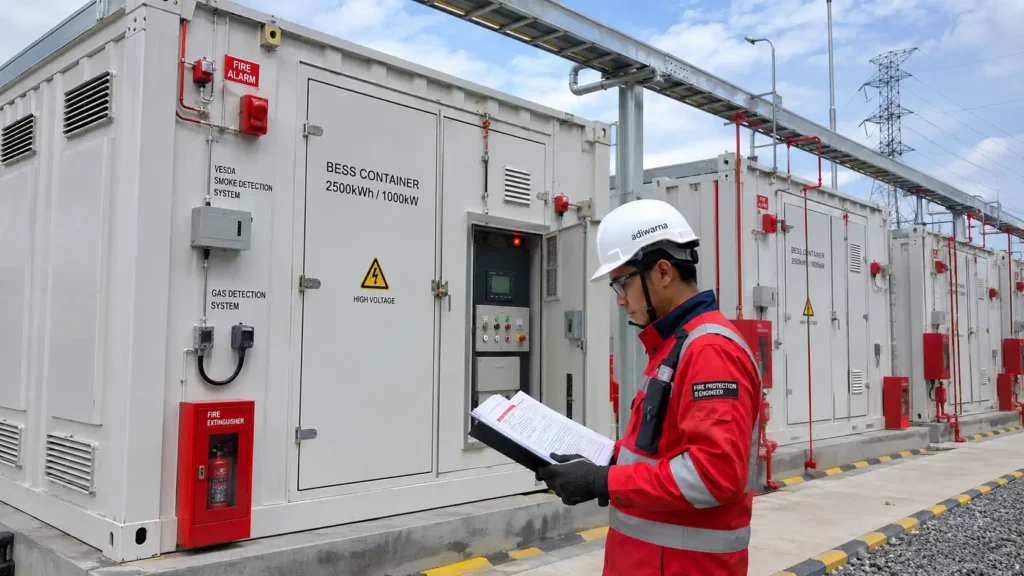
NFPA 855 BESS is an important consideration when designing safety systems for Battery Energy Storage Systems because energy storage installations present hazards that differ from those found in conventional electrical facilities. Lithium-ion batteries, for example, can experience thermal runaway that may generate heat, flammable gases, fire, cell-to-cell propagation, and potential deflagration hazards.
NFPA 855 is formally titled Standard for the Installation of Stationary Energy Storage Systems. The current edition is NFPA 855:2026, published by NFPA on October 13, 2025. The standard establishes minimum requirements intended to mitigate hazards associated with stationary Energy Storage System installations.
View the official NFPA 855 standard information.
Therefore, BESS fire protection should not focus only on selecting detectors or extinguishing agents. The design should also consider battery chemistry, system configuration, thermal runaway, gas release, fire propagation, shutdown functions, explosion protection, testing, commissioning, and emergency response.
Quick Answer
NFPA 855 BESS refers to the application of NFPA 855 requirements to Battery Energy Storage Systems. The standard addresses stationary ESS installation safety, including electrochemical ESS, lithium battery storage, fire protection, hazard mitigation, decommissioning, and firefighting considerations. Implementation should also consider system data, UL 9540 and UL 9540A results, engineering analysis, manufacturer requirements, and Authority Having Jurisdiction approval.
What Is NFPA 855 BESS?
The term NFPA 855 BESS is commonly used when discussing how NFPA 855 applies to Battery Energy Storage System installations.
A BESS stores electrical energy in batteries and releases that energy when required. Applications include renewable energy integration, grid support, industrial facilities, data centers, commercial buildings, microgrids, and utility-scale energy storage.
NFPA 855 provides minimum requirements for mitigating hazards associated with stationary ESS. The 2026 edition includes sections covering general requirements, electrochemical energy storage systems, decommissioning, and lithium-metal or lithium-ion battery storage.
The standard also includes supporting annex material addressing:
- BESS hazards;
- firefighting considerations;
- ESS technologies;
- permits and inspections;
- system approvals;
- lithium-ion ESS fire suppression and safety considerations.
Access NFPA 855:2026 through NFPA LiNK.
Why Is NFPA 855 BESS Important?
Battery Energy Storage Systems can store significant amounts of electrical energy within relatively compact installations.
When a lithium-ion battery experiences a failure, heat from one cell can affect surrounding cells and potentially initiate thermal runaway propagation.
Thermal runaway can result in:
- rapidly increasing temperature;
- battery venting;
- flammable gas release;
- smoke;
- fire;
- cell-to-cell propagation;
- module-to-module propagation;
- deflagration;
- possible reignition.
UL Solutions describes thermal runaway as a battery failure condition where overheating can result in the release of flammable gases and, under certain conditions, ignition.
Learn more about large-scale BESS fire testing from UL Solutions.
Gas accumulation is another important consideration. Research by the Fire Safety Research Institute has demonstrated that cascading lithium-ion battery thermal runaway can generate conditions capable of developing into deflagration and creating severe hazards for emergency responders.
Read the FSRI report on a lithium-ion BESS deflagration incident.
Therefore, NFPA 855 should not be viewed solely as a fire-extinguishing standard. BESS safety requires consideration of several interacting hazards and protection layers.
Scope of NFPA 855 BESS
NFPA 855 addresses stationary energy storage systems and is not limited only to lithium-ion BESS.
However, electrochemical energy storage systems are particularly important because battery technologies are increasingly used in modern energy storage applications.
Areas that may require evaluation in a BESS project include:
- battery technology and chemistry;
- energy storage capacity;
- indoor or outdoor installation;
- module, rack, cabinet, or container configuration;
- separation between units;
- fire detection;
- thermal monitoring;
- off-gas detection;
- fire suppression;
- explosion prevention;
- deflagration control;
- emergency shutdown;
- ventilation;
- commissioning;
- maintenance;
- decommissioning;
- emergency response planning.
Specific limits and technical requirements should always be verified against the applicable NFPA 855 edition, product listing, fire-test documentation, project specifications, and Authority Having Jurisdiction requirements.
NFPA 855 BESS and Thermal Runaway Risks
NFPA 855 BESS is closely related to thermal runaway because lithium-ion battery failure can progress from a single cell to an entire module, rack, or surrounding BESS unit if propagation is not controlled.
Thermal runaway occurs when internal battery reactions generate heat faster than the battery can dissipate it.
The event can produce:
- venting;
- flammable off-gases;
- smoke;
- flames;
- pressure increase;
- thermal propagation.
UL Solutions uses UL 9540A to evaluate thermal runaway fire propagation in Battery Energy Storage Systems.
Testing may be conducted at:
- cell level;
- module level;
- unit level;
- installation level.
This approach provides information that can be more representative of actual BESS configurations.
Learn about the UL 9540A test method.
For a more detailed discussion of this failure mechanism, see Adiwarna’s supporting article on lithium battery thermal runaway.
Fire Detection in NFPA 855 BESS
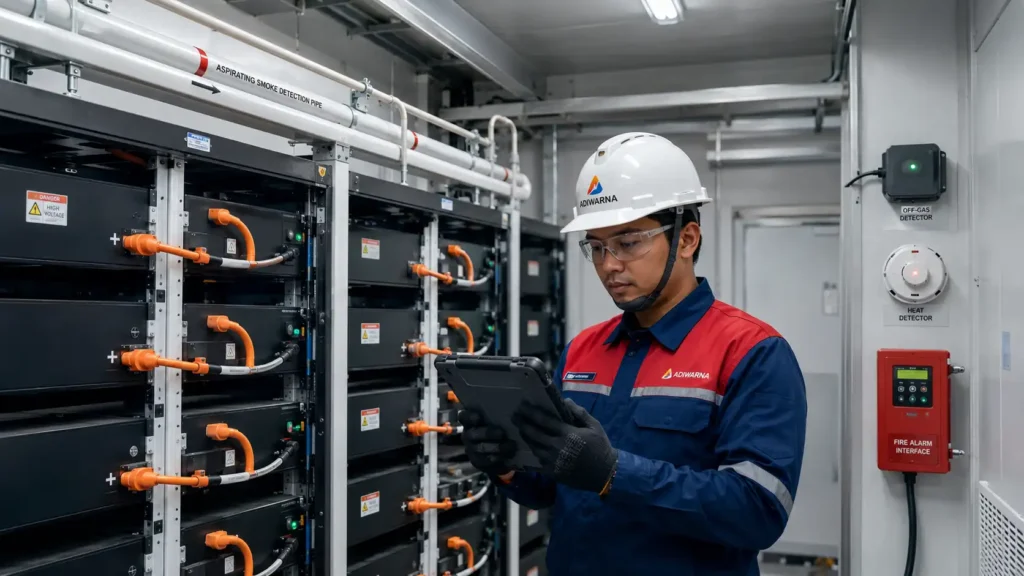
Fire detection is an important protection layer for BESS installations.
The system should identify abnormal conditions as early as practical before an incident develops into extensive propagation or fire.
Depending on the hazard and system configuration, detection technologies may include:
- conventional smoke detection;
- aspirating smoke detection;
- heat detection;
- battery monitoring;
- thermal monitoring;
- off-gas detection.
A fire alarm control panel may then serve as an integration point for predetermined cause-and-effect actions.
Depending on the engineering design, these actions can include:
- visual and audible alarms;
- notification to a control room;
- communication with a Building Management System;
- equipment shutdown;
- HVAC control;
- emergency ventilation;
- suppression-system activation.
For more information about detection and alarm systems, see Adiwarna’s Fire Alarm Systems.
Fire Suppression in NFPA 855 BESS
NFPA 855 BESS should not be interpreted as requiring the same extinguishing medium for every battery storage installation.
Battery technologies and installation configurations may have different fire behavior. Therefore, suppression-system selection should consider:
- battery chemistry;
- enclosure configuration;
- cooling requirements;
- thermal propagation;
- fire-test results;
- ventilation;
- gas accumulation;
- surrounding exposures;
- water availability.
Depending on the specific project, systems that may be evaluated include:
- automatic sprinklers;
- water spray systems;
- deluge systems;
- water mist;
- gaseous fire suppression;
- local application systems;
- combinations of multiple protection methods.
A suppression system that extinguishes visible flames does not necessarily stop thermal runaway reactions inside battery cells.
Research into BESS incidents has demonstrated why cascading thermal runaway and gas accumulation must be considered in addition to visible flame.
Read the FSRI BESS incident investigation.
To understand automatic suppression components, read Adiwarna’s guide to Fire Suppression System Equipment.
NFPA 855 BESS and Explosion Control
Fire is not the only hazard that should be evaluated in NFPA 855 BESS applications.
Lithium-ion batteries undergoing thermal runaway can release flammable gases before or during a fire event.
If those gases accumulate inside an enclosure and later encounter an ignition source, deflagration may occur.
FSRI has conducted experiments involving:
- prompt ignition of flammable off-gases;
- delayed ignition following gas accumulation;
- propagating thermal runaway.
These studies demonstrate why gas accumulation and deflagration should be considered as part of ESS safety analysis.
Read FSRI research on explosion hazards from lithium-ion battery thermal runaway.
Depending on the hazard analysis, BESS installations may require evaluation of:
- gas detection;
- mechanical ventilation;
- emergency exhaust;
- pressure relief;
- explosion prevention;
- deflagration venting;
- emergency shutdown;
- enclosure design;
- ignition-source control.
The sequence between gas detectors, fire alarm systems, HVAC, emergency exhaust, battery shutdown, and fire suppression should be established through engineering analysis.
Ventilation should not simply be programmed to activate immediately under every abnormal condition without considering gas concentration and ignition risks.
NFPA 855 BESS and Emergency Response
BESS fire protection should also address emergency responder safety.
Firefighters may face hazards that are not immediately visible, including:
- energized electrical equipment;
- flammable gas accumulation;
- toxic combustion products;
- continuing thermal runaway;
- battery reignition;
- explosion hazards.
A well-known BESS incident in Surprise, Arizona involved cascading thermal runaway within a 2.16 MWh lithium-ion energy storage system. The event developed into a deflagration and seriously injured four firefighters.
The incident highlights the importance of:
- responder training;
- situational awareness;
- gas monitoring;
- explosion prevention;
- emergency planning;
- appropriate exclusion zones.
Read the FSRI incident report.
NFPA 855:2026 also provides annex material addressing BESS hazards and firefighting considerations.
What Is the Relationship Between NFPA 855 BESS and UL 9540?
NFPA 855 BESS, UL 9540, and UL 9540A perform different functions.
They should not be treated as interchangeable standards.
| Standard or Test Method | Primary Function |
|---|---|
| NFPA 855 | Installation requirements for stationary Energy Storage Systems |
| UL 9540 | Safety standard for Energy Storage Systems and Equipment |
| UL 9540A | Test method for thermal runaway fire propagation in BESS |
UL Solutions explains that UL 9540A is referenced by NFPA 855 and other fire and building codes when evaluating thermal runaway fire propagation.
Learn more about UL 9540A from UL Solutions.
Why Is UL 9540A Important for NFPA 855 BESS?
UL 9540A provides data about how an energy storage system behaves when thermal runaway is initiated.
The test can help evaluate:
- whether thermal runaway propagates to neighboring cells;
- propagation within a module;
- unit-level behavior;
- gas release;
- heat release;
- flame spread;
- installation configuration;
- performance of selected fire protection measures.
UL Solutions explains that the test method can be used when evaluating ESS safety behavior and when installation conditions require analysis beyond prescriptive code limits.
However, having a UL 9540A report does not automatically mean that an entire BESS installation complies with NFPA 855.
Test results still need to be translated into:
- project design;
- equipment configuration;
- fire protection strategy;
- hazard analysis;
- installation documentation;
- AHJ approval.
NFPA 855 BESS 2026: What Has to Be Considered?
The current edition is NFPA 855:2026.
The 2026 edition includes revisions and reorganized requirements, including consolidation of general ESS requirements into Chapter 4.
View NFPA’s information for the 2026 edition.
The edition includes sections and supporting material related to:
- general ESS requirements;
- electrochemical energy storage systems;
- lithium-ion and lithium-metal battery storage;
- decommissioning;
- BESS hazards;
- firefighting considerations;
- ESS technologies;
- permits;
- inspections;
- approvals;
- fire suppression and lithium-ion ESS safety.
Because standards evolve as energy-storage technology and research advance, engineers should verify the edition required by the project rather than automatically applying an older version.
Does NFPA 855 BESS Apply in Indonesia?
NFPA 855 is an NFPA standard developed in the United States.
Its use in Indonesia should therefore be coordinated with:
- Indonesian regulations;
- applicable SNI requirements;
- project specifications;
- owner requirements;
- insurance requirements;
- consultant requirements;
- equipment listings;
- local authorities.
NFPA 855 should not automatically be considered a replacement for Indonesian regulations.
However, NFPA standards may be specified as technical references for international projects, data centers, industrial facilities, energy infrastructure, insurer-driven projects, and facilities operated according to global engineering standards.
For complex projects, engineers should prepare a compliance matrix comparing:
- NFPA requirements;
- applicable Indonesian regulations;
- SNI requirements;
- manufacturer requirements;
- insurer requirements;
- project specifications.
NFPA 855 BESS Implementation Checklist
Use the following checklist as an initial planning guide before determining the final fire protection strategy.
Battery Data
Confirm:
- battery chemistry;
- energy capacity;
- cell format;
- module configuration;
- rack arrangement;
- Battery Management System;
- charging characteristics;
- permitted operating temperature.
Testing Documentation
Review:
- UL 9540 listing where applicable;
- UL 9540A test reports;
- manufacturer fire-test reports;
- gas-release information;
- propagation data.
Installation Conditions
Determine whether the system is installed:
- indoors;
- outdoors;
- in a container;
- in a dedicated battery room;
- on a rooftop;
- within an industrial facility.
Also evaluate:
- emergency access;
- separation;
- fire compartmentation;
- drainage;
- exposure to neighboring equipment.
Fire Detection
Determine whether the installation requires:
- smoke detectors;
- aspirating smoke detection;
- heat detection;
- off-gas detection;
- integration with the BMS.
Fire Suppression
Define the objective of the suppression system first.
Possible objectives include:
- flame suppression;
- cooling;
- exposure protection;
- propagation control.
Explosion Protection
Evaluate:
- flammable gas generation;
- ventilation;
- enclosure pressure;
- deflagration risk;
- ignition sources.
Cause-and-Effect
Document the sequence between:
- BMS;
- fire detectors;
- fire alarm;
- HVAC;
- emergency shutdown;
- ventilation;
- fire suppression;
- notification systems.
Emergency Response
Prepare:
- emergency response plans;
- site information;
- equipment isolation procedures;
- exclusion zones;
- responder access;
- remote system data.
Testing and Commissioning
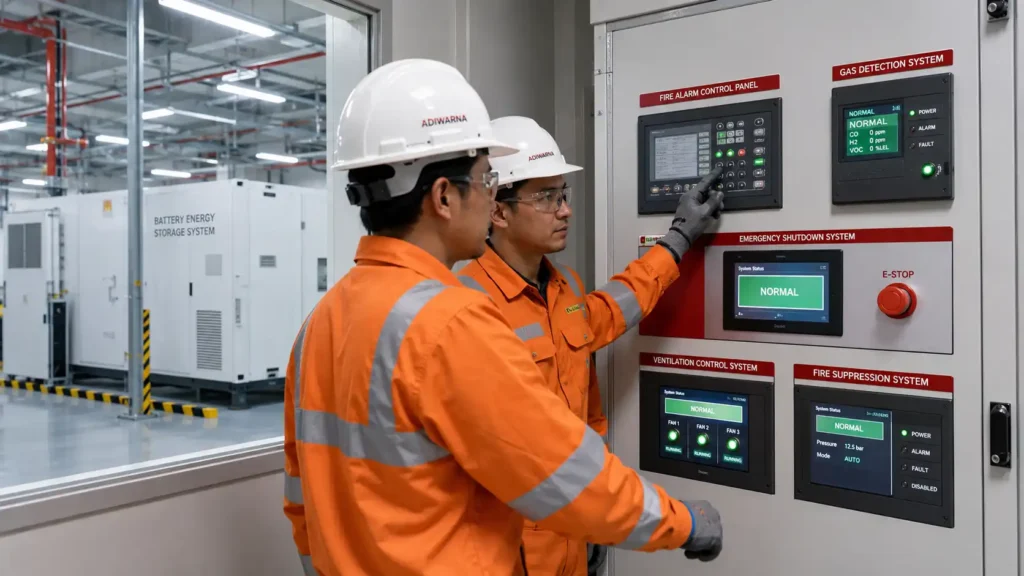
Verify every relevant:
- alarm;
- shutdown;
- ventilation function;
- suppression sequence;
- interlock;
- notification function
before the BESS enters full operation.
Common Mistakes in NFPA 855 BESS Implementation
Focusing Only on Fire Suppression
NFPA 855 covers much more than extinguishing systems.
BESS hazards should also be evaluated from the perspective of:
- installation configuration;
- thermal propagation;
- electrical conditions;
- gas release;
- explosion risks;
- commissioning;
- emergency response;
- decommissioning.
Treating UL 9540A as a Fire Suppression Certification
UL 9540A is a thermal runaway fire propagation test method.
It is not a certification for an extinguishing agent or suppression product.
Its results provide data that can be used to understand how a BESS may behave under failure conditions.
Copying Another BESS Project’s Design
Battery chemistry, module arrangement, enclosure design, stored energy, ventilation, and fire-test results can vary significantly between projects.
Therefore, a design that is appropriate for one installation should not automatically be reused elsewhere.
Relying Only on Fire Alarm Systems
Fire alarms are an important protection layer, but BESS safety may also require:
- Battery Management Systems;
- off-gas detection;
- thermal monitoring;
- fire suppression;
- explosion mitigation;
- shutdown strategies.
Involving the AHJ Too Late
Late coordination can result in major changes to:
- layout;
- separation distances;
- fire protection systems;
- testing requirements;
- project documentation.
AHJ coordination should begin during the design-development stage.
How to Choose a Contractor for NFPA 855 BESS Implementation
A contractor working with BESS should understand more than detector installation and suppression cylinders.
The engineering team should be capable of:
- Understanding battery data and system hazards.
- Reviewing UL 9540A reports.
- Evaluating fire detection requirements.
- Evaluating gas and explosion hazards.
- Developing a fire protection philosophy.
- Preparing a cause-and-effect matrix.
- Integrating BMS and fire alarm systems.
- Integrating shutdown and HVAC controls.
- Performing testing and commissioning.
- Preparing documentation and maintenance plans.
PT Adiwarna Anugerah Abadi Tbk provides design and engineering, supply, installation, testing and commissioning, as well as service and maintenance for fire protection systems.
For technical consultation, visit the Adiwarna contact page.
For facilities containing UPS and battery systems, you can also read Adiwarna’s guide to data center fire protection.
FAQ About NFPA 855 BESS
What Does NFPA 855 BESS Mean?
NFPA 855 BESS refers to the application of NFPA 855 requirements to Battery Energy Storage Systems.
NFPA 855 is the Standard for the Installation of Stationary Energy Storage Systems and provides minimum requirements intended to reduce hazards associated with ESS installations.
Is NFPA 855 BESS Only for Lithium Batteries?
No.
NFPA 855 addresses several stationary energy storage technologies. However, the 2026 edition includes dedicated requirements for electrochemical ESS and lithium-metal or lithium-ion battery storage because these technologies have specific hazard characteristics.
What Is the Difference Between NFPA 855 and UL 9540A?
NFPA 855 establishes requirements for stationary ESS installations.
UL 9540A is a test method for evaluating thermal runaway and fire propagation.
UL 9540A test data can therefore support engineering and compliance evaluations associated with NFPA 855.
Does NFPA 855 BESS Require Clean Agent Fire Suppression?
It is not accurate to assume that NFPA 855 always requires a specific extinguishing agent for all BESS installations.
The fire protection strategy should consider:
- battery technology;
- system configuration;
- fire-test results;
- hazard analysis;
- installation requirements.
Why Is Thermal Runaway Important in NFPA 855 BESS?
Thermal runaway can generate heat, flammable gases, fire, and propagation to neighboring cells or modules.
UL 9540A is specifically used to evaluate thermal runaway fire propagation in battery energy storage systems.
Does NFPA 855 BESS Address Explosion Risks?
BESS safety must also account for flammable gases and deflagration hazards.
Research into lithium-ion BESS incidents has shown that gases generated during cascading thermal runaway can accumulate and create an explosion hazard.
Read the FSRI BESS incident study.
What Is the Latest Edition of NFPA 855?
As of August 2026, the latest edition is NFPA 855:2026.
The edition was published on October 13, 2025.
View NFPA 855 information from NFPA.
Consult Adiwarna About NFPA 855 BESS
Implementing NFPA 855 BESS requires coordination between battery systems, fire detection, alarms, suppression, ventilation, electrical shutdown, explosion mitigation, and emergency response.
Because every BESS can differ in battery chemistry, stored energy, layout, enclosure design, and fire-test results, the fire protection strategy should be based on project-specific technical information.
PT Adiwarna Anugerah Abadi Tbk can support fire protection requirements involving design and engineering, fire detection, fire alarms, fire suppression, installation, testing and commissioning, and preventive maintenance.
To discuss protection requirements for your Battery Energy Storage System, contact the Adiwarna team for an initial technical assessment.
Conclusion
NFPA 855 BESS is an important reference when designing the safety of Battery Energy Storage Systems. NFPA 855:2026 addresses stationary ESS broadly, including general requirements, electrochemical ESS, lithium battery storage, decommissioning, BESS hazards, firefighting considerations, and related safety topics.
However, compliance should not rely on a single standard alone.
Engineers should also evaluate:
- UL 9540;
- UL 9540A;
- manufacturer documentation;
- battery chemistry;
- fire-test results;
- project specifications;
- local regulations;
- AHJ requirements.
This integrated approach allows NFPA 855 BESS to be applied as part of a comprehensive energy-storage safety strategy rather than simply as a fire suppression checklist.