

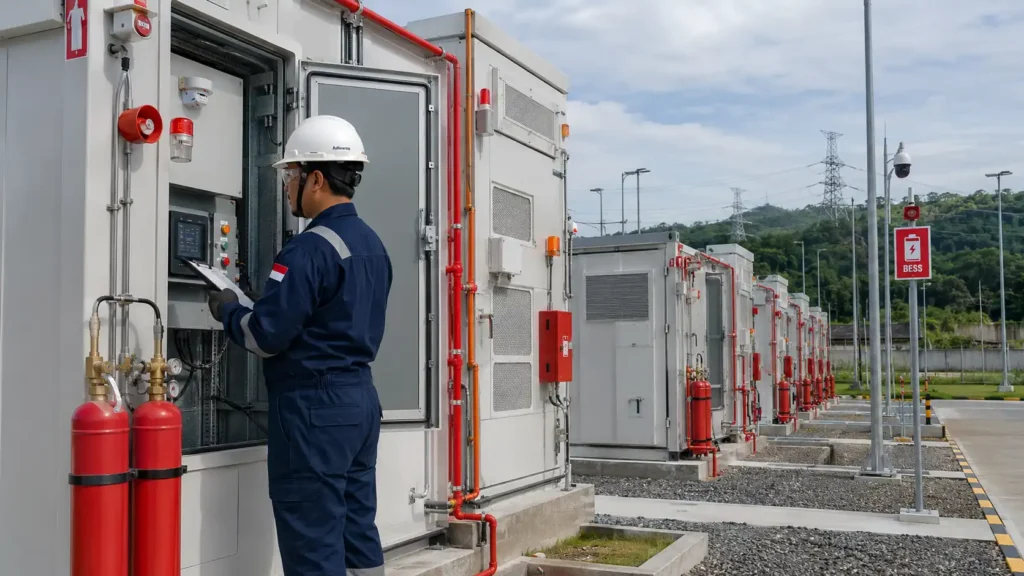
A BESS fire protection system is designed to detect, control, and reduce the impact of fire incidents within a Battery Energy Storage System. Protection requires more than detectors and extinguishing agents. Battery monitoring, thermal runaway mitigation, gas detection, ventilation, separation, emergency shutdown, and response planning are also essential.
Lithium-ion battery failures can create heat, fire, explosion hazards, and hazardous chemical releases. Therefore, BESS protection must consider battery chemistry, storage capacity, rack or container configuration, installation location, test results, and applicable standards.
This article explains the components, working principles, standards, detection methods, fire suppression options, and planning considerations for protecting energy storage facilities.
Quick Answer
A BESS fire protection system is a layered safety arrangement that combines a Battery Management System, smoke and heat detection, off-gas monitoring, fire alarms, shutdown controls, ventilation, explosion mitigation, and fire suppression. Final design should consider battery chemistry, UL 9540A test results, installation requirements, risk analysis, and the facility’s emergency response plan.
What Is a BESS Fire Protection System?
A Battery Energy Storage System, or BESS, stores electrical energy in batteries so it can be used when required. Systems may be installed in dedicated battery rooms, cabinets, racks, containers, separate buildings, industrial facilities, data centers, renewable energy plants, or utility sites.
A BESS fire protection system combines technical equipment and operational procedures intended to:
- prevent abnormal battery conditions from developing into fires;
- identify battery failures as early as possible;
- limit thermal runaway propagation;
- reduce fire and explosion hazards;
- provide alarms to operators;
- stop charging or discharging when necessary;
- protect occupants and emergency responders;
- minimize damage to surrounding equipment and buildings.
NFPA 855 establishes minimum requirements intended to mitigate hazards associated with stationary energy storage system installations. Its requirements address energy storage installations, fire protection considerations, inspections, permitting, and system safety.
Why Does BESS Require Specialized Fire Protection?
Battery fires do not necessarily behave like conventional fires involving ordinary combustible materials. In lithium-ion batteries, internal damage, electrical abuse, mechanical damage, overheating, manufacturing defects, or abnormal operating conditions can initiate thermal runaway.
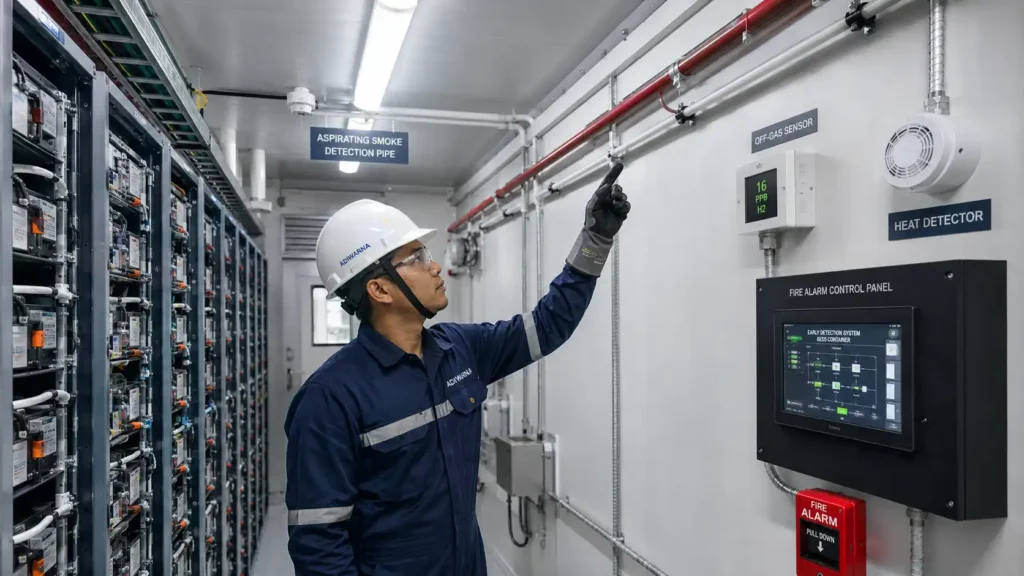
Thermal runaway is a rapid temperature increase caused when internal chemical reactions generate heat faster than the battery can release it. The event may lead to venting, gas release, flames, pressure increase, and failure of nearby cells.
Major hazards that should be evaluated include:
1. Thermal Runaway Within a Cell
A failure may begin at cell level and escalate rapidly if heat generation becomes uncontrollable.
2. Cell-to-Cell or Module-to-Module Propagation
Heat released by one battery cell can trigger thermal runaway in adjacent cells or modules.
3. Flammable Gas Release
Battery failure may release combustible gases that accumulate inside cabinets, rooms, or containers before ignition occurs.
4. Deflagration or Explosion
Accumulated gases within their flammable concentration range may ignite when they encounter an ignition source.
5. Smoke and Hazardous Chemicals
Lithium-ion battery failure can produce carbon monoxide and other hazardous compounds. Depending on battery chemistry and fire conditions, hazardous gases may also be released.
6. Reignition
Damaged battery cells may continue storing energy and heat after visible flames have been extinguished. As a result, batteries can reignite after the initial incident.
Therefore, fire suppression should never be treated as the only layer of BESS protection.
How Does a BESS Fire Protection System Work?
An effective system uses multiple protection layers that work together.
| Protection Layer | Main Function |
|---|---|
| Prevention | Keeps batteries within safe operating limits |
| Monitoring | Detects changes in temperature, voltage, current, and battery condition |
| Early detection | Identifies smoke, heat, off-gas, or other abnormal conditions |
| Alarm and control | Warns personnel and activates safety interlocks |
| Shutdown | Stops charging, discharging, or selected energy sources |
| Propagation mitigation | Limits heat and failure spreading between battery units |
| Fire suppression | Controls fire according to the design and fire testing |
| Explosion control | Reduces combustible gas accumulation or explosion consequences |
| Emergency response | Supports operators and firefighters during an incident |
| Post-event monitoring | Monitors temperature, gas, and potential reignition |
A layered approach is important because no single detector or extinguishing agent can address every possible battery failure scenario.
Typical Operating Sequence
- The BMS detects battery parameters outside normal operating limits.
- The system sends a warning or alarm to operators.
- Fire detection or off-gas detection identifies early indications of failure.
- The control system activates alarms and safety interlocks.
- Charging or discharging is stopped when appropriate.
- Ventilation or explosion-control systems operate according to the cause-and-effect matrix.
- Fire suppression is activated according to the approved system logic.
- Operators and emergency responders receive information about system conditions.
- The affected area remains monitored for temperature changes, gases, and possible reignition.
This sequence should be verified during testing and commissioning.
Main Components of a BESS Fire Protection System
1. Battery Management System
A Battery Management System, or BMS, monitors important battery operating parameters such as:
- cell or module temperature;
- voltage;
- current;
- state of charge;
- state of health;
- cell imbalance;
- charging and discharging conditions;
- faults and communication failures.
The BMS acts primarily as a prevention and monitoring layer. However, it does not necessarily replace a dedicated fire alarm system designed for fire detection and life-safety notification.
When the two systems are integrated, the design should clearly determine what information is exchanged, which automatic actions occur, and who receives each alarm.
2. Smoke Detection System
Smoke detectors can detect combustion products generated during a battery incident. Selection should consider airflow, room size, battery rack arrangement, cooling systems, and possible environmental interference.
For applications requiring highly sensitive detection, aspirating smoke detection systems can continuously sample air through a network of pipes to identify very low concentrations of airborne particles.
However, smoke detection may respond only after combustion particles appear. Therefore, it can be complemented by battery monitoring and off-gas detection.
3. Heat Detection and Thermal Monitoring
Heat detectors generate alarms when temperature reaches a predetermined level or rises at an abnormal rate.
Thermal sensors and thermal cameras can also help operators identify abnormal heating in cabinets, electrical terminals, connections, or other parts of the installation.
However, thermal imaging should not be used as the sole method for determining internal battery conditions because heat generated within cells or modules may not always be clearly visible on external surfaces.
4. Off-Gas Detection
Off-gas detection systems are designed to identify gases or compounds released during early stages of battery failure.
Earlier warning may provide valuable time to:
- stop battery charging;
- isolate affected equipment;
- issue an alarm;
- activate ventilation according to the safety strategy;
- prepare an emergency response;
- prevent personnel from entering a hazardous area.
Sensor selection should consider battery chemistry, test results, enclosure configuration, and the target gases that need to be detected.
5. Fire Alarm and Control Panel
The fire alarm control panel receives signals from detectors and executes predetermined cause-and-effect sequences.
Integrated actions may include:
- audible and visual alarms;
- notifications to a control room;
- equipment shutdown;
- charging interruption;
- fire damper activation;
- HVAC control;
- ventilation activation;
- fire suppression release;
- communication with the building management system;
- notifications to the emergency response team.
Learn more about its role in our guide to fire alarm systems for early warning.
6. Ventilation and Explosion Control
Battery failure may release combustible gases that can accumulate inside an enclosure.
A BESS design may therefore require:
- gas monitoring;
- mechanical ventilation;
- emergency exhaust;
- pressure relief;
- deflagration venting;
- explosion prevention;
- physical isolation;
- safe separation distances;
- control logic to reduce potential ignition sources.
Ventilation should not be activated automatically without proper analysis. Changes in airflow can influence gas concentrations, heat movement, and fire development.
For this reason, ventilation sequence should be determined through engineering analysis and incorporated into the emergency response strategy.
Fire Suppression Options for BESS Fire Protection System
There is no single extinguishing medium that is automatically appropriate for every BESS configuration.
Selection should consider:
- battery chemistry;
- stored energy capacity;
- cell, module, rack, or container configuration;
- indoor or outdoor installation;
- enclosure characteristics;
- ventilation systems;
- UL 9540A results;
- cooling requirements;
- propagation risk;
- electrical hazards;
- impact on nearby facilities;
- personnel safety;
- Authority Having Jurisdiction requirements.
Water-Based BESS Fire Protection System
Water has a high heat-absorption capacity and can play an important role in cooling batteries and controlling thermal propagation.
Water-based systems may include:
- automatic sprinklers;
- water spray;
- deluge systems;
- water mist;
- hose streams for emergency firefighting.
However, effectiveness depends on whether water can reach the affected battery area, discharge density, rack configuration, drainage, and fire testing results.
Clean Agent and Inert Gas Systems
Clean agent and inert gas systems may be used to suppress certain types of fire without leaving residue on sensitive equipment.
However, suppressing visible flames does not always mean that thermal runaway reactions inside battery cells have stopped.
Therefore, system selection must consider cooling requirements, test data, ventilation, combustible gas hazards, explosion mitigation, and emergency response—not merely the ability of an extinguishing agent to eliminate visible flames.
To learn more about gaseous fire suppression components, see our guide to fire suppression system equipment for critical assets.
Local Application or Rack-Level Suppression
Local application systems target individual cabinets, racks, or specific battery zones.
Their main advantage is the ability to deliver suppression closer to the source of an incident.
However, the design should confirm that the system can reliably identify the affected area, limit propagation, and avoid creating a false assumption of safety if thermal runaway continues inside battery cells.
Selection Based BESS Fire Protection System on Fire Testing
Fire test data should play an important role in protection-system selection.
UL 9540A evaluates thermal runaway and potential propagation at several levels:
- cell;
- module;
- unit;
- installation.
Testing can provide information about:
- temperature;
- gas release;
- flame spread;
- heat release;
- pressure;
- propagation behavior;
- separation requirements;
- performance of suppression measures.
The Role of UL 9540 and UL 9540A for BESS Fire Protection Sytstem
UL 9540 and UL 9540A serve different purposes.
| Standard | Main Focus |
| UL 9540 | Safety of energy storage systems and equipment as an integrated system |
| UL 9540A | Test method for evaluating thermal runaway and fire propagation |
| NFPA 855 | Installation requirements for stationary energy storage systems |
UL 9540A is not a fire suppression product standard. Instead, it is a test method used to evaluate how batteries behave when thermal runaway is intentionally initiated and whether that condition propagates to surrounding components.
Why Is UL 9540A Data Important?
Test data can help engineers determine:
- separation distances;
- unit arrangement;
- fire barrier requirements;
- ventilation strategies;
- explosion potential;
- gas detection requirements;
- fire suppression strategies;
- installation-level testing needs;
- emergency response procedures.
Certification or listing of individual equipment does not replace the need to install the system according to its listing, manufacturer instructions, project design, and applicable local requirements.
BESS Fire Protection System Planning Checklist
Use the following checklist before determining the protection strategy.
Battery Information
- What battery chemistry is used?
- What is the total stored energy capacity?
- How are cells, modules, racks, and units configured?
- Is a UL 9540A report available?
- Does the system have relevant listing or certification?
- What are the charging and discharging conditions?
- What are the specified operating temperature limits?
Installation Conditions
- Is the BESS installed indoors or outdoors?
- Is it configured as a room, cabinet, rack, or container?
- What is the separation distance between units?
- How are evacuation routes and emergency access arranged?
- Are other critical facilities located nearby?
- Is fire compartmentation provided?
- Are drainage and containment systems available?
Detection and Control
- Which parameters are monitored by the BMS?
- Are smoke, heat, or aspirating detectors installed?
- Is off-gas detection required?
- How does the system communicate with the fire alarm panel?
- What automatic actions occur at each alarm stage?
- When is battery shutdown initiated?
- How does ventilation or pressure relief operate?
Fire Suppression and Mitigation
- Which hazards need to be controlled?
- Is battery cooling required?
- Has the extinguishing agent been tested on a comparable battery configuration?
- How will propagation between racks be limited?
- Is explosion control required?
- What water supply is available?
- How will water or suppression residue be managed after an incident?
Emergency Response
- Is an emergency response plan available?
- Do emergency responders have access to site information?
- Is manufacturer emergency contact information available?
- Can battery temperature and gas data be monitored from a safe location?
- How will exclusion zones be established?
- How long will post-event monitoring continue?
Common Mistakes in BESS Fire Protection System Design
Relying on Only One Type of Detector
Thermal runaway can develop through changes in electrical parameters, temperature, gas concentration, smoke generation, and pressure.
Therefore, relying on only one detection technology may create blind spots.
Treating the BMS as a Fire Alarm System
The BMS monitors battery health and operating parameters, while the fire alarm system performs dedicated fire safety and notification functions.
The two systems can communicate, but their responsibilities and operating logic should remain clearly defined.
Selecting an Extinguishing Agent Without Test Data
An extinguishing agent capable of suppressing visible flames may not stop internal cell reactions or prevent propagation.
Selection should therefore be supported by fire testing, hazard analysis, and manufacturer information.
Ignoring Gas and Explosion Hazards
Focusing only on visible fire can overlook the hazard of combustible gas accumulation.
Dangerous conditions may remain inside an enclosure even when flames are not visible.
Failing to Prepare Emergency Response Procedures
Information about battery chemistry, storage capacity, layout, shutdown procedures, gas monitoring, and exclusion zones should be available before an incident occurs.
Emergency response planning should not begin only after the BESS is placed into operation.
Copying Another Project’s Design
Every BESS installation can differ in energy capacity, battery chemistry, enclosure design, spacing, ventilation, and surrounding conditions.
Previous project designs should be treated only as references and must not be reused without a new engineering assessment.
How to Choose a BESS Fire Protection System Contractor

A contractor should understand fire protection as well as electrical systems, control integration, battery monitoring, and thermal runaway hazards.
Evaluate whether the contractor can:
- Conduct site surveys and hazard identification.
- Review battery data and UL 9540A reports.
- Develop a fire protection philosophy.
- Establish detection and alarm logic.
- Integrate BMS, fire alarm, HVAC, and shutdown systems.
- Evaluate fire suppression and explosion control requirements.
- Develop a cause-and-effect matrix.
- Perform testing and commissioning.
- Prepare documentation and as-built drawings.
- Provide preventive maintenance and technical support.
PT Adiwarna Anugerah Abadi Tbk provides design, supply, installation, testing, commissioning, and maintenance services for fire protection systems.
Specific BESS requirements should still be determined through a site survey, battery technical data, hazard analysis, and coordination with all relevant project stakeholders.
Frequently Asked Questions About BESS Fire Protection Systems
What Causes BESS Fire Protection System?
BESS fires can result from internal short circuits, overheating, overcharging, physical damage, manufacturing defects, cooling-system failures, or electrical faults.
In lithium-ion batteries, these conditions may initiate thermal runaway, resulting in heat generation, gas release, flames, and propagation to neighboring cells or modules.
Can Clean Agent BESS Fire Protection System Extinguish Lithium Battery Fires?
Clean agents can suppress flames under certain conditions, but they may not always stop thermal runaway inside battery cells.
Selection should consider cooling requirements, fire testing, enclosure configuration, ventilation, combustible gas hazards, and propagation risk.
Therefore, clean agent systems should not be selected solely because they leave no residue.
Does a BESS Fire Protection System Need Sprinklers?
Sprinkler requirements depend on the applicable standard, installation location, stored energy capacity, battery chemistry, system configuration, UL 9540A results, and local authority requirements.
Automatic sprinklers or other water-based systems may form part of a cooling and propagation-control strategy, but final design requires engineering analysis.
What Is the Function of Off-Gas Detection in a BESS?
Off-gas detection identifies gases released during early stages of battery failure.
Early warning can support charging shutdown, equipment isolation, alarm initiation, emergency procedures, and operator response before conditions develop into visible smoke, fire, or explosion.
What Is the Difference Between UL 9540 and UL 9540A?
UL 9540 evaluates the safety of an energy storage system and its equipment as an integrated system.
UL 9540A is a test method for evaluating thermal runaway and fire propagation at cell, module, unit, and installation levels.
Neither standard replaces NFPA 855 installation requirements.
Can Thermal Runaway Continue After the Fire Is Extinguished?
Yes. Internal reactions may continue producing heat even after visible flames disappear.
Damaged cells can also heat neighboring batteries and create a risk of reignition.
For this reason, temperature, gas levels, and equipment conditions should continue to be monitored after fire suppression.
How Much Does a BESS Fire Protection System Cost?
Cost depends on stored energy capacity, battery chemistry, enclosure size, detector requirements, fire alarm systems, gas detection, ventilation, explosion control, suppression systems, water supply, control integration, testing, and commissioning.
An accurate quotation requires technical battery information and a site assessment.
Consult Adiwarna for BESS Fire Protection System
A BESS fire protection system should be designed as an integrated safety system. BMS, detectors, fire alarms, off-gas monitoring, shutdown controls, ventilation, explosion mitigation, and fire suppression need to operate according to an approved and tested cause-and-effect strategy.
PT Adiwarna Anugerah Abadi Tbk can support the evaluation of fire detection, fire alarm, and fire suppression requirements for energy storage facilities.
The engineering team will require information about battery chemistry, storage capacity, system layout, enclosure design, test reports, and applicable project standards.
To begin a technical evaluation, contact the Adiwarna team and discuss the fire protection requirements for your battery energy storage facility.
Conclusion About BESS Fire Protection System
A BESS fire protection system cannot rely solely on fire extinguishing equipment. Effective protection combines prevention, BMS monitoring, early detection, gas monitoring, fire alarms, shutdown functions, ventilation, explosion control, suppression, and emergency response.
Technical decisions should also consider battery chemistry, installation configuration, UL 9540A test results, NFPA 855 requirements, manufacturer instructions, and hazard analysis.
With proper engineering and system integration, a facility can detect battery failures earlier, limit thermal runaway propagation, protect personnel, and reduce the operational and asset impact of a battery fire.