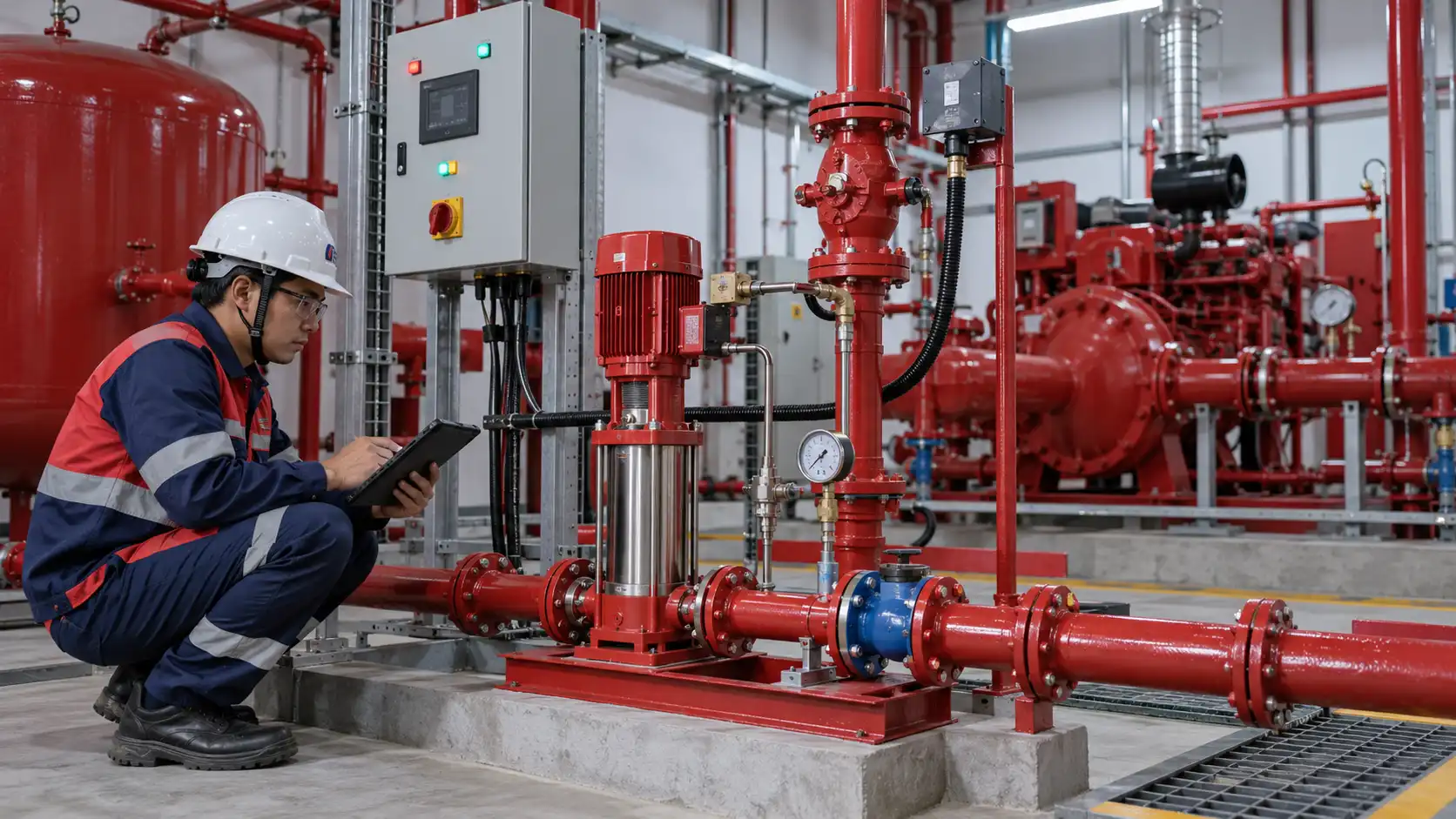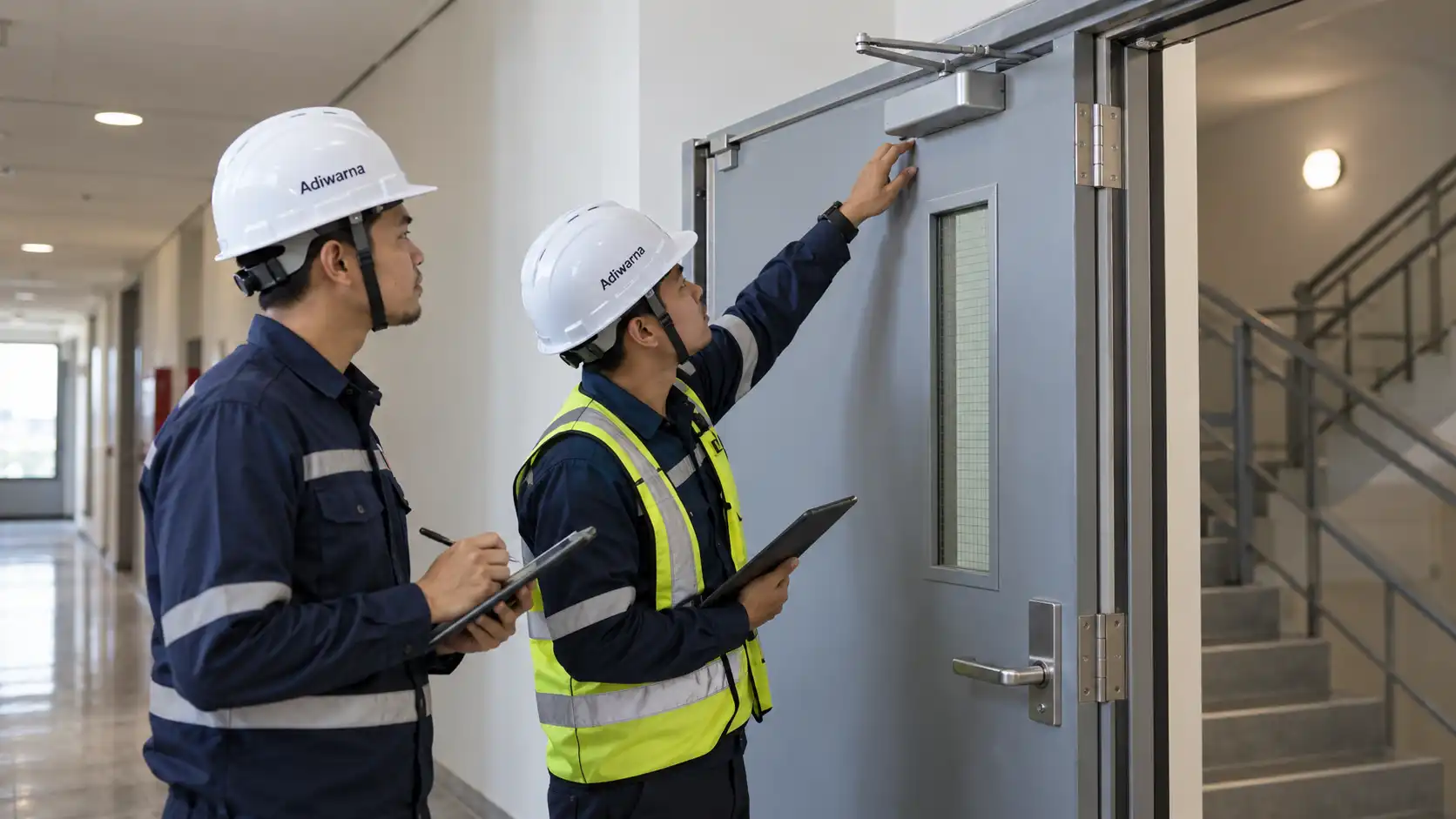


The difference addressable and conventional fire alarm systems mainly involves how each panel identifies devices, locates alarms, manages wiring, displays faults, and supports system expansion. Therefore, building owners should understand both technologies before selecting the most suitable system.
A conventional system generally identifies an alarm according to a predetermined zone. Meanwhile, an addressable system can identify an individual detector, module, or manual call point because every compatible field device has a unique address.
Furthermore, a small office building has different requirements from a hospital, hotel, shopping center, data center, factory, or industrial complex. Consequently, the selection process should consider building size, device quantity, risk level, integration requirements, initial investment, and future expansion plans.
For integrated planning and installation, PT Adiwarna Anugerah Abadi provides professional Fire Alarm System solutions for commercial buildings, industrial facilities, and high-risk operational areas.
Difference Addressable and Conventional. What Is a Conventional Fire Alarm System?
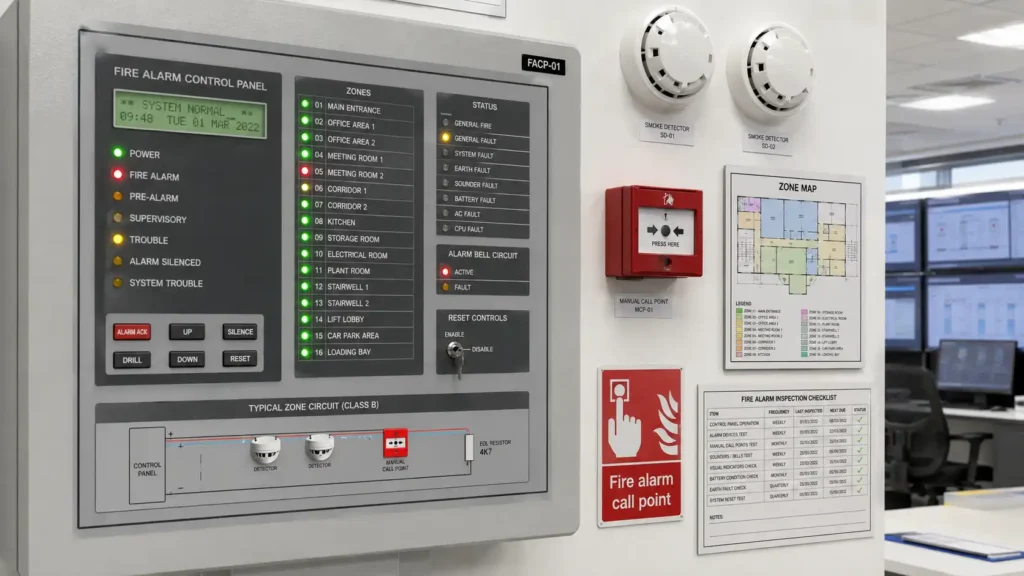
Difference Addressable and Conventional. A conventional fire alarm system divides a building into several detection zones. Therefore, when a detector or manual call point is activated, the control panel identifies the affected zone rather than the exact individual device.
For example, several smoke detectors on the second floor may be connected to Zone 2. When one device activates, the panel displays an alarm for Zone 2, although security personnel must still inspect the zone to find the exact source.
Additionally, conventional fire alarm control panels are available in different zone capacities. Smaller panels may support only a few zones, while larger models can accommodate more areas according to project requirements.
Because its architecture is relatively straightforward, a conventional system is often considered for small or medium-sized buildings with simple layouts. Nevertheless, its suitability must still be confirmed through engineering design, applicable regulations, and fire risk assessment.
How a Conventional Fire Alarm System Works
First, smoke detectors, heat detectors, and manual call points are connected to dedicated zone circuits. Then, the control panel continuously monitors the electrical condition of every circuit.
When one field device changes the circuit condition, the panel registers an alarm for the relevant zone. Afterward, alarm bells, sounders, strobes, or other notification devices activate according to the programmed configuration.
Meanwhile, an end-of-line resistor or supervision device is normally installed at the end of the circuit. As a result, the panel can distinguish between normal, alarm, open-circuit, and certain fault conditions, depending on the selected equipment.
Although the system is comparatively simple, zone division must remain clear and logical. Therefore, zone maps, panel labels, and location descriptions should always reflect the actual building layout.
Difference Addressable and Conventional. What Is an Addressable Fire Alarm System?
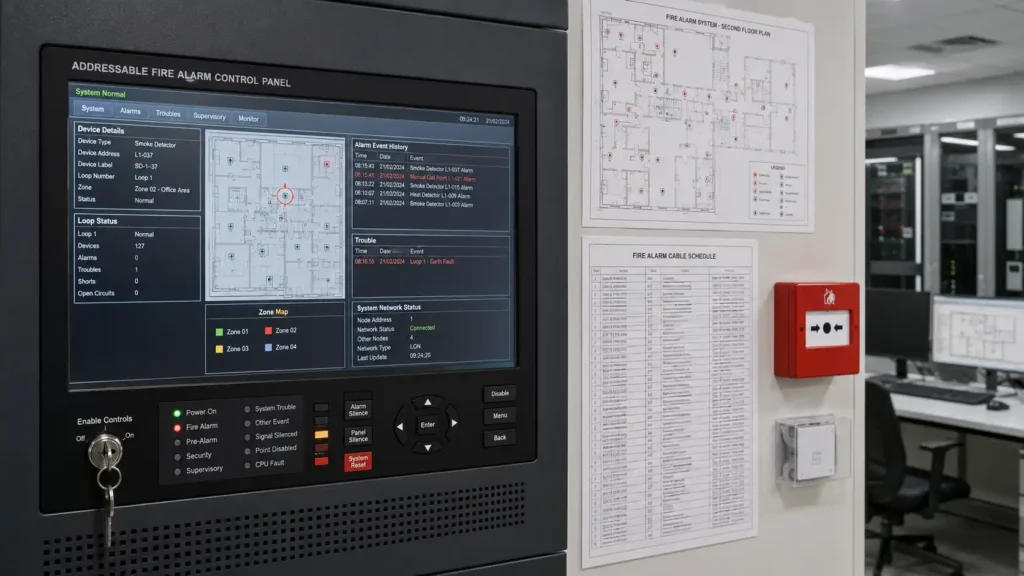
Difference Addressable and Conventional. An addressable fire alarm system assigns a unique identification address to every compatible field device. Therefore, the control panel can identify the specific detector, module, or manual call point that produces an alarm, supervisory, or trouble signal.
For example, instead of displaying only “Zone 5 Alarm,” the panel may show “Smoke Detector, Fifth Floor Server Room.” Consequently, security officers and emergency response personnel can reach the affected location more efficiently.
Furthermore, addressable systems can operate as standalone panels or as part of a larger network. Depending on the equipment capacity, the system may protect a small building, a multi-story facility, or an extensive industrial complex.
The Adiwarna article about a fully addressable fire alarm system provides additional information about individual device identification and intelligent monitoring.
How an Addressable Fire Alarm System Works
Difference Addressable and Conventional. Initially, detectors, manual call points, monitor modules, control modules, and other compatible equipment are connected to a signaling line circuit or addressable loop. Subsequently, the control panel communicates with every device through its programmed address.
When a detector identifies a fire condition, it sends its identity and status to the panel. Then, the control panel can activate a cause-and-effect sequence based on the location, device type, alarm stage, or programmed logic.
In addition, the panel can display detailed information about communication faults, missing devices, loop problems, and equipment status. Therefore, troubleshooting can be more targeted than checking every device within an entire zone.
However, an addressable system requires compatible equipment, accurate programming, and complete documentation. Consequently, installation and maintenance should be performed by technicians who understand the relevant manufacturer’s platform.
Main Difference Addressable and Conventional Fire Alarm Systems
The difference between addressable and conventional fire alarm systems can be evaluated through alarm identification, circuit architecture, wiring, troubleshooting, programming, scalability, and integration.
| Aspect | Conventional System | Addressable System |
|---|---|---|
| Alarm identification | Based on zone | Based on individual device |
| Panel information | Zone number or zone name | Device address and exact location |
| Detection circuit | Separate zone circuit | Addressable loop or SLC |
| Alarm investigation | Inspect devices within the zone | Begin at the device shown by the panel |
| Expansion | Limited by available zones | Flexible within loop and network capacity |
| Programming | Relatively simple | Requires device and logic programming |
| Troubleshooting | May require checking an entire zone | Faults can be localized more precisely |
| Initial cost | Usually lower for simple installations | Usually higher because of intelligent devices |
| Typical application | Small buildings with simple layouts | Large or complex facilities |
| System integration | Generally more limited | More flexible through intelligent modules |
Although this comparison illustrates common characteristics, product capabilities can vary considerably. Therefore, the manufacturer’s datasheet, compatibility list, technical manual, and project specifications must remain the primary references.
Difference Addressable and Conventional. Alarm Location Identification

The most noticeable difference involves how each system communicates the alarm location. A conventional panel usually indicates the affected zone, whereas an addressable panel identifies the individual device.
For instance, a conventional system may display “Alarm Zone 3.” In contrast, an addressable panel may show “Heat Detector, Third-Floor Kitchen.”
Because the second message provides more specific information, emergency personnel can begin their inspection at the indicated point. Therefore, device-level identification is highly useful in buildings with many floors, rooms, and detection devices.
Nevertheless, accurate information depends on correct device programming. Consequently, device labels, room descriptions, zone maps, loop drawings, and as-built documents must be prepared carefully.
Zone-Based Detection Versus Individual Device Addressing
Difference Addressable and Conventional. In a conventional installation, several detectors and manual call points can share one zone circuit. Therefore, the panel recognizes which circuit has entered an alarm condition, although it cannot normally identify the exact device directly.
By comparison, every addressable device has an identity that can be read by the control panel. As a result, operators receive more detailed information about the alarm or fault location.
Logical zones may still be created within an addressable system. However, the panel can continue displaying the individual device inside each logical group.
Through this approach, an addressable system provides both general area information and detailed device identification. Consequently, alarm management in complex facilities becomes more structured.
Installation and Wiring Differences
Difference Addressable and Conventional. A conventional system generally uses a separate detection circuit for each zone. Therefore, adding more zones may increase the amount of cable returning to the fire alarm control panel.
Furthermore, alarm bells, sounders, and strobes normally use separate notification appliance circuits. Consequently, wiring requirements can grow significantly in buildings with many detection zones.
In contrast, an addressable system connects many compatible field devices through one or more loops. Therefore, its main wiring architecture may be more flexible for large buildings.
However, an addressable system does not automatically use less cable in every project. Instead, actual requirements depend on circuit class, short-circuit isolators, notification devices, input-output modules, redundancy, and building layout.
Accordingly, the final decision should be based on approved fire alarm drawings and technical calculations. Moreover, designers need to consider fire-rated cable, containment routes, voltage drop, circuit supervision, and maintenance accessibility.
Difference Addressable and Conventional Control Panels
Difference Addressable and Conventional. A conventional fire alarm control panel manages input signals according to detection zones. Therefore, its interface normally provides individual indicators for each zone.
Meanwhile, an addressable control panel manages field devices according to unique addresses. As a result, its display can show device names, locations, alarm types, event histories, communication faults, and supervisory conditions.
Additionally, addressable panels usually support more complex cause-and-effect logic. For example, the panel can operate specific output modules according to a detector combination, alarm stage, building floor, or protected area.
However, advanced capability also requires disciplined programming management. Therefore, every software change should be documented, tested, backed up, and included in the final handover package.
Panel selection should also consider more than the initial number of detectors. Instead, the project team must review loop capacity, network capability, power supply, battery capacity, event history, graphical monitoring, and future expansion.
Speed of Locating a Fire Alarm
Difference Addressable and Conventional. When a conventional system activates, the panel guides personnel to the affected zone. Afterward, the response team must inspect the rooms or devices within that area.
Conversely, an addressable system immediately identifies the device that generated the signal. Therefore, verification can begin from a much more specific location.
In a small building, this difference may not significantly affect response time. However, in hospitals, hotels, shopping centers, campuses, factories, or large warehouses, individual device information can improve response efficiency.
Even so, personnel must still verify the event physically. Therefore, panel information should always be supported by operational procedures, internal communication, emergency response plans, and trained employees.
Difference Addressable and Conventional. Troubleshooting and Maintenance
In a conventional system, technicians may need to examine several devices within one zone before finding the source of a fault. Consequently, troubleshooting can take longer when a zone contains numerous detectors.
Meanwhile, an addressable panel may identify a specific missing device, loop fault, communication problem, or module condition. Therefore, technicians can narrow down the inspection area before entering the field.
Additionally, certain addressable detectors provide maintenance alerts or diagnostic information, depending on the manufacturer. As a result, preventive maintenance can become more focused.
However, addressable systems may require programming software, passwords, communication interfaces, and technicians familiar with the selected protocol. In comparison, conventional installations are often easier to understand when the building is small.
Ultimately, maintenance efficiency depends on more than system technology. Clear labeling, current drawings, spare-part availability, technician competency, and scheduled testing remain equally important.
Initial Cost and Total Cost of Ownership
A conventional fire alarm system often has a lower initial cost for a small building with only a few zones. Therefore, it may offer an economical solution when the layout and integration requirements are simple.
In comparison, addressable panels, intelligent detectors, modules, programming, and commissioning generally require a larger initial investment. Nevertheless, the additional features can provide important operational benefits.
The cost comparison should not focus only on equipment prices. Instead, owners should evaluate wiring quantity, installation time, future expansion, troubleshooting duration, downtime, software requirements, and lifecycle support.
For a large building, rapid alarm identification may produce significant long-term value. Therefore, an addressable system can become more cost-effective for facilities with complex operations.
A proper total-cost-of-ownership analysis should also include training, software access, maintenance agreements, replacement parts, battery renewal, and future product availability.
Scalability and Future Expansion
A conventional system is limited by the number of zones available on the control panel. Therefore, expansion may require an additional panel or significant circuit modification after all zones are occupied.
By contrast, an addressable system can be expanded by adding devices within the available loop capacity. Furthermore, larger projects may add loop cards, network nodes, or additional panels.
This flexibility makes addressable technology suitable for facilities expected to grow. Nevertheless, expansion must still respect panel capacity, loop loading, power supply, battery calculations, network topology, and manufacturer limitations.
Consequently, future development should be considered during the initial engineering phase. Otherwise, the owner may need expensive modifications when new rooms or building areas are added.
Integration with Other Building Systems
A conventional panel can provide alarm, fault, and supervisory outputs through relays or interface equipment. Therefore, basic integration with other systems remains possible.
However, an addressable system normally provides greater flexibility through monitor modules, control modules, network interfaces, graphical workstations, and BMS communication. As a result, monitoring and control functions can be managed more systematically.
Common integration functions include:
- Fire pump status monitoring.
- Sprinkler waterflow monitoring.
- Valve supervisory monitoring.
- Fire suppression releasing panel interface.
- Smoke-control system activation.
- Elevator recall.
- Access-control release.
- Emergency door release.
- Public-address and voice-evacuation systems.
- Building management system monitoring.
- Fire command center workstation.
- Remote annunciator panels.
Nevertheless, every integration function must follow an approved cause-and-effect matrix. Therefore, all inputs, outputs, interlocks, and sequences need functional and integrated testing.
Difference Addressable and Conventional. False Alarm Management
Addressable technology provides detailed device information. Moreover, some intelligent detectors support adjustable parameters, maintenance indications, or advanced signal-processing features.
However, an addressable system cannot automatically eliminate false alarms. Instead, unwanted alarms may still occur because of dirty detectors, dust, steam, humidity, construction work, unsuitable placement, electrical interference, or inadequate maintenance.
In a conventional system, personnel must inspect the devices inside the active zone. Consequently, locating the false alarm source may require a wider field inspection.
Therefore, preventing unwanted alarms requires proper detector selection, suitable placement, effective commissioning, good housekeeping, and periodic maintenance. Additionally, event histories should be reviewed to identify recurring patterns.
When Should You Choose a Conventional Fire Alarm System?
A conventional fire alarm system may be considered when a building is small, easy to understand, and divided into only a few detection zones. Moreover, this system can be suitable when integration and future expansion requirements are limited.
Conditions that may support conventional system selection include:
- A relatively small building.
- A limited number of rooms.
- A simple floor plan.
- A low number of detectors.
- Clearly defined detection zones.
- Basic integration requirements.
- Limited future expansion.
- Operators who understand the zone map.
- Project regulations that permit the system.
Nevertheless, selection should not be based only on initial cost. Instead, the owner must ensure that the time required to locate an alarm is acceptable for the building size and risk level.
When Should You Choose an Addressable Fire Alarm System?
An addressable system is generally more suitable when a facility contains many devices, multiple floors, wide operational areas, or complex integration requirements. Additionally, it is useful when exact alarm identification is a major priority.
Facilities that commonly benefit from addressable systems include:
- High-rise buildings.
- Hotels.
- Hospitals.
- Shopping centers.
- Data centers.
- Universities and campuses.
- Airports.
- Large factories.
- Extensive warehouses.
- Oil and gas facilities.
- Buildings with numerous detection zones.
- Projects with future expansion plans.
- Facilities requiring graphical monitoring.
- Systems with many input-output interfaces.
Because each device can be identified individually, addressable technology helps emergency personnel locate alarm events more quickly. Therefore, it is particularly valuable in complex and mission-critical facilities.
Is an Addressable System Always Better?
An addressable system provides more advanced functions, although it is not automatically the most efficient choice for every project. Therefore, technology selection should match actual facility risks and operational needs.
In a small building, a properly designed and maintained conventional system can provide suitable protection. Conversely, installing an unnecessarily complex system may increase costs without delivering proportional benefits.
However, larger facilities usually require more detailed information, flexible integration, and future expansion. Consequently, addressable technology often delivers stronger operational advantages in these environments.
The term “better” should therefore be evaluated within the project context. Moreover, compliance, engineering quality, installation workmanship, commissioning, documentation, and maintenance are more important than technology alone.
Difference Addressable and Conventional. Fire Alarm Standards and Design References
Fire alarm planning must follow applicable technical standards, local regulations, authority requirements, and manufacturer instructions. Therefore, the choice between addressable and conventional technology should never be based only on vendor preference.
NFPA 72 provides widely used requirements for fire alarm, signaling, and emergency communication systems. Accordingly, it supports design, installation, inspection, testing, and maintenance practices.
Projects in Indonesia should also consider applicable SNI requirements, local fire department provisions, building regulations, insurance requirements, and internal company standards. Through this combination, the design can satisfy both technical and administrative obligations.
Even when individual products have recognized certifications, the complete system must still be engineered correctly. Therefore, compatibility lists, installation manuals, battery calculations, voltage-drop calculations, and cause-and-effect matrices should be reviewed carefully.
Difference Addressable and Conventional. Steps for Selecting the Right System
First, engineers need to conduct a site survey to understand the building size, function, layout, and fire-risk level. Then, the project team can calculate the number of detectors, manual call points, alarm devices, modules, and system interfaces.
Next, the owner should determine how much alarm information operators require. When exact device location is essential, an addressable system generally provides greater value.
Furthermore, future expansion and integration requirements should be evaluated from the beginning. As a result, major system replacement may be avoided when the facility grows.
After the design is approved, equipment must be selected according to compatibility and project specifications. Subsequently, installation should be followed by programming, testing, commissioning, training, and documentation handover.
Finally, the system must enter a preventive maintenance program. Therefore, inspection and testing should continue throughout the operational life of the building.
Common Mistakes When Selecting a Fire Alarm System
Many projects experience problems because system selection focuses only on the lowest price. However, fire alarms are life-safety systems that must provide accurate and timely information.
Common mistakes include:
- Skipping the fire risk assessment.
- Comparing only control panel prices.
- Failing to calculate the final device quantity.
- Ignoring future expansion.
- Not planning system integration.
- Dividing conventional zones incorrectly.
- Using unclear device labels.
- Omitting short-circuit isolators where required.
- Failing to calculate battery capacity.
- Ignoring voltage drop.
- Combining incompatible devices.
- Not preparing a cause-and-effect matrix.
- Skipping integrated system testing.
- Failing to provide as-built drawings.
- Not training the system operators.
By avoiding these problems, the installation can operate more consistently. Moreover, owners can reduce future modification and troubleshooting costs.
Fire Alarm Testing and Commissioning
Testing and commissioning confirm that every detector, module, panel, alarm device, and interface operates according to the approved design. Therefore, all functions must be checked before system handover.
Typical activities include:
- Visual inspection.
- Cable continuity testing.
- Insulation testing according to the approved procedure.
- Detector activation testing.
- Manual call point testing.
- Alarm bell and strobe testing.
- Conventional zone indication verification.
- Addressable device verification.
- Open-circuit simulation.
- Short-circuit simulation.
- Battery testing.
- Main-power failure testing.
- Input and output module testing.
- Cause-and-effect testing.
- BMS interface testing.
- Fire pump monitoring testing.
- Fire suppression interface testing.
- Event history verification.
- Documentation review.
Additionally, all results should be recorded in an official commissioning report. Consequently, the owner receives evidence that the system functions according to its design logic.
Maintenance of Conventional and Addressable Systems
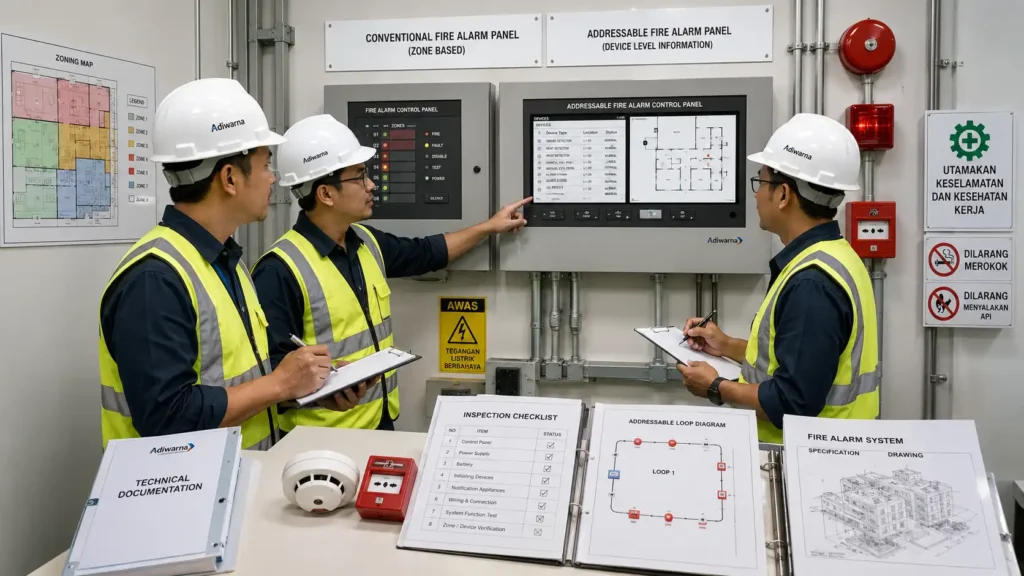
Both conventional and addressable fire alarm systems require periodic inspection and testing. Therefore, panels, detectors, batteries, wiring, notification devices, and interfaces must not be left without maintenance.
For a conventional system, technicians need to confirm that each zone remains in normal condition. Additionally, zone maps and device labels must remain visible and accurate.
For an addressable system, maintenance includes reviewing loop status, device addresses, event history, communication faults, and programming. Therefore, software access and database backups must be managed securely.
With consistent maintenance, faults can be identified before they affect emergency performance. Conversely, a system that is rarely tested may create a false sense of security even when the panel appears normal.
Why Choose PT Adiwarna Anugerah Abadi?
PT Adiwarna Anugerah Abadi can help companies select fire alarm technology according to building characteristics and fire risks. Moreover, Adiwarna supports engineering, procurement, installation, programming, testing, commissioning, service, and maintenance.
Through a proper engineering approach, the choice between conventional and addressable systems can be based on building size, device quantity, required alarm information, integration, expansion, and budget. Therefore, the recommended solution does not focus only on panel price.
For industrial facilities, Adiwarna also provides Industrial Fire Protection Contractor services that support integration between fire alarms, hydrants, sprinklers, fire pumps, suppression systems, and foam systems.
Furthermore, projects requiring a complete scope can use Adiwarna EPC Fire Protection services. Consequently, activities from engineering through commissioning can be coordinated within one integrated project.
For design consultation, installation, upgrades, testing, or maintenance, companies can contact PT Adiwarna Anugerah Abadi through the Adiwarna contact page.
Conclusion
The difference between addressable and conventional fire alarm systems involves alarm identification, circuit architecture, displayed information, troubleshooting, integration, and expansion capability. Therefore, conventional technology is usually suitable for simpler buildings, whereas addressable technology provides greater flexibility for large or complex facilities.
However, advanced technology alone does not guarantee system reliability. Instead, performance depends on risk assessment, engineering, equipment compatibility, installation, programming, testing, commissioning, documentation, and maintenance.
With proper planning, either system can provide appropriate protection for its intended application. Therefore, PT Adiwarna Anugerah Abadi is ready to support professional and integrated fire alarm solutions for commercial buildings and industrial facilities.