


Sprinkler coverage area calculation per SNI that is incorrectly performed is the most common cause of fire protection system failures during inspection. The sprinkler coverage area per SNI 0391 is determined based on occupancy hazard classification, sprinkler head type, and head spacing. This article guides you through calculating the coverage area of each sprinkler head accurately, in compliance with SNI 0391 and NFPA 13 standards applicable in Indonesia.
Why Is Sprinkler Coverage Area Calculation Important?
Automatic sprinkler systems are designed to respond to fires within specific zones. If head spacing is too wide, uncovered areas allow fire to grow before water reaches that point. Conversely, spacing that is too close increases costs without adding significant protection. SNI 0391 and NFPA 13 provide maximum and minimum limits to ensure an effective balance between cost and protection.
According to NFPA 13 Standard for the Installation of Sprinkler Systems, each sprinkler head has a maximum coverage area based on hazard classification. Violations of these values can result in failed audits by the Fire Department or rejected property insurance claims.
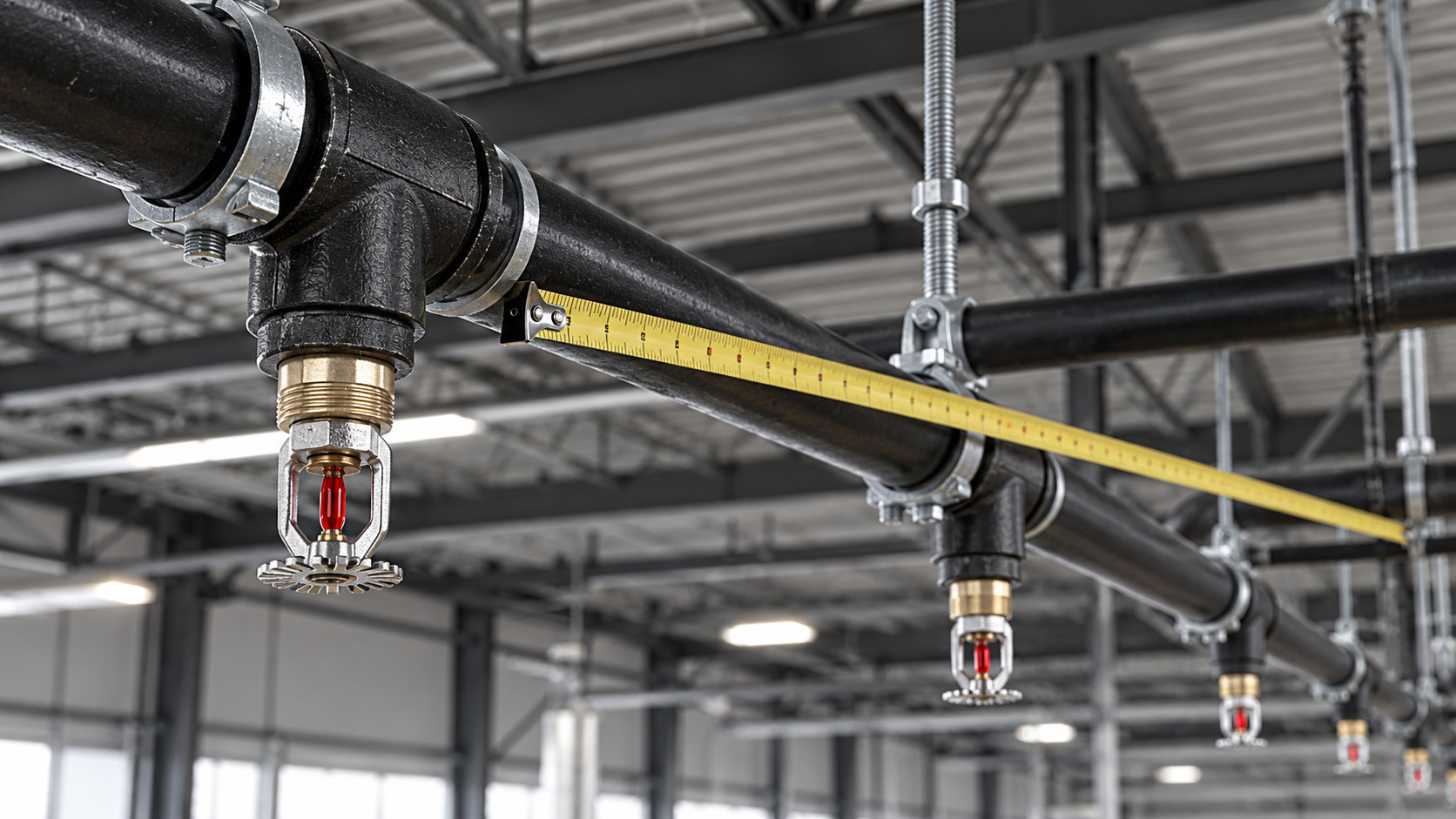
Occupancy Hazard Classification in SNI 0391 and NFPA 13
The first step in calculating sprinkler coverage area is establishing the occupancy hazard classification. SNI 0391 adopts three main categories that determine the maximum area per sprinkler head:
| Hazard Classification | Example Occupancy | Max Area/Head |
|---|---|---|
| Light Hazard | Offices, hotels, hospitals | 21 m2 |
| Ordinary Hazard Group 1 (OH1) | Light manufacturing, parking | 12 m2 |
| Ordinary Hazard Group 2 (OH2) | General storage warehouses, showrooms | 12 m2 |
| Extra Hazard | Chemical plants, painting areas | 9 m2 |
These values are maximum limits per head. When a room has physical obstacles such as high racks or large machinery, the calculation should be more conservative than the table values. Some property insurers also require values stricter than the SNI minimum.
Sprinkler Coverage Area Formula
After establishing the hazard classification, use the following basic formula to determine the maximum spacing between sprinkler heads and the coverage area of each head.
Square Grid Spacing Method
For square or rectangular layouts, the maximum head spacing is calculated from the square root of the maximum coverage area per head:
S = sqrt(A_max)
Example Light Hazard (A_max = 21 m2): S = 4.58 m
Max distance head to wall: S/2 = 2.29 m
Where S is the head-to-head distance in meters (center-to-center) and A_max is the maximum coverage area allowed per sprinkler head based on occupancy hazard classification.
Staggered (Diagonal) Spacing Method
The staggered layout is more efficient for irregular-shaped rooms. Heads in even rows are offset by half the odd-row spacing. The effective area per head remains the same, but distribution is more even toward walls and corners, allowing wall distances to be optimized without significantly adding heads.
Practical Steps to Calculate the Number of Sprinkler Heads
Below is the step-by-step procedure used by Adiwarna Fire Protection Specialist technicians when designing sprinkler systems:
- Determine the total floor area to be protected, separating rooms by partitions and construction type.
- Establish the hazard classification for each zone based on the type of activity and stored materials.
- Determine the maximum coverage area per head according to the hazard classification from the SNI 0391 table.
- Calculate head spacing using S = sqrt(A_max) and ensure it does not exceed SNI or NFPA 13 limits.
- Determine head-to-wall distance: must not exceed S/2 and not less than 0.6 m from the long-side wall.
- Calculate the number of heads per row and column based on the actual room dimensions.
- Validate with hydraulic software to ensure pressure and flow rate meet SNI 0391 requirements.

Worked Example: OH1 Warehouse (600 m2)
Suppose we have a general storage warehouse measuring 30 m x 20 m with Ordinary Hazard Group 1 (OH1) classification. Here are the calculation steps:
- A_max = 12 m2 for OH1
- S_max = sqrt(12) = 3.46 m; use S = 3.4 m (below limit)
- Row on 30 m axis: 30/3.4 = 8.8, rounded up to 9 heads per row
- Column on 20 m axis: 20/3.4 = 5.9, rounded up to 6 heads per column
- Total heads = 9 x 6 = 54 sprinkler heads
- Actual area per head = 3.33 x 3.33 = 11.1 m2 (valid, below 12 m2)
For early detection that complements this sprinkler system, read our guide on industrial smoke detection systems at the Adiwarna services page. Integrated smoke detection within sprinkler zones enables faster, coordinated response.
Correction Factors and Special Conditions
SNI 0391 and NFPA 13 provide additional requirements for special situations frequently encountered in the field:
- High storage racks: coverage area is reduced and in-rack sprinklers are required when rack height exceeds 3.5 m.
- Sloped ceilings: upper-row heads require position adjustment so coverage is not obstructed by the slope.
- Structural obstructions: beams or ducting more than 0.2 m below sprinkler heads require additional heads on the obstruction side.
- ESFR Sprinklers: NFPA 13 Chapter 14 applies a smaller coverage area (9.3 m2 per head) due to higher flow rates.
Sprinkler Integration in a Comprehensive Fire Protection System
Sprinkler coverage area calculation does not stand alone. Sprinkler systems work most effectively when integrated with other fire protection components. Fire alarm systems trigger early notifications, while smoke detectors can provide warnings before a sprinkler head activates. Adiwarna Fire Protection Specialist provides integrated design services including hydraulic calculations, fire simulation, and coordination with local Fire Departments.
The international standard ISO 6182 for automatic sprinkler systems complements SNI 0391 requirements and can be accessed through Indonesia’s National Standardization Agency (BSN) for technical reference in sprinkler installation projects.
FAQ: Common Questions about Sprinkler Coverage Area per SNI
What is the sprinkler coverage area for an office?
Offices fall under Light Hazard classification. Each sprinkler head may cover a maximum of 21 m2, with head-to-head spacing not exceeding 4.6 m and distance to wall not exceeding 2.3 m.
Is SNI 0391 the same as NFPA 13?
SNI 0391 is adapted from NFPA 13 with adjustments for Indonesian building conditions. Coverage area values and head spacing are nearly identical; however, projects with international insurance requirements should refer directly to the latest NFPA 13 edition.
Can the calculation be done without software?
Head position and count calculations can be performed manually using the sqrt(A_max) formula. However, hydraulic analysis to verify adequate pressure and flow rate at each head must use licensed software per SNI 0391 and NFPA 13 requirements.
What happens if head spacing exceeds the standard?
Spacing that exceeds the standard limit creates unprotected zones. During audits by the Fire Department or insurance companies, this can result in certification rejection and a requirement to completely re-layout the sprinkler system.
Conclusion
Correct sprinkler coverage area calculation per SNI is the foundation of a reliable fire protection system. Starting from occupancy hazard classification, applying the head spacing formula, through hydraulic validation, each step directly impacts system effectiveness when fire occurs. Errors at this stage are not merely technical issues but real risks to lives and property assets.
Need assistance with sprinkler design and calculation per SNI 0391 for your project? Contact the Adiwarna Fire Protection Specialist team at our contact page for a free technical consultation and a comprehensive system design proposal.