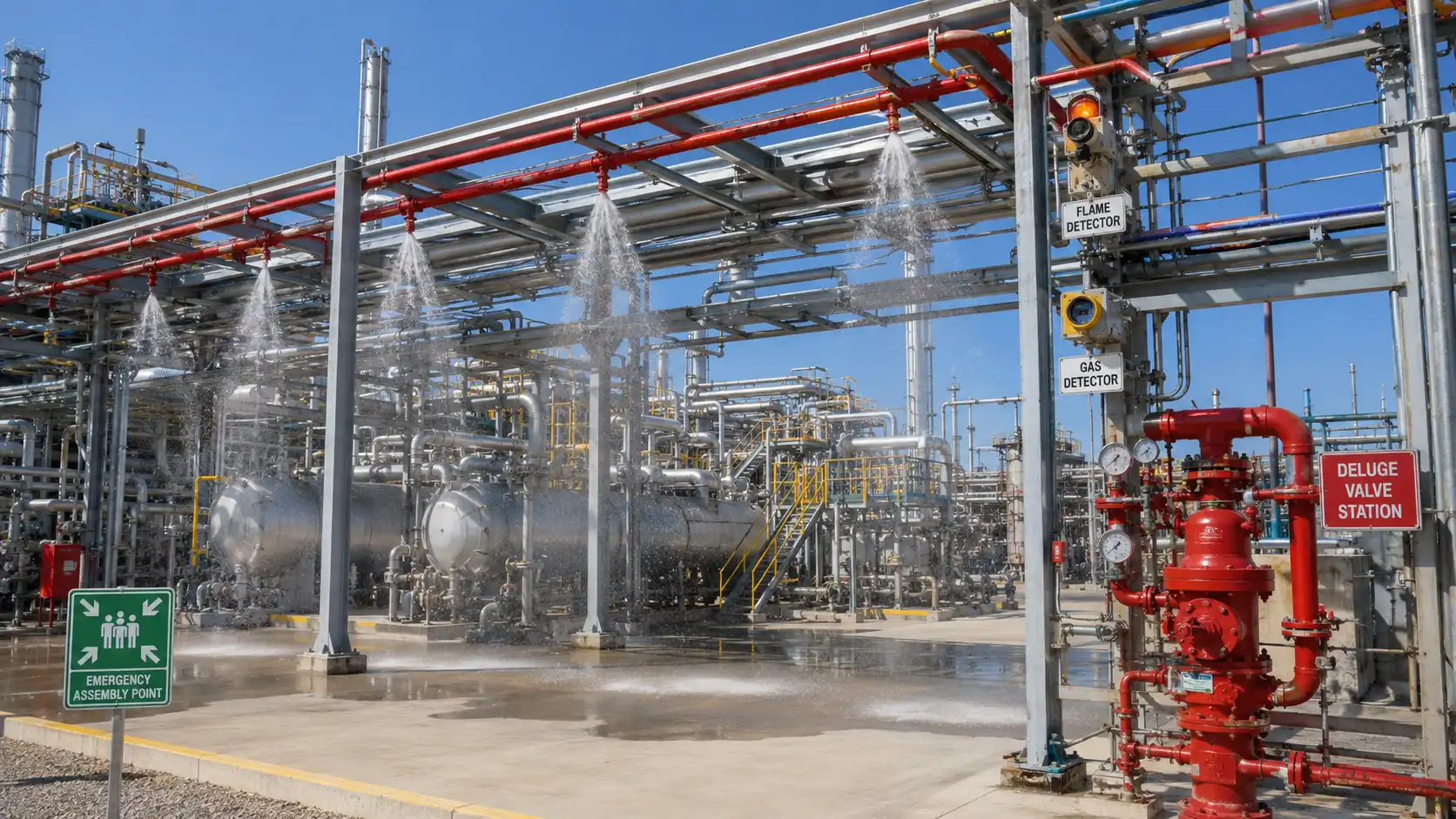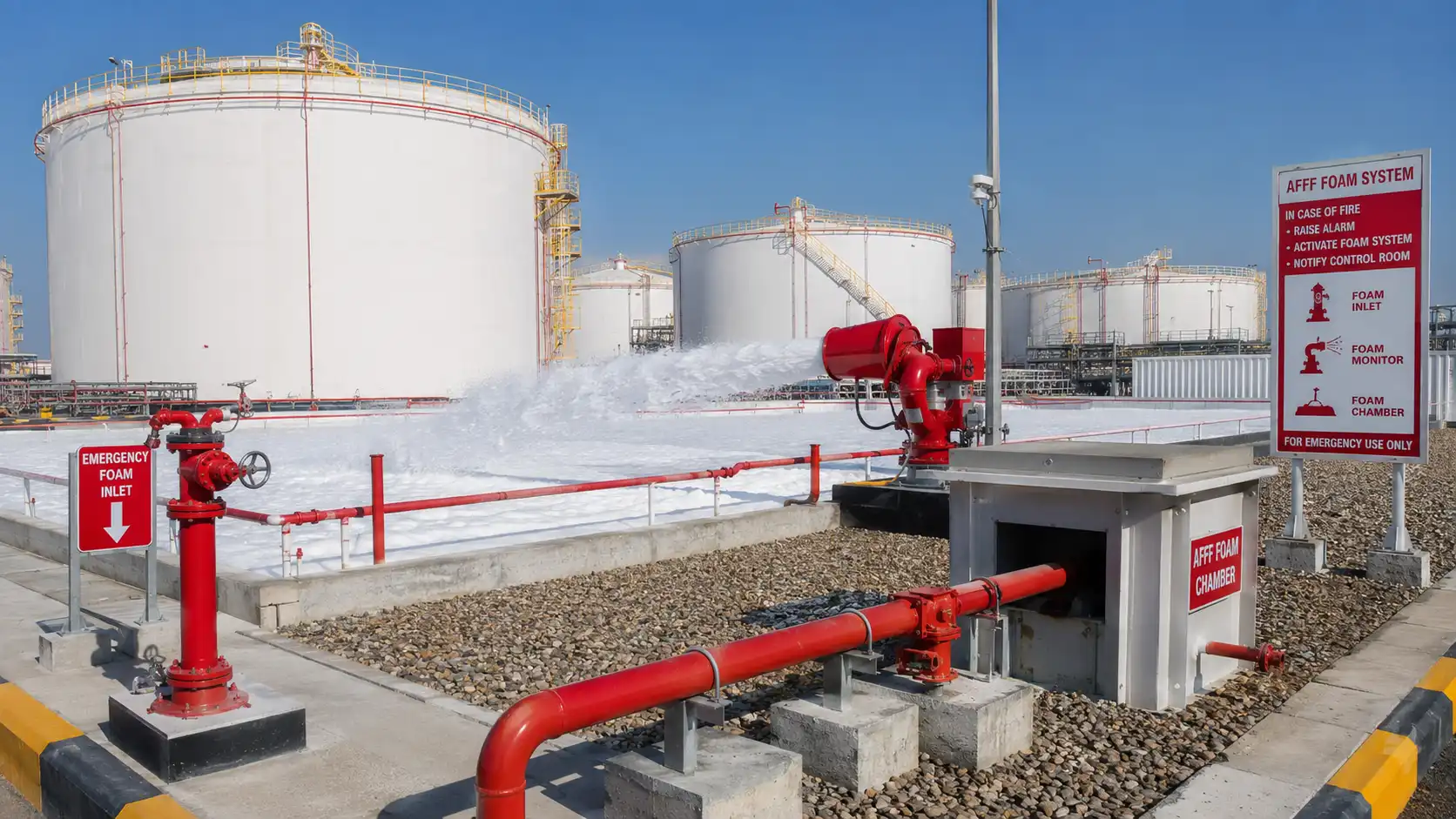


Deluge system fire protection is a water-based fire suppression system that uses open sprinkler heads or spray nozzles, allowing every discharge point within a protected zone to release water simultaneously after the deluge valve is activated. Therefore, this system is widely used to protect transformers, loading areas, process equipment, conveyor systems, chemical plants, power generation facilities, and oil and gas sites where fire can develop rapidly.
Unlike a standard wet-pipe sprinkler system, water is not continuously present throughout the deluge distribution piping. Instead, the water supply is held back by a deluge valve until a detection system or releasing device initiates activation.
Once the valve opens, water flows rapidly to all open nozzles within the protected zone. As a result, the hazard receives a large and simultaneous water discharge.
Deluge sprinklers use permanently open sprinkler heads, while water release begins only after the detection system activates the main valve. This configuration makes the technology suitable for high-hazard areas requiring fast response and extensive coverage.
For industrial applications, PT Adiwarna Anugerah Abadi provides Industrial Fire Fighting System solutions that can integrate deluge protection with fire pumps, fire water tanks, detectors, fire alarms, hydrants, foam systems, and monitoring equipment.
Why Is a Deluge System Fire Protection Required?
A deluge system fire protection is required because certain fire scenarios can develop too rapidly for protection that depends on the activation of only one sprinkler head. Therefore, simultaneous protection may be necessary where fires can involve flammable liquids, high-voltage equipment, heated surfaces, or hazardous production processes.
A wide-area water discharge can help:
- Control or suppress fire.
- Cool exposed equipment.
- Reduce radiant heat.
- Limit fire spread.
- Protect nearby structures and assets.
- Reduce the potential for escalation.
For transformers, process vessels, and other critical equipment, water spray can be directed toward specific surfaces. Therefore, nozzle arrangement must consider spray pattern, application angle, distance, physical obstructions, and required water density.
NFPA 15 provides minimum requirements for the design, installation, and acceptance testing of fixed water spray systems. These systems may be designed for fire control, extinguishment, prevention, or exposure protection.
How a Deluge System Fire Protection Works
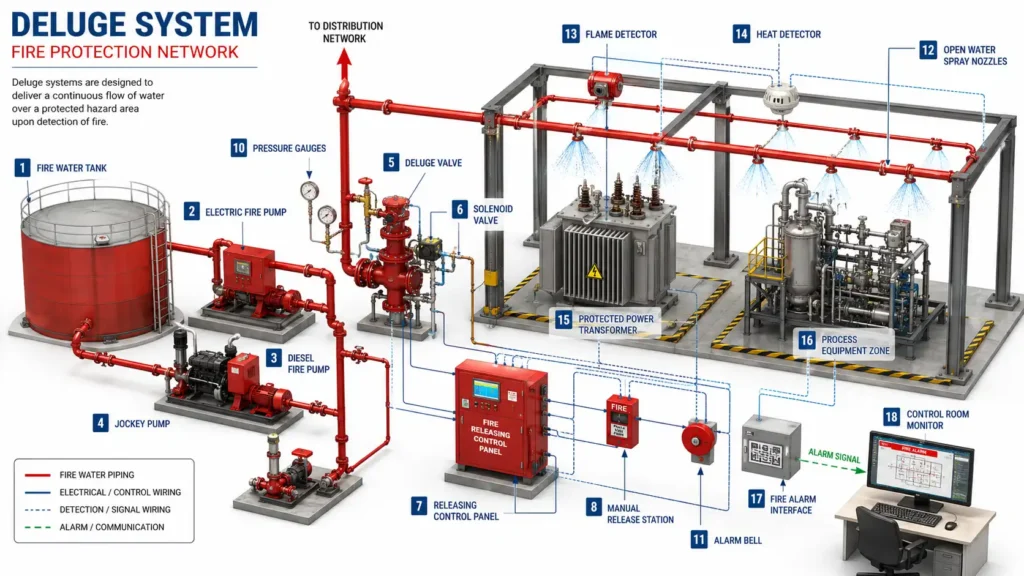
Initially, the distribution piping remains ready for operation while the deluge valve holds back the fire water supply. Heat detectors, flame detectors, pilot sprinklers, linear heat detection, or manual releasing devices monitor the protected area.
When a fire condition is detected, the signal is sent to a releasing panel or fire alarm control panel. The panel then activates a solenoid valve, actuator, or another approved release mechanism.
This action changes the pressure condition within the deluge valve trim assembly, causing the main valve to open. Water then flows rapidly through the distribution piping and discharges from every open nozzle within the protected zone.
A pressure switch or waterflow switch can also transmit an operating signal to the fire alarm panel and control room. Therefore, operators can immediately identify that the system has activated.
Depending on the approved cause-and-effect sequence, the same event may also activate:
- Alarm bells.
- Sirens and strobes.
- Fire pumps.
- Fire and gas controllers.
- Emergency shutdown systems.
- Control room alarms.
- Foam proportioning equipment.
- Remote monitoring interfaces.
Because several systems may operate together, every input, output, interlock, and sequence should be documented in a clear cause-and-effect matrix.
Adiwarna’s Deluge Valve solutions can support different releasing arrangements, including electric, wet-pilot, and dry-pilot actuation. The selected method should match the facility environment, detection strategy, and operational requirements.
Main Components of Deluge System Fire Protection
Deluge system fire protection consists of mechanical, electrical, detection, and control components that must function as one integrated system. A failure in one part can affect overall system performance.
Common components include:
- Fire water tank.
- Electric fire pump.
- Diesel fire pump.
- Jockey pump.
- Deluge valve.
- Valve trim assembly.
- Solenoid release valve.
- Manual emergency release.
- Pressure gauges.
- Pressure switch.
- Waterflow switch.
- Isolation valve.
- Check valve.
- Strainer.
- Open sprinkler heads.
- Water spray nozzles.
- Heat detectors.
- Flame detectors.
- Linear heat detection.
- Smoke detectors for selected applications.
- Releasing control panel.
- Alarm bell, sounder, and strobe.
- Fire alarm interface.
- Test connection.
- Drain piping.
- Fire water distribution piping.
- Control room monitoring interface.
The installation may also require approved pipe supports, cable trays, junction boxes, electrical conduits, and field instruments. Hazardous locations may require explosion-proof devices and materials suitable for corrosive environments.
Equipment selection should not be based only on pipe size or purchase price. Engineers must also consider hazard classification, environmental conditions, hydraulic demand, material compatibility, and required product approvals.
Deluge System Fire Protection for Oil and Gas Facilities
Deluge system fire protection is highly relevant to oil and gas facilities because fire may involve hydrocarbons, process piping, compressors, pumps, pressure vessels, and loading operations. Therefore, the protection system must provide rapid and coordinated response.
In a process area, flame detectors or heat detectors can provide the initial alarm signal. A fire and gas controller then processes the signal and activates the relevant deluge valve according to the approved logic.
Water spray may be used to cool exposed equipment and reduce radiant heat affecting nearby assets. Consequently, the possibility of fire escalating into adjacent process areas can be reduced.
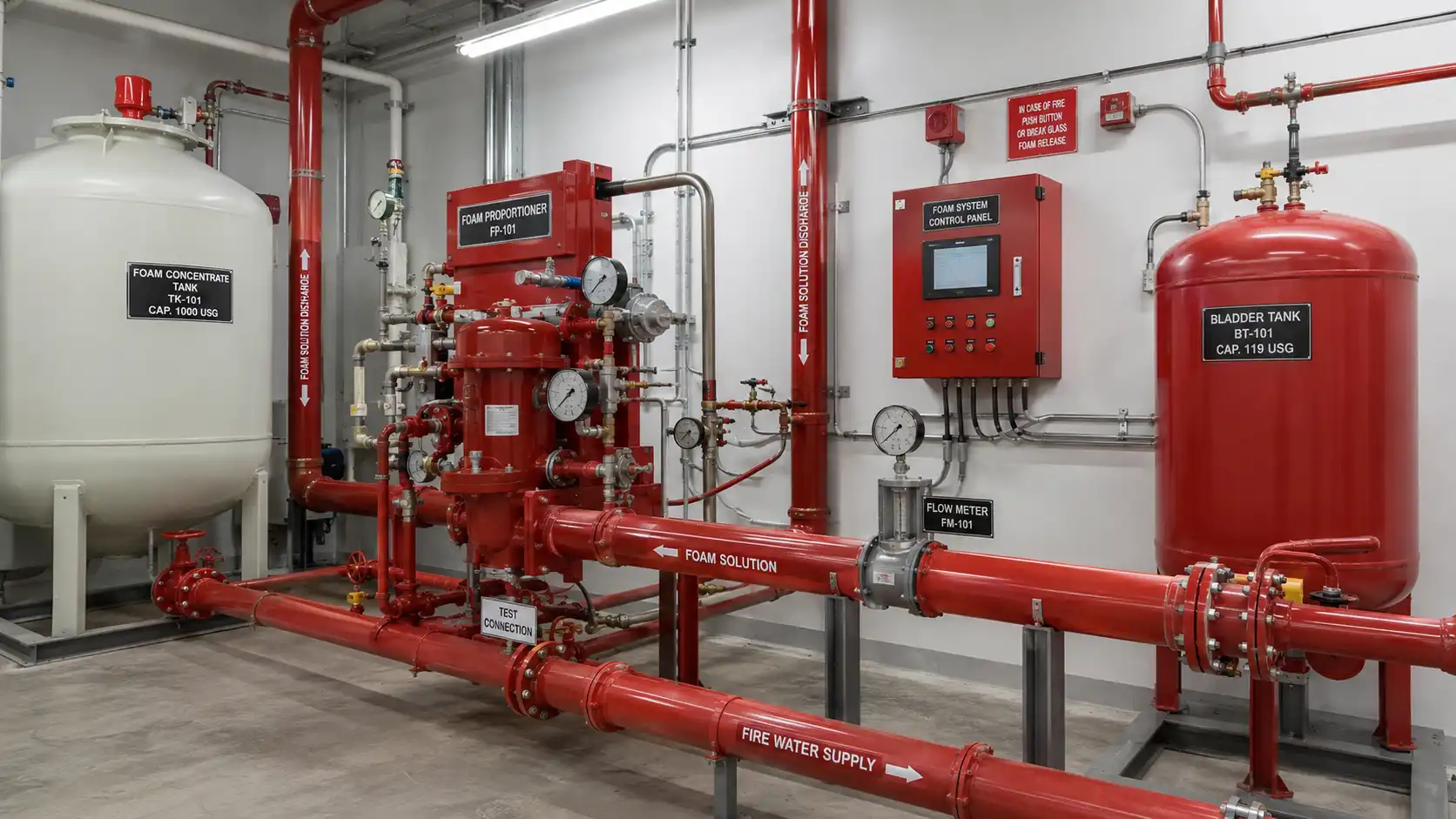
For hydrocarbon risks, deluge protection can also be combined with foam proportioning equipment. In this configuration, a foam-water solution is discharged through open nozzles or other application devices based on the fuel type and design fire scenario.
Adiwarna provides integrated protection for high-risk facilities through its Oil and Gas Fire Protection System, including deluge systems, foam systems, flame detectors, gas detectors, hydrants, fire pumps, and fire alarm monitoring.
Deluge System Fire Protection for Transformers
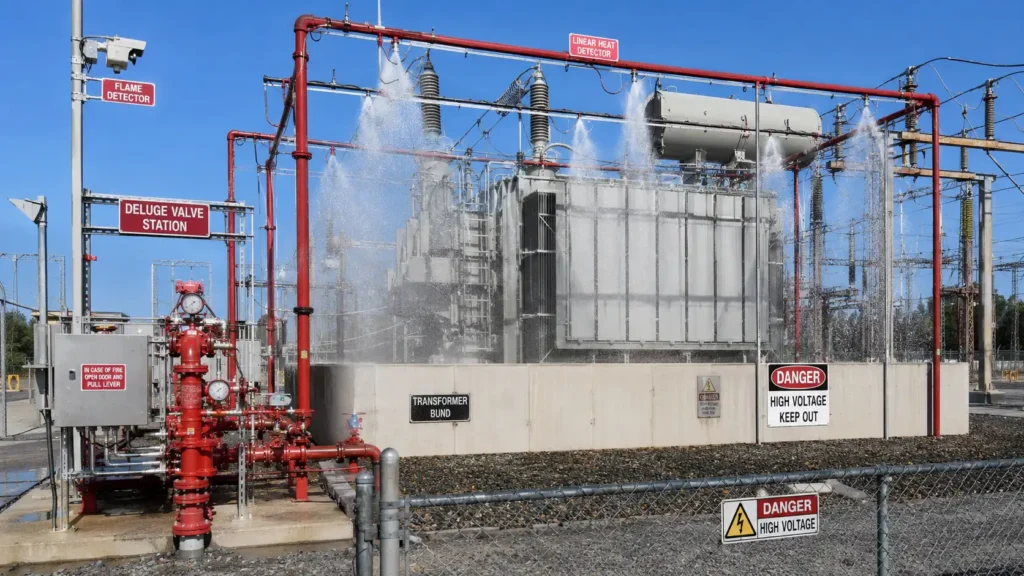
Deluge system fire protection is also commonly considered for transformer protection because transformers may contain insulating oil and operate at high voltage. A transformer fire can produce intense heat and expose nearby equipment to significant thermal radiation.
Water spray nozzles are normally positioned around the transformer so their discharge patterns cover the required surfaces. The design may need to address:
- Transformer tank surfaces.
- Radiators.
- Bushings.
- Conservator tanks.
- Cable boxes.
- Physical obstructions.
- Bund walls.
- Distance between transformers.
- Drainage and oil containment.
The detection system may use heat detectors, linear heat detection, flame detectors, or a combination of technologies based on the risk analysis. Once a valid release condition is confirmed, the deluge valve opens and all nozzles discharge simultaneously.
Transformer protection design should be supported by engineering calculations, spray-pattern analysis, hydraulic calculations, and relevant requirements such as those contained in NFPA 15.
Industrial Applications of Deluge System Fire Protection
Deluge system fire protection can be used in many facilities where fire may spread quickly or where immediate exposure protection is required.
Common applications include:
- Transformer yards.
- Turbine enclosures.
- Cable galleries.
- Conveyor systems.
- Coal-handling areas.
- Oil and gas process areas.
- Compressor stations.
- Pump stations.
- Loading racks.
- Fuel-transfer areas.
- Chemical-processing areas.
- Flammable-liquid storage.
- Aircraft hangars.
- High-hazard warehouses.
- Power generation facilities.
- Petrochemical plants.
- Refineries.
- LPG or LNG support areas.
- Tank-farm process equipment.
- Marine loading terminals.
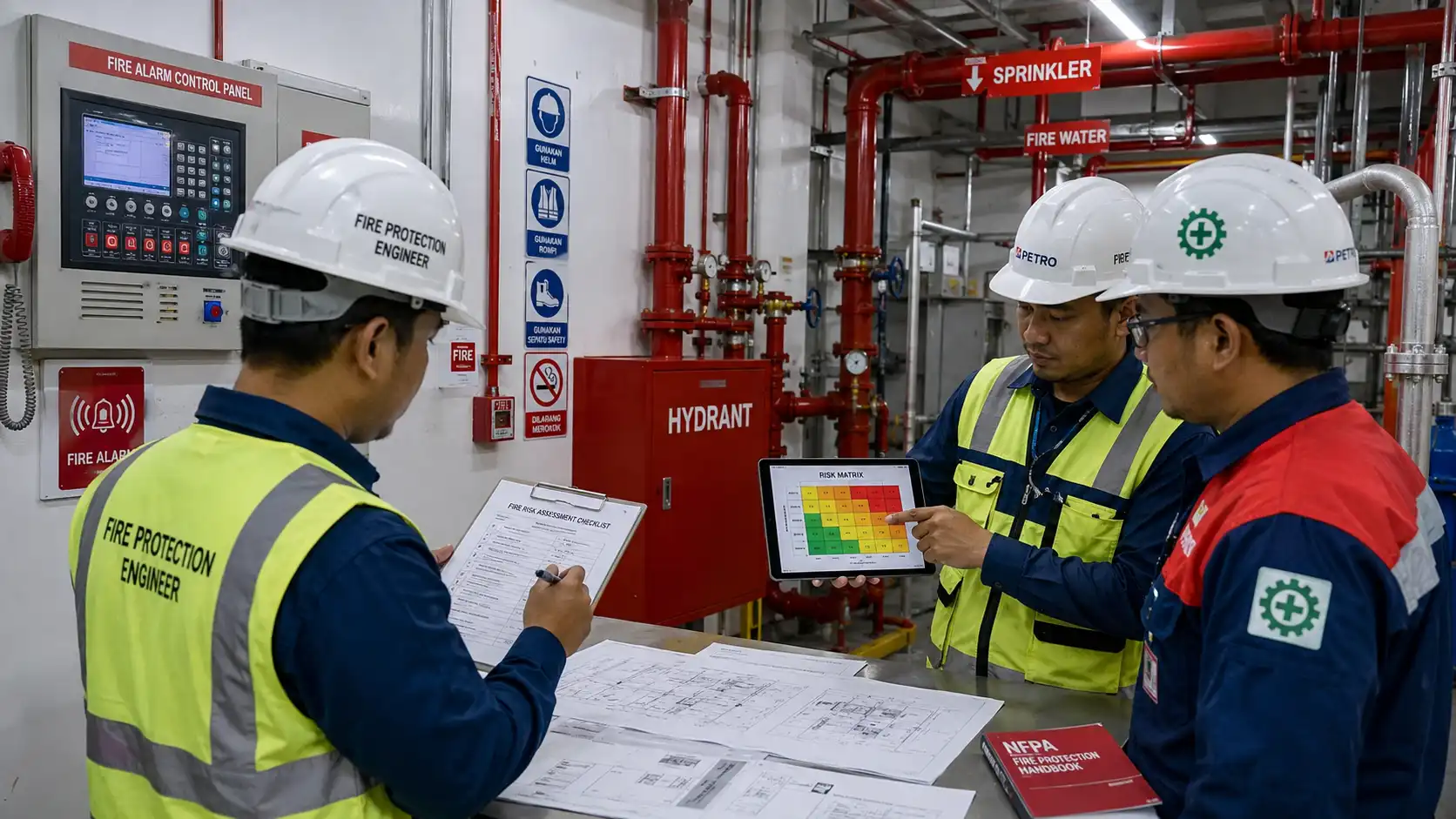
Deluge system fire protection may also be designed specifically for exposure protection to prevent heat from damaging surrounding structures or equipment. Therefore, system selection should begin with a fire risk assessment or detailed hazard analysis.
Difference Between Deluge, Wet Pipe, Dry Pipe, and Preaction Systems
Each sprinkler system has a different operating method. Therefore, system selection should follow the hazard, environmental conditions, asset sensitivity, and required response.
| Aspect | Wet Pipe | Dry Pipe | Preaction | Deluge |
|---|---|---|---|---|
| Piping condition | Filled with water | Filled with pressurized air or nitrogen | Commonly supervised with air | Normally dry downstream of the valve |
| Sprinkler condition | Closed | Closed | Closed | Open |
| Main operating trigger | Heat opens an individual sprinkler | Sprinkler opens and air pressure drops | Detection event and sprinkler operation, depending on system type | Detection system or manual release |
| Water discharge points | Activated sprinklers only | Activated sprinklers only | Activated sprinklers only | All open outlets in the zone |
| Typical application | General buildings | Areas exposed to freezing | Data centers and water-sensitive facilities | High-hazard industrial areas |
| Initial discharge | Localized | Localized | Localized | Large and simultaneous |
A preaction system is generally intended to reduce the risk of unintended water release in sensitive areas. In contrast, a deluge system is designed to discharge water from all open outlets as soon as the valve operates.
For this reason, deluge protection is usually not appropriate for ordinary office areas. However, it can provide significant benefits where fire may spread rapidly or where complete area coverage is required immediately.
Deluge Valve Activation Methods
A deluge valve can be activated through several methods. The selected release arrangement must consider environmental conditions, detection reliability, response time, supervision, and fail-safe requirements.
Electric Release
With electric release, fire detectors transmit signals to the releasing control panel. The panel then energizes the solenoid release valve, allowing the deluge valve to open.
Electric release offers flexibility for:
- Cross-zone detection.
- Voting logic.
- Time delays.
- Manual confirmation.
- Alarm sequencing.
- Cause-and-effect programming.
- Remote monitoring.
However, the electrical power supply, backup batteries, field wiring, detector circuits, and panel programming must be designed and tested carefully.
Wet-Pilot Release
A wet-pilot system uses a pressurized water-filled pilot line and heat-responsive releasing devices. When a pilot device operates, pressure drops in the pilot line and causes the main deluge valve to open.
This method can be suitable for environments where freezing is not a concern. Nevertheless, the actual arrangement must comply with the valve manufacturer’s instructions.
Dry-Pilot Release
A dry-pilot system uses pressurized air or gas within the pilot line. When a pilot device activates, the pressure change initiates operation of the deluge valve.
This configuration may be considered for particular environmental conditions. However, compressor capacity, air-maintenance devices, pressure supervision, and system response time must be evaluated.
Manual Emergency Release
A manual release station enables operators to activate the deluge system directly. It should be installed in a safe, visible, and accessible location.
Although manual activation is essential, the automatic releasing arrangement should remain reliable. The system should not depend entirely on personnel being present when a fire begins.
Integration with Fire Detection Systems
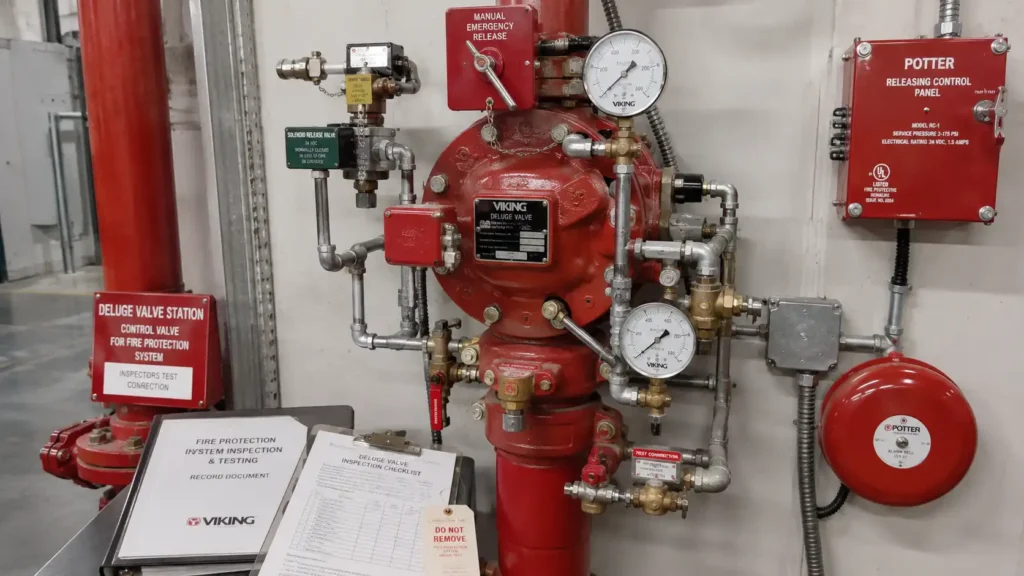
A deluge system relies heavily on fire detection because its open nozzles do not contain individual thermal elements. Therefore, the selected detection method directly affects activation speed and reliability.
Flame detectors can be used where an open flame may develop rapidly. Heat detectors or linear heat detection may be suitable for conveyors, cable trays, transformer areas, or selected industrial processes.
Gas detectors can also provide early warning before ignition in facilities with combustible-gas hazards. This allows operators or automatic safety systems to respond before a leak develops into a fire.
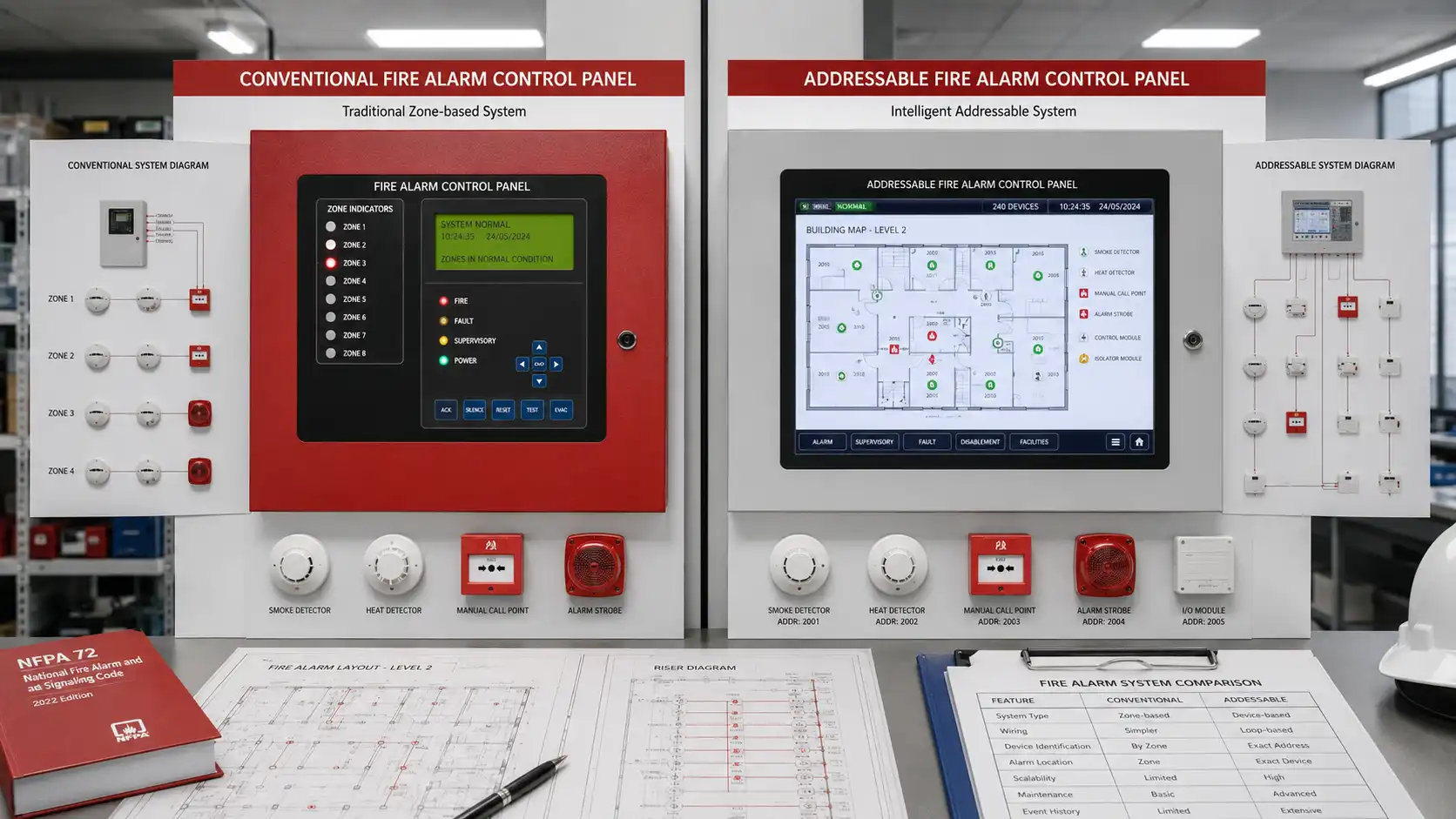
Adiwarna provides integrated Fire Alarm System solutions and specialized Flame Detector protection for industrial facilities. The detection and releasing systems can therefore be coordinated under one cause-and-effect strategy.
Integration with Fire Pumps and Fire Water Tanks
Deluge protection may require a substantial water flow within a very short time. Therefore, the fire pump set and fire water tank must be capable of supplying the calculated hydraulic demand.
A fire pump installation commonly includes:
- Electric main fire pump.
- Diesel standby fire pump.
- Jockey pump.
- Fire pump controller.
- Suction and discharge headers.
- Pressure gauges.
- Test header or flow-meter arrangement.
The jockey pump maintains normal system pressure, while a main fire pump supplies the required flow after pressure decreases or an automatic starting signal is received.
The fire water tank must provide sufficient capacity for the required operating duration. Furthermore, deluge demand may need to be combined with simultaneous hydrant, sprinkler, foam, or fire monitor demand, depending on the design scenario.
When pump capacity is insufficient, nozzle pressure can fall below the design requirement. As a result, spray pattern and equipment coverage may become inadequate.
Excessive pressure can also affect equipment performance and water distribution. Therefore, hydraulic calculations, pump curves, pipe sizing, and pressure control should be evaluated as an integrated system.
Integration with Foam-Water Systems
For flammable-liquid hazards, water alone may not adequately suppress fuel vapor. Therefore, a deluge system can be integrated with foam concentrate and proportioning equipment.
Water from the fire pump first passes through an approved foam proportioner. Foam concentrate is then introduced at the specified concentration.
The resulting foam solution flows through the deluge valve and distribution piping. Once activated, every open nozzle within the zone can discharge the foam-water solution.
NFPA 16 provides minimum requirements for foam-water sprinkler and spray systems using low-expansion foam. Important design considerations include:
- Foam compatibility.
- Fuel characteristics.
- Proportioning accuracy.
- Application density.
- Discharge duration.
- Water supply.
- Drainage.
- Environmental controls.
For liquid-fuel fire protection, Adiwarna’s Foam System solutions can be integrated with fire pumps, hydrants, fire alarms, and deluge protection.
Technical Standards to Consider
System planning must follow applicable standards, local regulations, authority requirements, insurance specifications, company HSE requirements, and manufacturer instructions.
Common references include:
- NFPA 15 for water spray fixed systems.
- NFPA 16 for foam-water sprinkler and spray systems.
- NFPA 20 for fire pump installations.
- NFPA 24 for private fire service mains.
- NFPA 25 for inspection, testing, and maintenance of water-based fire protection systems.
- NFPA 72 for fire alarm and signaling systems.
- Applicable Indonesian standards and local regulations.
- Manufacturer datasheets and installation manuals.
- Hazardous-area classification requirements.
- Company and insurance engineering standards.
Inspection, testing, and maintenance requirements should be considered during the design stage rather than added only after installation. This ensures that valves, detectors, nozzles, test connections, and drainage arrangements remain accessible throughout the system lifecycle.
Important Deluge System Fire Protection Design Factors
The design process must begin with hazard identification and a defined fire scenario. Engineers need to understand the protected process, combustible materials, ignition sources, equipment arrangement, and potential escalation path.
Important design factors include:
- Type of hazard.
- Protected area dimensions.
- Equipment size and geometry.
- Required spray pattern.
- Nozzle type and K-factor.
- Nozzle spacing.
- Physical obstructions.
- Minimum operating pressure.
- Total water demand.
- Required operating duration.
- Fire water tank capacity.
- Fire pump capacity.
- Distribution-pipe dimensions.
- Activation method.
- Detector technology.
- Cause-and-effect logic.
- Hazardous-area classification.
- Material selection.
- Corrosion protection.
- Drainage capacity.
- Water or foam-solution disposal.
- Inspection and maintenance access.
- Risk of unintended system activation.
Wind direction and weather exposure should be considered for outdoor installations. Facilities exposed to extreme temperatures may also require additional evaluation of valve trim, pilot lines, detectors, and field instruments.
Installation Stages
Installation should follow approved drawings, material submittals, and method statements. Coordination is normally required between civil, mechanical, electrical, instrumentation, process, and HSE teams.
Typical work stages include:
- Site survey and field-condition verification.
- Hazard review and design-basis confirmation.
- Hydraulic calculations.
- Nozzle and piping layout development.
- Deluge valve and trim selection.
- Detector and releasing-panel selection.
- Material approval.
- Piping fabrication and installation.
- Electrical cable installation and termination.
- Control-panel programming.
- Pipe flushing.
- Hydrostatic pressure testing.
- Functional testing.
- Integrated cause-and-effect testing.
- Water-discharge or flow testing.
- Operator training.
- As-built drawing preparation.
- Handover and maintenance planning.
Any field modification should be recorded on red-line drawings. The final as-built documentation must accurately represent the completed installation.
Testing and Commissioning Deluge System Fire Protection
Testing and commissioning demonstrate that the system performs according to the approved design. Therefore, the process should cover mechanical, electrical, detection, alarm, control, and integration functions.
Typical activities include:
- Visual inspection.
- Pipe flushing.
- Hydrostatic pressure testing.
- Valve trim inspection.
- Deluge valve trip testing.
- Manual release testing.
- Solenoid activation testing.
- Detector activation testing.
- Releasing-panel testing.
- Alarm bell and strobe testing.
- Pressure-switch testing.
- Waterflow-signal testing.
- Automatic fire pump start testing.
- Nozzle flow testing.
- Spray-pattern verification.
- Drain testing.
- Cause-and-effect testing.
- Control-room signal testing.
- Emergency shutdown interface testing.
- Reset and restoration testing.
- Documentation review.
All test results should be recorded in an official commissioning report. This documentation provides evidence that valves, pumps, detectors, alarms, and nozzles operate in the approved sequence.
When the spray pattern does not cover the complete protected surface, nozzle positions may need adjustment. Likewise, pressure or flow deficiencies must be investigated before system handover.
Deluge System Maintenance
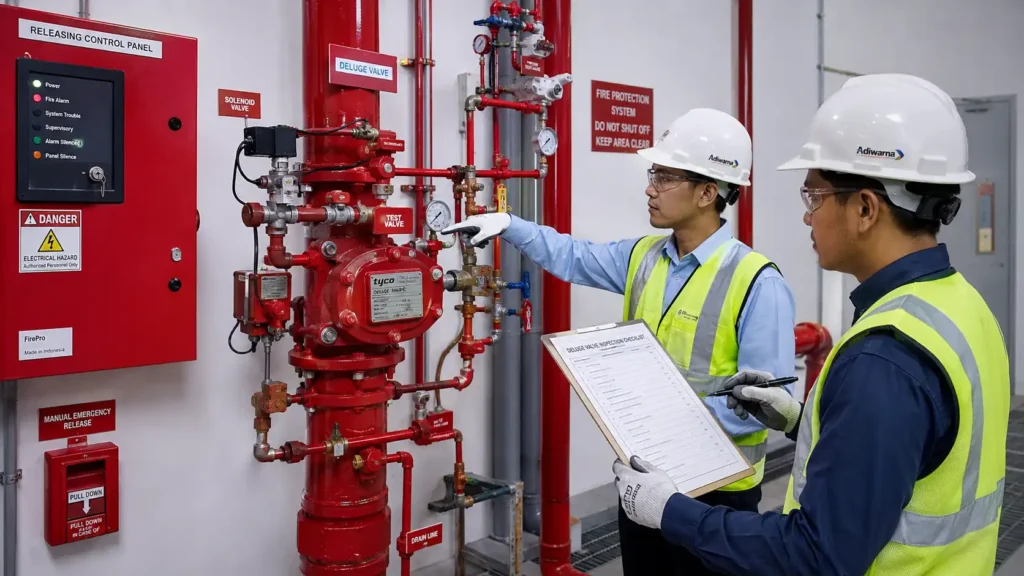
A deluge system requires regular inspection because valves, trim components, open nozzles, detectors, and releasing panels can experience deterioration or operational faults.
Routine inspections may include:
- Deluge valve condition.
- Valve alignment and position.
- Trim assembly condition.
- Solenoid release valve.
- Manual emergency release.
- Pressure gauges.
- Pressure switches.
- Detector condition.
- Releasing-panel status.
- Battery condition.
- Pipe corrosion.
- Nozzle obstruction.
- Drain condition.
- Fire pump readiness.
- Fire water tank level.
- Alarm and control-room signals.
- Previous inspection records.
Open nozzles are directly exposed to dust, corrosion, insects, paint, and process contaminants. Therefore, nozzle blockage and physical damage must be checked carefully.
After testing, the complete system must be returned to its normal ready condition. Valve positions, panel status, drain closure, power supply, and alarm reset should be verified through a restoration checklist.
Common Mistakes in Deluge System Projects
Many system problems begin when protection is selected without adequate hazard analysis. The design must reflect the actual facility risk rather than copy another project.
Common mistakes include:
- Failing to conduct a fire risk assessment.
- Defining the wrong fire scenario.
- Using nozzles that do not cover the protected equipment.
- Ignoring physical obstructions.
- Underestimating water demand.
- Selecting an inadequate fire pump.
- Providing insufficient fire water storage.
- Selecting unsuitable detection technology.
- Omitting cross-zone or voting logic where required.
- Installing manual release stations in inaccessible locations.
- Using incorrect valve trim arrangements.
- Failing to design sufficient drainage.
- Installing non-compliant equipment in hazardous areas.
- Preparing an incomplete cause-and-effect matrix.
- Skipping integrated system testing.
- Failing to inspect open nozzles.
- Ignoring facility-layout changes.
- Providing incomplete commissioning documentation.
Avoiding these mistakes improves system reliability and reduces future modification costs, operational disruption, and maintenance difficulties.
Benefits of a Deluge System for Industrial Facilities
A deluge system provides wide-area protection when a fire can develop rapidly. Therefore, it supports high-hazard scenarios that cannot be adequately managed through localized protection alone.
Water spray can cool equipment and reduce exposure to radiant heat. As a result, surrounding assets may be protected from escalation and secondary damage.
Integration with detectors, releasing panels, fire pumps, control-room systems, and emergency shutdown functions improves response coordination. Operators receive clear alarms while automatic actions occur according to an approved sequence.
A professionally designed and documented system can also support:
- HSE audits.
- Insurance reviews.
- Authority inspections.
- Emergency-response planning.
- Business-continuity strategies.
- Asset-protection objectives.
- Operational risk management.
Why Choose PT Adiwarna Anugerah Abadi?
PT Adiwarna Anugerah Abadi can support the design and installation of deluge protection as part of an integrated industrial fire protection system. Adiwarna serves high-hazard sectors such as oil and gas, petrochemical facilities, power plants, industrial plants, and other critical infrastructure.
Through an engineering-based approach, the solution can be developed according to hazard type, hydraulic demand, nozzle coverage, detector technology, activation method, and integration requirements. Therefore, the work does not focus only on supplying and installing a deluge valve.
The project scope can include:
- Engineering.
- Procurement.
- Installation.
- Programming.
- Testing.
- Commissioning.
- Training.
- Service.
- Preventive maintenance.
- System upgrades.
For projects requiring a complete scope, Adiwarna EPC Fire Protection can coordinate fire alarms, fire pumps, hydrants, sprinklers, foam systems, deluge systems, and fire suppression systems.
Companies requiring consultation, design, installation, testing, or maintenance can contact PT Adiwarna Anugerah Abadi through the Adiwarna contact page.
Conclusion
Deluge system fire protection provides simultaneous water discharge through open nozzles after a detection system or manual release activates the deluge valve. Therefore, this technology is suitable for transformers, process equipment, loading areas, conveyor systems, power plants, and high-hazard industrial facilities.
However, system performance is not determined by the valve alone. Reliability depends on hazard analysis, hydraulic calculations, water supply, nozzle layout, detector selection, cause-and-effect logic, installation quality, testing, commissioning, and maintenance.
With proper planning, a deluge system can help control fire, cool equipment, reduce heat exposure, and limit escalation. PT Adiwarna Anugerah Abadi is ready to support professional, integrated, and risk-based fire protection solutions for industrial facilities.
Deluge System Fire Protection FAQ
Is a deluge system the same as an ordinary sprinkler system?
No. A deluge system uses open sprinkler heads or nozzles, and all outlets discharge when the deluge valve opens. In a wet-pipe sprinkler system, only sprinkler heads individually activated by heat discharge water.
Does a deluge system always activate automatically?
The system can activate automatically through detectors and a releasing panel. However, a manual emergency release is normally provided so authorized personnel can activate the system when required.
Can a deluge system discharge foam?
Yes. A deluge system can be integrated with foam concentrate and proportioning equipment. The foam type, application rate, concentration, and discharge equipment must match the protected fuel.
Is a deluge system suitable for office buildings?
It is generally intended for high-hazard areas requiring simultaneous discharge. Ordinary office buildings typically use wet-pipe sprinkler systems, although the final decision should follow a fire risk assessment and applicable regulations.
How often should a deluge system be tested?
Inspection and testing frequencies should follow applicable standards, local regulations, manufacturer instructions, and the facility maintenance program. Owners should establish a documented schedule based on relevant requirements such as NFPA 25.